
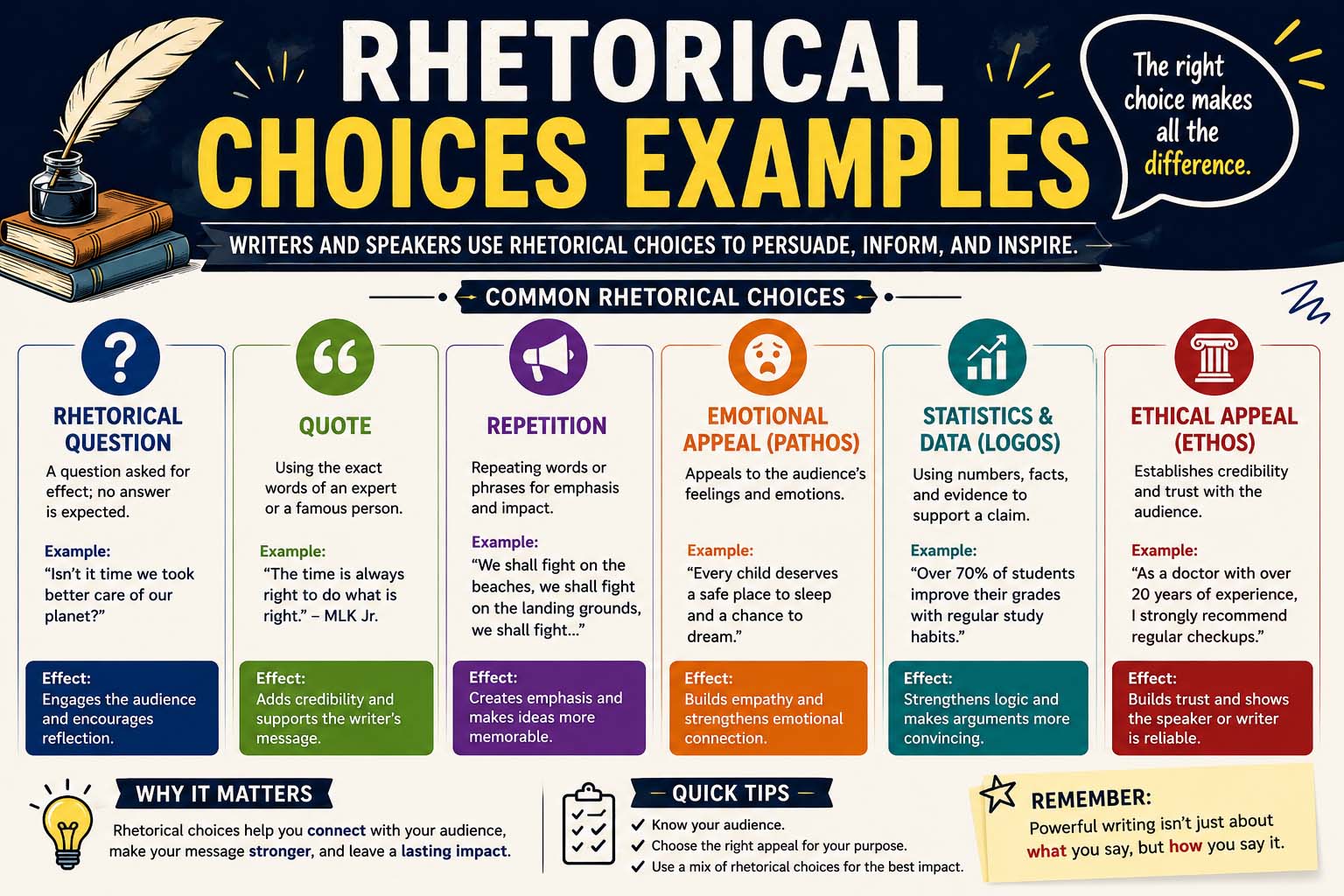
If you’ve been asked to analyze a speech, essay, or article, you’ve probably heard your teacher mention “rhetorical choices.” At first, the phrase can sound complicated, but the idea is actually simple.
A rhetorical choice is any decision a writer or speaker makes to communicate more effectively with an audience. These choices help persuade, inform, entertain, or inspire readers and listeners.
Understanding rhetorical choices examples can make literary analysis much easier, especially in English classes and AP Language courses. Once you know what to look for, you’ll begin noticing these techniques everywhere—from famous speeches and advertisements to novels and social media posts.
This guide explains what rhetorical choices are, why writers use them, and how to identify them with clear examples.
Quick Reference Guide
| Term | Meaning |
|---|---|
| Rhetorical Choice | A deliberate writing or speaking decision that influences the audience |
| Purpose | To persuade, inform, entertain, or inspire |
| Common Examples | Repetition, rhetorical questions, imagery, ethos, pathos, logos |
| Frequently Studied In | English, AP Language, literature, communication |
What Are Rhetorical Choices?
Rhetorical choices are techniques writers and speakers use to communicate their message effectively.
These choices can affect:
- Tone
- Organization
- Word choice
- Sentence structure
- Emotional impact
- Credibility
- Persuasion
Every time an author decides how to present an idea, they are making rhetorical choices.
For example, compare these two sentences:
“The storm damaged several homes.”
“The storm tore through neighborhoods, leaving families without shelter.”
Both communicate the same event, but the second sentence creates a stronger emotional response through descriptive language.
Why Do Writers Use Rhetorical Choices?
Good writing isn’t just about sharing information.
Authors want readers to:
- Understand ideas
- Feel emotions
- Trust the speaker
- Remember important points
- Take action
Rhetorical choices help accomplish those goals. Developing Critical Thinking Exercises alongside rhetorical analysis can also improve a student’s ability to evaluate persuasive writing.
What Are Examples of Rhetorical Choices?
Many students ask, what are examples of rhetorical choices.
Here are some of the most common techniques.
Word Choice (Diction)
Writers carefully select words to create a specific mood or tone.
Example:
“The child skipped into the classroom.”
The word skipped creates a cheerful feeling.
Repetition
Repeating words or phrases emphasizes important ideas.
The repeated structure strengthens the message.
Rhetorical Questions
These questions encourage readers to think rather than answer aloud.
Example:
What Future Should We Build for the Next Generation?
The question invites reflection.
Imagery
Imagery appeals to the senses.
Example:
“Golden leaves drifted quietly across the sidewalk.”
Readers can easily picture the scene.
Statistics
Facts and numbers add credibility.
Example:
“More than 80% of students reported studying with digital resources.”
Statistics often support logical arguments.
Anecdotes
An anecdote is a short personal story.
Example:
A speaker begins with a childhood memory before discussing education.
Stories make ideas feel more personal.
Emotional Appeal (Pathos)
Pathos connects with readers’ emotions.
Example:
Why Every Child Deserves a Safe Place to Learn
This appeals to compassion.
Credibility (Ethos)
Ethos builds trust.
Example:
A doctor discussing public health recommendations.
Readers are more likely to trust qualified experts.
Logical Appeal (Logos)
Logos relies on facts and reasoning.
Example:
Presenting research findings to support an argument.
Examples of Rhetorical Choices
Let’s look at several examples of rhetorical choices in everyday writing.
| Technique | Example | Purpose |
|---|---|---|
| Repetition | “Never give up.” repeated throughout a speech | Reinforce a message |
| Imagery | “Snow covered every rooftop.” | Create visual detail |
| Statistics | “Nine out of ten customers recommend this product.” | Build credibility |
| Anecdote | Personal story about overcoming challenges | Connect with readers |
| Rhetorical Question | “Who wouldn’t want cleaner air?” | Encourage agreement |
| Parallelism | “Reading, writing, and learning.” | Improve rhythm |
These techniques often appear together rather than separately.
Rhetorical Choices Examples in Famous Speeches
Many famous speeches rely on rhetorical choices.
For example:
Repetition
Repeated phrases help audiences remember key ideas.
Emotional Language
Speakers often connect important issues with hope, courage, or responsibility.
Inclusive Pronouns
Words like:
- we
- us
- our
help create a sense of unity.
Rhetorical Choices Examples AP Lang
Students taking AP Language frequently search for rhetorical choices examples AP Lang because rhetorical analysis is a major part of the course.
AP Language passages often include:
- Diction
- Syntax
- Tone
- Organization
- Imagery
- Appeals to ethos, pathos, and logos
- Figurative language
Rather than simply identifying these techniques, students explain why the author used them.
For example:
Instead of writing:
“The author uses repetition.”
A stronger analysis says:
“The author repeats the phrase ‘we must act’ to create urgency and motivate readers toward collective action.”
Explaining the purpose earns stronger scores. Learning what is a hook in an essay can also help students understand how authors capture attention before developing persuasive arguments.
Rhetorical Choices AP Lang Examples
Here are a few rhetorical choices AP Lang examples students commonly analyze.
Contrast
Example:
“Some choose fear. Others choose hope.”
Contrast highlights differences.
Parallel Structure
Example:
“To learn, to grow, to succeed.”
Parallel structure improves rhythm and memorability.
Short Sentences
Example:
“Change starts today.”
Short sentences add emphasis.
Strong Tone
An author’s tone may be:
- Hopeful
- Serious
- Persuasive
- Optimistic
- Critical
- Encouraging
Tone shapes how readers interpret the message.
How to Identify Rhetorical Choices
Finding rhetorical choices becomes easier with practice.
Step 1
Read the passage once for understanding.
Don’t analyze yet.
Simply understand the main idea.
Step 2
Identify the author’s purpose.
Ask yourself:
- Are they informing?
- Persuading?
- Entertaining?
- Inspiring?
Step 3
Look for noticeable techniques.
Examples include:
- Repetition
- Statistics
- Stories
- Questions
- Emotional language
Step 4
Explain the effect.
This is where many students lose points.
Don’t stop after identifying a technique.
Always explain:
“Why did the author use it?”
Common Mistakes Students Make
Many beginners make the same errors.
Avoid these mistakes:
Only Naming the Technique
Instead of simply writing:
“The author uses imagery.”
Explain:
“The imagery helps readers visualize the destruction, making the argument more emotionally powerful.”
Ignoring Purpose
Every rhetorical choice serves a purpose.
Always connect the technique to the author’s goal.
Confusing Literary Devices and Rhetorical Choices
Some literary devices also function as rhetorical choices.
The key question is:
“How does this choice affect the audience?”
Practice Exercise
Read this sentence:
“If we ignore today’s challenges, tomorrow’s problems will only grow larger.”
Possible rhetorical choices include:
- Contrast
- Future-focused language
- Cause-and-effect reasoning
Now ask yourself:
Why did the author write it this way?
A possible answer:
The author encourages readers to take action without delay by highlighting the negative consequences that can arise from postponing important decisions or change.
Study Tips
If you’re preparing for quizzes or AP Language exams, these habits can help.
- Read speeches regularly.
- Highlight repeated words.
- Notice emotional language.
- Practice explaining the author’s purpose.
- Study sample rhetorical analyses.
- Write short paragraph responses.
The more examples you analyze, the faster you’ll recognize common patterns. Reviewing Introduction Paragraph Examples can also help you recognize effective rhetorical strategies at the beginning of an essay.
Why Rhetorical Choices Matter Beyond School
Understanding rhetorical choices helps in everyday life.
You’ll become better at:
- Evaluating advertisements
- Understanding political speeches
- Reading opinion articles
- Writing persuasive essays
- Giving presentations
- Creating professional emails
Strong communication skills are essential in almost every profession because they help people share ideas clearly, collaborate effectively, and avoid misunderstandings. These skills are also valuable when preparing an executive summary example or improving methods of business communication in professional settings.
Frequently Asked Questions
What are rhetorical choices?
Rhetorical choices are deliberate decisions writers or speakers make to communicate effectively and influence their audience.
What are examples of rhetorical choices?
Common examples include repetition, imagery, rhetorical questions, anecdotes, statistics, ethos, pathos, logos, diction, syntax, and parallelism.
What are examples of rhetorical choices in AP Lang?
AP Language students often analyze tone, diction, syntax, organization, figurative language, and persuasive appeals while explaining how each supports the author’s purpose.
What are rhetorical choices examples AP Lang?
Examples include repetition to emphasize ideas, statistics to build credibility, emotional language to connect with readers, and rhetorical questions to encourage reflection.
How do I identify rhetorical choices?
Read carefully, determine the author’s purpose, identify noticeable techniques, and explain how those techniques influence the audience.
Why are rhetorical choices important?
They help writers communicate more clearly, persuade audiences, strengthen arguments, and create memorable writing.
Building Stronger Reading and Writing Skills
Learning rhetorical choices examples is one of the best ways to improve your reading, writing, and analytical thinking. Instead of only spotting techniques like repetition or imagery, focus on why the author chose them and how they shape the audience’s response. With regular practice, rhetorical analysis becomes much more natural, making classroom discussions, essays, and AP Language assignments easier to understand and complete with confidence.