
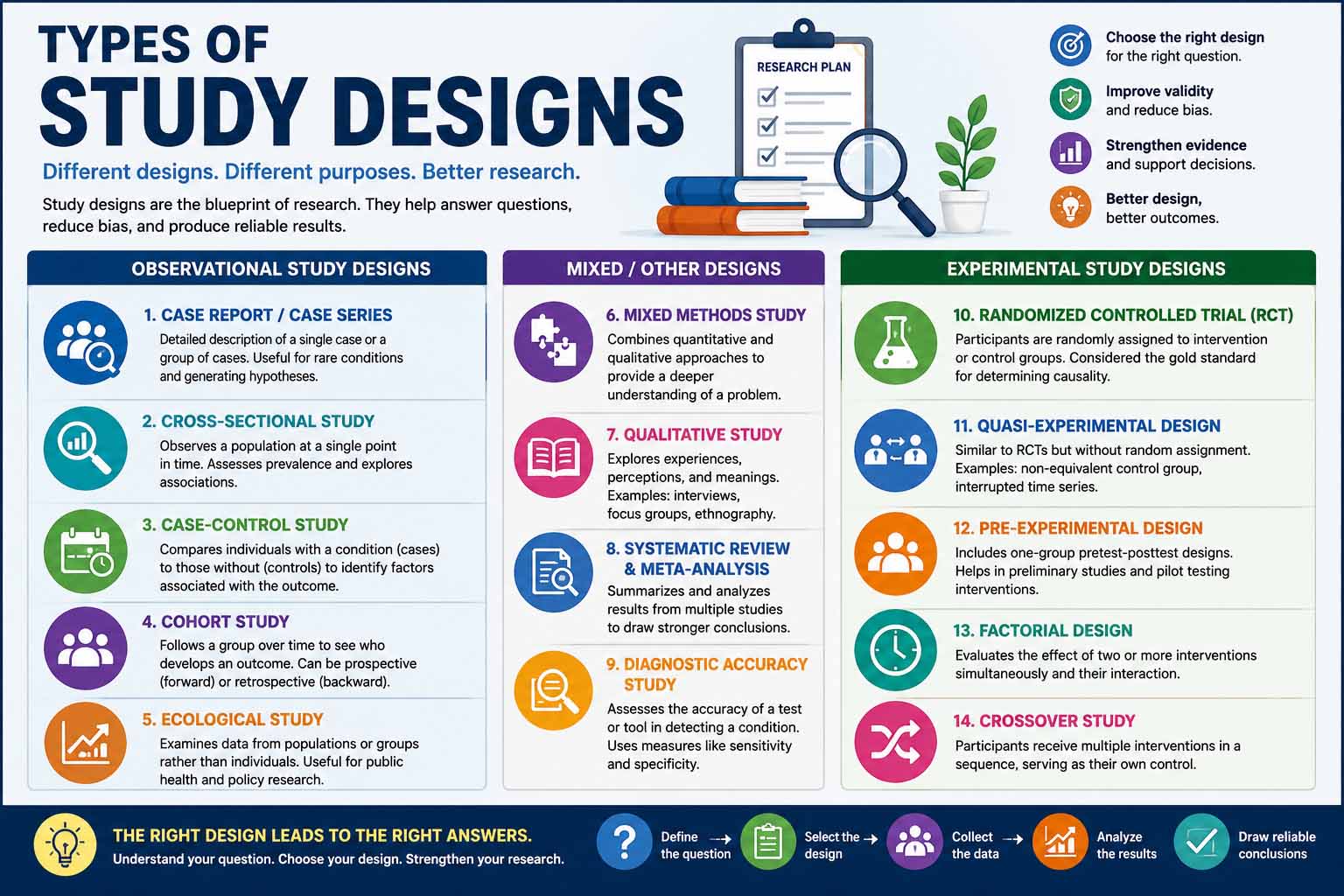
Imagine two researchers asking the same question about whether regular exercise improves student well-being. One assigns participants to different exercise programs, while another simply observes students’ existing habits. Although both researchers investigate the same topic, they use very different types of study designs. Those choices affect what data they collect, what conclusions they can reasonably draw, and how confidently they can interpret the results.
Understanding study design is useful far beyond professional research. Students encounter it in science, psychology, sociology, health, statistics, and many other subjects. Once you understand how common designs work, research papers become easier to evaluate because you can recognize how the evidence was produced.
This guide explains the major approaches in plain English, with practical examples to help you tell them apart.
What Is a Study Design?
A study design is the overall plan researchers use to answer a research question. In simple terms, it explains who or what will be studied, what information will be collected, when researchers will collect it, and how they will compare or interpret the results.
The right design depends on the question.
For example, researchers studying student opinions may use a survey.
Before selecting a design, researchers usually clarify several elements:
- The research question
- The population being studied
- Variables or experiences of interest
- Data collection methods
- Time frame
- Comparison groups, when appropriate
- Ethical considerations
- Planned analysis
Students who work with quantitative research may also encounter formulas for probability, distributions, confidence intervals, and hypothesis testing. An ap stats formula sheet can be useful when learning the statistical tools that may later be applied to data collected through different research designs.
Main Types of Study Designs at a Glance
Researchers classify studies in several ways, so categories sometimes overlap. Still, most beginner-level research can be understood by starting with experimental, observational, and qualitative approaches.
| Study Design | Main Purpose | Typical Example |
|---|---|---|
| Experimental | Test an intervention or potential causal effect | Comparing two teaching methods |
| Cohort | Follow groups based on exposure or characteristics | Tracking students over several years |
| Case-control | Compare people with and without an outcome | Looking backward for possible risk factors |
| Cross-sectional | Examine a population at one point in time | Surveying current study habits |
| Case study | Examine one case closely | Studying one school program |
| Qualitative | Understand experiences and meanings | Interviewing students about classroom stress |
| Mixed methods | Combine quantitative and qualitative evidence | Survey plus interviews |
The categories are not always mutually exclusive. For instance, a cohort study is usually observational, while interviews might form part of a broader mixed-methods project.
Experimental Types of Study Designs
Experimental research involves deliberately introducing an intervention and comparing outcomes.
Instead of simply observing what already happens, researchers change something under controlled conditions.
Randomized Controlled Trials
A randomized controlled trial, or RCT, randomly assigns eligible participants to different study groups. One group may receive an intervention, while another receives a comparison treatment, placebo, usual care, or another appropriate condition.
Random assignment helps balance known and unknown participant characteristics between groups. As a result, a well-designed randomized trial can provide strong evidence about whether an intervention caused a difference in outcomes.
Suppose researchers want to test a new mathematics tutoring program. They could randomly assign participating students to the new program or a comparison condition and later compare performance.
However, experiments are not always practical or ethical. Researchers cannot randomly expose people to many potentially harmful conditions simply to study their effects.
Observational Types of Research Study Designs
In observational studies, researchers measure what happens without assigning the exposure of interest.
These designs are especially useful when experimentation would be unethical, impractical, expensive, or unnecessary.
Cohort Studies
A cohort study follows a group of people over time or uses existing records to reconstruct a defined period.
Researchers often compare people with different exposures and observe whether their outcomes differ.
For example, researchers could compare students who regularly participate in extracurricular activities with those who do not, then examine later academic or social outcomes.
Prospective cohort studies move forward from exposure toward outcomes. Retrospective cohort studies, by contrast, use existing historical data to examine events that have already occurred.
Case-Control Studies
A case-control study starts with an outcome.
Researchers identify people who already have a particular outcome—the cases—and compare them with people who do not—the controls. Then, they look backward to examine previous exposures or characteristics.
For example, researchers studying a rare condition might compare affected participants with similar unaffected participants and investigate previous environmental exposures.
This design can be efficient for rare outcomes. However, researchers must carefully select controls and consider potential bias in past information.
Cross-Sectional Studies
A cross-sectional study provides a snapshot of a population at a particular time or during a short defined period.
For instance, a university could survey students about current sleep patterns, study habits, and academic stress during one semester.
Surveys frequently appear in cross-sectional research. A Student Perception Survey Guide can help learners understand how perception-based data may be gathered when researchers want to measure attitudes, experiences, or opinions within a population.
Cross-sectional research can estimate prevalence and identify associations. However, because exposure and outcome may be measured at the same time, establishing which came first can be difficult.
Different Types of Study Designs Based on Time
Time provides another useful way to classify research.
Prospective Studies
Prospective studies identify participants and then collect relevant information moving forward.
For example, researchers could recruit first-year college students and track their study habits and academic outcomes for four years.
This approach can provide clear information about the sequence between exposure and outcome. However, prospective research can require substantial time and resources.
Retrospective Studies
Retrospective research looks at information that already exists.
Researchers might use school records, medical records, databases, or historical documents to investigate previous exposures and outcomes.
Because the data already exist, retrospective studies can sometimes be completed faster. Still, researchers are limited by the accuracy, completeness, and variables available in those records.
Longitudinal Studies
Longitudinal studies collect information from participants or populations across multiple points in time.
That structure helps researchers examine change.
For example, a researcher could measure students’ reading ability at the beginning and end of every school year to examine how performance develops.
Longitudinal is a broad time-based description rather than one single design. A cohort study, for example, may also be longitudinal.
Types of Qualitative Study Designs
Numbers cannot answer every research question.
If researchers want to understand how people interpret an experience, make decisions, or describe a social situation, qualitative research may provide richer information.
Phenomenological Research
Phenomenology focuses on people’s lived experiences of a particular phenomenon.
For example, a researcher might interview first-generation college students about how they experience the transition into university life.
Rather than calculating an average score, the researcher examines recurring meanings and patterns within participants’ descriptions.
Ethnography
Ethnographic research explores cultures, communities, or social groups, often through sustained observation and participation.
An educational researcher might spend significant time observing interactions within a particular school community.
Because context matters greatly, detailed field notes and observations are often central to this approach.
Grounded Theory
Grounded theory aims to develop a theory or explanatory framework from systematically collected and analyzed data.
Researchers collect information, examine emerging patterns, and continually compare new data as their explanation evolves.
Therefore, the process is often more iterative than following a fixed hypothesis from the beginning.
Case Study Research
Case study research examines a bounded case—such as one person, organization, classroom, program, event, or community—in depth.
For example, a researcher could investigate how one school introduced a new literacy program by examining interviews, observations, reports, and student data.
Students conducting this kind of research may benefit from learning How to Write a Case Study, since strong case-based work requires a clear focus, suitable evidence, context, and careful interpretation rather than simply telling a story about one example.
Types of Clinical Study Designs
Health and medical research uses many of the designs already discussed, although terminology may become more specialized.
Clinical studies may be interventional or observational.
Interventional clinical trials assign participants to one or more interventions according to a research protocol. Depending on the question, researchers may use randomization, comparison groups, and blinding to reduce bias.
Observational clinical research, meanwhile, may include cohort, case-control, and cross-sectional designs.
Other research can include diagnostic accuracy studies, case reports, case series, and studies of prognosis.
A case report describes an individual clinical case, while a case series describes several similar cases. These reports can identify unusual patterns and generate research questions, but they generally cannot establish causation on their own.
Quantitative vs Qualitative Study Designs
One common student mistake is assuming that quantitative and qualitative research are competing methods where one is automatically stronger.
They answer different kinds of questions.
Quantitative research works with numerical information. Therefore, it is useful for measuring frequency, comparing groups, testing relationships, and estimating effects.
Qualitative research focuses on experiences, perspectives, language, behaviors, and meanings.
For example, a quantitative study could measure how many hours students study each week and compare those numbers with test performance.
A qualitative project might instead interview students about why they struggle to maintain consistent study routines.
Researchers should match the method to the research question rather than choosing one simply because it seems more advanced.
Mixed-Methods Research
Mixed-methods studies intentionally combine quantitative and qualitative approaches within one research project.
Suppose a school wants to evaluate a new online learning platform.
Researchers could first survey 500 students and compare satisfaction scores. Then, they might interview a smaller group to understand why certain features helped or frustrated students.
The numerical results show broad patterns, while interviews provide context behind those patterns.
However, mixed-methods research requires careful planning because researchers must decide how the two forms of evidence will connect.
How Researchers Choose the Right Study Design
A good study begins with the research question, not with a favorite method.
First, determine what you want to know.
Are you describing something? Comparing groups? Exploring experiences? Measuring prevalence? Investigating an association? Testing an intervention?
Next, identify the data needed to answer that question.
Researchers using interviews or surveys should also think carefully about the types of questions they ask because wording, response format, and sequence can influence the quality of the information participants provide.
After that, consider practical limits. Time, money, access to participants, ethics, available records, and researcher expertise may all affect which design is realistic.
Finally, think about what conclusions the design can support. An association found in an observational study should not automatically be described as proof that one variable caused another.
Evaluating Evidence From Different Study Designs
Knowing the name of a design is only the beginning.
When reading research, ask how participants were selected, whether groups were comparable, how variables were measured, how much data were missing, and whether other factors could explain the findings.
Source quality matters too. Students learning what is a scholarly source can become better at separating peer-reviewed research and credible academic materials from unsupported online claims.
At the same time, do not assume that a particular design guarantees trustworthy findings. A poorly conducted randomized trial can have serious weaknesses, while a carefully designed observational study may provide valuable evidence.
Quality depends on both the design and how well researchers carry it out.
Common Mistakes Students Make
A frequent mistake is confusing a research method with a study design.
For example, a questionnaire is a data collection tool. Cross-sectional research is a study design. A questionnaire may be used within that design, but the two terms do not mean the same thing.
Another mistake is treating correlation as causation. If a cross-sectional study finds that students who sleep more have higher grades, that result alone does not prove that extra sleep caused the higher grades.
Students also sometimes describe every study that follows people over time as an experiment. Yet observational cohort studies can follow participants for years without researchers assigning any intervention.
Finally, avoid selecting a design before defining the research question. The question should guide the design—not the other way around.
FAQs About Types of Study Designs
What Are the Main Types of Study Designs?
Major categories include experimental and observational research, along with qualitative and mixed-methods approaches. More specific research designs include randomized controlled trials, cohort studies, case-control studies, cross-sectional studies, case studies, ethnographic studies, phenomenological studies, and grounded theory.
What Is the Difference Between Observational and Experimental Research?
In an experimental study, researchers assign an intervention or condition. In observational research, they observe exposures and outcomes without assigning the exposure being studied.
Which Study Design Is Best?
There is no single best design for every research question.
Randomized trials can provide strong evidence about causal effects of interventions when appropriate. However, observational or qualitative approaches may be better for questions that cannot or should not be studied experimentally.
Is a Survey a Study Design?
Not necessarily. A survey is commonly a method for collecting data. It can be used within several study designs, including cross-sectional and longitudinal research.
What Is the Easiest Study Design for Students to Understand?
Cross-sectional studies are often a useful starting point because they examine information from a defined population at a particular time. Still, students should understand their limitations, especially when interpreting cause and effect.
A Simple Way to Remember Study Designs
Instead of memorizing every research term separately, start by asking three questions: Did researchers assign an intervention? When was the information collected? What kind of evidence did they collect?
If researchers assign an intervention, you are probably looking at experimental research. If they observe existing exposures without assigning them, the study is observational. Meanwhile, interviews and detailed observations may point toward qualitative research, while a combination of numerical and qualitative evidence may indicate mixed methods.
Once you understand those basic distinctions, the many types of study designs become much easier to recognize. From there, focus on what each design can reasonably tell you, what limitations it carries, and whether it actually fits the research question being asked.
That skill will help you not only in exams and assignments but also whenever you need to judge whether a research claim is supported by the evidence behind it.