Preparing for the Registered Behavior Technician (RBT) exam can feel overwhelming when you first look at the study materials. There are behavior reduction plans, reinforcement procedures, data collection methods, ethics, and many ABA terms to remember.
The good news is that you don’t need to memorize every possible scenario. The exam focuses on understanding core concepts and knowing how to apply them in real-world situations.
This RBT exam study guide walks you through the most important topics, practical study strategies, common mistakes, and helpful tips to build confidence before test day.
What Is the RBT Exam?
The Registered Behavior Technician (RBT) exam is designed to evaluate whether candidates understand the basic knowledge and skills needed to work under the supervision of a qualified behavior analyst.
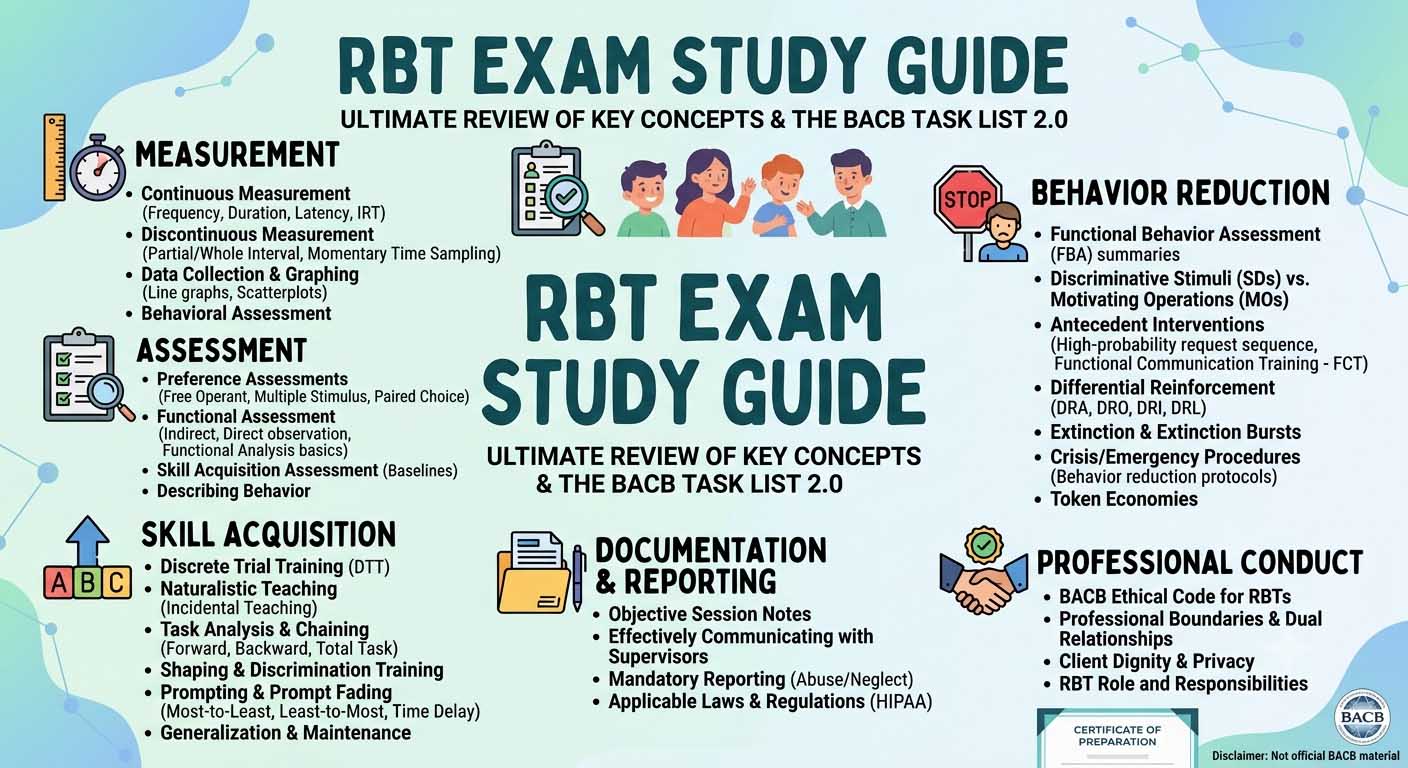
The exam measures your understanding of:
- Data collection
- Assessment support
- Skill acquisition
- Behavior reduction
- Documentation
- Professional conduct
Rather than testing advanced theory, it focuses on applying ABA principles in practical situations.
Quick Study Overview
| Study Area | Focus |
|---|---|
| Measurement | Collecting accurate data |
| Assessment | Assisting with assessments |
| Skill Acquisition | Teaching new skills |
| Behavior Reduction | Following intervention plans |
| Documentation | Recording information correctly |
| Ethics | Professional responsibilities |
These six areas form the foundation of most study plans.
How the RBT Exam Is Structured
Although testing procedures may change over time, candidates can generally expect:
- Multiple-choice questions
- Scenario-based questions
- Practical situations
- Questions covering the RBT Task List concepts
Read each question carefully.
Many questions include several reasonable answers, but only one best follows ABA principles and professional ethics.
Using This RBT Exam Study Guide Effectively
The best study plans focus on understanding rather than memorization.
Instead of simply reading definitions, try to answer questions like:
- Why is this procedure used?
- When should it be applied?
- What would I do in this situation?
Thinking through examples improves long-term understanding. Building critical thinking exercises into your daily study routine can also strengthen your decision-making skills during scenario-based questions.
Topic 1: Measurement and Data Collection
Accurate data collection is one of the most important responsibilities of an RBT.
You may be asked about:
- Frequency
- Duration
- Latency
- Permanent product recording
- Interval recording
Example
If a child raises their hand five times during class, recording the total number of times is an example of frequency.
Understanding when to use each measurement method is more valuable than memorizing definitions alone.
Topic 2: Assessment Support
RBTs assist with assessments but do not independently conduct formal behavior assessments.
Responsibilities may include:
- Following supervisor instructions
- Collecting observation data
- Recording behaviors accurately
- Preparing materials
Remember your role within the treatment team. Learning what is a scholarly source can also help when reviewing evidence-based ABA resources and educational materials.
Topic 3: Skill Acquisition
A large portion of the exam focuses on teaching new skills.
Examples include:
- Communication
- Social interaction
- Self-care
- Academic skills
- Daily living skills
You’ll need to understand teaching procedures such as:
- Prompting
- Prompt fading
- Reinforcement
- Chaining
- Discrete Trial Training (DTT)
Positive Reinforcement
Positive reinforcement increases the likelihood that a behavior will happen again.
Example:
A child finishes homework and receives praise.
The praise encourages future homework completion.
Prompting
Prompts help learners complete tasks successfully.
Common prompts include:
- Verbal
- Gestural
- Visual
- Physical
- Model prompts
The goal is to gradually reduce prompts as independence improves.
Topic 4: Behavior Reduction
Behavior reduction questions often present realistic situations.
Your job is to identify the safest and most appropriate response according to the behavior intervention plan.
Common concepts include:
- Antecedents
- Consequences
- Replacement behaviors
- Differential reinforcement
- Extinction procedures
Always follow the written treatment plan created by your supervisor.
Topic 5: Documentation
Documentation should always be:
- Accurate
- Objective
- Complete
- Timely
Avoid opinions.
Instead of writing:
“The child was lazy.”
Write:
The learner did not start the assigned task within five minutes of being instructed to begin.
Objective language is a key exam concept.
Topic 6: Professional Conduct and Ethics
Ethics questions are among the most important sections.
Expect scenarios involving:
- Confidentiality
- Professional boundaries
- Client dignity
- Supervision
- Reporting concerns
When unsure, ask yourself:
“Does this protect the client and align with professional and ethical standards?”
That question often points toward the correct answer.
Study Guide for RBT Exam: Weekly Plan
A structured schedule helps many students stay organized.
| Day | Focus Area |
|---|---|
| Monday | Measurement and data collection |
| Tuesday | Assessment concepts |
| Wednesday | Skill acquisition |
| Thursday | Behavior reduction |
| Friday | Ethics and documentation |
| Saturday | Practice questions |
| Sunday | Review weak areas |
Studying a little each day is usually more effective than trying to learn everything at once.
RBT Exam Study Guide PDF: Is It Helpful?
Many candidates search for an RBT exam study guide PDF because printable resources are convenient.
PDF guides can help you:
- Highlight important terms
- Review offline
- Create notes
- Study during travel
A PDF should be viewed as a supplement rather than your only study resource.
Combining reading with practice questions and active recall usually leads to better results. Some learners also benefit from understanding gestalt language processing when working with clients who communicate using whole language chunks.
RBT Exam Study Guide Free Resources
There are many RBT exam study guide free resources available online.
Useful options include:
- Practice quizzes
- Flashcards
- Study groups
- Educational videos
- Printable vocabulary lists
- Instructor review sessions
Always make sure free resources reflect the current exam content and accepted ABA terminology. Understanding a student perception survey may also provide useful insight into how educational programs gather feedback to improve learning experiences.
Study Tips That Actually Work
Many students spend hours reading without retaining much information.
Instead, try these methods.
Use Flashcards
Flashcards are excellent for:
- ABA terminology
- Definitions
- Reinforcement schedules
- Ethics concepts
Review them regularly rather than only once.
Practice Scenario Questions
The exam often presents situations instead of simple definitions.
Ask yourself:
“What would I do?”
This approach prepares you for real exam questions. Developing critical thinking exercises alongside practice scenarios can also improve decision-making during the exam.
Teach Someone Else
Explaining concepts aloud reveals what you truly understand.
If you can’t explain reinforcement or prompting simply, review those topics again.
Study in Short Sessions
Many learners remember more by studying:
- 30–45 minutes
- Taking short breaks
- Returning later
Long sessions often reduce focus.
Common Mistakes During Preparation
Avoid these frequent problems.
Memorizing Without Understanding
Knowing a definition isn’t enough.
Understand how each concept applies during therapy sessions.
Ignoring Ethics
Some students spend most of their time studying teaching procedures.
Professional conduct questions deserve equal attention.
Skipping Practice Questions
Practice tests help identify knowledge gaps and weak areas before exam day, giving you the opportunity to focus your study efforts where they are needed most. They also improve familiarity with the exam format, build confidence, and strengthen time-management skills under test conditions.
Review both correct and incorrect answers carefully.
Waiting Until the Last Week
Trying to learn everything in a few days increases stress.
Consistent study usually leads to better results.
Test Day Checklist
Before your exam:
- Sleep well the night before.
- Eat a balanced meal.
- Arrive early if testing in person.
- Bring required identification.
- Read every question carefully.
- Eliminate incorrect answers first.
- Stay calm if you encounter unfamiliar questions.
Many candidates perform better than they expect once the exam begins.
Sample Practice Question
Question
A learner receives praise every time they complete a math worksheet.
What procedure is being used?
A. Extinction
B. Positive Reinforcement
C. Punishment
D. Prompt Fading
Answer
B. Positive Reinforcement
The praise increases the likelihood that the learner will complete future worksheets.
Frequently Asked Questions
Is the RBT exam difficult?
Many candidates find the exam manageable with consistent preparation. Understanding concepts is usually more helpful than memorizing definitions.
How long should I study?
Study time varies by experience, but many learners prepare over several weeks using daily review sessions. Creating a structured plan similar to how long to get a bachelor’s degree timelines can help you stay organized over several weeks.
Are practice tests worth using?
Yes. Practice questions help reinforce concepts and improve confidence by exposing you to exam-style scenarios.
Should I use an RBT exam study guide PDF?
A printable study guide can be a valuable revision resource, especially when paired with flashcards, practice quizzes, and your own study notes.
What topic should I study the most?
Focus on the areas where you feel least confident while continuing to review ethics, behavior reduction, skill acquisition, and data collection throughout your study plan.
Build Confidence One Topic at a Time
Preparing for the certification exam doesn’t have to feel overwhelming. A well-organized RBT exam study guide helps you focus on the concepts that matter most instead of trying to memorize every detail. Whether you’re using a study guide for RBT exam, reviewing an RBT exam study guide PDF, or taking advantage of an RBT exam study guide free resource, the key is consistent practice and understanding how ABA principles apply in real situations.
Study a little each day, work through scenario-based questions, review your weaker topics regularly, and stay familiar with professional ethics. With steady preparation and a clear study plan, you’ll be well prepared to approach the RBT exam with confidence and take the next step toward your career in applied behavior analysis.