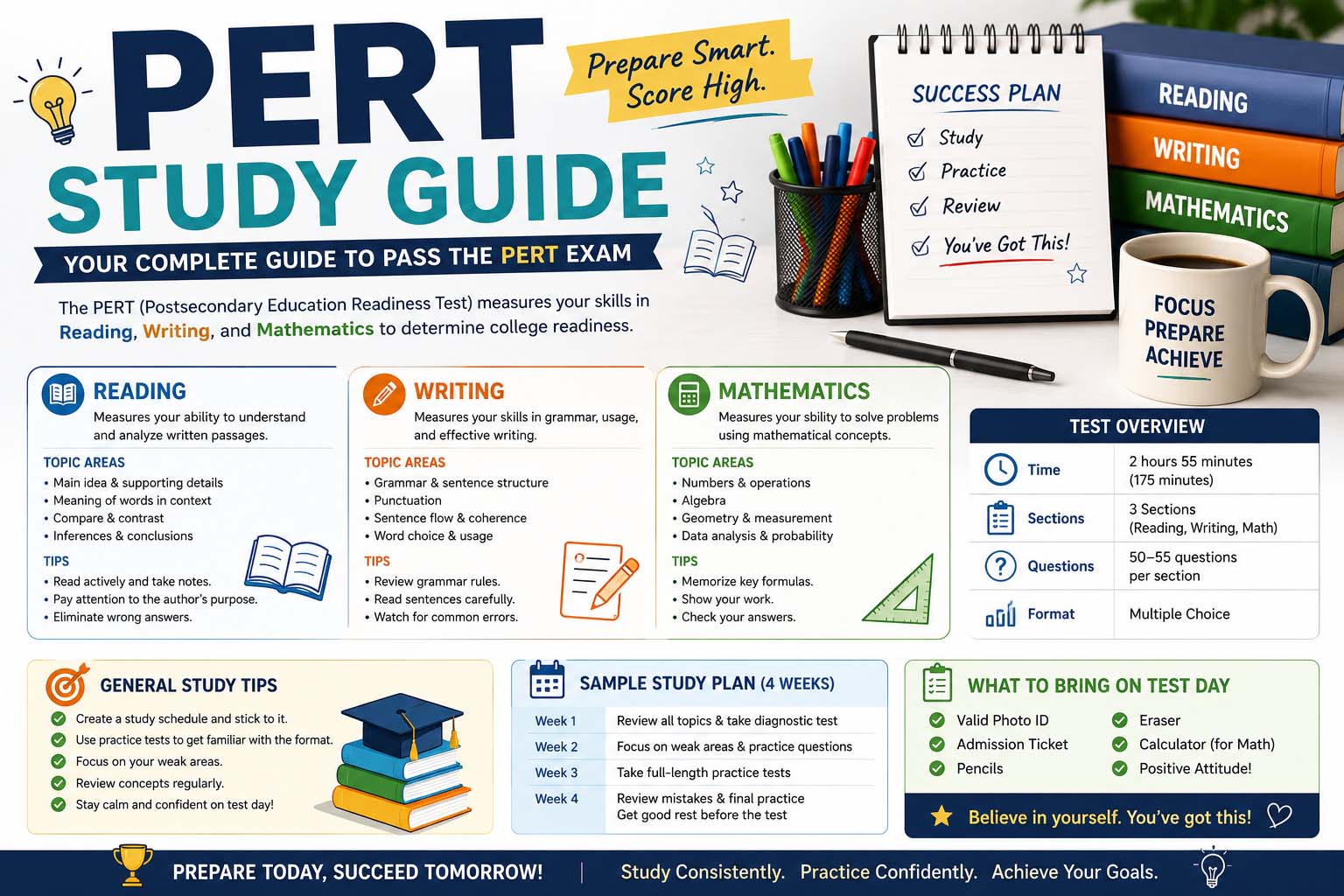
If you’re getting ready for college placement, you’ve probably come across the PERT exam. Using a reliable PERT study guide can make the process feel less stressful, especially if you aren’t sure what to expect. The exam measures your current academic skills so colleges can place you in the right courses.
This PERT study guide explains the exam, covers each test section, and shares practical study strategies to help you feel confident on test day.
Whether you’re taking the exam for the first time or planning to improve your score, this guide will help you prepare effectively.
What Is the PERT Test?
PERT stands for Postsecondary Education Readiness Test.
It is a college placement test used primarily by colleges in Florida to evaluate a student’s readiness for college-level coursework. Students can use this PERT Study Guide to understand the test and prepare for each section.
Instead of determining admission, the PERT helps schools decide whether students are ready for entry-level college classes or would benefit from developmental coursework first.
The exam measures skills in three main subjects:
Mathematics
Reading
Writing
Your results help colleges place you into courses that match your current skill level.
What Does the PERT Measure?
Unlike many standardized exams, the PERT focuses on fundamental academic skills rather than memorized facts.
The exam evaluates your ability to:
Solve math problems
Read and understand passages
Apply grammar rules
Analyze written information
Use reasoning through Critical Thinking Exercises
Because it measures readiness instead of knowledge from a specific class, steady practice is often more valuable than last-minute cramming.
PERT Test Overview
SectionSkills TestedFocusMathematicsAlgebra, geometry, arithmeticProblem solvingReadingComprehension, vocabulary, analysisUnderstanding passagesWritingGrammar, punctuation, sentence structureLanguage skills
Each section evaluates different academic abilities, so preparing for all three is the best approach.
PERT Math Study Guide
For many students, math is the most challenging section of the exam.
A strong PERT math study guide should focus on understanding concepts rather than memorizing formulas.
Topics commonly include:
Basic Arithmetic
Review:
Fractions
Decimals
Percentages
Ratios
Proportions
These questions often appear throughout the exam.
Algebra
Expect questions involving:
Linear equations
Inequalities
Variables
Exponents
Factoring
Simplifying expressions
Being comfortable solving equations step by step can improve both speed and accuracy.
Geometry
You may encounter problems covering:
Area
Perimeter
Angles
Volume
Basic shapes
Memorizing common formulas can save valuable time.
Graphs and Data
The test may also include:
Charts
Tables
Coordinate planes
Data interpretation
Practice reading information carefully before solving each problem.
Math PERT Study Guide: Best Ways to Practice
If you’re using a math PERT study guide, try these study habits.
Work Problems Every Day
Even 20–30 minutes of daily math practice builds confidence over time.
Consistency usually works better than long study sessions once a week.
Review Mistakes
Don’t just check whether an answer is right or wrong, because reviewing explanations, identifying mistakes, and understanding the reasoning process leads to deeper learning and long-term improvement.
Figure out:
Why you missed it
Which step caused the mistake
How to solve it correctly next time
Learning from errors is one of the fastest ways to improve.
Use a Formula Sheet
Create a page with:
Geometry formulas
Fraction rules
Exponent properties
Order of operations
Review it regularly until the formulas become familiar.
Reading Section Preparation
Reading questions measure your understanding rather than your reading speed.
You’ll likely answer questions about:
Main ideas
Supporting details
Vocabulary in context
Author’s purpose
Logical conclusions
Read each passage carefully before looking at the answer choices.
This helps you avoid being influenced by distractor answers. Learning What Is the Central Idea of This Passage? can also strengthen your ability to understand a text’s primary message.
Writing Section Preparation
The writing section focuses on standard English usage.
Topics often include:
Grammar
Sentence structure
Word choice
Punctuation
Capitalization
Organization
Many questions ask you to identify the best revision rather than simply finding an error.
Practice editing sentences as part of your preparation.
PERT Test Study Guide Checklist
Use this simple checklist before test day.
| Task | Complete |
|---|---|
| Reviewed math basics | ☐ |
| Practiced algebra | ☐ |
| Reviewed geometry formulas | ☐ |
| Completed reading passages | ☐ |
| Practiced grammar questions | ☐ |
| Took a full-length practice test | ☐ |
| Reviewed incorrect answers | ☐ |
| Planned test-day materials | ☐ |
Working through this checklist helps ensure balanced preparation.
PERT Math Test Study Guide: Most Common Topics
Students searching for a PERT math test study guide often want to know which topics deserve extra attention.
Spend additional practice time on:
Solving equations
Fractions and decimals
Percent problems
Word problems
Linear graphs
Algebraic expressions
Geometry formulas
These topics appear frequently in placement-style exams.
Study Plan for One Week
If your exam is coming soon, here’s a simple schedule.
Review arithmetic
Complete practice questions
Study algebra
Solve equation problems
Review geometry
Memorize formulas
Practice reading comprehension
Study grammar and writing
Take a full-length practice test
Review mistakes
Relax and prepare for test day
Avoid trying to learn entirely new material the night before the exam.
Common Mistakes Students Make
Many students lose points because of simple errors rather than difficult questions.
Watch out for these common mistakes.
Rushing
Read each question carefully.
One missed word can completely change the correct answer because even small changes in language can alter context, meaning, or interpretation, leading to misunderstandings or incorrect conclusions.
Skipping Basic Skills
Some students spend all their time studying advanced algebra while forgetting fractions and percentages.
Strong fundamentals are just as valuable.
Ignoring Practice Tests
Practice exams help you become comfortable with the pacing and question style.
They’re one of the best preparation tools available.
Not Reviewing Incorrect Answers
Every incorrect answer teaches you something.
Reviewing mistakes helps prevent repeating them on the actual exam.
Test-Day Tips
Good preparation continues on exam day.
Try these strategies.
Get enough sleep the night before.
Eat a balanced meal.
Arrive early.
Bring any required identification.
Read directions carefully.
Stay calm if you encounter a difficult question.
Move forward and return later if needed.
Confidence often comes from preparation rather than luck, because even small differences in wording or understanding can affect outcomes, interpretation, and overall accuracy in communication and decision-making.
Helpful Study Resources
Students preparing for the PERT often benefit from using multiple learning tools.
Good options include:
Practice tests
Flashcards
Online math tutorials
Reading comprehension exercises
Grammar workbooks
Study groups
Using different resources keeps studying more engaging. Learning How to Create a Study Guide can also help you organize important concepts and improve your overall preparation.
How Long Should You Study?
Every student starts at a different level, shaped by their prior knowledge, learning pace, and personal strengths, which means progress and understanding can vary widely from person to person.
As a general guide:
Strong students: 1–2 weeks
Average preparation: 3–4 weeks
Students needing extra review: 6–8 weeks
The key is steady practice rather than trying to study everything at once. Good time management for students can make this process more effective.
Frequently Asked Questions
Is the PERT test difficult?
Most students find it manageable with regular practice. The exam focuses on foundational academic skills instead of advanced college material.
Can I use a calculator?
Calculator policies vary by testing location and section. Check with your testing center before exam day so you know what to expect.
What should I study first?
Start with the subject you find most challenging. Many students choose math because it often requires the most review.
How can I improve my math score?
Use a PERT math study guide, practice problems every day, review mistakes, and strengthen your understanding of basic algebra and arithmetic.
Are practice tests worth using?
Yes. Practice tests help you understand the question format, improve time management, and identify areas that need more attention, making your preparation more structured and effective over time.
Your Next Steps Toward a Strong PERT Score
Preparing with a reliable PERT study guide gives you a clear path toward success. By reviewing math concepts, strengthening reading comprehension, and practicing grammar skills, you’ll build the confidence needed to perform your best on test day.
Remember that improvement comes from steady effort. Whether you’re working through a PERT test study guide, focusing on a math PERT study guide, or reviewing a PERT math test study guide, short daily study sessions, practice questions, and careful review of your mistakes can make a real difference. Stay consistent, trust your preparation, and walk into the testing center ready to show what you know.