
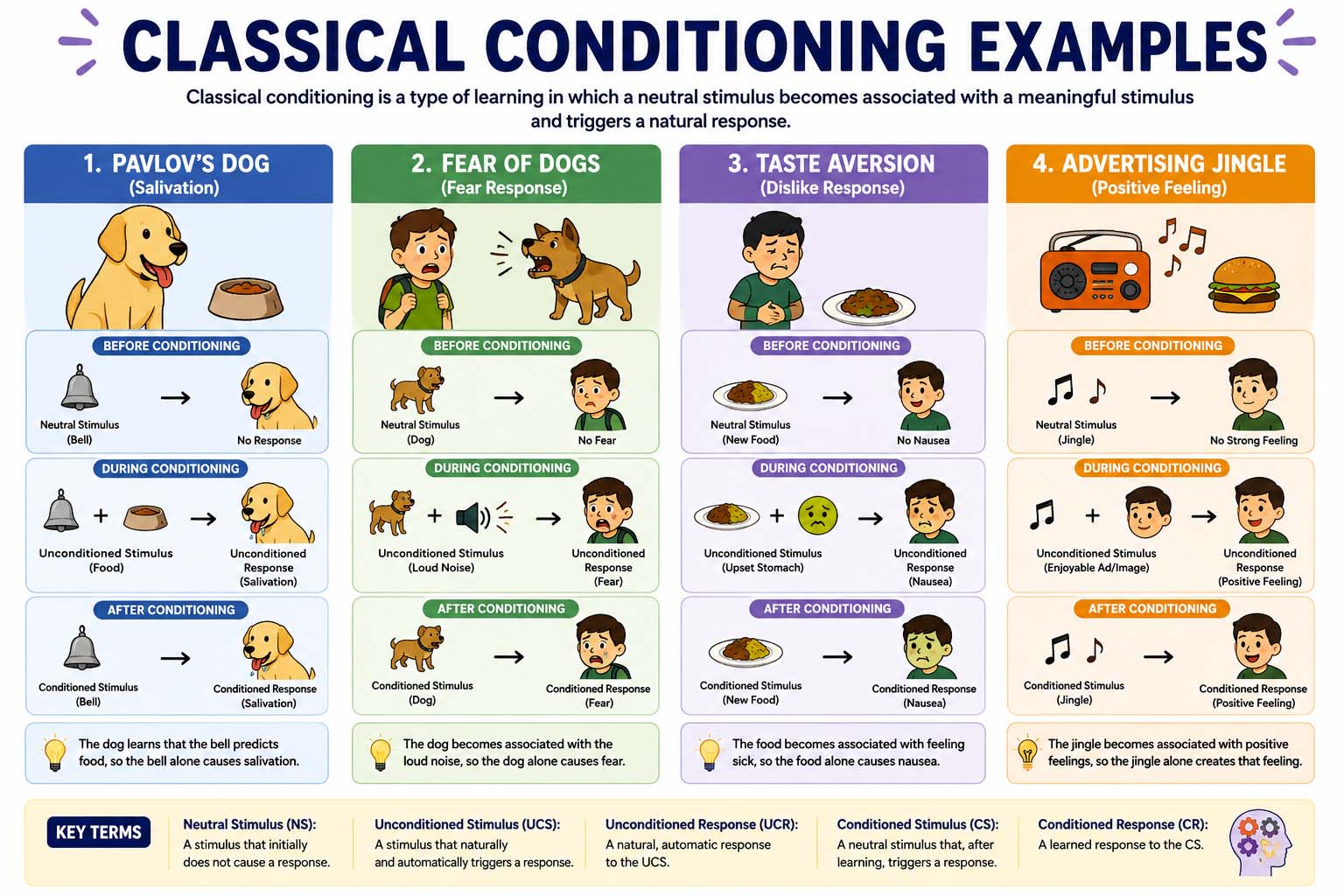
Have you ever started feeling hungry just by smelling popcorn? Or felt nervous when hearing the sound of a dentist’s drill before treatment even begins?
These are common classical conditioning examples. Your brain has learned to connect one thing with another through repeated experiences.
Classical conditioning is one of the first concepts students learn in psychology because it helps explain many everyday behaviors. Once you understand the basic idea, you’ll begin noticing examples almost everywhere.
This guide explains classical conditioning in simple language, includes real-life examples, and offers study tips to help you remember the concept for exams.
What Is Classical Conditioning?
Classical conditioning is a type of learning where a person or animal learns to connect two different stimuli.
After enough repeated pairings, one stimulus begins to trigger a response that originally belonged to another stimulus.
The concept was discovered by Russian physiologist Ivan Pavlov while studying digestion in dogs.
His famous experiment showed that dogs could learn to associate the sound of a bell with food. After hearing the bell several times before receiving food, the dogs eventually began salivating when they heard the bell alone. This is one of the best-known experiments in behavioral psychology.
Key Terms You Should Know
| Classical Conditioning | Classical vs Operant Conditioning Explained |
|---|---|
| Learning through association | Learning through consequences |
| Passive learner | Active learner |
| Response happens automatically | Behavior is voluntary |
| Developed by Pavlov | Developed by B. F. Skinner |
| Bell paired with food | Reward for good behavior |
Pavlov’s Dog Example
Food = Unconditioned Stimulus
Salivation from food = Unconditioned Response
Bell before learning = Neutral Stimulus
Bell after repeated pairings = Conditioned Stimulus
Salivation after hearing bell = Conditioned Response
This pattern appears in many everyday situations.
How Classical Conditioning Works Step by Step
The learning process happens in a few simple stages.
Step 1: Before Learning
The neutral stimulus has no effect.
Example:
A phone notification sound doesn’t make you excited because you’ve never used that app before.
Step 2: During Learning
The neutral stimulus is repeatedly paired with something meaningful.
Example:
Every notification brings a message from your best friend.
Step 3: After Learning
The notification sound alone creates excitement.
Your brain has formed an association.
Examples of Classical Conditioning
Here are some simple examples of classical conditioning that students often recognize immediately.
1. School Bell
Students hear the final bell every day before going home.
Eventually, hearing the bell creates excitement.
2. Ice Cream Truck Music
Children often become excited simply by hearing the familiar music.
The music becomes associated with getting ice cream.
3. Coffee Aroma
Many adults begin feeling awake or energized after smelling fresh coffee.
Repeated morning routines help build this association.
4. Phone Notification Sound
A familiar notification can trigger anticipation before you even check your phone.
5. Restaurant Smells
Walking past your favorite restaurant may suddenly make you hungry.
Your brain connects the smell with enjoyable meals.
6. Alarm Clock
Some people feel stress immediately after hearing their alarm because it’s associated with waking up early.
7. Movie Theme Songs
Hearing music from a favorite movie may bring back emotions connected to memorable scenes.
8. Dentist Office
The sound of dental equipment may create nervous feelings due to previous experiences.
9. Hospital Smell
Certain medical smells remind people of past hospital visits.
10. Sports Stadium
Fans often become excited after hearing their team’s entrance music.
Examples of Classical Conditioning in Everyday Life
Many students ask for examples of classical conditioning in everyday life because they help make the concept easier to remember.
Here are several more practical situations.
Favorite Store
Walking into a favorite store may instantly improve your mood because you’ve had enjoyable shopping experiences there.
Holiday Decorations
Seeing Christmas decorations often creates excitement before the holiday actually arrives.
Rainy Weather
Someone who enjoys cozy days indoors may feel relaxed whenever rain begins.
Perfume or Cologne
A familiar scent may remind you of someone you know.
The smell triggers memories and emotions.
Popcorn at the Movies
The smell of popcorn often creates excitement because people associate it with watching movies.
Classroom Presentation
If a student once had a stressful presentation, standing at the front of the classroom later may create nervousness.
Classical Conditioning Examples in Everyday Life at School
Schools provide many easy examples of learned associations.
Students may notice:
Feeling hungry before lunch when the lunch bell rings
Becoming focused after hearing the teacher’s attention signal
Feeling relaxed when class ends
Becoming nervous before exams after seeing test papers
Feeling excited on the last day of school
These classroom experiences make excellent study examples.
Examples of Classical Conditioning in Real Life
Classical conditioning isn’t limited to psychology textbooks—it happens in everyday life more often than most people realize.
Pets Running to Their Food Bowl
Pets often run toward their bowls after hearing the sound of food bags opening.
Babies and Feeding Time
Babies may become excited after seeing a bottle because they associate it with feeding.
Commercial Jingles
Companies often use catchy music so customers associate positive feelings with a product.
Favorite Vacation Spot
Seeing photos of a beach you visited may immediately improve your mood.
Gym Music
Listening to your workout playlist can make you feel ready to exercise before you’ve even started.
Classical Conditioning vs Operant Conditioning
Students often confuse these two learning theories.
Here’s an easy comparison.
Classical Conditioning Operant Conditioning Learning through associationLearning through consequencesPassive learnerActive learnerResponse happens automaticallyBehavior is voluntaryDeveloped by PavlovDeveloped by B. F. SkinnerBell paired with foodReward for good behavior
A simple way to remember:
Classical conditioning = Association
Operant Conditioning = Rewards and consequences
Why Is Classical Conditioning Important?
Understanding this concept helps explain many everyday behaviors.
Psychologists use it to study:
Learning
Habits
Emotional responses
Behavior change
It also has practical uses in fields such as:
Education
Marketing
Animal training
Mental health
Healthcare
Knowing how associations form helps teachers, parents, and professionals support positive learning experiences and understand Behavior Psychology.
Common Mistakes Students Make
Learning psychology terms can be tricky at first.
When studying classical conditioning, it’s easy to confuse key concepts or overlook important details. Av
Mixing Up the Stimuli
Students sometimes confuse the unconditioned stimulus with the conditioned stimulus.
Remember:
Food naturally causes salivation.
The bell only causes salivation after learning.
Forgetting the Learning Process
The association doesn’t happen instantly.
Repeated pairings are necessary.
Confusing Classical and Operant Conditioning
Classical conditioning focuses on automatic responses.
Operant conditioning focuses on choices and consequences.
Thinking Everything Is Classical Conditioning
Not every learned behavior fits this theory.
Always ask:
“Did the response happen automatically because two things became associated?”
If yes, it’s probably classical conditioning.
Study Tips for Remembering Classical Conditioning
These strategies make exam preparation much easier.
Remember Pavlov’s Dog
Most psychology teachers begin with this famous example because it explains every key term.
Create Your Own Examples
Think about your daily routine.
Ask yourself:
Next, the neutral stimulus is repeatedly paired with something meaningful.
What smells bring back memories?
What places change my mood?
Personal examples are easier to remember.
Practice with Flashcards
Write one psychology term on one side.
Write the definition and an example on the other.
An AP Psychology Study Guide can also help organize these concepts for revision.
Draw the Learning Process
Visual learners often remember concepts better by creating diagrams.
Example:
Neutral Stimulus → Bell
Food → Salivation
Bell + Food (Repeated)
Bell → Salivation
Understanding related concepts, such as Negative Reinforcement Examples, becomes easier when the learning process is presented visually.
Frequently Asked Questions
What is the easiest example of classical conditioning?
Pavlov’s dog experiment is the most common example. The dog learns to associate a bell with food and eventually salivates after hearing the bell alone.
What are examples of classical conditioning in everyday life?
Examples include hearing an ice cream truck, smelling popcorn at the movies, feeling hungry after a lunch bell, reacting to a phone notification, or becoming excited by holiday music.
Who discovered classical conditioning?
Ivan Pavlov discovered classical conditioning while studying digestion in dogs during the late 1800s.
Is classical conditioning still used today?
Yes. It continues to influence psychology, education, advertising, animal training, and healthcare.
What’s the difference between classical and operant conditioning?
Classical conditioning teaches associations between stimuli, while operant conditioning teaches behaviors through rewards or consequences.
Key Takeaways for Students
Learning classical conditioning examples becomes much easier once you connect the theory to real life. From school bells and phone notifications to favorite songs and restaurant smells, your brain constantly builds associations between experiences.
When studying, focus on identifying the four main parts of every example: the unconditioned stimulus, unconditioned response, conditioned stimulus, and conditioned response. Practice with examples of classical conditioning, especially examples of classical conditioning in everyday life and to strengthen your understanding. The more examples you recognize around you, the easier this psychology concept becomes to remember for quizzes, exams, and future courses.