
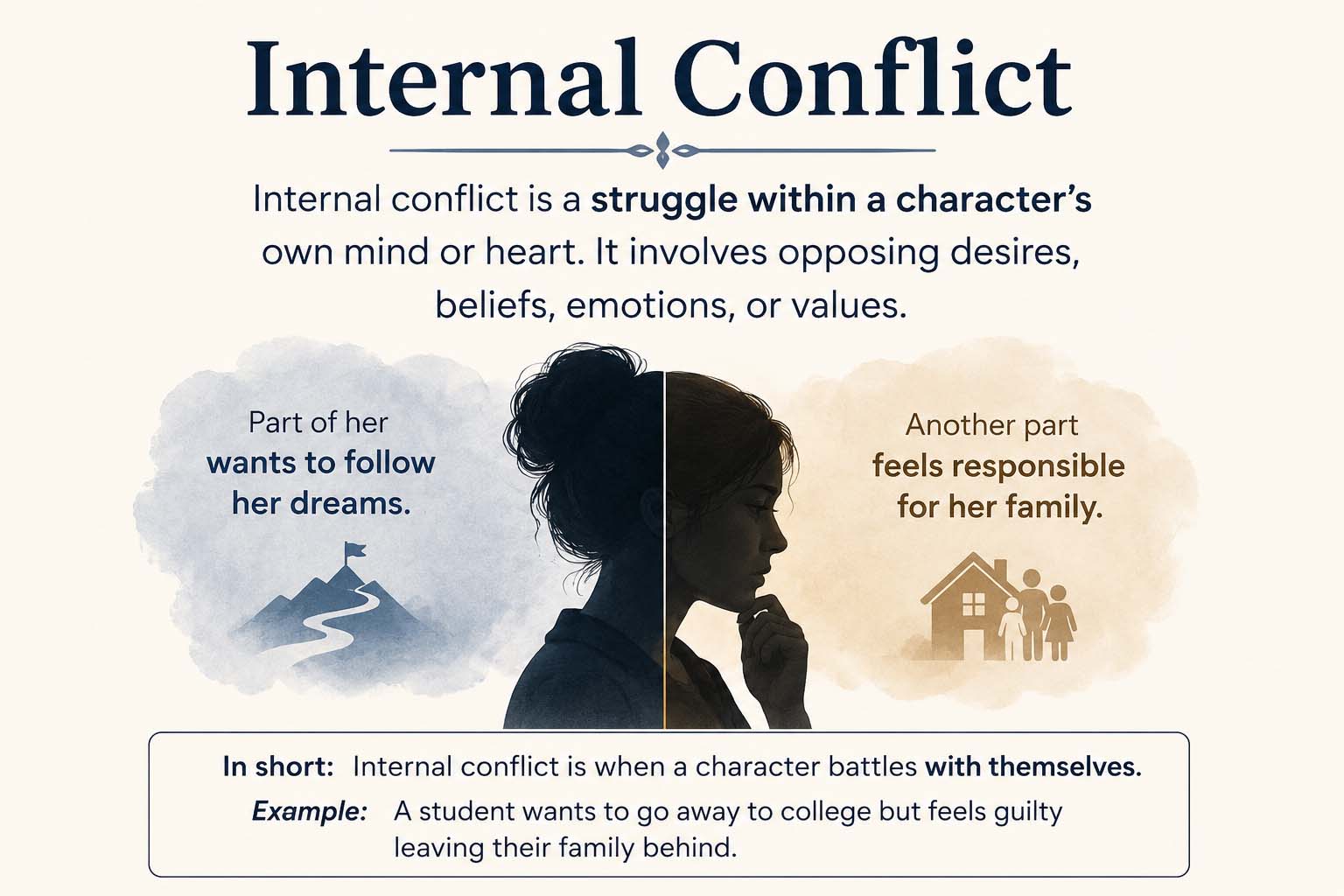
The internal conflict definition refers to a mental or emotional struggle that takes place within a character. For example, a character may want to tell the truth but fear the consequences. Another character might dream of following their passion while feeling pressure to meet family expectations.
These struggles often involve difficult decisions, competing emotions, or personal beliefs. As a result, they make fictional characters more realistic and help readers understand their motivations.
You’ll find internal conflict in novels, movies, plays, poems, and even real-life situations.
This guide explains what internal conflict means, why it matters, how to recognize it, and how teachers often ask students to analyze it in class.
What Is the Internal Conflict Definition?
Internal conflict is a struggle that takes place within a character’s mind or emotions. Instead of fighting another person or facing an outside obstacle, the character struggles with thoughts, feelings, beliefs, or difficult decisions.
For example, internal conflict often involves questions like:
- Should I tell the truth?
- Am I making the right choice?
- Do I follow my dreams or my responsibilities?
- Can I forgive myself?
- Should I face my fears?
These questions create emotional tension. As a result, readers become interested in how the character will respond.
Simple Definition of Internal Conflict
Internal conflict is a mental or emotional struggle experienced by a character as they face difficult choices, competing desires, or personal challenges.
For example, a student who wants to admit a mistake but fears punishment experiences an internal struggle.
The conflict happens within the student’s thoughts rather than through a physical confrontation.
Definition of Internal Conflict in Simple Words
If your teacher asks for the definition of internal conflict, you can explain it this way:
Internal conflict happens when a character struggles with their own thoughts, emotions, values, or decisions rather than with another person or outside force.
This explanation works well for classroom discussions, homework, and reading assignments.
For instance, a character may feel torn between helping a friend and following school rules.
Although nobody is physically fighting, the character still faces a meaningful conflict.
Why Internal Conflict Matters in Stories
Without internal conflict, many characters would feel flat or unrealistic.
People make mistakes, doubt themselves, and change over time. Similarly, fictional characters become more believable when they experience personal struggles.
Internal conflict helps readers:
- Understand a character’s personality
- Connect emotionally with the story
- Recognize character development
- Identify important themes
- Stay interested in the plot
For example, a character who struggles with fear may gradually develop courage.
As a result, readers can understand not only what the character does but also why their decisions matter.
Many memorable stories rely just as much on emotional struggles as action scenes.
Internal Conflict vs. External Conflict
Students often confuse these two literary concepts. However, the difference becomes clear when you consider where the struggle happens.
| Internal Conflict | External Conflict |
|---|---|
| Happens inside a character | Involves an outside force |
| Includes emotional or mental struggles | Includes external obstacles |
| Often involves personal decisions | May involve another person, society, or nature |
| Focuses on thoughts and feelings | Often appears through events and actions |
| Examples include fear, guilt, and doubt | Examples include arguments, disasters, and battles |
Example of Internal Conflict
A student wants to stand up for a friend but worries about becoming a target of bullying.
The student struggles between loyalty and fear.
Therefore, the main conflict occurs within the student’s mind.
Example of External Conflict
That same student argues with the bully.
In this situation, the student faces another person directly.
However, the story may still include the student’s internal fear.
Many stories combine both forms of conflict because outside events often influence a character’s emotions.
For a broader understanding of these literary struggles, students can explore the different types of conflicts in literature and learn how each one influences characters and plot development.
Internal Conflict in Literature
When studying novels and short stories, teachers may ask students to identify a character’s internal struggles.
In literature, internal conflict often drives character development.
Readers learn what matters to a character by observing how they respond to difficult choices.
For example, common situations include:
- Choosing family over personal goals
- Fighting fear before taking action
- Deciding between honesty and self-protection
- Overcoming guilt after making a mistake
- Questioning personal values
These moments reveal personality more clearly than simple descriptions.
In addition, internal struggles can influence the plot because a character’s decisions often lead to important events.
Common Types of Internal Conflict
Not every internal struggle looks the same.
However, recognizing different patterns helps students understand characters and strengthen their reading comprehension skills.
Character vs. Self
Character vs. self is the classic form of internal conflict.
The character struggles with personal emotions, beliefs, or decisions.
Example: A runner doubts whether they can finish an important race.
Although the race creates an external challenge, the runner’s self-doubt represents the internal struggle.
Fear vs. Courage
In this situation, a character wants to act but feels afraid.
Example: A student wants to give a speech but fears public speaking.
The student must decide whether to avoid the situation or face that fear.
Right vs. Wrong
Sometimes, characters understand the ethical choice but worry about its consequences.
Example: A student finds lost money and must decide whether to return it.
As a result, the conflict involves honesty, temptation, and personal responsibility.
Desire vs. Responsibility
Characters often struggle between what they want and what they believe they should do.
Example: A teenager wants to travel with friends but has promised to help their family.
Therefore, the teenager must balance personal enjoyment with responsibility.
Love vs. Duty
This conflict appears in many novels, plays, and films.
A character may need to choose between personal happiness and an important obligation.
For example, someone might want to stay with a loved one but feel responsible for protecting their community.
Although these categories overlap, each highlights a different source of emotional tension.
How Internal Conflict Supports Character Development
The literary meaning of internal conflict goes beyond describing emotions.
Instead, personal struggles often influence how characters grow throughout a story.
For example, characters may begin a story feeling uncertain, fearful, or confused.
However, their experiences may eventually help them:
- Learn something important
- Change emotionally
- Gain confidence
- Accept responsibility
- Understand their values
- Make peace with a difficult decision
This growth is known as character development.
However, not every character overcomes their struggle. Some make poor decisions or remain uncertain.
Even then, their internal conflict can reveal important themes and consequences.
Examples of Internal Conflict
Examples make the concept easier to understand.
| Situation | Internal Conflict |
|---|---|
| Student finds exam answers | Tell the teacher or stay quiet? |
| Athlete loses confidence | Keep trying or quit? |
| Character tells a lie | Admit the truth or continue lying? |
| Hero faces danger | Protect others or stay safe? |
| Teen chooses a career | Follow personal interests or family expectations? |
Notice that every example involves a personal struggle.
Although outside circumstances may create the problem, the internal conflict involves how the character thinks or feels about it.
Famous Literary Examples of Internal Conflict
Many well-known books and plays include characters who experience difficult emotional struggles.
Hamlet by William Shakespeare
Hamlet struggles with revenge, justice, uncertainty, and responsibility.
For example, he questions what he should do and whether he can trust the information he receives.
As a result, his hesitation and inner struggles create much of the play’s tension.
The Hunger Games by Suzanne Collins
Katniss Everdeen faces difficult emotional and moral choices.
She wants to survive while protecting the people she loves.
However, those goals sometimes conflict with one another.
Therefore, her internal struggles influence many important decisions throughout the story.
To Kill a Mockingbird by Harper Lee
Characters confront questions about fairness, prejudice, courage, and morality.
For example, Scout learns to question assumptions and better understand other people’s experiences.
These personal challenges contribute to the novel’s themes and character development.
Harry Potter by J. K. Rowling
Harry frequently questions his abilities and decisions.
He struggles with friendship, loyalty, bravery, and responsibility.
Although he faces powerful external enemies, his emotional challenges also shape his development.
How to Identify Internal Conflict in a Story
Students sometimes struggle to recognize internal conflict in reading assignments.
However, a few simple steps can make identification easier.
Step 1: Focus on the Character’s Thoughts
First, pay attention to what the character thinks.
Do they seem uncertain, afraid, or confused?
For example, a character may repeatedly question whether they made the right decision.
Such thoughts can reveal an internal struggle.
Step 2: Look for Difficult Choices
Next, identify situations where the character must choose between competing options.
Ask yourself:
What decision must this character make?
For instance, a character may need to choose between telling the truth and protecting a friend.
The difficulty of that decision reveals the conflict.
Sometimes, students wonder When Does Decision-Making Become More Complex? Understanding how competing priorities and possible consequences affect choices can also help readers recognize why fictional characters struggle with important decisions.
Step 3: Watch for Emotional Reactions
Then, look for emotions such as fear, guilt, regret, jealousy, or hope.
These feelings may indicate that the character is struggling internally.
However, emotions alone do not always establish conflict. Look for competing desires, beliefs, or pressures that create tension.
Step 4: Notice Character Growth
Finally, consider how the character changes.
Ask yourself:
What did the character learn from this struggle?
If the character becomes more confident, changes their beliefs, or accepts responsibility, an internal conflict may have contributed to that development.
For further guidance on understanding storytelling techniques, Purdue University’s creative writing resources provide educational material for writers, teachers, and tutors.
What Is the Definition of Internal Conflict for Students?
Students often need a short explanation for homework, quizzes, and classroom discussions.
A useful answer is:
Internal conflict is the emotional or mental struggle that happens inside a character when they face difficult choices, competing feelings, or personal challenges.
For example, a student in a story may want to confess to cheating but fear the consequences.
The struggle between honesty and fear represents internal conflict.
Therefore, a strong classroom answer should identify both the character’s struggle and the competing feelings or choices.
Why Teachers Ask About Internal Conflict
Understanding internal conflict helps students develop several reading and writing skills.
These include:
- Character analysis
- Theme identification
- Critical thinking
- Reading comprehension
- Essay writing
Instead of simply describing what happened, students learn why characters make certain choices.
For example, a teacher may ask why a character hesitates before making a decision.
To answer effectively, students should explain the character’s competing motivations and support their interpretation with details from the text.
As a result, analyzing internal conflict encourages deeper reading rather than simple plot summaries.
Internal Conflict in Everyday Life
Internal conflict isn’t limited to books.
People experience similar struggles in everyday situations.
For example:
- Choosing between two colleges
- Deciding whether to apologize
- Speaking up about unfair treatment
- Trying something new despite fear
- Balancing work and personal life
Imagine someone receives two job offers.
One position provides better pay, while the other offers more meaningful work.
Although both opportunities seem attractive, the person may struggle to decide which matters more.
This situation resembles the personal conflicts that fictional characters experience.
Therefore, connecting literature to everyday decisions can make the concept easier to understand.
Common Mistakes Students Make
Many learners confuse internal conflict with other story elements.
However, recognizing these mistakes can improve literary analysis.
Confusing Internal and External Conflict
Remember that internal conflict happens within the character.
In contrast, external conflict involves an outside force.
For example, arguing with a friend is an external conflict.
However, feeling guilty about the argument may create an internal struggle.
Looking Only for Arguments
Not every conflict involves fighting.
Sometimes, the biggest struggle is silent.
For instance, a character may spend an entire chapter deciding whether to reveal an important secret.
Although no argument occurs, the character still experiences conflict.
Ignoring Character Thoughts
Pay attention to inner dialogue and emotional reactions.
Characters often reveal their struggles through their thoughts rather than their actions.
Therefore, examine both what characters say and what they privately believe.
Assuming Every Emotion Is a Conflict
A character feeling sad or angry does not automatically mean an internal conflict exists.
Instead, look for tension between competing feelings, desires, beliefs, or decisions.
For example, feeling nervous before an exam is an emotion. Wanting to cheat to succeed while believing cheating is wrong creates an internal conflict.
Study Tips for Remembering Internal Conflict
These techniques make the concept easier to remember.
- Identify what the character wants. First, determine their main goal or desire.
- Look for emotional obstacles. Next, consider what creates doubt, fear, or hesitation.
- Highlight important thoughts. Pay attention to words that reveal uncertainty or competing beliefs.
- Compare the beginning and ending. Notice whether the character changes during the story.
- Practice with familiar examples. Use books, movies, and classroom stories to identify personal struggles.
For example, after reading a chapter, write one sentence explaining the character’s internal struggle.
Then, identify the thoughts or decisions that support your answer.
The more examples you study, the easier it becomes to recognize this literary element.
Quick Reference Guide
| Question | Answer |
|---|---|
| Where does internal conflict happen? | Inside the character |
| What causes it? | Competing thoughts, emotions, choices, or beliefs |
| Why is it important? | Supports character development and themes |
| Is it emotional? | Often, yes |
| Does it involve another person? | Another person may influence it, but the struggle is internal |
| What are common examples? | Fear, guilt, doubt, and difficult decisions |
This reference can help students review the main ideas before quizzes or writing assignments.
Frequently Asked Questions About Internal Conflict
What Is the Internal Conflict Definition?
Internal conflict is a mental or emotional struggle that happens within a character as they deal with difficult choices, beliefs, or feelings.
For example, a character may want to admit a mistake but fear punishment.
What Is the Definition of Internal Conflict in Literature?
In literature, internal conflict is a personal struggle inside a character that influences their decisions, emotions, and development throughout the story.
As a result, it often contributes to important plot events and themes.
What Is the Difference Between Internal and External Conflict?
Internal conflict happens within a character’s mind.
In contrast, external conflict involves outside challenges such as other characters, society, nature, or circumstances.
However, both forms can appear in the same story.
Why Is Internal Conflict Important?
It helps readers understand characters, creates emotional depth, and supports meaningful character development.
In addition, it can explain why characters make difficult or unexpected decisions.
Can a Story Include Both Internal and External Conflict?
Yes. Many stories combine both.
For example, a character may battle an outside enemy while also struggling with fear, guilt, or uncertainty.
How Can I Identify Internal Conflict?
Look for emotional struggles, difficult decisions, self-doubt, or moments when a character questions their own beliefs or actions.
Then, consider how those struggles influence the character’s behavior.
Key Takeaways for Students
Understanding the internal conflict definition helps students recognize what happens inside a character’s mind. These personal struggles make stories more realistic, reveal character development, and help readers connect emotionally with the plot.
Internal conflict often involves competing desires, difficult choices, fear, guilt, or uncertainty. However, it does not always lead to a positive outcome.
As you read novels, short stories, or plays, pay close attention to characters’ thoughts, emotions, and decisions.
With regular practice, you’ll find it easier to identify internal struggles, analyze literature, answer classroom questions, and write stronger essays.