
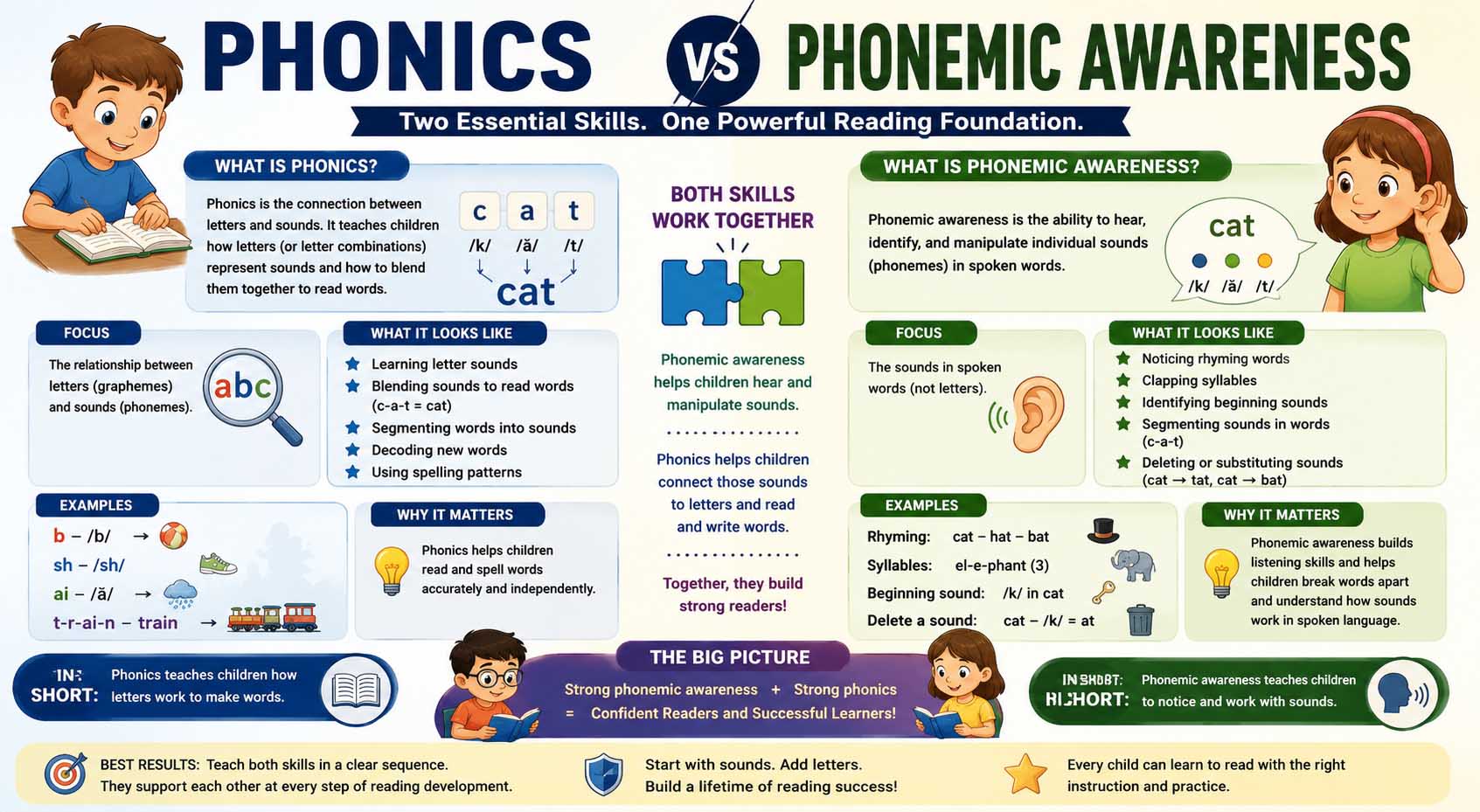
Parents and new teachers often hear the terms phonics vs phonemic awareness used in the same conversation, so it is easy to assume they mean the same thing. However, the distinction is simple: phonemic awareness involves hearing and working with individual sounds in spoken words, while phonics connects those sounds to written letters and spelling patterns.
Both skills support early reading development, yet they work in different ways. A child can practice phonemic awareness with their eyes closed because printed letters are not required. By contrast, phonics involves print. Once this difference becomes clear, planning reading activities becomes much easier.
Phonics vs Phonemic Awareness at a Glance
The quickest way to separate the two concepts is to ask whether written letters are involved.
If a teacher says cat and asks a student to identify the first sound, the activity targets phonemic awareness. However, if the teacher shows the letter c and asks which sound it represents in cat, the activity involves phonics.
Here is a simple comparison:
| Skill | Phonemic Awareness | Phonics |
|---|---|---|
| Main focus | Individual speech sounds | Sounds and written letters |
| Requires print? | No | Yes |
| Example | Break fish into /f/ /i/ /sh/ | Identify sh in fish |
| Main purpose | Understand sound structure | Decode and spell printed words |
| Common activities | Blending, segmenting, deleting sounds | Reading, spelling, letter-sound matching |
| Usually taught | Early literacy stages | Early and developing reading stages |
Although these skills are different, they support each other. Therefore, strong early literacy instruction usually includes both rather than treating them as competing methods.
What Is Phonemic Awareness?
Phonemic awareness is the ability to notice, identify, and manipulate phonemes, which are the smallest meaningful units of sound in spoken words.
Consider the word sun. It contains three phonemes:
/s/ /u/ /n/
A learner with developing phonemic awareness can hear those individual sounds even when the word is spoken normally.
The learner might also blend the sounds /s/ /u/ /n/ to form sun. Similarly, the learner may hear sun and separate it back into three sounds.
Because the focus is sound rather than print, letters are not necessary for a phonemic awareness activity.
Common phonemic awareness skills
Students may practice several types of sound manipulation.
For instance, they can identify the first sound in moon, blend /m/ /a/ /p/ into map, or segment dog into /d/ /o/ /g/.
Later, they may work on more challenging tasks. A teacher could ask, “Say smile without /s/.” The learner then responds with mile.
These activities train children to notice the internal sound structure of spoken words.
As students progress, this sound awareness can also support their understanding of types of syllables, because larger spoken words contain sound patterns that eventually connect with recognizable spelling structures.
What Is Phonics?
Phonics teaches learners how sounds relate to written letters and combinations of letters.
For example, students learn that m commonly represents /m/. They also discover that letter combinations such as sh, ch, ee, and oa can represent particular sounds.
Therefore, phonics helps children move from spoken language into written language.
Suppose a learner sees the word shop. The student may identify sh as /sh/, o as /o/, and p as /p/. Next, the student blends those sounds and reads the complete word.
This process is called decoding.
Phonics also supports spelling. When learners hear a word, they can segment its sounds and connect those sounds to letters or spelling patterns they have learned.
Phonemic Awareness vs Phonics: A Practical Example
Imagine a teacher working with the word ship.
First, the teacher says the word without showing it in print.
“Tell me the sounds you hear in ship.”
The learner responds:
/sh/ /i/ /p/
That is phonemic awareness because the activity works entirely with spoken sounds.
Next, the teacher writes ship on a card and asks the student which letters represent /sh/.
The student points to sh.
Now the activity has moved into phonics because written letters are involved.
This sequence shows why phonemic awareness vs phonics is not an either-or decision. Instead, students can move naturally from hearing sounds to connecting those sounds with print.
Phonological Awareness vs. Phonemic Awareness vs. Phonics
Another source of confusion is the difference among phonological awareness, phonemic awareness, and phonics.
Phonological awareness is the broadest concept. It involves recognizing and working with the sound structure of spoken language at several levels.
For example, learners may recognize:
- Words within sentences
- Rhyming words
- Syllables
- Onsets and rimes
- Individual phonemes
Phonemic awareness is a more specific part of phonological awareness that focuses specifically on identifying and manipulating individual sounds, or phonemes, in spoken words. It focuses only on individual phonemes.
Phonics is different because it brings written language into the process.
Therefore, when comparing phonological awareness vs phonemic awareness vs phonics, think of phonological awareness as the broad sound category, phonemic awareness as work with individual speech sounds, and phonics as the connection between sounds and written symbols.
Why the Difference Matters for Reading Instruction
Understanding these terms is useful because a child can struggle with one skill while performing well in another.
For example, a learner might recognize many printed letters but struggle to blend sounds into words. Another child might easily blend spoken sounds but know very few letter-sound correspondences.
Those learners need different types of support.
If teachers treat every reading difficulty as the same problem, practice may miss the skill that actually needs attention. Instead, observing how a student handles both spoken sounds and printed words can provide a clearer picture.
This distinction also matters when teaching word structure. For instance, understanding What Is a Root Word? becomes more useful as students move beyond basic decoding and begin examining how meaningful word parts contribute to vocabulary and spelling.
Science of Reading: Phonemic Awareness vs Phonics
The phrase science of reading phonemic awareness vs phonics often appears when parents and educators explore evidence-based literacy instruction.
However, the science of reading is not a single program or one classroom activity. Rather, the term refers broadly to a body of research from areas such as education, psychology, linguistics, and neuroscience about how reading develops and how it can be taught.
Within that broader picture, phonemic awareness and phonics play related roles.
Phonemic awareness helps learners become conscious of the individual sounds in spoken words. Meanwhile, systematic phonics instruction teaches learners how those sounds connect with print.
As students become more accurate decoders, they also need vocabulary, language comprehension, background knowledge, fluency, and opportunities to read meaningful text.
Therefore, effective reading instruction is broader than choosing between phonics and phonemic awareness.
Teaching Phonemic Awareness Step by Step
Phonemic awareness activities can start very simply.
Begin with identifying sounds
A teacher might say:
“What sound do you hear at the beginning of fish?”
The learner identifies /f/.
Once that becomes comfortable, the teacher can ask about ending or middle sounds.
Move into blending
Next, say individual sounds slowly:
/s/ /i/ /t/
Ask the learner to combine them.
The answer is sit.
At first, use short words with simple sound structures. Then, increase complexity as the learner becomes more confident.
Practice segmentation
Now reverse the process.
Say map and ask the student to identify each sound:
/m/ /a/ /p/
Counters, blocks, or fingers can represent individual phonemes. Since phonemic awareness focuses on sounds, letters do not need to appear during the activity.
Introduce manipulation
Later, learners can add, remove, or substitute phonemes.
For example:
“Say cat. Change /k/ to /h/.”
The answer becomes hat.
These activities require more mental manipulation, so they usually come after basic identification, blending, and segmentation.
Moving From Phonemic Awareness Into Phonics
Once students can work with spoken sounds, teachers can connect those sounds with written symbols.
For example, after blending /m/ /a/ /p/ orally, show the letters m-a-p. Then, ask the learner to point to each letter while saying its corresponding sound.
This creates a bridge between listening and reading.
Next, students can build words with letter tiles, magnetic letters, or cards. Changing map to mat, for instance, demonstrates that replacing one sound requires changing one letter.
As learners become more skilled, introduce digraphs, vowel teams, consonant blends, and other spelling patterns.
Meanwhile, language development remains relevant to literacy. Topics such as Gestalt language processing concern patterns of language acquisition rather than phonics instruction itself, yet understanding different aspects of language development can help educators recognize that spoken language and reading involve related but distinct skills.
Classroom Activities That Practice Both Skills
Teachers do not always need completely separate lessons for phonemic awareness and phonics. Instead, a carefully planned activity can move from one skill into the other.
For example, say three sounds aloud:
/f/ /o/ /g/
Ask students to blend them into fog. That first step practices phonemic awareness.
Next, show the letters f-o-g and have students match each sound to its spelling. Now the lesson becomes phonics.
Finally, ask students to read fog in a short sentence:
“The fog is thick.”
This last step allows learners to apply decoding during connected reading.
Over time, reading comprehension becomes increasingly significant. When students encounter unfamiliar vocabulary, strategies such as types of context clues can help them work out meaning from surrounding information, while phonics helps them decode the printed word itself.
Common Mistakes When Teaching These Skills
A common mistake is using the terms interchangeably. Although both concern sounds, only phonics requires a connection to written print.
Another mistake is asking beginners to complete advanced sound manipulation before they can blend or segment simple words comfortably. Skills generally become easier when instruction moves from manageable tasks toward more challenging ones.
Likewise, teachers should not keep phonemic awareness completely disconnected from print for longer than necessary once students are ready to connect sounds and letters.
On the other hand, introducing many spelling patterns too quickly can overload beginners. A planned sequence with frequent review gives learners more opportunities to build automatic recognition.
Finally, neither skill should consume the entire reading lesson. Students also need to hear good language, learn vocabulary, build knowledge, develop fluency, discuss texts, and enjoy reading.
How Parents Can Practice at Home
Home practice can be simple and brief.
During a phonemic awareness activity, parents might say a word and ask the child to identify its first sound. They can also play oral blending games during a car ride or while preparing dinner.
For phonics practice, use printed letters or simple word cards. Ask the child to say each sound and blend the word.
However, avoid turning every reading session into a test. Instead, keep practice short, supportive, and appropriate for the child’s current level.
Reading aloud together also remains valuable. While phonics helps children decode words, shared reading exposes them to vocabulary, sentence structures, knowledge, and stories that may be above their independent reading level.
Frequently Asked Questions
Which comes first, phonemic awareness or phonics?
Early phonological and phonemic awareness can begin before children know printed letters. However, once learners are ready, phonemic awareness and phonics can be taught in a coordinated way rather than waiting for one to be completely mastered.
Can you teach phonemic awareness without letters?
Yes. In fact, phonemic awareness is based on spoken sounds, so many activities require no print at all.
Does phonics require letters?
Yes. Phonics specifically involves relationships between speech sounds and written letters or letter combinations.
Are phonological awareness and phonemic awareness the same?
No. Phonological awareness is broader and includes awareness of words, rhymes, syllables, and other sound units. Phonemic awareness focuses specifically on individual phonemes.
Is phonics enough to teach a child to read?
Phonics is a key part of early reading instruction, but reading also requires language comprehension, vocabulary, fluency, background knowledge, and experience with meaningful texts.
Helping Learners Build Both Skills Together
The simplest way to remember phonics vs phonemic awareness is this: phonemic awareness works with the sounds we hear and say, while phonics connects those sounds with the letters we see and read.
Rather than choosing one over the other, teachers and parents can help learners move naturally from listening to sounds, to manipulating them, to connecting them with print, and finally to reading words in meaningful sentences.
When these skills develop alongside vocabulary, fluency, comprehension, and regular reading practice, students gain a much stronger foundation for becoming confident readers.