
Have you ever wondered why some vowels make a long sound while others make a short one? In fact, the answer often comes down to the types of syllables in a word. Therefore, understanding syllable patterns helps students become stronger readers, better spellers and more confident writers.
Because these patterns make unfamiliar words much easier to decode, they help every student, parent, teacher and lifelong learner. Instead of memorizing every word, you can apply a set of reliable rules to thousands of English words.
What Are Syllables and Syllable Types?
First, a syllable is a unit of pronunciation that contains one vowel sound. Every English word has at least one syllable, while longer words may have two, three or even more. For example:
- Cat has 1 syllable.
- Table has 2 syllables.
- Computer has 3 syllables.
- Communication has 5 syllables.
Likewise, longer words are often built from roots, prefixes and suffixes, each with its own syllable pattern. As a result, understanding What Is a Root Word? also helps explain how these longer words form.
Why Learning the Types of Syllables Matters
Many reading programs teach syllable patterns because they give predictable pronunciation rules. So, when you recognize a pattern, you can often decide:
- How the vowel should sound
- Where to divide a word
- Also, how to spell an unfamiliar word
- How to pronounce longer vocabulary
- Finally, why similar words sound different
As a result, these skills support reading fluency and build confidence with new words.
The Six Types of Syllables
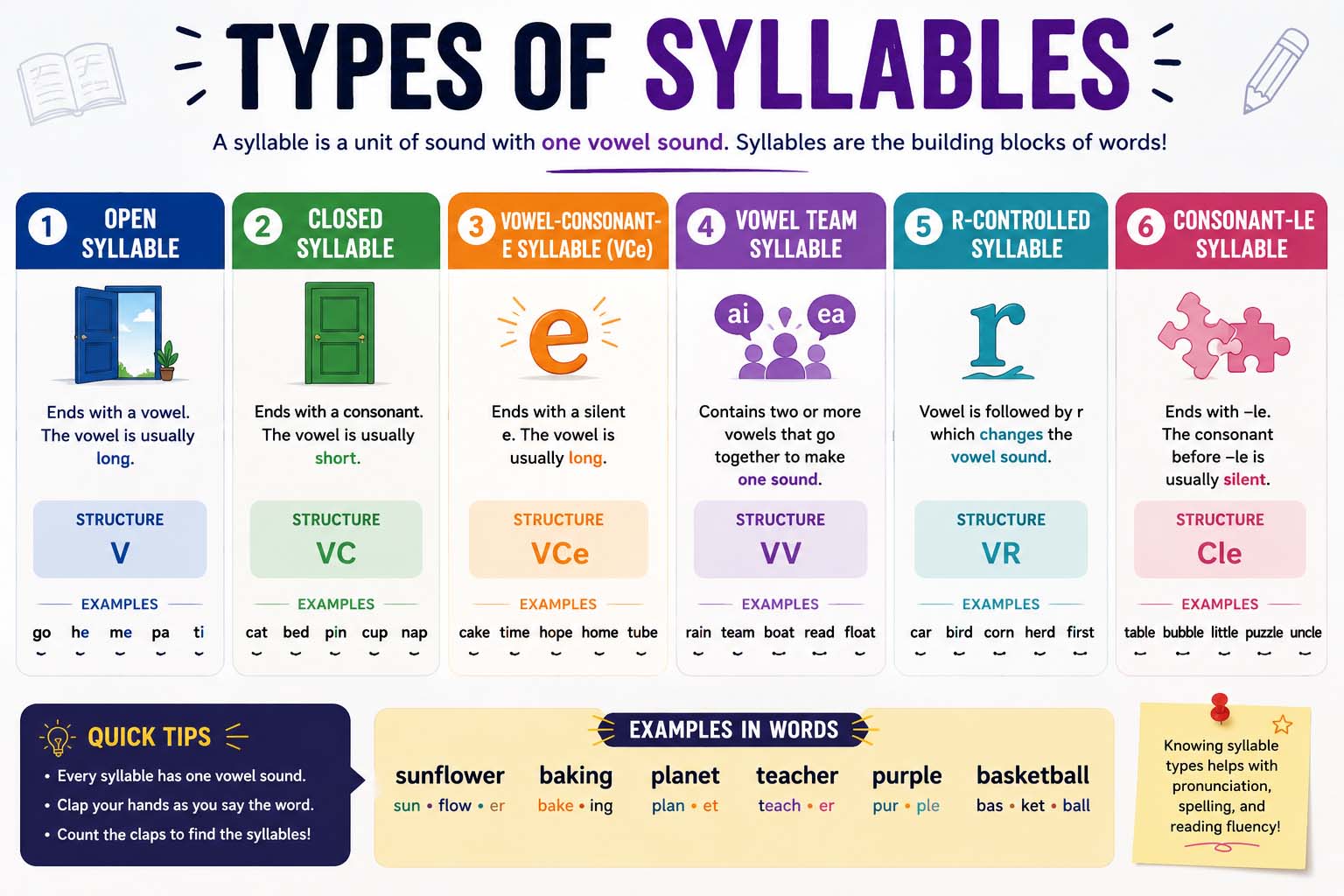
Most reading specialists teach six patterns because together they explain the pronunciation of most English words. For example, the Reading Rockets guide to the six syllable types lists the same six patterns. Also, each one follows its own vowel pattern.
1. Closed Syllable
A closed syllable ends with one or more consonants after the vowel. Because the vowel is “closed in,” it usually makes a short sound. For example, cat, bed, fish, jump and rabbit (rab-bit) are closed.
Also, short vowel sounds are among the first pronunciation patterns students learn.
2. Open Syllable
In contrast, an open syllable ends with a vowel. Since nothing follows the vowel within the syllable, it usually makes its long sound. For example, he, go, me, baby (ba-by) and music (mu-sic) are open.
Moreover, open syllables appear frequently in longer English words.
3. Vowel-Consonant-E Syllable
Also, this pattern is sometimes called the silent-e syllable. First, the final “e” changes the earlier vowel from a short sound to a long sound. For example, the table below compares closed words with their silent-e partners.
| Closed word | Vowel-consonant-e word |
|---|---|
| cap | cape |
| kit | kite |
| hop | hope |
| tub | tube |
| mad | made |
However, the silent “e” itself is not pronounced. Instead, it changes the vowel before it.
4. Vowel Team Syllable
Next, a vowel team has two or more vowels that work together to make one sound. Sometimes the vowels create a long vowel, but other times they produce a different sound. For example, rain, boat, team, day, play, food, coin and cloud all contain vowel teams.
Therefore, vowel teams form one of the largest syllable categories in English.
5. R-Controlled Syllable
Then, an r-controlled syllable occurs when a vowel is immediately followed by the letter r. Instead of making its normal sound, the vowel changes because of the “r.” For example, car, bird, fern, storm and turn are r-controlled.
As a result, many students find these vowels challenging, because they do not follow the usual short or long vowel rules.
6. Consonant-LE Syllable
Finally, this syllable appears at the end of many English words. It consists of a consonant followed by “le,” and the final “e” is usually silent. For example, table, little, candle, purple and simple all end this way.
Meanwhile, this pattern commonly appears in two- and three-syllable words.
Quick Reference: Types of Syllables Chart
So, this chart summarizes the six patterns with a sample word for each.
| Syllable type | Vowel sound | Example |
|---|---|---|
| Closed | Short | cat |
| Open | Long | go |
| Vowel-consonant-e | Long | cake |
| Vowel team | Varies | boat |
| R-controlled | Changed by the r | bird |
| Consonant-le | Final syllable with a silent e | table |
Also, many teachers call these the basic syllable patterns of English. Similarly, some programs simply refer to them as the six syllable types.
Seven or Four Types of Syllables?
Most phonics programs teach six syllable types because they cover the majority of English words. However, you may also hear people discuss seven. According to Reading Rockets, a seventh group of “leftovers” holds odd and schwa syllables, so it is not a new vowel pattern.
On the other hand, some elementary resources introduce four types first: closed, open, vowel team and silent-e. Then, after students master those patterns, teachers add r-controlled and consonant-le syllables. As a result, beginning readers avoid feeling overwhelmed while they build a strong foundation.
How to Identify Syllable Types Step by Step
Therefore, when you meet a new word, follow these simple steps:
- Find the vowels.
- Next, divide the word into syllables.
- Then look at the letters surrounding each vowel.
- After that, identify the syllable pattern.
- Apply the pronunciation rule.
- Finally, blend the syllables together.
For example, take the word fantastic. Then it divides into fan, tas and tic, and each one is a closed syllable. Therefore, each vowel stays short because every syllable ends with a consonant.
Likewise, this method becomes easier with practice and helps students read longer words more confidently.
Practicing With Everyday Words
In fact, the best way to remember the patterns is to practice with words you already know. Instead of memorizing long lists, look for them while reading books, completing homework or writing sentences. For example, consider these words:
| Word | Number of syllables | Syllable types |
|---|---|---|
| cat | 1 | Closed |
| robot | 2 | Open + closed |
| sunshine | 2 | Closed + silent-e |
| teacher | 2 | Vowel team + r-controlled |
| little | 2 | Closed + consonant-le |
| rainbow | 2 | Vowel team + vowel team |
Also, as you practice, you will notice that many longer words contain more than one pattern. The same strategy helps when studying types of context clues, because spotting patterns makes unfamiliar vocabulary easier to understand.
Classroom Activities for Learning Syllable Patterns
Generally, teachers use interactive activities to help students recognize patterns quickly. For example, some effective classroom ideas include:
Syllable Sorting
First, write words on cards and sort them into groups by syllable type. For example, closed words include dog, lamp and jump. Also, open words include he, go and me. Likewise, vowel team words include boat, rain and seed. As a result, sorting encourages students to look for patterns instead of guessing.
Word Building
Next, give students syllables to combine into complete words. For example, ta + ble makes table, mu + sic makes music and sun + shine makes sunshine. Therefore, this activity reinforces both pronunciation and spelling.
Highlight the Vowel Pattern
Finally, use colored pencils or highlighters to mark vowels, vowel teams, silent e or r-controlled vowels. Moreover, visual learners often find this strategy especially helpful.
How Syllable Types Improve Reading
Strong readers do not decode every letter one at a time. Instead, they recognize patterns. Therefore, knowing the six patterns helps students:
- First, read unfamiliar words more accurately
- Improve reading speed
- Develop stronger spelling habits
- Grow their vocabulary
- Finally, pronounce academic words with greater confidence
For example, when students meet a long science or history word, dividing it into syllables makes it much less intimidating.
Meanwhile, reading skills also grow when students understand sentence structure. For example, studying complex sentence examples shows how words and ideas work together in longer writing.
Using Syllable Knowledge in Writing
However, syllable awareness is not only useful for reading. It also supports better writing. Students who understand these patterns often:
- Spell multisyllable words more accurately
- Divide words correctly when taking notes
- Use dictionaries more effectively
- Pronounce new vocabulary with confidence before using it in assignments
Furthermore, when writing essays, reports or presentations, recognizing word patterns makes editing much easier.
Common Mistakes Students Make
Even experienced readers occasionally misidentify syllables. Fortunately, you can avoid these common errors:
- Assuming every vowel makes a long sound. A vowel’s sound depends on its pattern, not just the letter. For example, cap has a short a, but cape has a long a because of the silent e.
- Forgetting about vowel teams. Two vowels often work together as one sound, as in train, clean and boat. Therefore, treating each vowel separately can lead to incorrect pronunciation.
- Ignoring the letter r. The letter r changes vowel sounds in words such as car, bird and storm. As a result, these vowels do not follow the standard short or long rules.
- Guessing instead of looking for patterns. Many students try to memorize every word individually. Instead, identify the syllable type first, and the pronunciation usually becomes much easier.
Study Tips for Remembering the Types of Syllables
Building confidence takes regular practice rather than long study sessions. For example, try these techniques:
- Read aloud for 10 to 15 minutes each day.
- Highlight vowel patterns in books.
- Practice dividing longer words into syllables.
- Make flashcards with examples of each syllable type.
- Challenge yourself to identify patterns on signs, menus or websites.
In fact, reviewing a few examples each day is often more effective than cramming once a week.
Syllables and Other Language Skills
Learning syllable patterns connects naturally with other areas of English language arts. For example, once students understand how words are built, they often find figurative language easier to analyze. Lessons on What Is a Rhetorical Device? become more meaningful because students spend less effort decoding vocabulary and more time on the author’s message.
Likewise, classroom discussions often involve different types of questions, which encourage students to explain why a word follows a particular pattern instead of only giving the correct answer.
FAQ About Types of Syllables
What are the six types of syllables?
The six main patterns are closed, open, vowel-consonant-e (silent-e), vowel team, r-controlled and consonant-le. Together, they explain the pronunciation of most English words.
Are there really seven types of syllables?
Some reading programs add a seventh group for odd or schwa syllables. However, most phonics curricula teach six core patterns because they cover the vast majority of words.
Why do some books mention four syllable types?
Many early reading programs introduce four patterns first to simplify instruction. Then, as students become more confident readers, they learn the remaining patterns.
How do syllable types help with spelling?
Understanding these patterns helps students predict vowel sounds, divide words correctly and recognize common spelling rules. As a result, they apply consistent phonics patterns instead of memorizing every word.
At what age should children learn syllable patterns?
Many students begin learning basic patterns in the early elementary grades. However, more advanced patterns are usually introduced as reading skills develop, and the exact timeline varies by curriculum.
Keep Practicing the Types of Syllables One Pattern at a Time
Learning the types of syllables gives you a powerful tool for reading, spelling and understanding English words. Rather than relying on memorization alone, you will begin to recognize patterns that appear again and again across thousands of words.
Therefore, start with the six core patterns and practice identifying them in everyday reading. Then apply the step-by-step method whenever you meet unfamiliar vocabulary. With regular practice, these patterns become second nature, so reading feels smoother, spelling becomes more accurate and new words feel much less challenging.