Have you ever wondered why some passages explain events step by step, while others compare ideas or solve a problem? Indeed, the answer lies in the types of text structure that authors use to organize information. In fact, knowing these patterns helps you read faster, spot key ideas and write more clearly.
Whether you are preparing for a class, a test or just better reading, text structure shows you how information is presented. First, you will learn the five common patterns. Next, you will see signal words, a simple way to identify each pattern, and tips for using them in your own writing.
What Is Text Structure?
In simple terms, text structure is the way an author organizes ideas in a passage. Instead of placing facts at random, writers arrange details in a pattern that helps readers follow the message.
If you are new to this topic, start with this beginner guide to text structure. Also, knowing the pattern lets you predict what may come next and understand the author’s purpose.
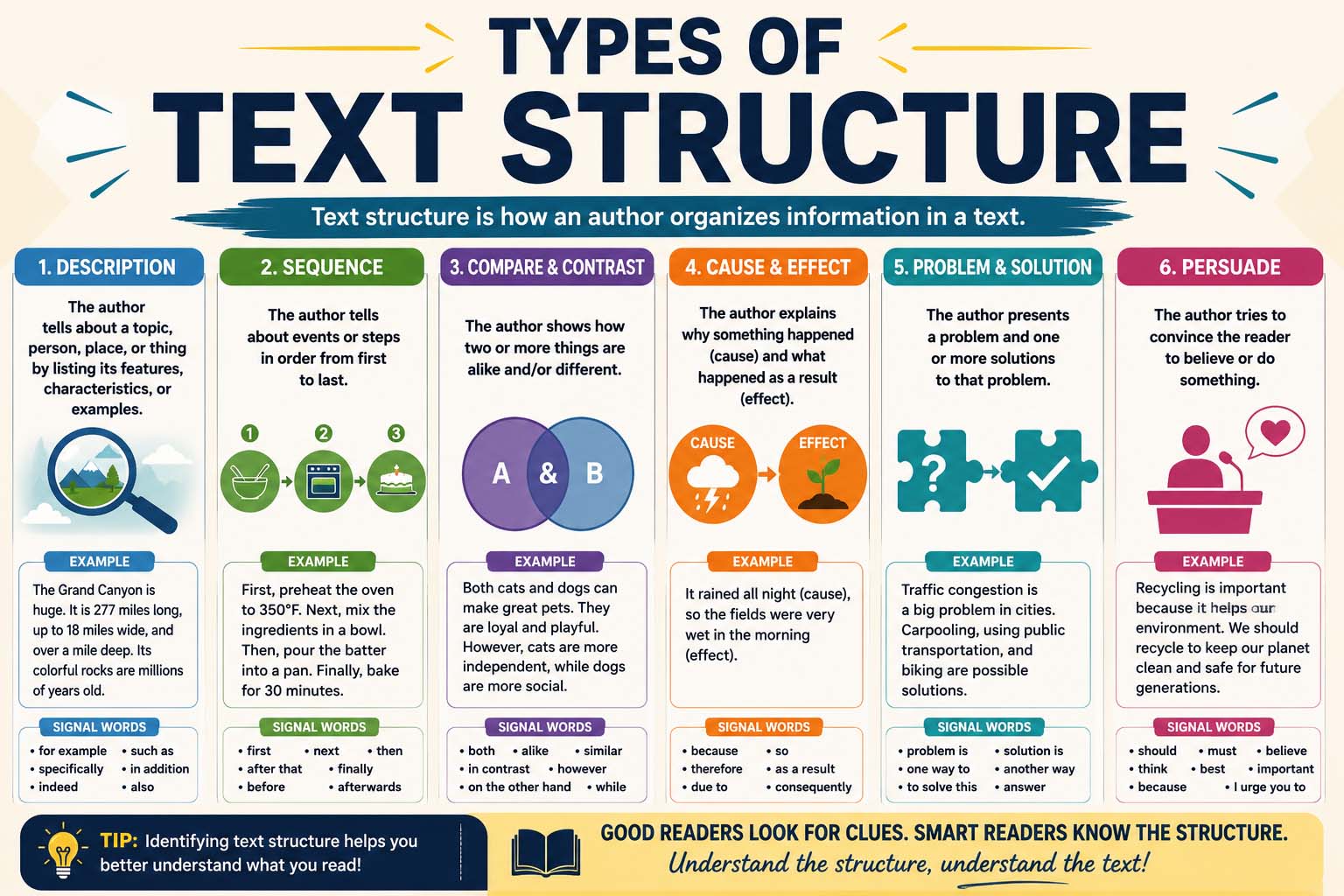
The 5 Types of Text Structure
Overall, most informational articles, textbooks and nonfiction passages use five patterns. For example, Reading Rockets lists the same five: description, cause and effect, compare and contrast, sequence and problem and solution. However, authors sometimes mix them in one passage.
1. Description
A descriptive passage explains a topic by giving features, facts or examples. Instead of following events in time, it helps the reader picture a subject.
Example: “A dolphin is a marine mammal known for its intelligence, playful behavior and excellent swimming ability.”
Common signal words are “for example,” “such as,” “includes” and “consists of.” As a result, this pattern is common in science and social studies textbooks.
2. Sequence or Chronological Order
Sequence presents events or steps in the order they happen. For example, authors use it for history, recipes, experiments and instructions.
Example: First, gather your materials. Next, mix the ingredients. Then bake the cake for 30 minutes. Finally, let it cool.
Common signal words are “first,” “next,” “then,” “after,” “before” and “finally.” Because the order is clear, many students find this pattern the easiest to spot.
3. Compare and Contrast
Essentially, this pattern shows how two or more subjects are alike and different.
Example: “Frogs and toads are both amphibians, but frogs usually have smoother skin, while toads often have dry, bumpy skin.”
Common signal words are “both,” “similarly,” “unlike,” “however,” “although” and “on the other hand.” In addition, contrasting two things does not mean judging one as good and one as bad.
4. Cause and Effect
Simply put, cause and effect explains why something happens and what results from it.
Example: “Heavy rainfall caused flooding, which closed roads and delayed school buses.”
Common signal words are “because,” “since,” “therefore,” “as a result,” “due to” and “consequently.” Sometimes one effect has several causes, or one cause has several effects.
5. Problem and Solution
A problem and solution passage names an issue and then explains one or more ways to fix it.
Example: “Plastic pollution harms marine life. For instance, one solution is to reduce single-use plastics and recycle more.”
Common signal words are “problem,” “challenge,” “solution,” “resolve” and “one answer is.” However, this pattern is more complex than the others. According to Prestwick House, explaining a problem may need cause and effect, and describing a solution may need sequence.
Types of Text Structure at a Glance
Use this table for a quick review.
| Structure | Purpose | Common signal words |
|---|---|---|
| Description | Explain features and details | for example, such as, includes |
| Sequence | Show the order of events | first, next, finally |
| Compare and contrast | Show likenesses and differences | both, unlike, however |
| Cause and effect | Explain reasons and results | because, therefore, as a result |
| Problem and solution | Present an issue and a fix | problem, solution, resolve |
Also, keeping this chart nearby can help you name the author’s pattern more quickly.
How to Identify the Types of Text Structure
Therefore, finding the right pattern is easier with a simple process.
- First, read the whole passage, not just the first sentence.
- Next, look for signal words, such as “first” for sequence, “because” for cause and effect, and “unlike” for comparison.
- Then ask what the author is trying to do. Is the author describing, ordering events, comparing, explaining a reason or solving a problem?
- Finally, check your answer against the whole passage, because one signal word is not proof.
Signal words work like context clues. Therefore, learning the types of context clues can also help you notice these hints while reading.
Types of Text Structure in Everyday Reading
Also, these patterns appear far outside school assignments. For example, you meet them in many everyday materials:
| Reading material | Common structure |
|---|---|
| Instruction manual | Sequence |
| News article | Cause and effect |
| Product review | Compare and contrast |
| Encyclopedia entry | Description |
| Opinion article | Problem and solution |
However, real texts do not always fit one label. In practice, one structure is usually the main framework, and others support it.
Why the Types of Text Structure Improve Reading
First, knowing the pattern helps readers organize information in their minds. According to Reading Rockets, it helps readers focus on key ideas, predict what comes next, check their understanding and summarize. As a result, students gain:
- Better comprehension.
- Easier note-taking.
- Stronger summaries.
- Faster reading of nonfiction.
Also, you can find the main message more easily when you see how details are organized around it. For example, finding the central idea of a passage becomes simpler once you know the pattern.
Using Text Structure in Your Own Writing
Likewise, good writers choose a pattern on purpose. For example:
- A science report may use description.
- A history essay often follows chronological order.
- A persuasive essay may use problem and solution.
- A comparison essay explains likenesses and differences.
Before you write, decide which pattern supports your purpose. In addition, begin each paragraph with a clear topic sentence. These topic sentence examples show how paragraphs fit into a larger pattern.
Text Structure vs. Story Elements
However, fiction has its own organization. Instead of the five patterns above, stories use characters, setting, plot, conflict and resolution. If you study the parts of a story, you will see that these elements organize a narrative, not facts. Therefore, knowing both helps you read fiction and nonfiction.
Common Mistakes With Text Structure
- Choosing a pattern from one signal word.
- Confusing sequence with cause and effect.
- Missing comparison clues.
- Ignoring the author’s purpose.
- Assuming a passage uses only one pattern.
Instead, read the whole passage and choose the pattern that organizes most of it.
Tips to Remember the Types of Text Structure
- Make flashcards with the definition and signal words.
- Highlight signal words while you read.
- Draw a simple graphic organizer for each pattern.
- Summarize a passage using its pattern.
- Practice with newspaper articles and textbook sections.
Also, try writing one short paragraph in each pattern. Because writing forces you to use the signal words, this practice builds memory fast.
Frequently Asked Questions
What are the five types of text structure?
They are description, sequence, compare and contrast, cause and effect, and problem and solution.
Can one passage use more than one text structure?
Yes. For example, authors often combine patterns in one article. However, one usually serves as the main framework.
Which text structure is easiest to identify?
Sequence is often the easiest because the events follow a clear order and use words such as “first,” “next” and “finally.”
Why are text structures important?
Because they show how ideas connect, they help readers organize ideas, find main points and understand what they read.
How can I get better at identifying text structures?
First, read nonfiction often, underline signal words and ask what the author is trying to do. Then summarize each passage using its pattern.
Key Takeaways on Types of Text Structure
Overall, learning the types of text structure gives you a strong tool for reading with confidence. Instead of seeing random facts, you see patterns that describe, order, compare, explain or solve.
First, read the passage. Next, find the signal words. Then name the pattern. As a result, reading, note-taking and writing will all become easier over time.