
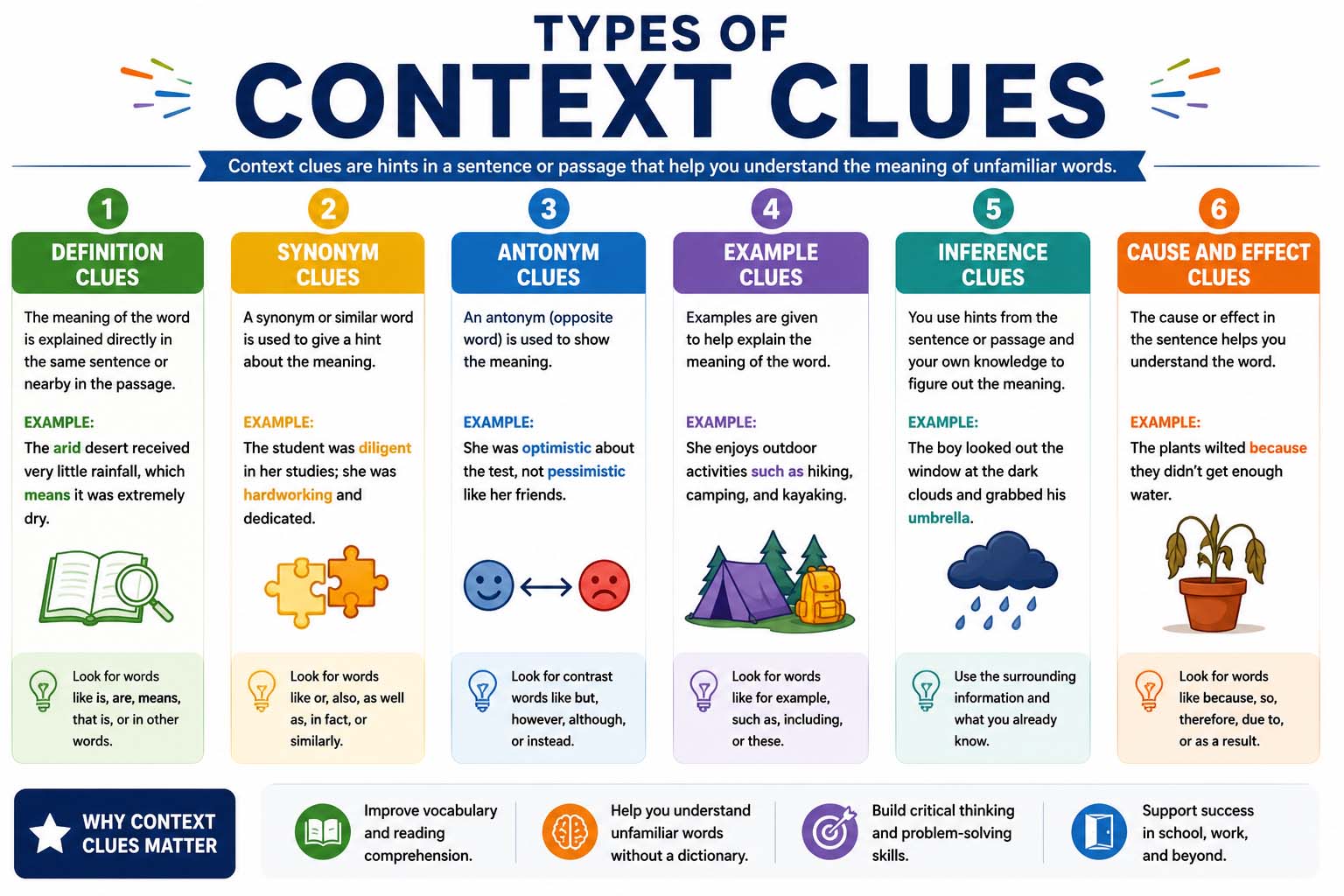
Have you ever met a word you did not know and still guessed its meaning without a dictionary? That is the power of the types of context clues. Writers often place hints before or after a hard word, so readers can work out its meaning from the text around it.
For example, a writer may define a word, give a synonym, show an opposite, list examples, or offer enough details to infer the meaning. As a result, learning these clues can improve reading, build vocabulary and boost confidence in every subject.
What Are the Types of Context Clues?
Context clues are hints in a sentence or paragraph that help you understand a new word. Instead of stopping to look up every word, you study the nearby words, examples and ideas, and then make a smart guess.
For instance, read this sentence: “The arid desert received almost no rain all year.” Even if you do not know “arid,” the words “desert” and “almost no rain” suggest that it means very dry.
Therefore, the types of context clues are the different ways a writer can hide a meaning inside a sentence. Word parts help too. If you want another tool for new words, learn what a root word is and use it together with context clues.
How Many Types of Context Clues Are There?
Students search for four, five, six, seven or even nine types of context clues. However, the number changes because teachers and books group the clues in different ways. For example, some lessons combine definition and explanation clues, while others split out comparison, cause-and-effect or punctuation clues.
This guide uses five common types of context clues:
- Definition or explanation
- Synonym
- Antonym or contrast
- Example
- Inference or general context
Therefore, if your teacher uses another number, do not assume one system is wrong. Instead, learn the categories your class requires, and keep the same core ideas in mind. Use this table for a quick look:
| Type | How it helps | Signal words |
|---|---|---|
| Definition | Explains the meaning directly | is, means, refers to, in other words |
| Synonym | Gives a word with a similar meaning | or, also called, that is |
| Antonym | Shows an opposite or contrasting idea | unlike, however, but, in contrast |
| Example | Lists examples that reveal the meaning | such as, including, for example |
| Inference | Needs you to combine nearby details | No signal word |
The 5 Types of Context Clues With Examples
Once you know the five patterns, new vocabulary gets much easier. Next, look at each type with a clear example.
Definition Clues
A definition clue gives the meaning right in the sentence. Writers often add it with a comma, dashes, or words such as “means” and “refers to.”
Example: A peninsula, a piece of land surrounded by water on three sides, extends into the ocean.
Even if you do not know “peninsula,” the phrase after the comma tells you. Therefore, definition clues are often the easiest to spot. Here is another case: “Nocturnal animals, meaning animals that are active mainly at night, often rest during the day.”
Synonym Clues
A synonym clue uses another word or phrase with a similar meaning. The word “or” often signals it.
Example: The child was elated, or extremely happy, after winning the competition.
Here, “extremely happy” explains “elated.” However, check the whole sentence, because synonyms rarely match perfectly in every situation. Here is another case: “The pathway was narrow, or very slender, between the two buildings.”
Antonym or Contrast Clues
Sometimes a writer shows what a word does not mean. Instead of defining the word, the sentence gives an opposite idea.
Example: Unlike his timid brother, Jake felt confident enough to speak in front of hundreds of people.
Because Jake is confident, you can infer that “timid” means shy or fearful. Look for signals such as “unlike,” “however,” “but,” “although” and “in contrast.” Similarly, in “While the first room was cramped, the second was spacious,” the word “spacious” shows that “cramped” means small or crowded.
Example Clues
An example clue lists items that belong to a category. Instead of a direct definition, the writer shows what fits.
Example: Celestial bodies, such as the sun, moon, stars and planets, fill the night sky.
Even if you do not know “celestial bodies,” the examples suggest objects in space. Signals include “such as,” “including,” “for example” and “for instance.” As a result, example clues work well for subject words in science and history.
Inference Clues
Inference clues are the hardest, because the writer never defines the word. Instead, you combine details from nearby sentences.
Example: After running several miles in the afternoon heat, Marcus was parched. He immediately drank two large glasses of water.
Running in the heat and drinking water quickly suggest that “parched” means very thirsty. Unlike a definition clue, no single phrase gives the meaning. Therefore, read the whole passage and connect the details.
4 Types of Context Clues vs. 6, 7 and 9 Types
Some classes teach four types of context clues: definition, synonym, antonym and example. Others fold inference into a wider group. In contrast, lists of six, seven or nine types often split the same ideas into smaller parts, such as restatement, comparison, cause and effect, or punctuation.
Because every list covers the same skills, you do not need to memorize several systems. Instead, follow the list your teacher or textbook uses, and focus on how each clue reveals meaning.
Context Clues Anchor Chart
Copy this chart into your notebook for a quick review before a quiz.
| Clue type | Ask yourself |
|---|---|
| Definition | Does the sentence explain the word directly? |
| Synonym | Is there another word with a similar meaning? |
| Antonym | Does the sentence show an opposite meaning? |
| Example | Does the writer give examples? |
| Inference | Which nearby details help me find the meaning? |
How to Use the Types of Context Clues While Reading
Finding clues gets easier when you follow the same steps each time.
- First, notice the word you do not know, and keep reading instead of stopping.
- Next, read the whole sentence, because clues can come before or after the word.
- Then look for signal words such as “or,” “unlike,” “such as” and “in other words.”
- Also, read the sentences before and after, since one sentence may not be enough.
- After that, make a smart guess about what the word means.
- Test your guess by putting it in place of the word. If the sentence still makes sense, your meaning is probably reasonable.
- Finally, check a dictionary when you need an exact meaning or when the clues stay unclear.
For longer passages, the main message can also help. For example, finding the central idea of a passage often gives extra hints about hard words. When you want to check a word, the Merriam-Webster dictionary is a reliable place to confirm your guess.
Practice With Context Clues in Sentences
Name the clue type before you read the answer.
Sentence: The habitat, or natural home of an organism, provides the resources it needs to survive.
Clue type: Definition. The phrase “natural home of an organism” explains “habitat.”
Sentence: The student was diligent, or hardworking, and finished every assignment on time.
Clue type: Synonym. The word “hardworking” matches “diligent.”
Sentence: Unlike the transparent glass, the wall was opaque.
Clue type: Antonym. The contrast with “transparent” shows that “opaque” means you cannot see through it.
Sentence: Marine mammals, such as whales, dolphins and seals, live in the ocean.
Clue type: Example. The animals listed show what “marine mammals” are.
Sentence: Sofia shivered, pulled her coat tightly around herself and hurried inside. The air outside was frigid.
Clue type: Inference. Shivering, a tight coat and hurrying inside suggest that “frigid” means very cold.
As a result, regular practice helps you spot clues without working through every step.
Common Mistakes With Types of Context Clues
- Looking at only one word instead of the whole sentence.
- Ignoring signal words such as “however” and “for example.”
- Choosing the first meaning that comes to mind, even though many words have more than one meaning.
- Assuming every sentence has a clear clue.
- Skipping hard words instead of trying to figure them out.
Therefore, always ask whether your guess fits the entire passage. If it does not, read further or use a dictionary.
Strong readers also notice how long sentences carry clues. For example, studying complex sentence examples shows how extra details inside a long sentence can reveal a word’s meaning.
Frequently Asked Questions
What are the 5 types of context clues?
The five common types are definition, synonym, antonym or contrast, example and inference clues.
What is an example of a context clue?
Take this sentence: “The puppy was famished, so it quickly ate all the food in its bowl.” Because the puppy ate quickly, “famished” must mean extremely hungry.
How many types of context clues are there?
There is no single number. First, five types give a useful base. However, some books teach four, and others teach six, seven or more.
Are context clues always enough to understand a word?
No. Sometimes the text does not give enough information for an exact meaning. Therefore, use a dictionary or another reliable source when the clues stay unclear.
Key Takeaways on Types of Context Clues
Learning the types of context clues is one of the most useful reading skills a student can build. Whether you read a novel, study for an exam or explore a new subject, these clues help you understand new words without stopping.
First, find the unknown word. Next, look for definitions, synonyms, contrasts, examples and nearby details. Then choose the meaning that fits the passage, and finally check the word if the clues are not enough. As a result, you will read with more confidence and understand harder texts.
Checks I ran