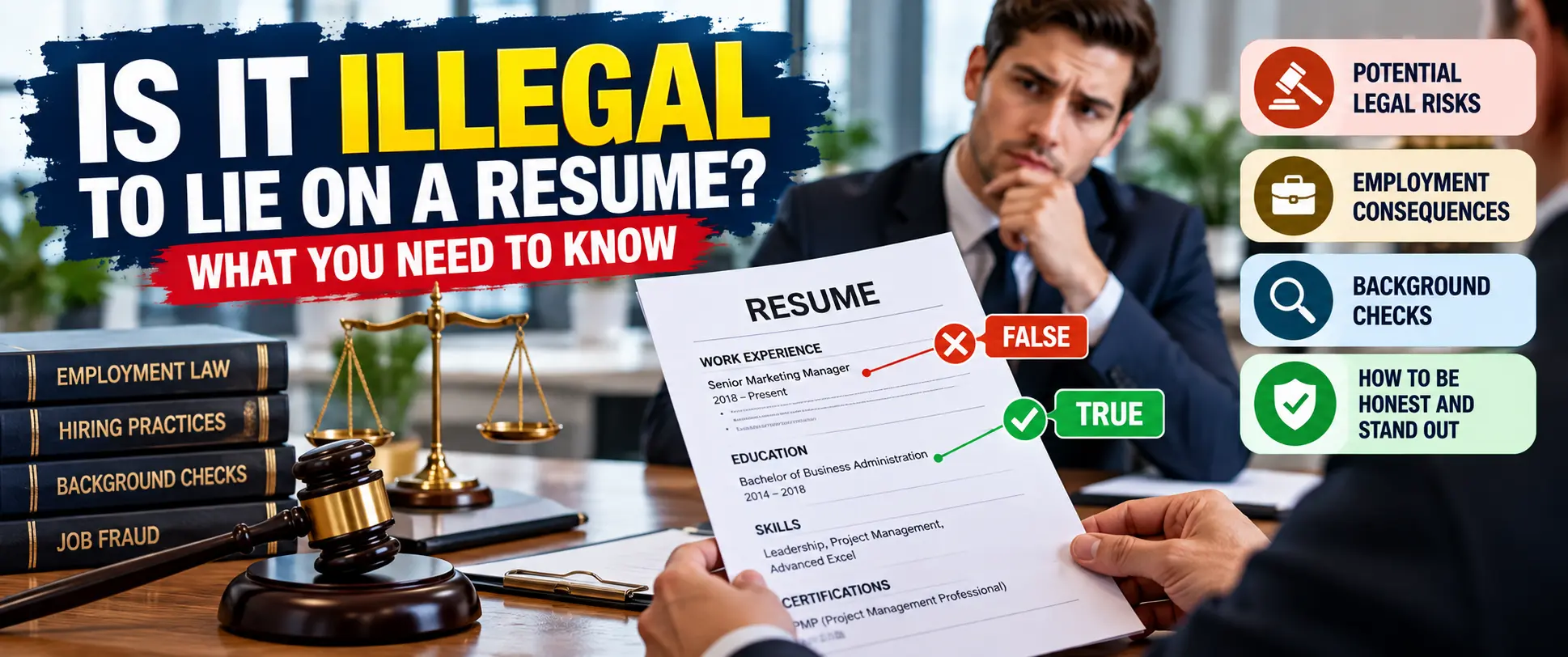
Is it illegal to lie on a resume? In the United States, there is no single rule that makes every inaccurate statement on an ordinary private-sector resume a crime. However, certain false statements can create legal problems depending on what was misrepresented, where the information was submitted, and whether fake documents, government applications, regulated credentials, or fraud are involved. Even when a lie does not lead to criminal liability, an employer may withdraw an offer or fire an employee after discovering it.
For students and recent graduates, the distinction matters. Making your responsibilities sound professional is different from inventing a degree, job, license, certification, or skill you never had.
So, instead of asking whether every resume exaggeration is illegal, it helps to understand what kind of information is being changed and how that information is used.
Is It Illegal to Lie on a Resume in the United States?
Usually, simply putting an inaccurate statement on a standard resume for a private employer is not automatically a criminal offense. Still, resume fraud can potentially create legal liability under fraud laws depending on the jurisdiction and circumstances. Cornell Law School’s Legal Information Institute notes that liability for “resume inflation” depends on jurisdiction and would most likely involve a fraud theory when legal liability exists.
The situation can become much more serious when a person submits false information to the federal government. Federal law prohibits knowingly and willfully making materially false statements in matters within the jurisdiction of the federal government.
Likewise, specialized rules may apply to immigration and employment-certification documents. For example, federal labor-certification regulations address false information and willful misrepresentation in applications and supporting documents.
Therefore, context matters.
A student exaggerating how often they answered phones during a summer job is not necessarily in the same legal situation as someone fabricating documents or knowingly providing materially false information on certain government forms.
What Counts as Lying on a Resume?
Resume dishonesty generally involves presenting false or misleading information to make yourself appear more qualified for a position.
Some examples are straightforward. For instance, claiming you graduated from a university you never attended is clearly different from shortening a lengthy job title while accurately describing the role.
Common resume misrepresentations can include:
- Inventing a college degree
- Listing employment that never happened
- Changing employment dates to hide a large gap
- Claiming certifications you never earned
- Inventing professional licenses
- Listing technical abilities you do not possess
- Significantly inflating job responsibilities
- Claiming awards or achievements you never received
Cornell describes resume inflation as including false or misleading information designed to make an applicant more attractive, such as listing degrees, awards, or positions the person never actually obtained or held.
Instead of inventing abilities, students can focus on legitimate skills to put on resume documents, including skills gained through coursework, volunteer work, internships, projects, and part-time employment.
Is It Illegal to Lie on a Resume About Education?
People often ask, is it illegal to lie on a resume about education? Again, the answer depends on what someone does and where they do it.
Simply writing an inaccurate education claim on an ordinary private-sector resume is not automatically a crime in every situation. However, fabricating documents to support the claim or making false statements in circumstances covered by specific laws can create legal consequences.
State laws can matter as well. For example, Cornell notes that Washington has a law criminalizing certain falsification of academic credentials. Consequently, a broad statement that lying about education is “always legal” would be inaccurate.
Degrees and Graduation Status
Suppose you completed three years of a four-year bachelor’s program but left before graduating.
Writing “Bachelor’s Degree” would falsely imply that you earned the degree.
Instead, you could accurately list the university, field of study, dates attended, and relevant coursework where appropriate. That approach communicates your educational experience without claiming a credential you did not receive.
Likewise, if you are currently enrolled, say so clearly. For example, you might list an expected graduation date rather than presenting the degree as already completed.
Employers may request education verification. In some situations, they might also ask for academic documentation. Understanding What Is a Transcript? can therefore help students know what information an official academic record may contain and how it differs from a resume.
Is It Illegal to Lie About Experience on a Resume?
Another frequent question is, is it illegal to lie about experience on a resume?
For an ordinary private-sector resume, an inaccurate description of experience does not automatically mean criminal prosecution. However, the legal situation can change when fraud, false official documents, government matters, regulated work, or other specific laws become involved.
The employment consequences are much more immediate.
Employers can compare resume information with references, employment records, interviews, and background checks. If the information does not match, the employer may question the applicant’s honesty. Indeed notes that employers may discover resume dishonesty through background checks and reference contacts, while discovery can lead to a withdrawn offer or termination.
Consider a student who worked as a marketing assistant.
It is reasonable to write that you “helped prepare social media content” if that accurately describes your work. However, claiming you “managed the company’s marketing department” when you never supervised anyone materially changes the nature of your experience.
The better approach is to strengthen the wording without changing the facts.
Exaggeration vs False Information
Not every strong resume phrase is dishonest.
A resume is a marketing document, so candidates naturally present their experience in a favorable way. Still, strong writing should remain accurate.
Consider these examples:
| Resume Statement | Better Assessment |
|---|---|
| “Helped customers with product questions” | Accurate if you performed the task |
| “Provided customer support and product guidance” | Stronger wording while potentially remaining accurate |
| “Managed 20 employees” when you managed none | False factual claim |
| “Bachelor’s degree” when you never graduated | False credential claim |
| “Familiar with Excel” after using it in coursework | Reasonable if you can demonstrate basic familiarity |
| “Advanced Excel expert” with no meaningful experience | Potentially misleading |
The key question is simple: Could you comfortably explain and support the statement if an interviewer asked for details?
If not, rewrite it.
How Illegal Is It to Lie on a Resume?
Asking how illegal is it to lie on a resume does not have one universal answer because the legal consequences depend on the circumstances and jurisdiction.
A false claim can move into more serious territory when it involves fake credentials, falsified documents, regulated licenses, fraudulent conduct, or materially false information submitted to government agencies.
For example, federal law can apply to knowingly and willfully false material statements within federal jurisdiction. Meanwhile, separate rules cover false information in particular immigration and employment-certification processes.
Therefore, students should not assume that a resume is a consequence-free document simply because it is not normally treated like a sworn legal statement.
The safest rule is easier: keep factual claims accurate.
What Can Happen If an Employer Discovers a Lie?
Legal consequences are only one risk. In many ordinary employment situations, professional consequences may arrive first.
Your Job Offer Could Be Withdrawn
Imagine that you receive an offer contingent on a background check.
If the employer verifies your education or work history and discovers a major discrepancy, it may reconsider the offer. Indeed notes that resume dishonesty discovered after an offer can result in the offer being rescinded.
That outcome can be especially frustrating because you may have already stopped applying elsewhere.
You Could Lose the Job Later
Getting through the hiring process does not guarantee that a false statement will remain undiscovered.
For instance, an employer might later verify a qualification while considering you for a promotion or assigning regulated work. If the employer discovers that a significant credential was fabricated, termination can be a possible consequence.
Your Professional Reputation Can Suffer
Early career relationships matter.
Supervisors, professors, internship coordinators, colleagues, and professional references can become part of your network for years. Therefore, a short-term attempt to look more qualified can create a long-term credibility problem.
Why Students May Feel Pressure to Exaggerate
A job advertisement may ask for two years of experience even though you have just graduated.
Meanwhile, another candidate may appear to have several internships, professional certifications, and a long list of technical skills.
That situation can make exaggeration tempting.
However, employers do not always expect entry-level applicants to have extensive professional histories. Academic projects, volunteer positions, student organizations, freelance projects, internships, part-time work, and relevant coursework can all demonstrate useful abilities.
For example, leading a university group project can demonstrate coordination and communication skills without pretending you held a management job.
The goal is to translate genuine experience into employer-friendly language.
What If You Already Sent a Resume With Incorrect Information?
First, determine whether the problem is a harmless mistake or a meaningful false statement.
A typo in an employment date is different from inventing a degree.
If you notice a genuine error before an interview, prepare a corrected resume. Then, depending on the significance of the error and stage of the hiring process, you may be able to provide the corrected version and briefly explain the mistake.
However, if the resume contains a deliberate and material falsehood, correcting it before the employer relies further on it is generally safer than building more statements around the original claim.
For a situation that could involve fraud, a government application, immigration documentation, a professional license, or another legal issue, consider getting advice from a qualified attorney in the relevant jurisdiction rather than relying on general online guidance.
How to Make Your Resume Strong Without Lying
You do not need fabricated credentials to create an effective resume.
Start by identifying what you have actually accomplished. Then, make those accomplishments specific.
Instead of writing:
“Worked at a campus bookstore.”
You could accurately write:
“Assisted customers with product questions, processed purchases, and organized inventory during busy campus periods.”
The second version sounds stronger because it explains what you did, not because it invents experience.
Numbers can also help when you genuinely know them. For example, “Tutored five students each week” communicates more information than “Helped students.”
Meanwhile, prepare for the interview as carefully as the resume. Learning unique interview questions to ask employer representatives can help you show curiosity and professionalism without exaggerating your background.
What About “Is It Illegal to Lie on a Resume Reddit” Advice?
Searching is it illegal to lie on a resume Reddit can produce personal stories and opinions, but those discussions should not be treated as legal authority.
One person’s experience may involve a different employer, profession, state, or type of false statement.
Therefore, use community discussions to understand people’s experiences, not to determine what the law permits.
For legal questions, statutes, government resources, reliable legal references, and qualified legal professionals are better sources.
FAQs
Can employers verify college degrees?
Yes. Employers may verify educational information during the hiring process, depending on their policies and applicable law. Therefore, applicants should accurately state whether a degree was completed, is still in progress, or was never awarded.
Can I change my job title on my resume?
You should avoid giving yourself a title that falsely represents your authority or responsibilities. However, if an internal title is unclear, you may be able to clarify your role with accurate descriptive wording. The description should still match what you actually did.
Is exaggerating a skill the same as lying?
It can become misleading when the exaggeration materially overstates your ability. For example, calling yourself fluent in a language when you know only basic phrases could quickly become obvious during an interview or on the job.
Should I include an unfinished degree?
You can include relevant unfinished education as long as the wording makes your status clear. Do not state or imply that you earned a degree that you did not complete.
Can lying on a resume get you fired?
Yes, an employer that discovers material resume dishonesty may terminate an employee, depending on the circumstances and applicable employment rules. Resume dishonesty can also lead to an offer being withdrawn before employment begins.
Build a Stronger Resume With Facts You Can Defend
The practical answer to is it illegal to lie on a resume is more nuanced than a simple yes or no. An ordinary resume lie is not automatically a crime in every U.S. situation, yet certain misrepresentations can trigger fraud laws or rules covering government matters, credentials, immigration documents, and other regulated situations. State law can matter too.
Even when criminal law is not involved, the career risks remain significant. A false claim can cost you an interview, an offer, a job, or professional trust.
Instead, describe genuine education and experience as clearly as possible. Use strong action verbs, quantify real achievements when you can, and be prepared to explain every major claim in an interview. An accurate resume that presents your real abilities well is far more useful than an impressive resume you cannot defend.