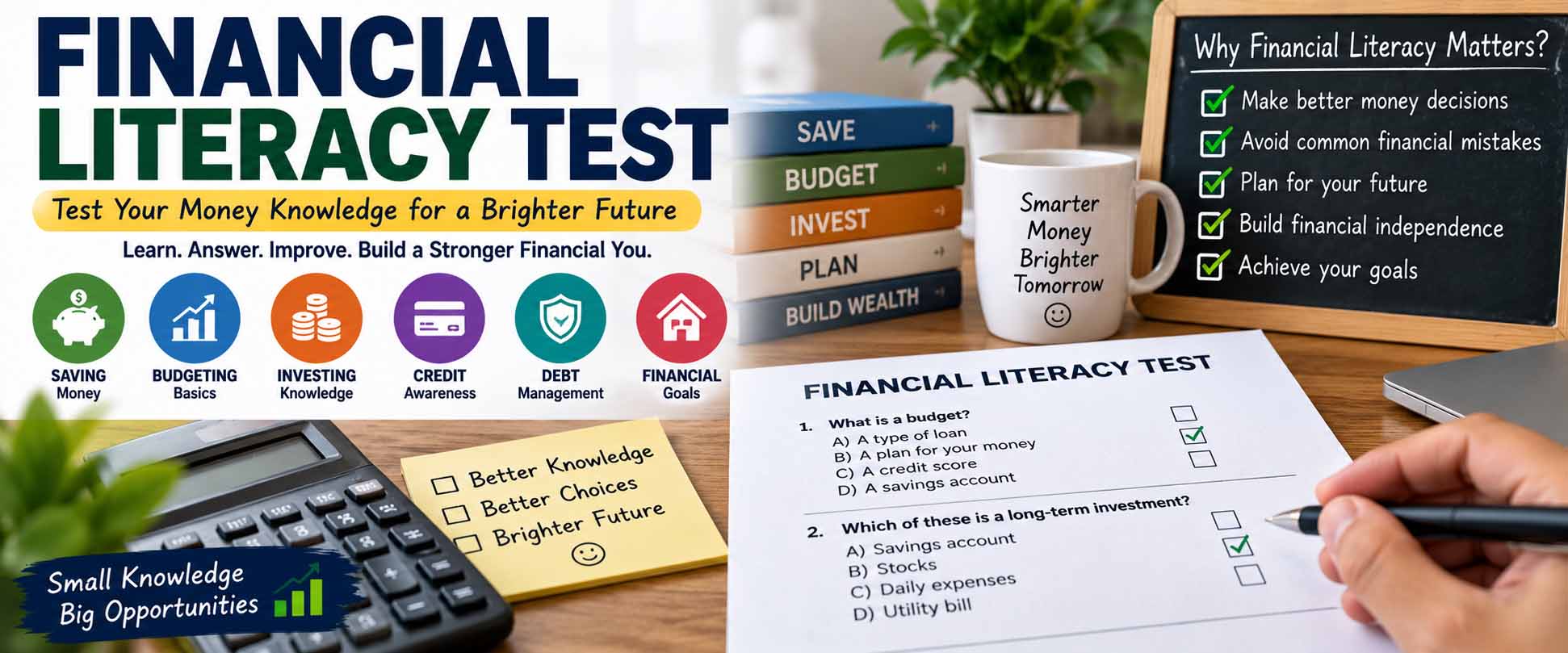
How well would you handle a question about budgeting, credit, interest, or saving for an emergency? A financial literacy test measures how well you understand everyday money concepts and whether you can apply them to realistic situations. Students may encounter these assessments in school, college, financial education programs, or personal finance courses. While the exact questions vary, most tests focus on practical skills such as budgeting, banking, borrowing, saving, investing, taxes, and understanding financial risk.
What Is a Financial Literacy Test?
A financial literacy test is an assessment designed to measure a person’s understanding of basic financial concepts.
Unlike a traditional math exam, it usually does not focus only on calculations. Instead, many questions ask you to make decisions based on real-life situations.
For example, you might need to determine which loan costs less, calculate simple interest, identify a good reason to build an emergency fund, or explain what happens when a credit card balance is not paid in full.
Therefore, financial literacy combines knowledge with decision-making skills.
The exact format varies by school, organization, course, or state requirement. Some tests use multiple-choice questions, while others may include scenarios, calculations, or short responses.
Financial education also increasingly involves online tools, calculators, banking apps, and digital learning platforms. For that reason, understanding what is computer literacy can support financial learning because students often need basic digital skills to access and evaluate financial information online.
What Does a Basic Financial Literacy Test Cover?
A basic financial literacy test usually covers the money concepts people are likely to encounter in everyday life.
Although individual assessments differ, several subjects appear frequently.
Budgeting and Money Management
Budgeting questions measure whether you understand how income and expenses work together.
For instance, imagine that a student earns $800 per month from part-time work. Their essential expenses total $550, while entertainment and other optional expenses total $150.
A test might ask how much remains for savings.
The calculation is simple:
$800 − $550 − $150 = $100
However, another question could ask which expense should be reduced if the student’s income suddenly falls.
Therefore, you need to understand the reasoning behind a budget rather than memorizing one formula.
Saving and Emergency Funds
Saving questions may cover short-term goals, emergency funds, and long-term financial planning.
For example, you could be asked why keeping some money readily accessible can be useful during an unexpected expense.
Similarly, a test may distinguish between saving for a purchase next month and investing toward a goal many years away.
The key is recognizing that different financial goals may require different approaches.
Banking
Banking questions commonly cover checking accounts, savings accounts, deposits, withdrawals, fees, and account balances.
You may also see questions about debit cards, electronic payments, overdrafts, or deposit insurance, depending on the course.
As a result, knowing basic banking vocabulary can make scenario-based questions much easier.
Financial Literacy Test Questions About Credit and Debt
Credit is another major area because borrowing decisions can affect someone’s finances for years.
Students should understand the basic relationship between the amount borrowed, interest rate, repayment period, fees, and total repayment cost.
For example, suppose two loans provide the same amount of money. One has a lower monthly payment but a much longer repayment period.
The lower monthly payment does not automatically make it cheaper. Instead, you need to compare the overall borrowing terms.
Credit-card questions may also ask about interest, minimum payments, credit limits, late fees, and balances.
Meanwhile, credit-score questions may examine behaviors that can influence a person’s credit history, such as payment history and amounts owed.
These questions are good opportunities to use Critical Thinking Exercises because financial decisions often require comparing several pieces of information instead of selecting the first option that appears attractive.
Understanding Interest, Inflation, and Purchasing Power
Interest questions can initially look intimidating, yet the basic ideas are straightforward.
When you save money in an interest-bearing account, interest may help the balance grow. In contrast, when you borrow money, interest generally increases the amount you repay.
Compounding is another common concept. With compound interest, interest can be calculated on both the original amount and previously accumulated interest, depending on the financial product and its terms.
Inflation focuses on purchasing power.
For example, suppose a product costs $10 today but costs $11 later while your income stays unchanged. Your money now buys less of that product.
Therefore, students should understand the concept rather than simply memorize a definition.
Broader economics lessons may also introduce topics such as supply side policies, although these are more relevant to economics courses than to most basic personal finance assessments.
Financial Literacy Test Questions About Saving and Investing
Saving and investing are related, but they are not identical.
Saving generally emphasizes preserving money for shorter-term needs or goals, while investing usually involves accepting some level of risk in pursuit of longer-term growth.
A financial literacy assessment may test terms such as:
- stocks
- bonds
- mutual funds
- diversification
- risk
- return
- retirement accounts
- compound growth
For example, a question might ask why spreading investments across different assets can reduce concentration risk.
The answer involves diversification. If all your money depends on one investment, poor performance in that single investment can have a greater effect on the overall portfolio.
However, financial literacy courses should not teach that an investment is guaranteed to increase in value. Investment returns can vary, and risk remains part of investing.
Income, Careers, Taxes, and Employment
Financial literacy is closely connected to employment because income affects almost every personal budget.
Students may need to distinguish between gross pay and take-home pay. Likewise, they may encounter deductions, taxes, employee benefits, or hourly versus salaried compensation.
Understanding employment conditions also provides useful context. For example, learning about the 4 types of unemployment can help students connect personal finance lessons with wider economic conditions and changes in the labor market.
Tax questions at the beginner level often focus on recognizing why deductions reduce the amount of a paycheck that reaches the worker.
Depending on the course, students may also learn about tax forms and filing basics.
However, tax rules can change. Therefore, when a test covers current tax requirements, students should rely on the course’s current materials rather than old study guides.
How to Prepare for a Financial Literacy Test
Studying for a financial literacy test works best when you understand concepts well enough to use them in unfamiliar situations.
Start by identifying the topics included in your specific course or assessment. Then, divide them into manageable groups.
A useful study checklist might look like this:
- Budgeting and expenses
- Saving and emergency funds
- Banking
- Credit and debt
- Interest
- Inflation
- Insurance basics
- Taxes
- Income and employment
- Investing
- Risk and diversification
- Consumer decision-making
Next, review vocabulary for each category.
However, do not stop at definitions. Create a practical example for each term.
For instance, instead of memorizing that “interest is a cost of borrowing,” compare two imaginary loans. Similarly, rather than simply defining a budget, create one using a fictional monthly income.
This approach turns passive reading into active learning.
Practice Financial Literacy Test Questions
Try these simple examples before checking the answers.
Question 1: Budgeting
A student earns $1,000 per month. Their monthly expenses total $750. How much remains before any additional spending?
A. $150
B. $200
C. $250
D. $350
Answer: C. $250
You subtract expenses from income:
$1,000 − $750 = $250.
Question 2: Interest
Which statement best describes interest on a loan?
A. Money automatically removed from the original purchase price
B. A cost associated with borrowing money
C. A guaranteed investment return
D. A type of monthly income
Answer: B. A cost associated with borrowing money
The exact cost depends on the loan’s terms, including its rate, balance, fees, and repayment structure.
Question 3: Diversification
Why might an investor diversify?
A. To guarantee a profit
B. To eliminate every financial risk
C. To reduce dependence on a single investment
D. To avoid learning about investments
Answer: C. To reduce dependence on a single investment
Diversification can spread exposure across investments, although it does not eliminate all risk.
Question 4: Needs and Wants
Which expense is generally considered a need rather than a want?
A. A second gaming subscription
B. Essential housing
C. Designer sneakers
D. Premium entertainment
Answer: B. Essential housing
Still, financial circumstances differ, so real-world budgeting can be more complicated than simple classroom categories.
Wise Financial Literacy Test
Students searching for a wise financial literacy test may be referring to financial literacy assessments or educational resources associated with a particular program.
Because program formats, course requirements, and assessment details can change, students should use the official materials supplied by their teacher, school, or program when preparing for a specific test.
However, the broader study strategy remains useful: understand budgeting, banking, saving, credit, debt, interest, investing, insurance, and consumer decisions rather than relying entirely on memorized answers.
If the test contains scenarios, read each one carefully before selecting an answer. Small details about interest rates, time periods, fees, or income can change the correct response.
TIAA Financial Literacy Test and Assessments
A search for a TIAA financial literacy test may lead learners toward financial education research, assessments, or resources connected with financial literacy.
However, students should distinguish between a general financial literacy assessment and a specific test required by their school or course.
A general assessment can help identify knowledge gaps. For instance, you may understand budgeting well but struggle with compound interest or investment risk.
Once you identify a weak area, focus your study time there.
Financial understanding can also support career preparation. Knowing Commercial Awareness Meaning, for example, can help learners see how financial knowledge connects with understanding businesses, markets, customers, and economic conditions.
Alabama Financial Literacy Test: Check Current Requirements
Students searching for an Alabama financial literacy test should check current information from their school, teacher, district, or relevant state education authority.
Education requirements can change over time, while course names and assessment procedures can vary between schools.
Therefore, avoid assuming that an unofficial practice quiz exactly matches a required assessment.
Instead, confirm what topics your course covers, whether a specific test is required, what format it uses, and which materials your teacher recommends.
Once you know the scope, you can prepare much more efficiently.
Common Mistakes Students Make
The first common mistake is memorizing definitions without understanding how to apply them.
Knowing what an interest rate is helps, but you should also understand why two loans with different rates or repayment periods can have different overall costs.
Another mistake is rushing through scenario questions. Financial questions often include numbers that are not all necessary for solving the problem.
Similarly, students sometimes confuse saving with investing or debit with credit.
Therefore, build a short vocabulary sheet that compares easily confused concepts side by side.
Finally, avoid memorizing answers from random online quizzes. Your actual assessment may ask the same concept in a completely different way.
Frequently Asked Questions
Is a financial literacy test difficult?
Difficulty depends on the assessment and your preparation. Most beginner tests focus on practical financial concepts, so understanding the ideas and practicing basic scenarios can make the questions more manageable.
What math is used in financial literacy?
Common skills include addition, subtraction, multiplication, division, percentages, and basic interest calculations. However, some courses may cover more advanced calculations.
What is a good financial literacy score?
There is no universal passing or “good” score for every financial literacy assessment. The scoring system depends on the specific test, course, school, or organization.
Can I improve my financial literacy without taking a class?
Yes. You can study budgeting, banking, credit, saving, investing, taxes, and consumer finance independently. Practice scenarios can also help you apply what you learn.
Why should students learn financial literacy?
Students eventually make decisions involving income, spending, banking, borrowing, and saving. Therefore, learning these concepts early can help them evaluate financial choices more carefully.
Turn Financial Knowledge Into a Practical Skill
A financial literacy test is most useful when it measures more than memorized vocabulary. Real financial literacy means understanding a concept well enough to use it when comparing a loan, planning a budget, reading a paycheck, evaluating risk, or deciding how to save.
Therefore, prepare by practicing realistic situations instead of simply rereading notes. Start with budgeting and banking, then move through credit, interest, investing, taxes, and employment. When you can explain why an answer makes sense in your own words, you are much better prepared to handle both the assessment and everyday financial decisions.