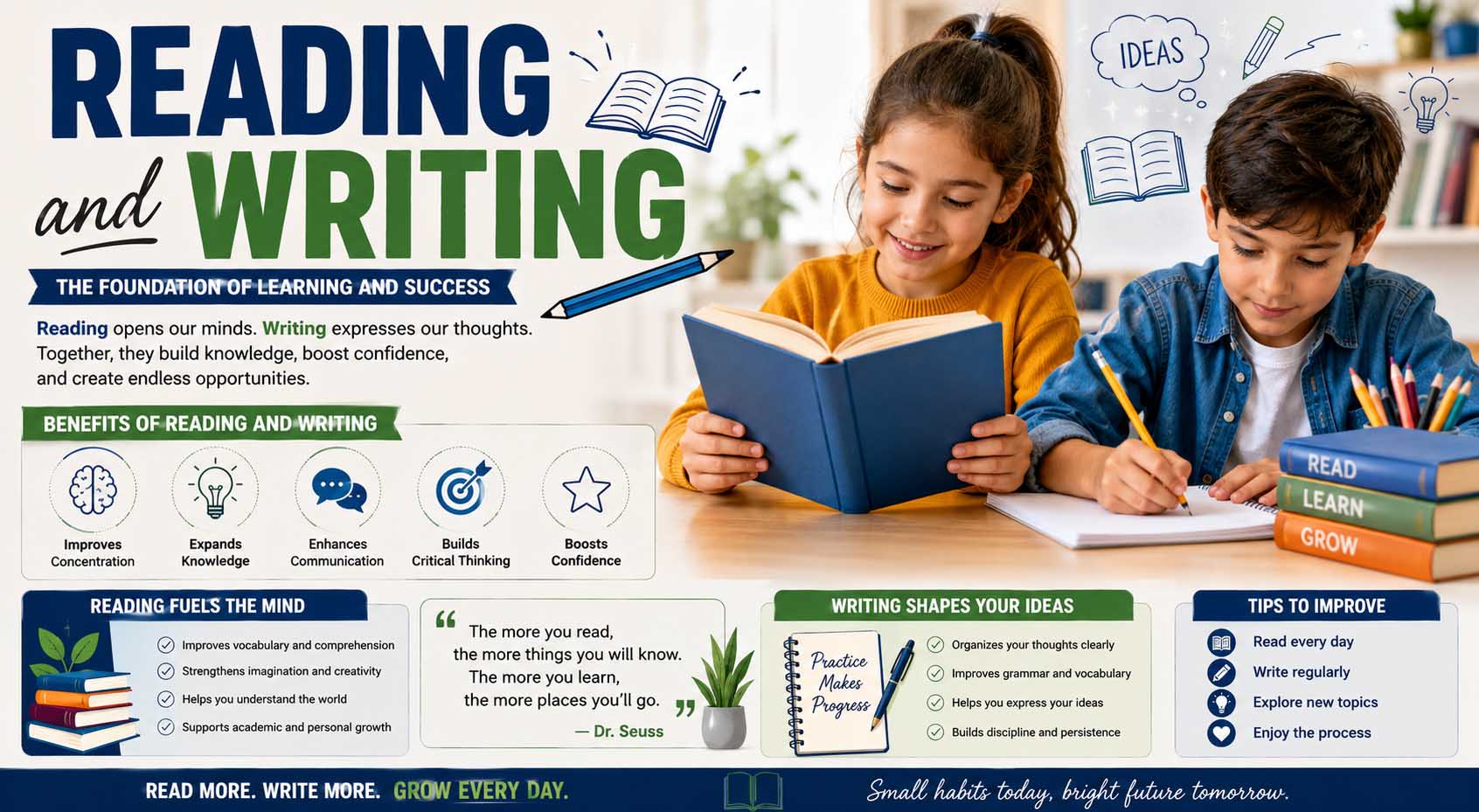
Reading and writing are closely connected skills that help people understand information, organize ideas, communicate clearly, and succeed in school and everyday life. Although students often practice them as separate subjects, becoming a stronger reader can improve writing, while regular writing practice can strengthen reading comprehension.
For students, these skills go far beyond finishing novels or writing essays. Reading helps them understand textbooks, instructions, websites, questions, and research. Meanwhile, writing helps students explain what they know, respond to questions, build arguments, and communicate their ideas.
The good news is that both skills can improve through consistent, focused practice. Instead of trying to become a “better reader” or “better writer” all at once, students can work on smaller abilities such as vocabulary, decoding, comprehension, sentence construction, organization, and revision.
What Are Reading and Writing Skills?
Reading involves making meaning from written language. At an early stage, learners recognize letters, connect them with sounds, blend those sounds into words, and develop fluency. Later, readers use vocabulary, background knowledge, reasoning, and comprehension strategies to understand increasingly complex texts.
The simple view of reading offers a useful way to understand this process because it highlights the relationship between recognizing written words and understanding language. As a result, a student may need support in different areas depending on where the difficulty occurs.
Writing works in the opposite direction in some ways. Instead of receiving ideas through text, a writer turns thoughts into written language. Therefore, effective writing involves choosing words, constructing sentences, organizing information, using appropriate grammar and punctuation, and revising ideas for clarity.
Together, these abilities form a large part of literacy.
Why Reading and Writing Work Better Together
Reading exposes students to language in action. For example, books, articles, and essays demonstrate how writers introduce topics, connect ideas, describe events, present evidence, and finish arguments.
Because of this exposure, frequent readers often develop a stronger sense of how written language sounds and works. However, simply reading large amounts of material does not automatically create excellent writing. Students still need deliberate writing practice.
Likewise, writing can make reading more active. When students summarize a chapter, annotate a passage, or explain an author’s argument, they must think carefully about what the text actually says.
Reading Builds Vocabulary and Language Knowledge
Every unfamiliar word is an opportunity to expand vocabulary. Sometimes readers need a dictionary, while at other times they can infer meaning from surrounding information.
Learning about types of context clues can therefore help students recognize definitions, examples, contrasts, synonyms, and other signals that reveal what an unfamiliar word probably means.
A wider vocabulary then supports writing. Instead of repeatedly relying on general words such as “good,” “bad,” or “thing,” students can choose language that expresses their meaning more precisely.
Writing Encourages Deeper Comprehension
Writing about a text requires more than remembering isolated facts. For instance, a student who explains why a character made a decision has to connect events, motivations, and evidence from the story.
Similarly, summarizing a science chapter requires students to identify its central information and leave out minor details. Consequently, writing becomes a practical comprehension exercise rather than simply a separate academic task.
Core Reading Skills Students Need
Strong reading depends on several abilities working together. While their importance changes as learners progress through school, the following skills remain valuable.
Word Recognition and Decoding
Beginning readers need to connect letters and letter combinations with spoken sounds. Decoding in reading refers to using knowledge of these relationships to identify written words.
As students gain experience, familiar words become quicker to recognize. Consequently, less mental effort goes into identifying individual words, leaving more attention available for understanding the text.
Older learners may still use decoding strategies when they encounter unfamiliar technical or academic vocabulary.
Fluency
Fluent readers recognize words accurately and read with suitable pacing and expression.
Fluency matters because reading that requires constant stopping and restarting can make comprehension harder. Therefore, regular practice with appropriately challenging material can gradually build smoother reading.
Comprehension
Comprehension means understanding and interpreting what has been read. Therefore, students should be able to identify main ideas, locate supporting details, make reasonable inferences, and explain relationships between ideas.
Strong readers also monitor their understanding. If a paragraph stops making sense, they may reread it, slow down, check an unfamiliar word, or review an earlier section.
Core Writing Skills Worth Practicing
Good writing starts with clear thinking rather than complicated vocabulary. A simple, well-organized explanation usually communicates more effectively than a paragraph filled with impressive words that do not quite fit.
Sentence Construction
Students should become comfortable writing simple, compound, and complex sentences. In particular, reviewing complex sentence examples can help learners understand how independent and dependent clauses work together.
Sentence variety also makes longer writing easier to read. Still, students should not make sentences complicated simply for variety. Clarity should remain the priority.
Organization
Readers need to follow the writer’s ideas without constantly guessing how one point connects to another. Therefore, organization matters at both paragraph and whole-text levels.
Writers may organize information by sequence, comparison, cause and effect, problem and solution, or description. Understanding types of text structure can help students recognize these patterns while reading and apply them when planning their own work.
Revision and Editing
Trying to correct every sentence while drafting can interrupt the flow of ideas.
Instead, students can first focus on getting their thoughts onto the page. Afterward, they can revise for meaning and organization before checking grammar, spelling, punctuation, and formatting.
A Practical Reading and Writing Study Routine
Improvement does not always require hours of study. Instead, a focused 30-minute routine can be effective when practiced consistently.
| Time | Activity | Main Skill |
|---|---|---|
| 10 minutes | Read an appropriate text | Fluency and comprehension |
| 5 minutes | Mark unfamiliar words or key ideas | Vocabulary |
| 5 minutes | Summarize what you read | Comprehension |
| 7 minutes | Write a short response | Writing and reasoning |
| 3 minutes | Review and edit | Grammar and clarity |
For example, a student might read a short history passage and then write three sentences explaining its main idea. Next, the student could support that explanation with one detail from the passage.
This routine connects reading directly with writing, so students practice understanding information and expressing it in their own words.
Reading and Writing Strategies for Different Grade Levels
The right practice depends partly on the learner’s current stage.
Elementary Students
Younger students usually benefit from phonics, vocabulary development, oral reading, short stories, and simple writing activities. At this stage, building confidence and accuracy matters more than producing long assignments.
For instance, after reading a short story, a child might write two sentences describing a favorite character. Later, that response can grow into a short paragraph.
Middle School Students
By middle school, students encounter more informational text across science, history, and other subjects. Therefore, reading strategies should include identifying main ideas, comparing sources, interpreting evidence, and learning subject-specific vocabulary.
Writing also becomes more structured. Students begin producing longer explanations, narratives, and arguments while learning to support claims with evidence.
Grade 11 and High School Learners
Common grade 11 reading and writing topics include literary analysis, argument development, research, source evaluation, rhetorical techniques, evidence, and academic vocabulary.
At this level, students should also learn to adjust their reading approach. A novel, scientific article, historical document, and persuasive essay each require somewhat different strategies.
SAT Reading and Writing Preparation
Students preparing for college entrance testing may also need focused practice with SAT reading and writing questions. The digital SAT combines these skills in its Reading and Writing section, where questions use relatively short passages or passage pairs.
Students may encounter questions involving information and ideas, craft and structure, expression of ideas, and standard English conventions. Therefore, preparation should involve more than simply reading quickly.
Instead, learners should practice identifying evidence, understanding vocabulary in context, recognizing logical relationships, improving sentence effectiveness, and applying grammar rules.
When researching the DSAT reading and writing domain distribution 2026, students should rely on current College Board SAT Reading and Writing information because test specifications and guidance can change. Using current official material also prevents study time from being wasted on outdated test formats.
When a Reading and Writing Tutor Can Help
Independent practice works well for many learners. However, a reading and writing tutor can be useful when a student repeatedly struggles with a specific skill or needs more structured feedback.
For example, one learner may understand stories well but have difficulty organizing essays. Another student may write clearly yet struggle to understand challenging passages.
A good tutor should identify the underlying difficulty rather than simply assign more worksheets. Ideally, tutoring should target specific skills and gradually help the learner become more independent.
Parents and students should also look for progress in practical abilities. Improved comprehension, clearer paragraphs, stronger vocabulary, and greater confidence are more meaningful than simply completing more exercises.
Common Habits That Slow Progress
One common mistake is choosing material that is far too difficult. Challenging texts can build skills, yet constantly stopping to decode unfamiliar vocabulary may make comprehension frustrating.
Another mistake is reading passively. Students can improve engagement by asking questions, predicting what comes next, highlighting key information selectively, and summarizing sections in their own words.
Likewise, some learners spend too much time editing sentences before completing a draft. Instead, separating drafting from revision usually makes writing more manageable.
Students should also avoid copying sentences from sources when taking notes. Paraphrasing information forces the brain to process meaning, which can support both comprehension and later recall.
How to Improve Reading and Writing Every Day
Consistency usually matters more than occasional long study sessions. Therefore, students can make progress by building literacy practice into ordinary routines.
Reading for 15 to 20 minutes each day is a practical starting point. The material can include novels, biographies, news articles, essays, or nonfiction related to personal interests.
Meanwhile, writing does not always need to mean completing an essay. Journaling, summarizing an article, reviewing a book, explaining a concept, or writing an email can all provide useful practice.
Students can also keep a vocabulary notebook. However, rather than recording definitions alone, they should write an original sentence for each new word. This approach connects vocabulary knowledge with actual language use.
Frequently Asked Questions About Reading and Writing
Why Are Reading and Writing Important?
They help people understand information and communicate ideas. In school, they support learning across nearly every subject, while outside the classroom they are useful for work, communication, decision-making, and everyday tasks.
Does Reading Improve Writing?
Yes, reading can expose learners to vocabulary, sentence patterns, organization, tone, and different writing styles. However, students still need regular writing practice and useful feedback to develop their own skills.
How Can a Struggling Reader Become Better at Writing?
First, identify the reading difficulty. For example, a learner may struggle with decoding, vocabulary, fluency, or comprehension. Then, combine targeted reading instruction with short writing activities based on material the student can understand.
How Much Should Students Read Each Day?
There is no single amount that suits everyone. Still, 15 to 30 minutes of focused daily reading can be a practical routine for many students. Younger learners or students who find reading difficult may benefit from shorter sessions.
Should Students Read Difficult Books to Improve?
Some challenge is useful, but material should not be so difficult that nearly every sentence becomes frustrating. Ideally, students should use a mix of comfortable reading and appropriately challenging texts.
Building Stronger Literacy One Skill at a Time
Reading and writing develop gradually, so students do not need to master everything at once. Instead, they can identify one skill that needs work, practice it regularly, and then build on that progress.
A student who struggles with comprehension might begin by summarizing one paragraph at a time. Meanwhile, someone who finds writing difficult could start with clear sentences before moving to organized paragraphs and longer assignments.
Above all, effective literacy practice connects the two skills. Read something meaningful, think about what it says, respond in your own words, and then improve that response. With consistent practice, this simple cycle can support stronger comprehension, clearer communication, and greater independence as a learner.