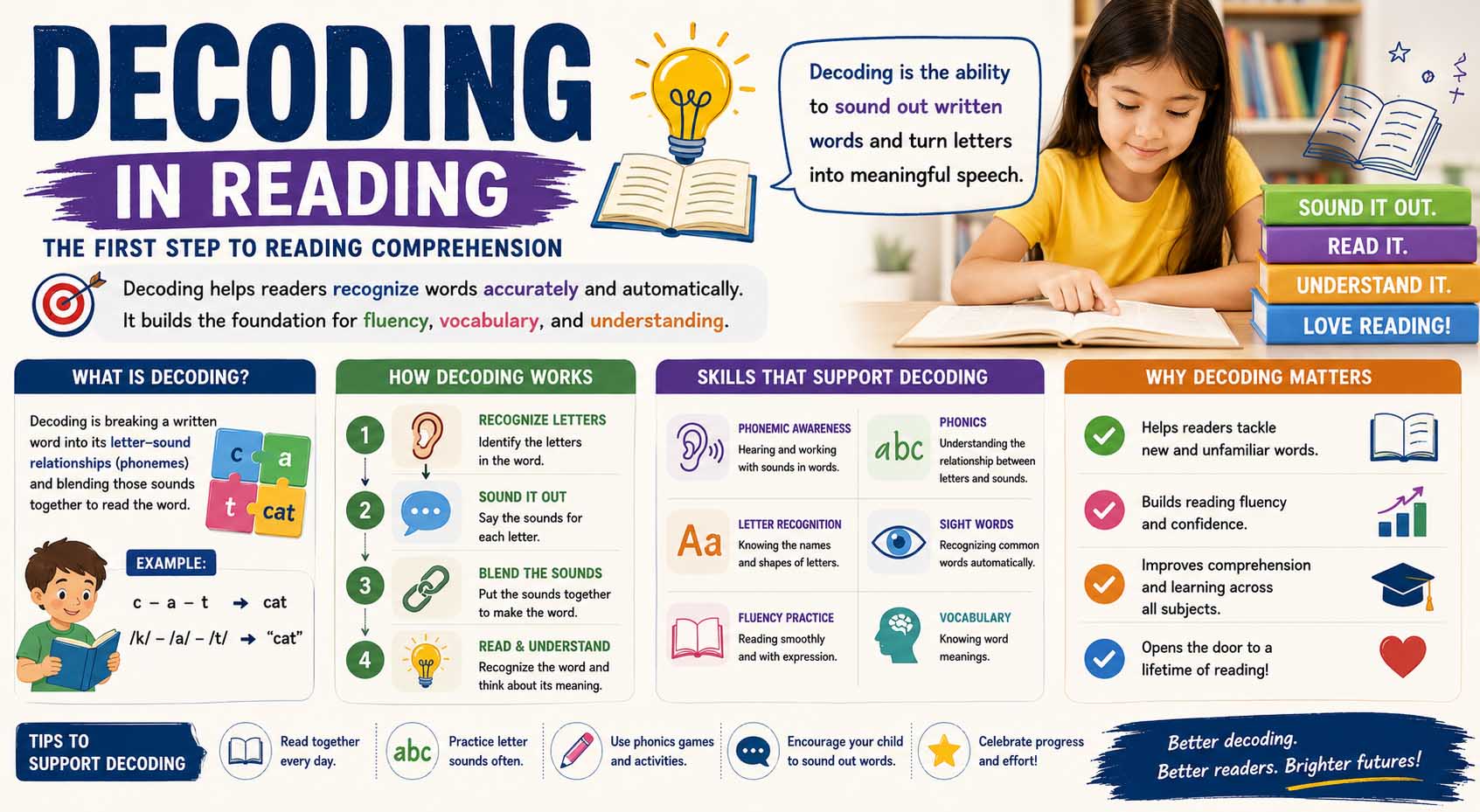
When a beginning reader sees the word “ship” and works out /sh/ /i/ /p/ before saying the whole word, they are using decoding in reading. Simply put, decoding is the process of looking at written letters and letter patterns, connecting them with sounds, and blending those sounds to recognize a word. Although skilled readers often do this almost instantly, beginners need instruction and plenty of practice before the process becomes automatic.
Decoding is one of the building blocks of learning to read. However, recognizing words is only part of successful reading. Students also need vocabulary, background knowledge, fluency, and language comprehension to understand what those words mean within sentences and longer texts.
What Is Decoding in Reading?
So, what is decoding in reading in everyday terms? It means translating printed words into spoken language by using knowledge of letters, sounds, spelling patterns, and word structures.
Suppose a student encounters the unfamiliar word “sunset.” The reader may recognize “sun” and “set” separately and then combine them. Likewise, a younger learner might decode “map” by identifying the sounds /m/, /a/, and /p/ before blending them into the complete word.
At first, this process can feel slow. However, as students repeatedly connect spelling patterns with sounds, many familiar words become automatic. As a result, they can spend less mental effort figuring out individual words and more effort understanding the text.
The distinction between phonics vs phonemic awareness also helps explain decoding. Phonemic awareness deals with hearing and manipulating individual sounds in spoken words, while phonics connects those sounds to written letters and patterns. Therefore, both skills can support successful word reading.
Why Decoding in Reading Matters for Students
Strong decoding gives learners a practical way to approach words they have never seen before. Instead of relying entirely on memory, pictures, or guesses, students can use the information contained within the written word.
For example, imagine a child knows the letter-sound relationships in “plant.” The learner can identify the sounds, blend them, and arrive at the spoken word. With repeated practice, recognizing “plant” becomes faster.
This growing automaticity matters because reading requires limited mental resources. When students spend too much effort identifying every word, following the meaning of a sentence becomes harder. In contrast, accurate and increasingly automatic word recognition can support smoother reading.
This relationship fits well with the simple view of reading, which describes reading comprehension as involving both word recognition and language comprehension. A learner may decode accurately yet struggle to understand unfamiliar vocabulary. Likewise, another student may understand spoken stories very well but have trouble reading printed words.
How Decoding in Reading Works Step by Step
Although experienced readers decode rapidly, beginners often move through several noticeable steps.
1. Look at the Letters and Word Patterns
First, the learner pays attention to the letters and their order. For instance, “cat” contains c, a, and t in a specific sequence.
2. Connect Letters With Sounds
Next, the reader retrieves the sounds associated with those letters or letter groups. Therefore, c may represent /k/, a may represent /a/, and t represents /t/ in this particular word.
English also contains common letter teams. For example, “sh” usually functions as a unit in words such as “shop” and “fish.”
3. Blend Sounds to Decode the Word
Then, the learner combines the individual sounds rather than leaving them separated. Consequently, /k/ /a/ /t/ becomes “cat.”
Teachers who want to develop this process systematically can benefit from understanding how to teach phonics, since explicit instruction can introduce sound-spelling relationships in a planned sequence.
4. Recognize the Complete Word
After blending the sounds, the student identifies the resulting word. If the word already exists in the learner’s spoken vocabulary, recognition may happen quickly.
5. Connect the Decoded Word to Meaning
Finally, the reader uses the word within the sentence. For example, reading “The cat slept on the rug” requires more than pronouncing “cat.” The learner also needs to understand the sentence as a whole.
Decoding in Reading Strategies and Examples
Students eventually need several decoding strategies because English words vary in structure and complexity.
| Strategy | Example | How It Helps |
|---|---|---|
| Sound blending | m-a-p → map | Combines phonemes into a word |
| Digraph recognition | sh in ship | Treats two letters as one sound pattern |
| Word families | light, night, sight | Builds recognition of recurring patterns |
| Syllable division | sun-set | Breaks longer words into manageable parts |
| Morphology | help + ful | Uses meaningful word parts |
| Context checking | “The dog began to ___.” | Helps confirm whether a decoded word makes sense |
Sounding out is especially useful for early readers. However, longer words often require chunking. Knowing the types of syllables can help students recognize familiar patterns within multisyllabic words rather than attempting to process every letter independently.
Word parts also become increasingly useful as reading develops. For instance, recognizing prefixes, suffixes, and roots can support both pronunciation and meaning. A learner who understands What Is a Root Word? can begin seeing connections among words such as “help,” “helpful,” and “helpless.”
Context still has a role, but it works best as a way to confirm a decoded word rather than replace attention to print. If a student encounters an unfamiliar word, looking carefully at its spelling should remain a central part of the process.
For more guidance on how children learn to identify written words, Reading Rockets’ decoding and word-recognition resources explain phonics, decoding, and related early reading skills.
What Is Decoding and Encoding in Reading?
The terms sound similar, yet they describe opposite processes. Decoding generally moves from print to speech: a reader sees written symbols and identifies the spoken word. Encoding moves from speech toward print: a learner hears or thinks of a word and works out how to spell it.
Consider the word “frog.”
While reading, a student sees f-r-o-g, connects the letters to sounds, blends those sounds, and says “frog.” That is decoding.
While spelling, the student hears “frog,” separates it into sounds, and chooses letters that represent those sounds. That is encoding.
Therefore, when people ask what is decoding and encoding in reading, the simplest distinction is that decoding supports reading written words, while encoding supports representing spoken words in writing.
Encoding vs Decoding in Reading
Although the two skills have different directions, they reinforce each other. Students learn that sounds and written symbols have systematic relationships, and they can apply that knowledge during both reading and spelling.
For example:
Decoding: “stamp” → /s/ /t/ /a/ /m/ /p/ → spoken word
Encoding: spoken “stamp” → identify sounds → write s-t-a-m-p
Because these processes are closely connected, reading and spelling instruction can support each other. For instance, after students learn a new phonics pattern, they can read words containing that pattern and then practice spelling similar words.
When comparing decoding vs encoding in reading, remember that neither skill replaces comprehension. A child might pronounce a word correctly without understanding it. Therefore, vocabulary and discussion still matter alongside word-reading practice.
Signs a Student May Need More Decoding Practice
Every learner develops at a different pace. Still, certain patterns can suggest that a student would benefit from more targeted practice.
For instance, the learner may frequently guess words based on their first letter, skip unfamiliar words, or struggle to blend simple sounds. Likewise, reading may remain unusually slow because the student has to work through the same familiar words repeatedly.
Other signs may include difficulty reading unfamiliar but decodable words, inconsistent recognition of common spelling patterns, or trouble breaking longer words into smaller units.
However, one mistake does not indicate a reading problem. Fatigue, unfamiliar vocabulary, text difficulty, attention, and limited background knowledge can all affect performance. Therefore, teachers and parents should look for persistent patterns rather than judging ability from a single reading session.
If difficulties continue despite appropriate instruction and practice, a qualified teacher, reading specialist, or other educational professional can help identify where the learner needs support.
Practical Ways to Strengthen Decoding in Reading
Effective practice does not need to feel like endless drilling. Instead, short, focused activities can help learners connect sounds and print while still enjoying reading.
Practice Sound Blending
Give the learner a sequence such as /s/ /i/ /t/ and ask them to blend it into “sit.” Initially, the sounds can be stretched slightly. Then, as the learner improves, blending can become quicker.
Practice Common Letter Patterns
Once basic letter-sound relationships are secure, introduce common patterns such as sh, ch, th, ai, and ee in an appropriate instructional sequence.
For younger students, phonics for kindergarten activities can use letter tiles, sound cards, simple word-building games, and short decodable texts to make this practice more engaging.
Build and Change Words
Magnetic letters or letter cards let students change one part of a word at a time. For example:
cat → hat → hot → hop
This activity helps learners notice that changing one letter can change both the sound and meaning of a word.
Decode Longer Words in Smaller Parts
After simple words become manageable, students can practice breaking longer words into syllables and meaningful parts. For example, “sunflower” can be approached as “sun” + “flow” + “er.”
However, the difficulty should increase gradually. If nearly every word feels overwhelming, students may spend more time struggling than learning.
Classroom and Home Reading Tips
Consistency usually matters more than one very long practice session. Therefore, teachers and families can use brief reading activities regularly.
At home, an adult might ask a child to look closely at an unfamiliar word and identify a familiar spelling pattern. After the child decodes it, the adult can reread the complete sentence so the meaning stays central.
Meanwhile, teachers can combine explicit instruction with connected reading. Students might first practice a spelling pattern in individual words and then encounter that same pattern in sentences or a decodable passage.
Feedback should also be specific. Instead of simply saying “wrong,” an adult might say, “Look at the vowel in the middle,” or “Try blending those sounds again.” As a result, the learner receives information that can improve the next attempt.
Common Mistakes That Can Slow Reading Progress
One common mistake is encouraging students to guess primarily from pictures or surrounding context. Pictures can support comprehension, but they do not teach learners how written words represent spoken language.
Another problem is moving too quickly. If a child has not developed secure knowledge of basic sound-spelling relationships, introducing complex multisyllabic words may create unnecessary frustration.
At the same time, decoding practice should not become the entire reading experience. Students also need stories, conversation, vocabulary development, knowledge-building texts, and opportunities to enjoy books.
Finally, avoid expecting instant speed. Accuracy often develops before fluency. With repeated successful reading, word recognition can become faster and require less conscious effort.
Frequently Asked Questions About Decoding in Reading
Is Decoding the Same as Phonics?
No. Phonics is instruction about relationships between sounds and written letters or spelling patterns. Decoding is the act of applying that knowledge to read words.
Is Decoding Only for Beginning Readers?
No. Although beginners use decoding very visibly, older students and adults may also use it when encountering unfamiliar names, technical vocabulary, or complex words.
Can a Child Decode Well but Still Struggle With Comprehension?
Yes. Reading comprehension also depends on vocabulary, language comprehension, background knowledge, attention to meaning, and other skills. Therefore, accurate word reading alone does not guarantee strong comprehension.
Should Students Memorize Words Instead of Decoding Them?
Students eventually recognize many words automatically. However, building knowledge of sound-spelling patterns gives them a more flexible way to approach unfamiliar words instead of depending only on memorization.
How Long Does It Take to Develop Strong Decoding Skills?
There is no single timeline because students begin with different experiences and learn at different rates. Still, systematic instruction, regular practice, suitable reading material, and useful feedback can support steady progress.
Helping Decoding Become More Automatic
The long-term goal of decoding instruction is not to make students labor through every word forever. Instead, repeated accurate reading helps familiar words and spelling patterns become easier to recognize, which can free attention for comprehension.
For that reason, combine explicit word-reading instruction with meaningful reading. Let students practice new patterns, read them in connected text, discuss what they have read, and revisit difficult words when necessary.
Above all, treat decoding as one part of becoming a capable reader. When learners can identify printed words accurately while also building vocabulary, fluency, and comprehension, reading becomes less about figuring out individual symbols and more about understanding ideas, stories, and information.