Teaching a child to read can feel complicated until you break the process into manageable skills. If you’re wondering how to teach phonics, start by helping children hear individual sounds in spoken words, connect those sounds with letters, and then blend the sounds to read simple words. From there, instruction can gradually move toward common letter combinations, more complex words, spelling patterns, and connected text.
Phonics works best when teaching is explicit and systematic rather than random. Instead of introducing unrelated spelling patterns whenever they appear, teachers and parents can follow a planned sequence and give children enough practice before moving forward.
What Is Phonics and Why Does It Matter?
Phonics teaches the relationship between written letters or groups of letters and the sounds they represent.
For example, a learner may discover that the letter m commonly represents /m/. Later, the child learns that two letters can work together to represent one sound, as in sh in “ship.”
The real goal is not simply memorizing letter sounds. Instead, children learn to use those relationships to read unfamiliar words.
Suppose a learner sees map. If the child knows the sounds represented by m, a, and p, they can blend:
/m/ /ă/ /p/ → map
As children practice this process, decoding becomes faster and increasingly automatic.
Understand Phonics vs Phonemic Awareness First
Before planning lessons, teachers and parents should understand phonics vs phonemic awareness because these skills are closely connected but not identical.
Phonemic awareness involves hearing and manipulating individual sounds, or phonemes, in spoken words. It does not require written letters.
For instance, asking a child to identify the first sound in “dog” is a phonemic awareness activity.
Phonics, on the other hand, connects those sounds to print. Once the child identifies /d/, you can show how the letter d represents that sound in the written word “dog.”
Therefore, children benefit from opportunities to work with spoken sounds alongside explicit instruction connecting those sounds to letters.
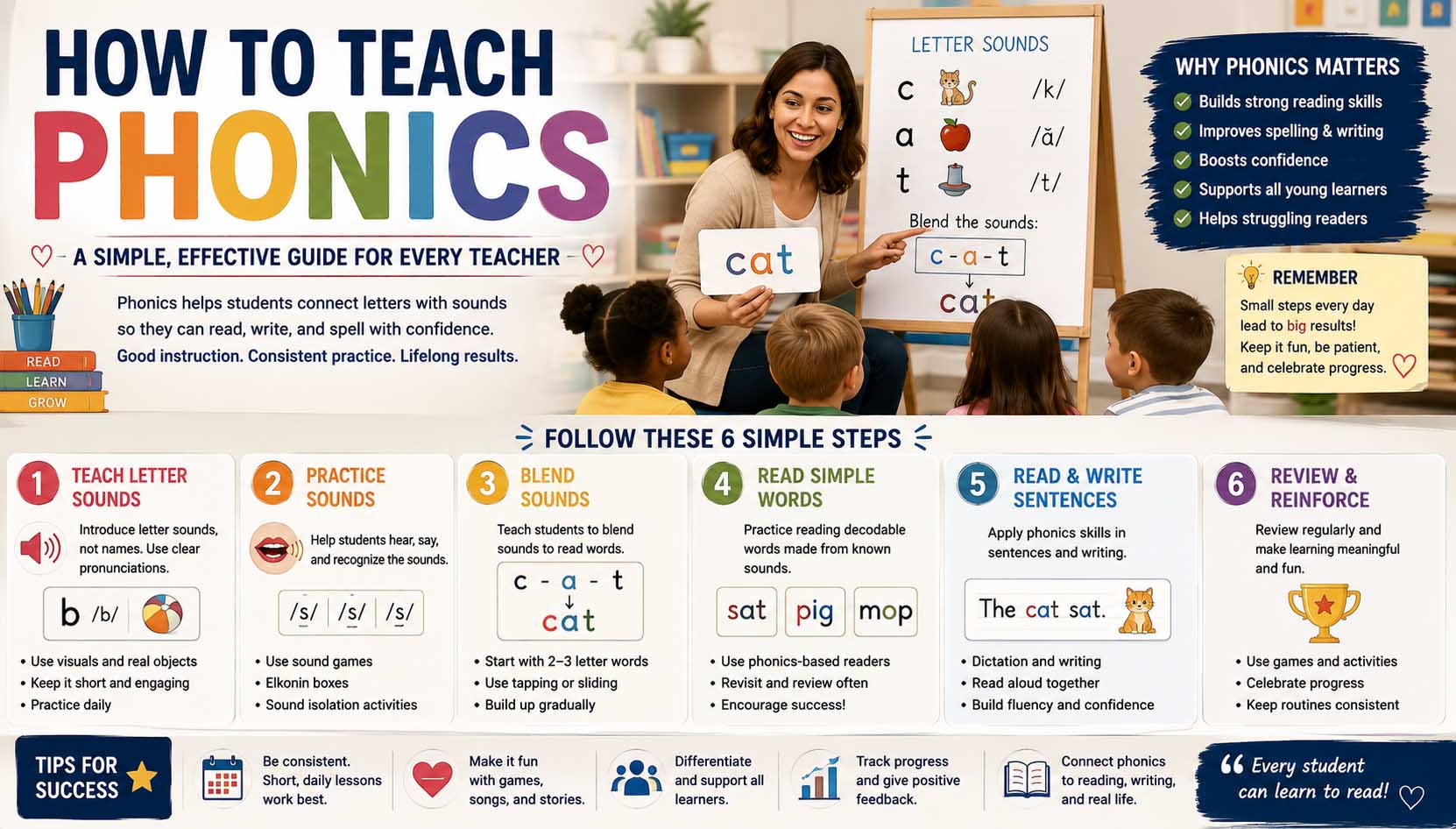
How to Teach Phonics Step by Step
Parents and new teachers often want to know how to teach phonics step by step without overwhelming a beginning reader.
Although instructional sequences can differ, the following progression provides a practical framework.
Step 1: Build Awareness of Spoken Sounds
Before asking children to decode printed words, give them opportunities to notice sounds in speech.
You can ask:
“What sound do you hear at the beginning of sun?”
“What is the last sound in map?”
“Can you blend /m/ /ă/ /p/?”
Simple oral activities help children pay attention to the sound structure of words.
However, phonemic awareness should connect to print as children begin learning letter-sound relationships. The two skills can support each other.
Step 2: Teach Letter-Sound Relationships
Next, explicitly teach children that written letters represent sounds.
Show a letter, say the sound clearly, and give examples.
For instance:
m → /m/ → map, moon, milk
Then ask the learner to say the sound and identify words containing it.
Avoid introducing too many new correspondences at once. Instead, teach a manageable set and review it frequently.
Also, choose an instructional sequence that allows children to begin building words fairly early.
Step 3: Teach Children to Blend
Once learners know several letter-sound relationships, show them how to blend those sounds into words.
Write:
s a t
Point to each letter and model the sounds:
/s/ /ă/ /t/
Then blend them:
sat
At first, children may separate the sounds with long pauses. Therefore, model smooth blending and gradually reduce the pauses between sounds.
This stage is essential because knowing isolated sounds does not automatically mean a child knows how to combine them into words.
Step 4: Practice Segmenting and Spelling
Reading and spelling can strengthen each other.
Say the word “map” and ask the learner to stretch it slowly.
Then identify:
/m/ /ă/ /p/
Next, ask the child to select letters that represent those sounds.
Magnetic letters, letter tiles, mini whiteboards, or pencil and paper all work well.
Because the child must listen carefully to every sound, spelling practice can reinforce the same alphabetic relationships used during reading.
Step 5: Move Into Connected Text
After children practice words containing familiar patterns, give them opportunities to encounter those words in sentences and short books.
For example:
Sam sat.
The cat is on the mat.
Appropriately chosen decodable texts allow learners to practice the letter-sound relationships they have already been taught.
At the same time, adults should continue reading richer books aloud. Read-alouds expose children to vocabulary, ideas, story structures, and language that may be well beyond what they can currently decode independently.
How to Teach Phonics to Kids Without Making It Boring
Knowing how to teach phonics to kids also means understanding that young learners need active practice.
Instead of spending an entire lesson repeating flashcards, mix direct teaching with short activities.
For example, place magnetic letters on a table and ask the child to build “cat.” Then change one letter:
cat → hat → hot → hop
This word-chain activity helps children notice that changing one grapheme changes the word.
Another option is a sound hunt. Choose /s/, for instance, and ask children to find objects whose names start with that sound.
Children might identify a sock, spoon, sticker, or sandwich.
However, keep the learning target clear. A phonics game should provide meaningful practice with a skill rather than simply entertain children.
A Simple Daily Phonics Lesson
Consistency can make phonics easier to teach.
A short lesson might follow this pattern:
| Lesson Part | Example Activity |
|---|---|
| Review | Practice previously taught letter sounds |
| Phonemic awareness | Blend or segment spoken words |
| New teaching | Introduce one letter-sound relationship or pattern |
| Word reading | Blend words using known patterns |
| Spelling | Segment and build or write words |
| Connected reading | Read a short decodable sentence or text |
| Quick review | Revisit the day’s target |
The exact length depends on the learner’s age, attention, and instructional setting.
However, a focused 15-minute home session can often be more productive than a long lesson that leaves a young child frustrated.
When to Teach Digraphs and More Complex Patterns
Once children can reliably blend simple words, instruction can gradually introduce more complex spelling patterns.
Common early examples include:
sh as in ship
ch as in chat
th as in thin
ck as in duck
Later, learners can work with vowel teams, r-controlled vowels, silent-e patterns, and other common spelling conventions.
Children will also begin noticing how words divide into spoken and written chunks. Understanding different types of syllables can become useful as learners move from simple one-syllable words toward more complex multisyllabic reading.
However, do not rush ahead simply because a pattern seems easy to an adult. Make sure the child has enough practice with earlier skills to use them accurately.
How to Teach Children to Read Using Phonics
If you’re learning how to teach children to read using phonics, remember that phonics is a means to an end.
The goal is reading words accurately and understanding meaningful text.
When a child reaches an unfamiliar decodable word, encourage them to look through the word at the letters and apply the sound-spelling relationships they know.
For example, rather than immediately telling them “fish,” help them identify:
f – i – sh
Then blend:
/f/ /ĭ/ /sh/ → fish
This approach gives children a reusable decoding strategy.
However, once the word has been read, return attention to meaning. Ask what happened in the sentence or story so reading never becomes only a pronunciation exercise.
How to Teach Phonics at Home
Parents wondering how to teach phonics at home do not need expensive programs or classroom equipment.
Instead, short daily practice can fit naturally into family routines.
Likewise, ask children to find a target letter on packaging, signs, or labels.
During reading time, choose books that match the child’s decoding ability for independent practice. Then, separately, read more advanced stories aloud so the child continues developing vocabulary and comprehension.
You can also make simple letter cards at home.
For example, show m, ask for the sound, and then build mat using two more cards.
Five or ten minutes of focused practice can be enough for many young learners at home, especially when it happens consistently.
Teaching Longer Words
As children become stronger readers, phonics instruction expands beyond CVC words and common digraphs.
Learners begin working with longer words, prefixes, suffixes, syllable patterns, and meaningful word parts.
For instance:
jump + ing = jumping
help + ful = helpful
At this stage, morphology becomes increasingly useful alongside phonics. If a learner asks What Is a Root Word?, understanding roots and related word parts can help them recognize connections among words and support both decoding and vocabulary growth.
This transition helps children move from basic phonics toward increasingly sophisticated word analysis.
Common Mistakes When Teaching Phonics
One frequent mistake is teaching letter names without spending enough time on the sounds those letters represent.
Letter names matter, but children also need quick access to sound-spelling relationships when decoding.
Another mistake is introducing many patterns but providing little review. Children need repeated opportunities to retrieve and apply what they have learned.
Also, avoid encouraging children to guess a word primarily from the picture. Pictures can support comprehension, but they should not replace attention to the printed word.
Likewise, do not ask children to memorize every unfamiliar word as a visual shape. Although some words contain less predictable spelling elements, much of English spelling can be taught through recurring sound-spelling and morphological patterns.
Finally, do not turn every mistake into a stressful event. Correct errors calmly, model the strategy, and let the learner try again.
How to Know When a Child Is Ready to Move Forward
Watch what the learner can do independently rather than relying only on how long you have taught a skill.
A child may be ready for the next step when they can quickly recall taught letter-sound relationships, blend simple words accurately, segment words for spelling, and apply familiar patterns while reading.
However, previously learned skills still need review.
A learner who starts digraphs should continue practicing simpler words. Likewise, someone beginning multisyllabic words still benefits from reviewing foundational patterns when needed.
This cumulative approach helps prevent earlier knowledge from fading as new skills are introduced.
Frequently Asked Questions
What is the best order for teaching phonics?
A useful sequence starts with foundational phonemic awareness and common letter-sound relationships. Then, children learn blending, segmenting, simple word reading, digraphs, common vowel patterns, and increasingly complex words. However, specific evidence-based programs may organize the sequence somewhat differently.
Should you teach uppercase or lowercase letters first?
Children should eventually recognize both. However, lowercase letters deserve plenty of early attention because they appear frequently in ordinary books and sentences.
How often should children practice phonics?
Regular practice is generally more useful than occasional long sessions. In school, phonics can be taught systematically each day, while home practice can be brief and focused.
What should I do if a child cannot blend sounds?
Model blending slowly and use words containing sound-spelling relationships the child already knows. Continuous sounds such as /m/, /s/, and /f/ can also make early blending easier to demonstrate. If difficulty persists despite appropriate instruction, the child’s teacher or reading specialist can help identify the specific support needed.
Are phonics games enough to teach reading?
No. Games provide useful practice, but learners also need explicit instruction, planned progression, spelling practice, and opportunities to apply phonics while reading connected text.
Helping Children Become Independent Readers
Learning how to teach phonics becomes much simpler when you focus on progression rather than trying to teach everything at once. Start with spoken sounds and letter-sound relationships, then explicitly teach blending and segmenting before moving toward more complex spelling patterns and longer words.
Meanwhile, give children frequent opportunities to use those skills in actual reading and writing. Review older material as you introduce new patterns, and keep practice manageable enough that learners can experience success.
Most of all, remember that phonics is not the final goal. It is a powerful tool that helps children recognize written words accurately and increasingly automatically. As decoding becomes easier, children can devote more attention to vocabulary, comprehension, knowledge, and the enjoyment that makes reading worth learning.