
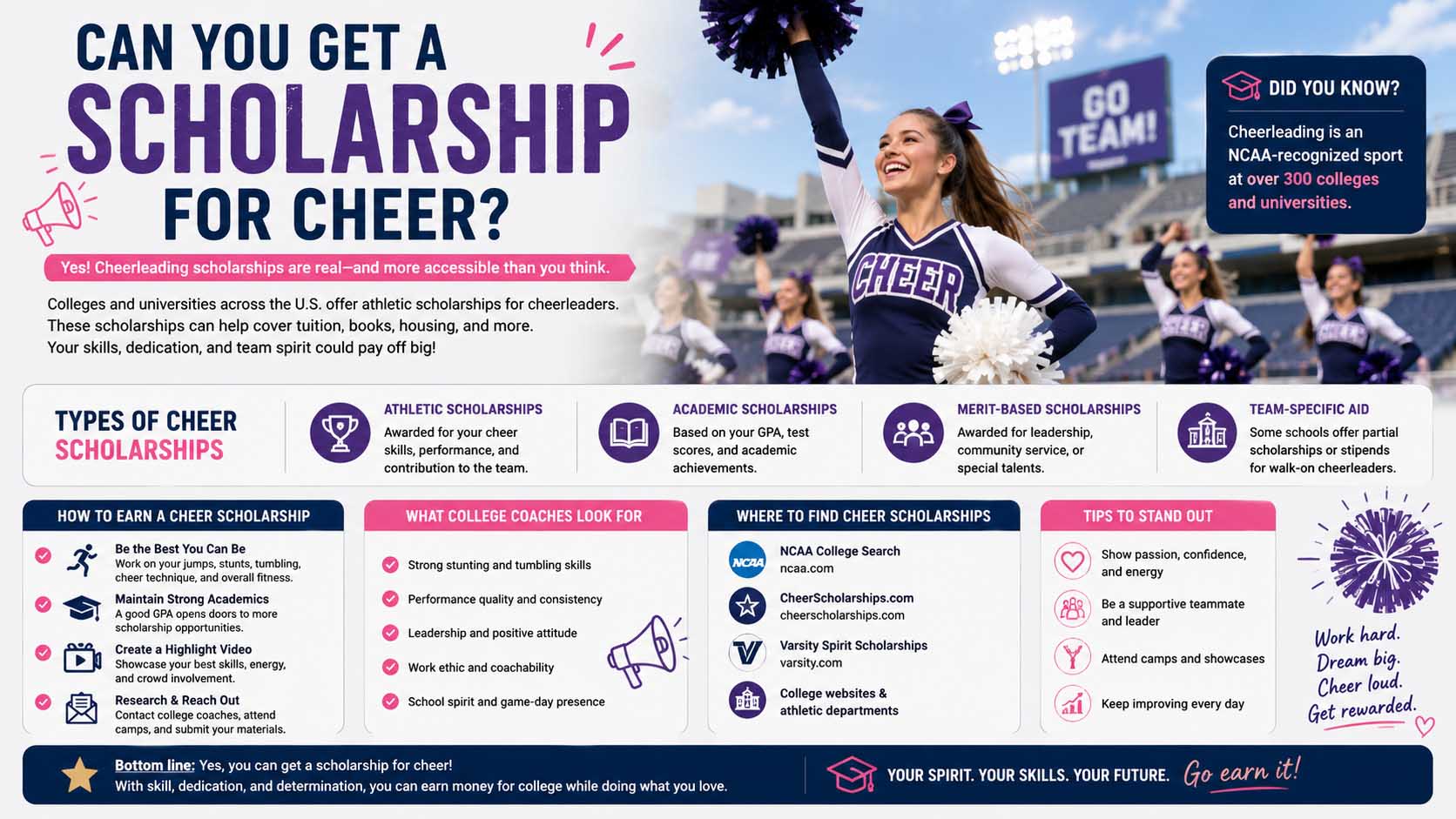
If cheerleading is a major part of your high school experience, you may be asking, can you get a scholarship for cheer when you go to college? Yes, some colleges and universities provide financial support to cheerleaders, but the opportunities work differently from scholarships in many NCAA-sponsored sports. Depending on the school, support may come through institutional cheer awards, athletic-department funding, booster organizations, academic scholarships, need-based aid, or other financial assistance. Because every program sets its own policies, students should research individual colleges instead of assuming every cheer team offers the same scholarship package.
Your cheer skills certainly matter. However, academics, tryout performance, team needs, leadership, and the specific college’s funding can matter just as much. Therefore, students who start researching early usually have more options to consider.
Can You Get a Scholarship for Cheer in College?
Yes, you can potentially receive scholarship money or other financial support for participating in college cheerleading. However, there is no single nationwide scholarship system that guarantees awards based on cheer ability.
College cheer programs vary widely. For example, one university might provide substantial institutional awards to selected team members, while another may offer smaller stipends or no cheer-specific scholarship at all.
Some schools also provide benefits that are not traditional tuition scholarships. These could include assistance with uniforms, travel, competition expenses, meals during team activities, or other program-related costs.
As a result, asking only whether a college has a cheer team is not enough. Instead, ask the coach or program directly what financial support is currently available and what requirements students must meet.
Why Cheer Scholarships Work Differently
College cheerleading does not fit neatly into the same scholarship model students may associate with sports such as football or basketball.
Consequently, cheer scholarship policies can differ considerably from one institution to another. Schools may fund their programs through different departments and budgets, while award amounts and eligibility rules can change.
For students, this means research matters.
A college’s website is a useful starting point. Still, if scholarship information is unclear or outdated, contact the cheer program directly. Ask whether awards are available, whether every team member receives support, and whether returning cheerleaders must try out again to keep an award.
At the same time, look at the entire financial aid package rather than focusing only on cheer. For example, understanding the benefits of community college may be useful for students comparing lower-cost education pathways before transferring to a four-year institution with cheer opportunities.
Can You Get a Cheer Scholarship for College Based on Skill?
Cheerleading ability can play a major role in earning a place on a competitive college team and may influence scholarship decisions where cheer awards are available.
However, coaches often evaluate the complete athlete rather than one impressive skill.
Tumbling Skills
Strong tumbling can make a candidate more competitive for many programs. Depending on the team’s level, coaches may look for standing and running tumbling skills appropriate to their routines.
However, requirements differ significantly. Therefore, research the specific program rather than assuming that one tumbling benchmark applies everywhere.
Stunting Ability
Stunting experience can also be valuable. Flyers, bases, back spots, and other athletes may be evaluated according to the roles a team needs to fill.
Good technique, consistency, body control, communication, and safe execution can matter more than attempting skills you cannot perform reliably.
Jumps and Overall Technique
Coaches may assess jump height, flexibility, timing, motions, sharpness, and overall presentation.
Meanwhile, game-day programs may place strong emphasis on crowd engagement and school spirit as well as technical cheer skills.
Teamwork and Coachability
A talented athlete who cannot work effectively with teammates may be less attractive than a slightly less advanced athlete who learns quickly and performs consistently.
Therefore, attitude, reliability, communication, and coachability can influence tryout decisions.
Academic Performance Still Matters
Even when cheer helps you earn financial support, your grades should remain a priority.
Colleges set academic requirements for admission, while individual scholarships can have their own GPA or enrollment standards. Some awards also require students to maintain a certain academic standing after enrolling.
Standardized testing policies vary by college as well. If a school considers SAT results for admission, placement, or merit aid, understanding what is a good sat score can help you set a realistic target based on that institution’s expectations.
Strong academics can also open scholarship opportunities unrelated to cheer. Consequently, a student who qualifies for both merit aid and cheer-related assistance may have more ways to reduce college costs.
Do not wait until senior year to think about grades. Instead, treat academic preparation as part of your overall college cheer strategy.
Can You Get a College Scholarship for Cheer at Any School?
Not every college with a cheerleading program provides cheer-specific scholarships.
Some highly competitive teams may provide financial assistance, while other programs may expect students to participate without scholarship funding. Likewise, the amount available can vary by year as budgets and policies change.
When researching a school, ask:
- Does the cheer program currently offer scholarships or financial awards?
- How many team members receive them?
- Are awards fixed or variable?
- Are freshmen eligible?
- Do students need to requalify each year?
- Does the award depend on which team they make?
- What academic requirements apply?
- Can cheer awards be combined with other financial aid?
These questions provide much more useful information than simply asking, “Do you give cheer scholarships?”
How to Find Colleges Offering Cheer Opportunities
Start by building a realistic college list based on academics, affordability, location, degree programs, campus environment, and cheer.
Then, visit each college’s official cheerleading page. Look for tryout requirements, clinics, team structure, coach contact information, and financial aid details.
If scholarship information is missing, send a short and professional email to the program.
Introduce yourself, include your graduation year, and explain your cheer background. Then ask where you can find current information about tryouts and financial assistance.
Your college application timeline matters as well. Students comparing application plans should understand the difference between early action and early decision, especially because binding admission options can affect how freely families compare financial aid offers.
Therefore, coordinate cheer recruitment with your wider admissions strategy instead of treating them as separate processes.
Can You Get a Scholarship for Competitive Cheer?
Students also commonly ask, can you get a scholarship for competitive cheer?
Your competitive cheer experience can certainly strengthen your skills and may help when trying out for a college team. However, participating in competitive cheer does not automatically create a college scholarship.
College programs may value athletes who arrive with strong tumbling, stunting, performance experience, and competition awareness. Yet coaches still evaluate whether those skills match the needs and style of their specific team.
Meanwhile, some colleges field different squads for game-day activities and competitions. Therefore, learn which team you are actually trying to join and whether financial support differs between squads.
Your best approach is to identify programs that match your current skill level while giving you room to develop.
Build a Strong Cheer Profile Before Applying
You do not need an elaborate recruitment package for every school. However, presenting your experience clearly makes it easier for coaches to understand what you can offer.
Create a Short Skills Video
A useful cheer video should show your actual ability clearly.
Include relevant tumbling, jumps, stunting, and performance clips. Keep the camera angle clear, and avoid editing that makes it difficult to evaluate technique.
Most of all, show skills you can perform consistently. A clean, reliable skill is usually more useful than an advanced attempt that repeatedly fails.
Organize Your Cheer Experience
Keep a simple record of teams, positions, competitions, leadership roles, awards, camps, and other relevant experience.
Likewise, keep your academic information organized. Colleges commonly review your school record during admission, so knowing What Is a Transcript? and what information it contains can help you prepare before application season begins.
Attend College Clinics When Practical
Some college cheer programs host clinics or recruitment events. These can help students experience the program’s style, learn expectations, and interact with coaches.
However, attending a clinic does not guarantee admission to the team or a scholarship. Treat it as an opportunity to learn and demonstrate your abilities.
A Step-by-Step Cheer Scholarship Plan
Students can make the process easier by breaking it into stages.
First, research colleges academically. Make sure each school offers programs you would genuinely consider even if cheer circumstances changed.
Next, study the cheer program. Review its team structure, skills expectations, tryout dates, and available financial assistance.
Then, evaluate your current abilities. Compare your tumbling, jumps, stunting, and performance skills with published program expectations.
After that, contact coaches when appropriate. Keep communication professional and ask specific questions.
Meanwhile, continue improving academically. Good grades can create more scholarship possibilities beyond cheer.
Finally, compare total college costs. A small cheer award at an expensive school may still leave a larger bill than another college offering stronger academic or need-based aid.
That final step is easy to overlook, yet it can make a major difference for families.
Cheer Scholarship vs Other College Funding
Cheer should be one part of your scholarship search rather than your only strategy.
| Funding Option | What It May Depend On |
|---|---|
| Cheer-related award | Team selection, program rules and available funding |
| Academic merit scholarship | Grades and other school-specific criteria |
| Need-based aid | Family financial circumstances and aid rules |
| External scholarship | Requirements set by private organizations |
| Institutional grant | College-specific eligibility |
| Fellowship | Usually associated with specific academic or professional opportunities |
Students sometimes encounter the term fellowship while researching educational funding. Learning What Is a Fellowship? can help distinguish these opportunities from typical undergraduate cheer scholarships.
Because funding sources differ, apply broadly whenever you meet legitimate eligibility requirements.
Common Mistakes Cheerleaders Should Avoid
The biggest mistake is assuming that being a strong high school cheerleader guarantees college scholarship money.
Another mistake is choosing a college solely because of its cheer program. Coaching staffs, team opportunities, injuries, interests, and personal circumstances can change. Therefore, the school should still make sense academically and financially.
Students should also avoid waiting until the last minute to contact programs. Tryout dates, clinics, admissions deadlines, and scholarship applications may follow different schedules.
Likewise, do not exaggerate skills in emails or recruitment videos. Coaches need an accurate picture of what you can safely and consistently perform.
Finally, never assume scholarship information found in an old social media post still applies. Confirm current details with the college or program.
FAQs About College Cheer Scholarships
Do colleges give full scholarships for cheerleading?
Some programs may offer significant financial support, but award structures vary greatly, and students should not assume full tuition is available. Ask each college about its current funding.
Can freshmen get cheer scholarships?
Potentially, yes. However, eligibility depends on the individual college and program. Some awards may be available to incoming students, while others operate differently.
Do you need perfect grades for a cheer scholarship?
Not necessarily. Still, you must meet the college’s admission requirements and any academic standards connected to the award. Strong grades may also qualify you for separate merit scholarships.
Do you have to compete in high school cheer?
Not always. Requirements vary by college. Competitive experience may strengthen certain skills, but coaches generally care about whether you can meet their team’s current expectations.
Can you get a scholarship for cheer in college without advanced tumbling?
Possibly. Different programs need different athletes, and not every team has identical tumbling requirements. Check the published standards for each college and contact the coaching staff when requirements are unclear.
Are cheer scholarships renewed every year?
That depends on the award. Some assistance may require continued team participation, academic progress, successful annual tryouts, or other conditions. Therefore, ask about renewal terms before relying on the money for future years.
Turn Cheer Experience Into a Strong College Plan
So, can you get a scholarship for cheer? Yes, opportunities exist, but they are highly school-specific and should be considered alongside academic scholarships, need-based aid, grants, and other funding.
Start early by researching programs that fit both your education goals and cheer abilities. Meanwhile, keep developing your skills, protect your academic record, prepare a clear cheer profile, and communicate professionally with college coaches.
Most importantly, compare the complete cost of attendance after all confirmed financial aid rather than choosing a school based on the headline value of a cheer award. That approach gives you a better chance of finding a college where cheer, academics, and affordability work together.