
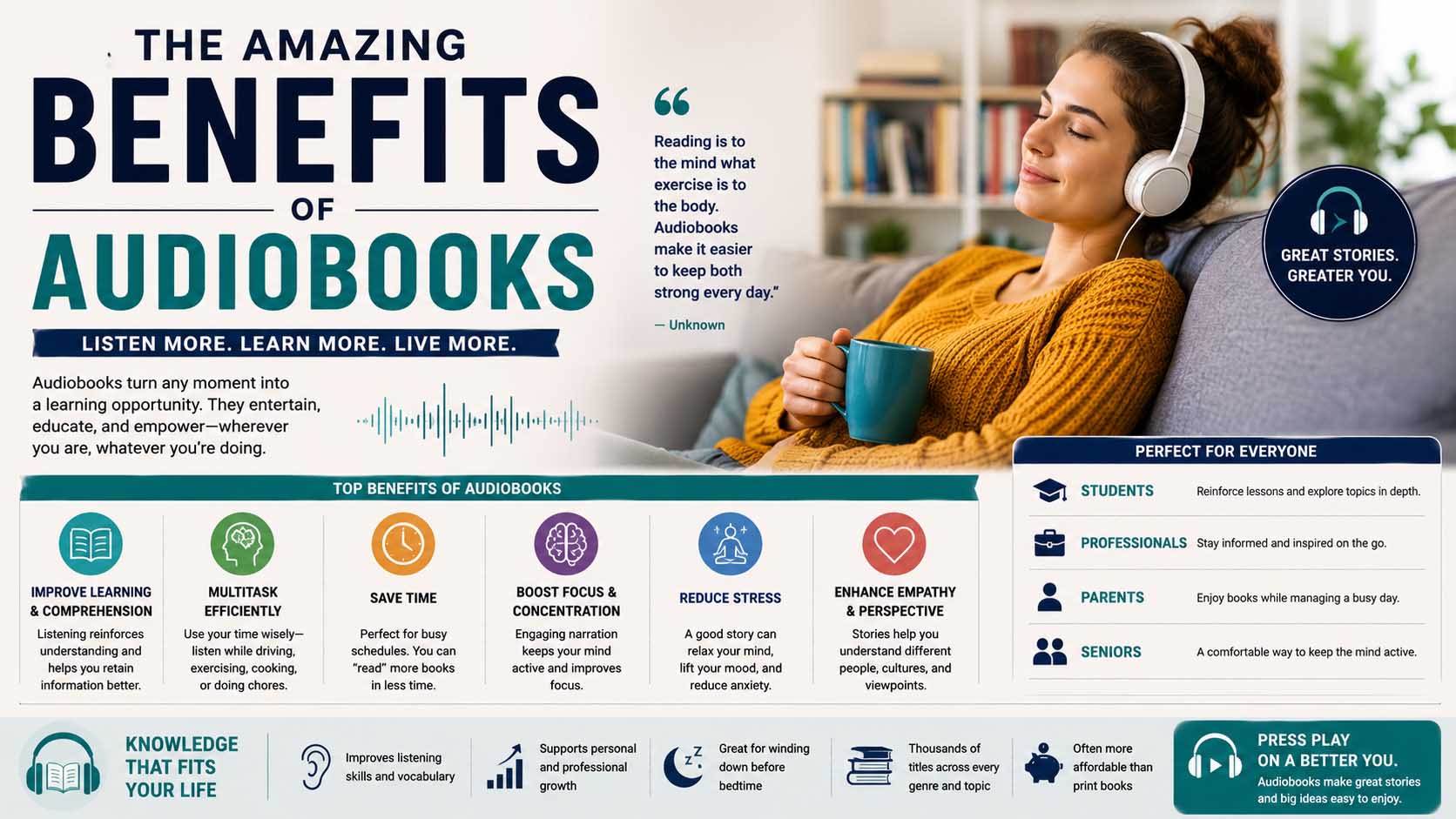
Reading does not always require looking at words on a page. One of the major benefits of audiobooks is that they give students and lifelong learners another way to access stories, ideas, vocabulary, and academic content. A well-narrated audiobook can make challenging material easier to follow while giving learners the freedom to listen during situations when traditional reading is inconvenient.
However, listening and print reading are not identical skills. Audiobooks can support learning in valuable ways, but they should not automatically replace printed or digital text in every situation. Instead, students often gain the most when they choose the format that matches their learning goal.
What Is an Audiobook?
An audiobook is a spoken recording of a book or other written work. A narrator reads the text aloud, while listeners access the recording through a phone, tablet, computer, dedicated audio device, or other compatible platform.
Some audiobooks use a single narrator. Meanwhile, others feature several voice actors, sound effects, or full-cast performances.
Educational audiobooks can cover far more than novels. Students may find nonfiction, biographies, history books, language-learning materials, classic literature, and other academic resources in audio formats.
However, audiobooks should not be confused with summaries. A complete unabridged audiobook normally presents the full written text, while an abridged edition removes some material.
Key Benefits of Audiobooks for Students
Audiobooks can support several parts of learning when students use them purposefully.
For example, they can improve access to books, model fluent oral reading, expose students to unfamiliar vocabulary, and make it easier to engage with longer texts.
They can also complement broader literacy instruction. The simple view of reading, for instance, highlights the relationship between word recognition and language comprehension. Listening removes much of the immediate demand for independently recognizing printed words, allowing learners to focus more directly on spoken language and meaning.
That distinction explains both the strength and limitation of audiobooks. They can support comprehension and engagement, yet students still need direct experience with print to develop independent reading skills.
Audiobooks Can Make Complex Text More Accessible
A student may understand ideas that are more advanced than the texts they can comfortably decode on their own.
In that situation, an audiobook can provide access to richer material.
For instance, a learner might struggle to read a challenging historical biography independently. However, hearing the same book narrated clearly may allow the student to follow its events, arguments, and vocabulary more successfully.
As a result, listening can help prevent decoding difficulty from completely blocking access to age-appropriate ideas.
Still, audio should complement rather than eliminate instruction in decoding in reading because students need practice connecting printed letters and spelling patterns with spoken language if they are developing independent reading ability.
Teachers can therefore use audiobooks strategically while continuing explicit reading instruction.
Benefits of Listening to Audiobooks for Vocabulary
One of the practical benefits of listening to audiobooks is regular exposure to spoken vocabulary in meaningful context.
Instead of encountering an unfamiliar word by itself, listeners hear it within a sentence. Consequently, surrounding information can help them begin to infer what the word means.
Narration also provides pronunciation. This can be useful when students have previously seen a word in print but are unsure how it sounds.
However, simply hearing a new word once does not guarantee that a student will learn it. Learners gain more when they pause, check unfamiliar vocabulary, discuss new terms, and encounter those words repeatedly.
For study purposes, students can keep a short vocabulary list while listening. Rather than recording every unfamiliar word, they can choose terms that appear repeatedly or seem central to the topic.
Audiobooks Provide a Model of Fluent Reading
Professional narrators demonstrate pacing, phrasing, expression, pauses, and changes in tone.
Therefore, audiobooks can give developing readers examples of what fluent oral reading sounds like.
This connection is especially useful when learning what is reading fluency, because fluency involves more than simply reading quickly. Accurate reading, appropriate rate, and expression all contribute to meaningful oral reading.
One useful classroom strategy is listening while following along with the printed text. Students can hear the narrator’s phrasing while simultaneously seeing punctuation, paragraph breaks, and sentence structure.
Then, they can reread a short section aloud themselves.
This approach turns passive listening into a more active literacy exercise.
Audiobooks vs Reading: Are the Benefits the Same?
Discussions about the benefits of audiobooks vs reading sometimes treat the two formats as competitors. However, that comparison is too simple.
Both can support comprehension and learning, yet they place different demands on the learner.
| Learning Activity | Audiobooks | Print Reading |
|---|---|---|
| Accessing spoken language | Strong | Indirect |
| Practicing word decoding | Limited | Strong |
| Hearing pronunciation | Strong | Limited |
| Seeing spelling and punctuation | Limited | Strong |
| Learning while hands are occupied | Convenient | Difficult |
| Practicing independent print reading | Limited | Strong |
| Modeling expression and pacing | Strong | Depends on reader |
Therefore, the better format depends on the goal.
If a student needs to practice decoding unfamiliar words, print is usually necessary. However, if the goal is understanding a story that’s currently above the student’s independent reading level, audio may provide useful support.
Combining both formats can sometimes provide the advantages of each.
Audiobooks Can Support the Wider Reading Process
Successful reading draws on several interconnected skills. Therefore, students shouldn’t view audiobooks as a shortcut that makes foundational literacy skills unnecessary.
The 5 pillars of reading traditionally emphasize phonemic awareness, phonics, fluency, vocabulary, and comprehension. Audiobooks can contribute most directly to areas such as oral language, vocabulary exposure, comprehension practice, and models of fluent expression.
However, audio alone doesn’t provide the same phonics or print-decoding practice as reading words on a page.
Teachers and parents can use this distinction to choose materials more effectively.
For example, a child might spend part of a literacy session reading a suitable print text independently. Later, the same child could listen to a more advanced story for comprehension, discussion, and enjoyment.
Benefits of Reading vs Audiobooks for Studying
When considering the benefits of reading vs audiobooks, students should think about what the assignment requires.
Print can be more convenient when learners need to examine a diagram, compare paragraphs, annotate passages, quote exact sentences, or quickly return to a specific section.
Meanwhile, audio can work well for reviewing a familiar chapter, listening to literature, or accessing material when sustained print reading is difficult.
For demanding academic material, active study still matters regardless of format.
A useful audiobook study routine might look like this:
- Preview the chapter title and learning goals.
- Listen in manageable sections.
- Pause after a major idea.
- Summarize the idea without replaying it.
- Write a few notes or questions.
- Revisit difficult sections.
- Review important concepts later.
This method gives the learner something to do with the information rather than simply allowing the audio to play.
Listening Can Fit Into Busy Schedules
Audiobooks make books available during times when holding a book isn’t practical.
For example, students might listen while riding in a car, walking, organizing their room, or doing a simple task that doesn’t require much mental concentration.
Lifelong learners can use the same approach during commuting or routine household activities.
However, multitasking has limits.
If the second activity demands substantial attention, comprehension may suffer. Trying to learn a difficult academic concept while simultaneously writing messages, playing a game, or completing another complex task is unlikely to be an efficient study strategy.
Therefore, match the listening environment to the difficulty of the material.
Audiobooks Can Encourage Reluctant Readers
Some students associate reading with frustration because they have repeatedly encountered books that feel too difficult.
Audiobooks can offer another entry point.
An engaging narrator may help a learner become interested in a story, author, topic, or series. Later, that interest may encourage the student to explore related print books.
Choice matters here. Allowing students to select topics they genuinely enjoy can make listening feel less like an assignment.
However, educators should avoid presenting audiobooks as the “easy version” of reading. Doing so can unnecessarily stigmatize the format or the students who benefit from it.
Instead, present audio as one of several legitimate ways to access information and literature.
Pairing Audiobooks With Reading and Writing
Audiobooks become even more useful when learners actively respond to what they hear.
For example, students can write a short summary after each chapter, predict what happens next, record questions, compare characters, or explain the author’s main argument.
These activities connect listening with reading and writing skills because learners must organize, interpret, and communicate ideas rather than merely hear them.
Younger students might draw a scene and explain it. Meanwhile, older learners can create chapter notes, discussion questions, or written reflections.
Teachers can also pause an audiobook before an important moment and ask students to make predictions. Consequently, the class becomes actively involved in meaning-making.
Benefits of Listening to Audiobooks While Sleeping
The claimed benefits of listening to audiobooks while sleeping need careful explanation.
Listening quietly before sleep can be part of a relaxing bedtime routine for some people. For example, a calm story may provide an alternative to visually stimulating activities before bed.
However, playing educational material while fully asleep should not be treated as a reliable way to learn an entire book or master new academic information.
Learning normally requires attention, processing, and later retrieval. Therefore, students shouldn’t replace awake study sessions with overnight audiobook playback.
If you enjoy bedtime listening, consider using a sleep timer so the recording stops automatically. Also, keep the volume comfortable and avoid letting nighttime listening interfere with adequate sleep.
Common Mistakes When Learning With Audiobooks
One common mistake is allowing the recording to continue after attention has wandered. Because the narrator keeps talking, it’s easy to “finish” a chapter without remembering much of it.
When that happens, pause and return to the last section you understood.
Another mistake is listening at an unnecessarily high playback speed. Faster audio can save time, yet speed becomes counterproductive when comprehension drops.
Likewise, students shouldn’t assume audio automatically replaces note-taking. For complex material, short written notes can make later review much easier.
Finally, don’t use audiobooks to avoid every challenging print task. If an assignment is designed to develop close reading, decoding, annotation, or textual analysis, students still need appropriate interaction with written text.
How Teachers and Parents Can Use Audiobooks Effectively
Teachers can use audiobooks during whole-class literature studies, independent reading periods, language-learning activities, or paired audio-and-print sessions.
Before listening, introduce key vocabulary or background knowledge. Then, pause occasionally for predictions, questions, or quick summaries.
Afterward, ask learners to explain what they understood rather than simply asking whether they enjoyed the recording.
Parents can use a similar strategy at home.
For instance, families can listen to a chapter together and discuss the characters or main ideas afterward. Children can also follow along in a printed copy when appropriate.
The goal isn’t to test children after every listening session. Instead, occasional conversation can turn the experience into meaningful language practice.
FAQs About the Benefits of Audiobooks
Are audiobooks good for learning?
Yes, they can support comprehension, vocabulary exposure, pronunciation, engagement, and access to complex material. However, their educational value depends on the learning goal and how actively the student listens.
Do audiobooks count as reading?
Audiobooks provide access to the same language and ideas in many books, but listening and print reading involve different processes. Therefore, audio can be valuable without being identical to reading printed text.
Can audiobooks improve vocabulary?
They can expose listeners to unfamiliar words in meaningful contexts and provide pronunciation models. However, students usually need repeated exposure and active practice to make new vocabulary part of their usable knowledge.
Should students read and listen at the same time?
Sometimes. Following printed text while listening can help students connect spoken language with written words and observe fluent phrasing. Still, the strategy should match the learner’s needs and instructional goal.
What speed should students use for audiobooks?
Use a speed that allows comfortable comprehension. Beginners may prefer normal speed, while experienced listeners might increase playback gradually. If you’re frequently rewinding because you missed information, slow the recording down.
Are audiobooks useful for struggling readers?
They can give struggling readers access to stories and information that may be difficult to decode independently. However, students who need reading instruction should still receive direct support in foundational print-reading skills.
Make Audiobooks Part of a Balanced Learning Routine
The strongest benefits of audiobooks appear when listening has a clear purpose. Use audio to access challenging books, hear fluent narration, encounter new vocabulary, review familiar material, or enjoy literature when print isn’t practical.
At the same time, keep reading printed or digital text when you need to practice decoding, examine spelling, annotate passages, or analyze exact wording.
For students, a balanced approach often works best: read when the task calls for close attention to print, listen when audio improves access or engagement, and occasionally combine both. Then, pause, think, discuss, or write about what you’ve learned so the audiobook becomes an active part of learning rather than background noise.