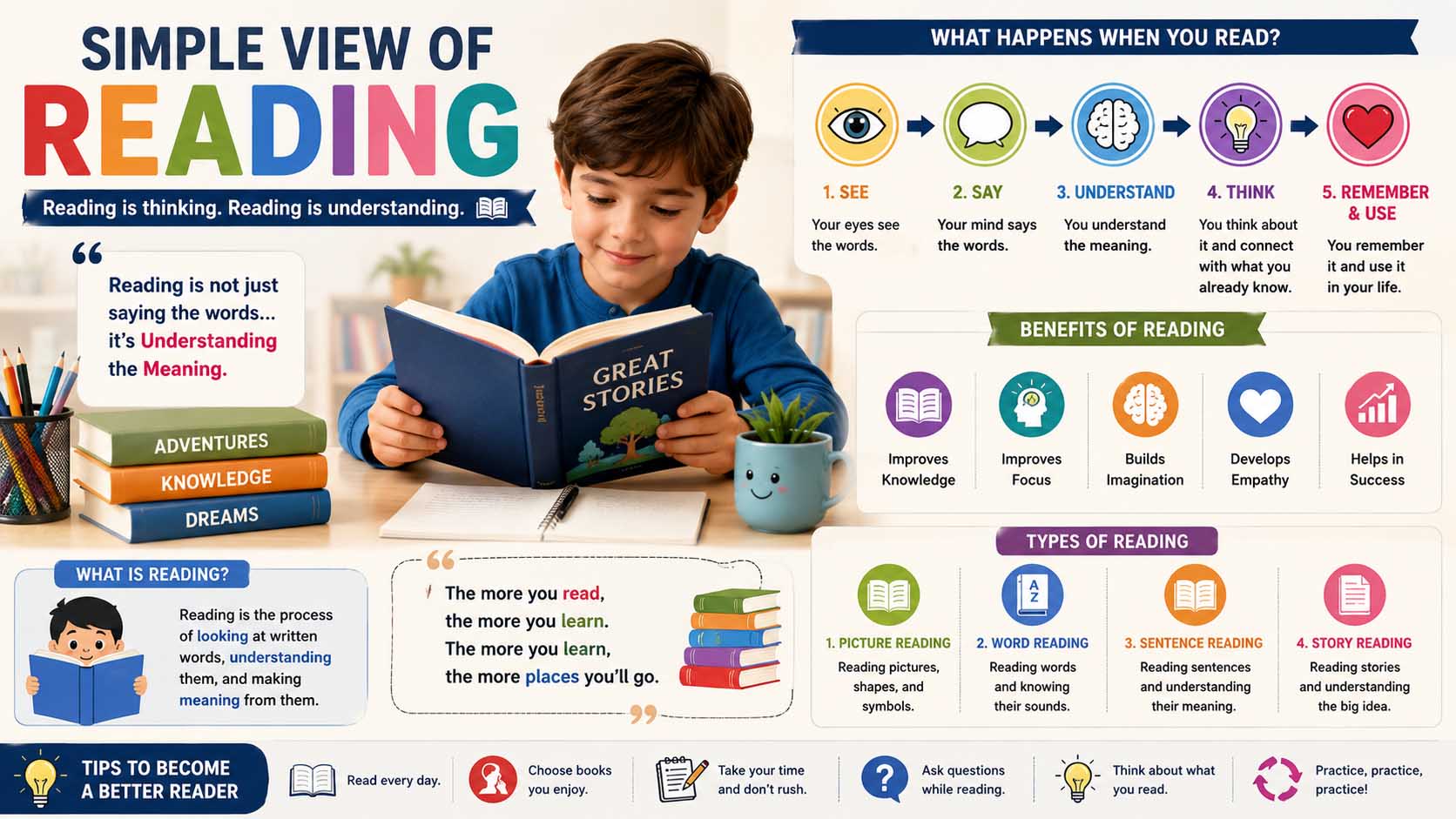
Why can one student read words accurately but struggle to explain a story, while another understands spoken stories yet finds printed words difficult? The simple view of reading offers a useful way to think about this difference. The model explains reading comprehension as the product of two broad abilities: decoding written words and understanding language. In other words, successful reading requires learners to identify the words on the page and understand the language those words communicate.
Although the name sounds basic, the framework can help teachers and parents think more precisely about reading difficulties. Instead of treating every struggling reader the same way, educators can consider whether the main challenge involves word recognition, language comprehension, or both.
What Is the Simple View of Reading?
The simple view of reading is a theoretical model originally proposed by researchers Philip Gough and William Tunmer in 1986. It describes reading comprehension as resulting from two components: decoding and linguistic, or language, comprehension.
Decoding refers broadly to a reader’s ability to recognize written words. For beginning readers, this involves connecting letters and spelling patterns with sounds and blending them into recognizable words.
Language comprehension refers to understanding spoken language, including vocabulary, sentence structures, background knowledge, and the meanings communicated through connected language.
Therefore, a learner needs both components to comprehend written text successfully.
This distinction also helps clarify phonics vs phonemic awareness. Phonemic awareness concerns identifying and manipulating individual sounds in spoken words, while phonics connects those sounds with written letters and patterns. Both can contribute to developing accurate word reading.
Understanding the Simple View of Reading Formula
The simple view of reading formula is commonly represented as:
Reading Comprehension = Decoding × Language Comprehension
It is also often shortened to:
R = D × LC
Here:
- R = Reading comprehension
- D = Decoding
- LC = Language comprehension
The multiplication sign is meaningful. The model proposes that both abilities contribute to successful reading comprehension.
Imagine that decoding and language comprehension are each represented on a scale from 0 to 1. A learner with strong decoding of 0.9 and strong language comprehension of 0.9 would have a predicted reading-comprehension value of 0.81 within this simplified illustration.
However, if decoding were only 0.2 while language comprehension remained 0.9, the resulting value would be much lower.
The same pattern works in reverse. A student could read printed words accurately but understand very little of the language. As a result, overall reading comprehension would remain limited.
The formula should not be treated as a literal classroom calculator. Instead, it illustrates the idea that weakness in either component can restrict successful comprehension.
The Two Parts of the Simple View of Reading Model
Understanding the simple view of reading model becomes easier when we examine its two components separately.
Decoding and Word Recognition
Beginning readers need to learn how print represents spoken language.
At first, decoding can be slow. A student may look at the word ship, identify the sounds associated with sh, i, and p, then blend those sounds.
With effective instruction and practice, however, familiar written words become increasingly automatic. Consequently, students no longer need to laboriously sound out every word they encounter.
Phonics is one major part of this development. Teachers who are learning how to teach phonics effectively often use an explicit sequence of letter-sound relationships, blending activities, word building, and opportunities to read text containing previously taught patterns.
As word recognition becomes more efficient, students can devote more attention to understanding what they read.
Language Comprehension
Reading is not simply saying printed words aloud.
Students also need to understand vocabulary, grammar, sentence relationships, concepts, and ideas. Likewise, they often need background knowledge to make sense of what a text assumes the reader already knows.
Consider this sentence:
The puppy hid beneath the porch when the thunder started.
A student might decode every word correctly. However, comprehension still depends on understanding words such as beneath and thunder, as well as the relationship between the events.
Therefore, strong reading instruction cannot stop once children learn phonics.
Four Reader Profiles the Model Can Help Explain
One practical use of the Simple View is thinking about different combinations of decoding and language comprehension.
| Reader profile | Decoding | Language comprehension | Possible instructional need |
|---|---|---|---|
| Strong in both | Strong | Strong | Increasingly complex reading |
| Word-reading difficulty | Weaker | Stronger | Decoding and word-recognition instruction |
| Comprehension difficulty | Stronger | Weaker | Vocabulary, language, knowledge and comprehension support |
| Difficulty in both | Weaker | Weaker | Support across both areas |
These profiles are broad rather than diagnoses. Still, they help explain why the same intervention will not necessarily work for every student.
For example, giving extra decoding practice to a learner who already reads words accurately may not address weak vocabulary or language comprehension.
Likewise, teaching comprehension strategies alone may not solve a problem when the student cannot accurately identify the printed words.
Why Phonics Matters for Decoding
Systematic phonics instruction helps learners understand relationships between sounds and spellings.
Rather than memorizing every written word as an individual visual object, students learn patterns they can apply to unfamiliar words.
For example, once children understand common consonant sounds and a short-vowel pattern, they may decode words such as map, sit, hot, and run.
Later, instruction expands to more complex spelling patterns.
Knowledge of types of syllables can also support word-reading instruction as learners encounter longer words. Recognizing useful patterns can help students approach multisyllabic words more systematically instead of guessing.
However, phonics instruction works best as part of broader literacy teaching. Students still need rich oral language, vocabulary, knowledge, fluency practice, and meaningful opportunities to read.
Language Comprehension Is More Than Vocabulary
Vocabulary matters, but language comprehension involves much more than knowing definitions.
Students must understand how words work together in sentences. They also need to follow references across sentences, understand increasingly complex grammar, make appropriate inferences, and connect new information with prior knowledge.
For instance, consider:
Maya packed an umbrella before leaving. Dark clouds had covered the sky.
The text does not directly say that Maya expects rain. Yet a reader can infer that possibility by connecting the two sentences with background knowledge about dark clouds and umbrellas.
As texts become more challenging, these demands increase.
Therefore, classroom instruction should include conversations, read-alouds, knowledge-building activities, explicit vocabulary teaching, and discussion of increasingly complex language.
What the Simple View of Reading Looks Like in a Classroom
The framework becomes most useful when it helps teachers make instructional decisions.
Suppose a second-grade student listens to an age-appropriate story and answers questions accurately. However, when asked to read a similar passage independently, the student struggles to identify many words.
That pattern may suggest that word reading deserves close attention.
Now imagine another student who reads the passage smoothly and accurately but cannot explain what happened or answer straightforward questions about it.
In that case, the teacher should look more carefully at vocabulary, oral language, background knowledge, and other aspects of comprehension.
A third student may struggle in both situations. Consequently, that learner may need instruction targeting both word recognition and language comprehension.
Teachers still need appropriate assessment rather than relying on observation alone, but the framework can guide what questions to investigate.
Context Clues Have a Role, but Not as a Replacement for Decoding
Context can help readers determine the meaning of an unfamiliar word once they can read it.
For instance:
The desert was arid, receiving almost no rainfall throughout the year.
A reader who does not know arid can use the rest of the sentence to infer that it means very dry.
Teaching different types of context clues can therefore strengthen vocabulary and comprehension, particularly as students encounter more advanced texts.
However, context should not become the primary strategy for identifying printed words. Asking beginners to guess a word from a picture, the first letter, or the surrounding sentence can draw attention away from the spelling itself.
Instead, readers should use their knowledge of print to identify the word and then use context to understand its meaning.
Common Misunderstandings About the Model
One misunderstanding is that the Simple View says reading instruction itself is simple.
It does not.
Both decoding and language comprehension contain many underlying skills. For example, successful word recognition develops through knowledge of the alphabetic system, phonological skills, spelling knowledge, and practice.
Meanwhile, language comprehension draws on vocabulary, grammar, verbal reasoning, knowledge, and other language abilities.
Another misunderstanding is that the two components should always receive equal instructional time.
Instruction should respond to students’ needs. A beginning reader may require substantial explicit word-reading instruction, while an older student with accurate decoding may need greater support with vocabulary, knowledge, and complex language.
Finally, the model should not be viewed as a complete inventory of everything involved in reading. Motivation, attention, fluency, instruction, text difficulty, and learning opportunities can also affect real-world reading performance.
How Parents Can Use the Simple View at Home
Parents do not need formal assessment tools to support both sides of reading development.
For word reading, children can practice previously taught sound-spelling relationships with letter tiles, word-building games, and appropriately selected books. Short, successful sessions are usually more productive than long periods of frustrating practice.
Meanwhile, reading aloud gives children access to language and ideas beyond what they can independently decode.
During a read-aloud, parents can briefly explain unfamiliar vocabulary, discuss characters’ choices, connect events to prior knowledge, and ask genuine questions about the story.
For example, instead of repeatedly asking factual quiz questions, try:
Why do you think the character did that?
What do you think will happen next?
What does this new word seem to mean here?
These conversations strengthen understanding while keeping reading meaningful.
Practical Teaching Mistakes to Avoid
A common mistake is assuming that fluent-sounding oral reading guarantees comprehension. A student can pronounce every word correctly without fully understanding the passage.
However, the opposite mistake also causes problems. A child with strong oral vocabulary may appear to understand stories very well while still struggling to read printed words independently.
Another problem is relying heavily on guessing. Pictures can support understanding and make books engaging, but they should not substitute for attending to written letters when identifying words.
Teachers should also avoid assuming that every struggling reader needs exactly the same intervention.
Instead, determine what the learner can already do and where the difficulty appears. Then, match instruction more closely to that need.
Simple View of Reading FAQs
What is the Simple View of Reading in plain English?
If you’re wondering what is the Simple View of Reading, it is a model stating that reading comprehension depends on both recognizing written words and understanding language. Strong performance in only one area may not be enough for strong reading comprehension.
Who developed the Simple View of Reading?
Philip Gough and William Tunmer introduced the model in a 1986 academic paper. Later research has examined and expanded discussion of its components and applications.
Is phonics part of the Simple View of Reading?
Phonics supports the word-recognition or decoding side because it teaches relationships between written spellings and spoken sounds. However, decoding development includes more than simply completing phonics lessons.
Does the model include vocabulary?
Vocabulary contributes to language comprehension. However, language comprehension also involves sentence understanding, background knowledge, verbal reasoning, and the ability to connect ideas.
Is reading comprehension just decoding times language comprehension?
The formula represents the model’s core theoretical relationship, but real reading is complex. Therefore, educators should use the formula as a helpful framework rather than treating it as a complete description of every process involved in literacy.
Can Good Decoding Skills Hide Reading Comprehension Difficulties?
Yes. Some students accurately recognize words yet have difficulty understanding vocabulary, complex sentences, background information, or relationships among ideas. Those students may need language and comprehension support rather than simply more basic decoding practice.
Putting the Simple View Into Practice
The simple view of reading gives teachers and parents a practical question to ask when a learner struggles: Is the difficulty mainly with recognizing the written words, understanding the language, or both?
From there, instruction can become more focused. Learners who struggle with word recognition may need explicit support with sound-spelling relationships, blending, and increasingly complex word patterns. Meanwhile, learners with weaker language comprehension may benefit from vocabulary teaching, knowledge-building, discussion, read-alouds, and work with complex sentences.
Most of all, avoid treating reading as a single skill. Children are learning both how to unlock the words on a page and how to build meaning from them. Supporting both sides gives developing readers a much stronger path toward independent, thoughtful reading.