
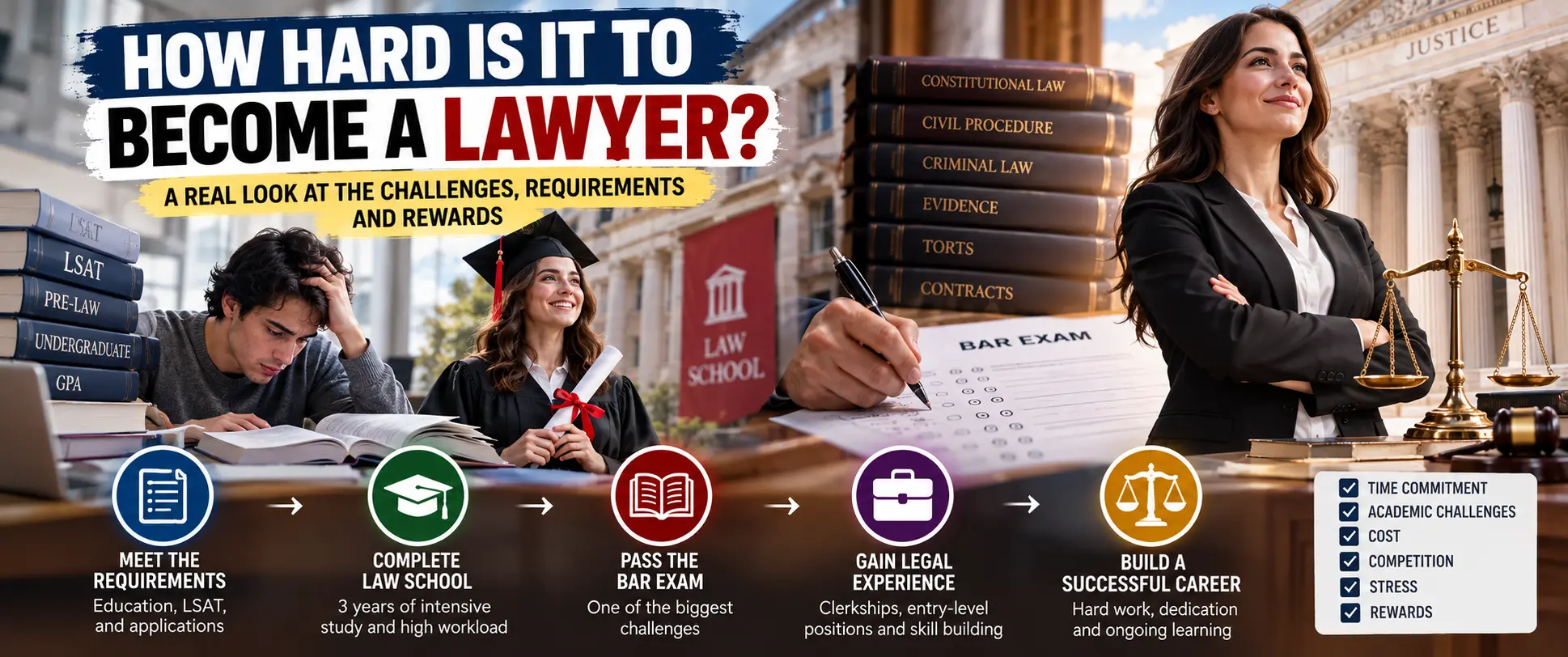
If you are considering law as a career, you may be wondering, how hard is it to become a lawyer? The short answer is that becoming a lawyer is challenging, but it is achievable for students who can handle several years of education, intensive reading and writing, competitive admissions, significant costs, and a licensing exam. In the United States, the traditional path usually involves earning a bachelor’s degree, completing a Juris Doctor (J.D.) program, and meeting the licensing requirements of the jurisdiction where you want to practice.
The difficulty does not come from one single step. Instead, students face different challenges throughout the journey. College requires consistent academic performance, law school demands analytical thinking and heavy reading, while the bar admission process tests whether graduates meet the requirements to practice law.
Understanding these stages before committing can help you decide whether the career fits your interests, abilities, finances, and long-term goals.
How Hard Is It to Become a Lawyer From Start to Finish?
For most students, becoming a lawyer requires years of structured education and preparation. However, the exact path varies by jurisdiction.
In the United States, a common route looks like this:
- Complete a bachelor’s degree.
- Apply to law school and meet its admission requirements.
- Earn a J.D. degree, usually through about three years of full-time study.
- Meet the licensing requirements for your jurisdiction.
- Pass the required bar examination where applicable.
- Complete character and fitness and other admission requirements.
- Become admitted to practice law.
Therefore, students should think of law as a long-term educational commitment rather than a quick career qualification.
If you are planning the college stage, understanding How Long to Get a Bachelor’s Degree? can help you estimate the first major part of the timeline before law school.
Why Becoming a Lawyer Can Feel Difficult
Different students struggle with different parts of the process. Some find law school admission stressful, while others find the volume of reading or bar preparation more challenging.
The Educational Path Is Long
Lawyers need substantial education before they can begin practicing independently.
In the traditional U.S. route, students normally complete undergraduate education before entering law school. A full-time J.D. program then commonly takes three academic years.
Consequently, students may spend around seven years in postsecondary education before accounting for bar preparation and the licensing process.
However, timelines can vary. Part-time programs, accelerated options, personal circumstances, and jurisdiction-specific pathways can all affect the total time.
Law School Requires a Different Style of Learning
Law school is not simply about memorizing laws.
Instead, students learn how to identify legal issues, interpret cases, analyze competing arguments, apply rules to new facts, and communicate conclusions clearly.
For example, a professor may present a situation where two businesses disagree about a contract. Rather than asking students to recall one definition, the professor may expect them to identify relevant legal issues, apply legal principles, consider both sides, and explain a reasoned outcome.
As a result, students often need time to adjust to legal reasoning.
What Makes Law School Academically Challenging?
Law students generally read large amounts of material, including judicial opinions, statutes, regulations, and secondary sources.
However, reading is only part of the challenge. Students must understand why a case matters and how its reasoning might apply in another situation.
Reading and Case Analysis
A legal case can contain procedural history, facts, legal rules, arguments, and judicial reasoning. Therefore, simply reading every word is not enough.
Students learn to identify the key facts, issue, rule, reasoning, and outcome. Over time, this process becomes faster as legal reading skills improve.
Writing and Clear Reasoning
Lawyers need to communicate complicated ideas accurately. Consequently, legal education places substantial emphasis on research, analysis, and writing.
Students may prepare briefs, memoranda, essays, research assignments, or other forms of legal writing. Strong grammar helps, yet logical organization and precise reasoning matter just as much.
Exams Can Carry Significant Weight
In many law school courses, a final exam may account for a large share of the course grade. Therefore, students need to understand the material well enough to apply it rather than simply recognize terminology.
Practice questions can help because they train students to identify issues quickly and organize answers under time pressure.
What Is the Degree Required for Law?
A J.D. is a professional graduate-level law degree and is the standard law degree for people pursuing the traditional lawyer-licensing path in the United States.
Students who are unfamiliar with career-focused graduate credentials may find What Is a Professional Degree? useful for understanding how programs such as law differ from many traditional academic degrees.
A J.D. program normally covers foundational subjects such as contracts, torts, civil procedure, criminal law, constitutional law, property, and legal research and writing.
Later, students can often choose electives based on their interests. For instance, someone interested in business may study corporate law, securities, taxation, or intellectual property.
How Difficult Is Getting Into Law School?
Admission difficulty varies greatly among law schools.
Schools may consider undergraduate academic performance, standardized test scores where required or accepted, personal statements, recommendations, resumes, experiences, and other application factors.
Therefore, students should research each school’s current requirements rather than assuming every law school follows exactly the same process.
Competitive applicants usually benefit from building strong academic habits during college. Meanwhile, developing reading, writing, research, and critical-thinking skills can prepare students for both admission and law school itself.
Although law school follows undergraduate education, students asking What Is Grad School? may find it helpful to understand the broader differences between undergraduate and post-bachelor’s education.
How Hard Is the Bar Exam and Licensing Process?
Graduating from law school does not automatically give someone permission to practice law.
In the United States, licensing requirements are controlled by individual jurisdictions. Therefore, requirements can differ from one state or territory to another.
Applicants commonly need to satisfy educational requirements, complete a bar examination or another approved licensing pathway where applicable, and pass character and fitness review. Some jurisdictions may impose other requirements as well.
Bar preparation can be demanding because graduates must review a large body of legal material while practicing timed questions and exam techniques.
Therefore, consistent preparation usually works better than relying on last-minute studying.
How Hard Is It to Become a Lawyer in California?
Students specifically asking how hard is it to become a lawyer in California should expect a demanding licensing process.
Depending on a student’s educational route, different requirements may apply.
For example, California recognizes some pathways beyond graduating from an American Bar Association-approved law school. However, alternative routes have their own rules and should not be mistaken for shortcuts.
Applicants also need to satisfy the state’s current examination, moral character, and other admission requirements.
Because licensing rules can change, students should always verify current requirements directly with the State Bar of California before planning their education.
How Hard Is It to Become a Lawyer in Canada?
The answer to how hard is it to become a lawyer in Canada differs because Canada does not use one nationwide licensing system for every lawyer.
or LL.B., although admission and education pathways vary.
After law school, graduates must satisfy the licensing requirements of the law society in the province or territory where they plan to practice. Depending on the jurisdiction, this may involve licensing examinations, experiential training, articling, or another approved pathway.
Therefore, anyone considering Canadian legal practice should check the requirements of the relevant provincial or territorial law society early.
How Hard Is It to Become a Corporate Lawyer?
Students interested in companies, contracts, mergers, finance, or business regulation often ask how hard is it to become a corporate lawyer.
The basic licensing path is generally the same as for other lawyers in the jurisdiction. However, building a corporate-law career can require specialized knowledge and strong academic and professional skills.
During law school, students might take courses related to corporations, securities, contracts, taxation, finance, or commercial transactions.
Internships, clinics, networking, and summer positions can also provide practical exposure.
Corporate law can involve long documents, complex negotiations, tight deadlines, and detailed analysis. Therefore, students who enjoy business strategy and careful problem-solving may find the field demanding but interesting.
How Hard Is It to Become a Patent Lawyer?
The question how hard is it to become a patent lawyer involves an extra consideration in the United States.
Lawyers who want to represent others in patent matters before the U.S. Patent and Trademark Office generally need to meet USPTO requirements for scientific and technical qualifications and pass the registration examination, often called the patent bar.
Consequently, students interested in this area should investigate technical education requirements before choosing an undergraduate major.
Patent law can suit students who enjoy both technical subjects and legal reasoning. However, the combination of specialized knowledge and legal training makes the pathway distinct from many other legal careers.
The Financial Side of Becoming a Lawyer
Academic difficulty is only one part of the challenge. Cost can also influence whether law school is practical.
Students may face undergraduate tuition, law school tuition, books, housing, application fees, test expenses, and bar-related costs. Meanwhile, attending school full time can limit how much a student earns during those years.
Therefore, applicants should compare tuition, scholarships, expected borrowing, living costs, employment outcomes, and career goals before choosing a school.
Students sometimes compare professional programs when evaluating education debt. For example, information about student loans for medical school can illustrate how financing another lengthy professional education works, although medical and law school costs, loan options, and career paths differ.
Skills That Make the Journey Easier
You do not need to arrive at college already thinking like an attorney. However, developing certain skills early can make legal education more manageable.
Strong reading comprehension helps students process dense material. Meanwhile, writing skills make it easier to present organized arguments.
Time management also matters because legal education can involve several demanding courses at once. Similarly, critical thinking helps students evaluate competing interpretations instead of accepting the first answer that seems correct.
Students can practice these abilities by reading challenging material, writing regularly, joining debate or discussion activities, taking research-heavy courses, and learning to support claims with evidence.
Is Becoming a Lawyer Harder Than Other Careers?
Comparing professional careers can be useful, but there is no universal difficulty scale.
Someone asking is it hard to become a nurse faces a different combination of academic study, clinical training, examinations, and licensing requirements. Law, by contrast, places especially heavy emphasis on reading, argument, research, analysis, and written communication.
Therefore, the better question is whether the challenges of law match your strengths.
A student who dislikes extensive reading and writing may find law school particularly difficult. Meanwhile, someone who enjoys analyzing complicated problems and building evidence-based arguments may adapt more comfortably.
Common Mistakes Aspiring Lawyers Can Avoid
One mistake is choosing law solely because it sounds prestigious. Instead, students should learn what lawyers actually do across different practice areas.
Another mistake is focusing only on getting admitted to law school. Cost, employment goals, geographic preferences, licensing requirements, and school outcomes deserve attention as well.
Likewise, students should avoid assuming every lawyer spends most of the day arguing in court. Many attorneys spend substantial time researching, drafting documents, advising clients, reviewing contracts, negotiating, and handling compliance matters.
Finally, do not wait until graduation to investigate licensing requirements. Knowing the rules early can prevent unpleasant surprises later.
FAQs About Becoming a Lawyer
Do you have to be extremely smart to become a lawyer?
No particular label or measure of intelligence guarantees success. Instead, law students benefit from persistence, reading comprehension, analytical thinking, organization, communication skills, and consistent study habits.
How many years does it take to become a lawyer?
Under the traditional U.S. route, students commonly spend about four years earning a bachelor’s degree and about three years completing a full-time J.D. program. Licensing and bar preparation add more time, while individual pathways can vary.
Is law school harder than college?
Many students find law school more demanding because the reading is specialized, exams require application rather than simple recall, and courses move quickly. However, students usually improve as they become familiar with legal reasoning.
Can an average student become a lawyer?
Yes, students can develop many of the skills needed for legal education. Consistent effort, effective study habits, careful school selection, and realistic planning often matter more than fitting a particular image of the “perfect” law student.
Deciding Whether Law Is Right for You
So, how hard is it to become a lawyer? It requires a long educational path, disciplined study, strong reading and writing skills, financial planning, and successful completion of jurisdiction-specific licensing requirements.
Still, difficulty alone should not determine your choice. Instead, consider whether you enjoy solving complicated problems, researching questions, reading carefully, communicating clearly, and working with rules and evidence.
If law genuinely interests you, start by researching undergraduate options, practicing academic writing, learning about different legal careers, and checking the current admission requirements for jurisdictions where you may eventually practice. That approach turns a difficult-looking career path into a series of manageable educational steps.