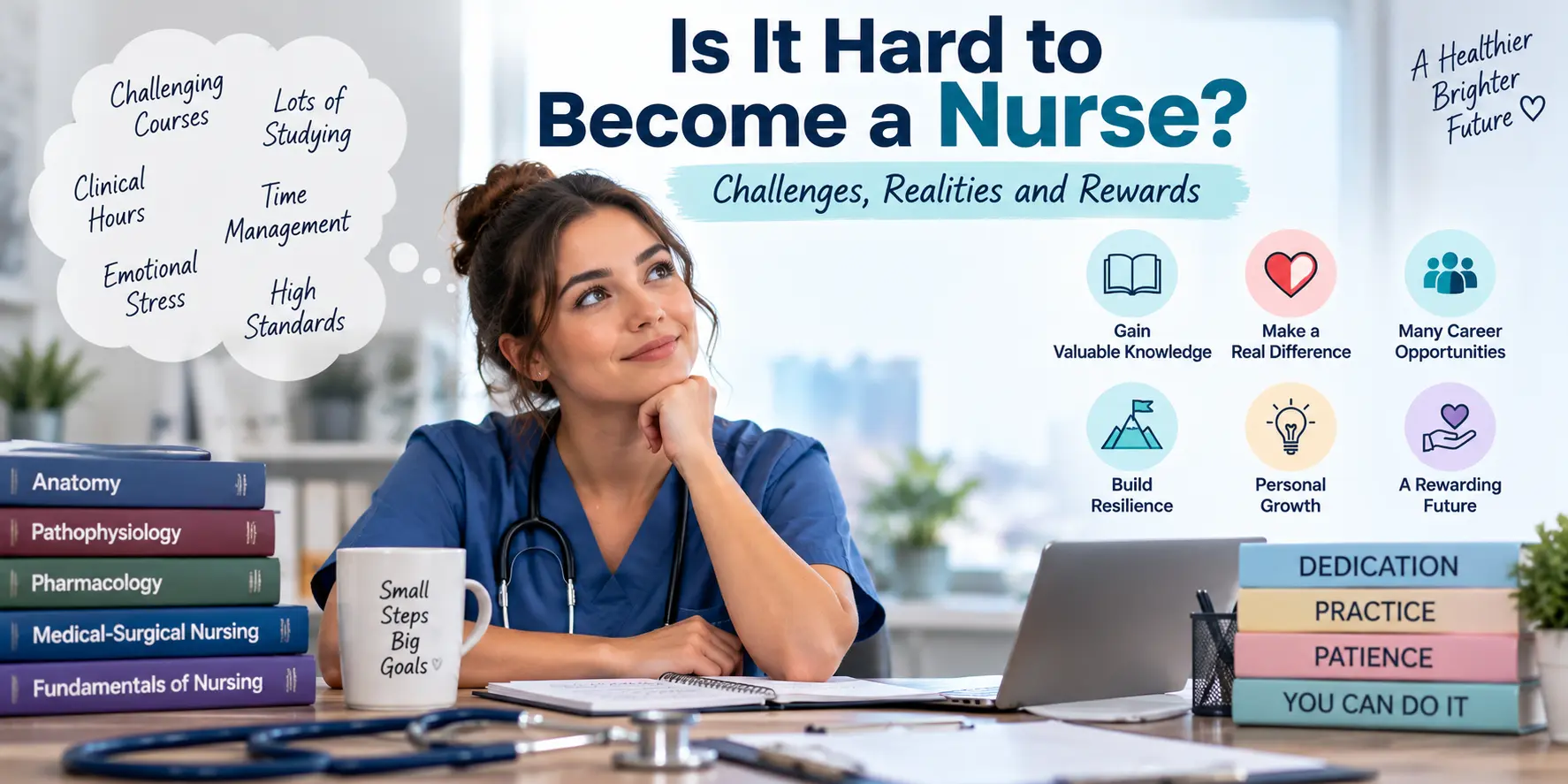
If you are thinking about nursing, you may wonder, is it hard to become a nurse? The short answer is yes, becoming a nurse can be challenging, but the difficulty is manageable for students who prepare well and stay consistent. Nursing education combines science courses, hands-on clinical training, exams, time management, and professional licensing requirements, so students need both academic knowledge and practical skills.
However, you do not need to be a perfect student to succeed. Instead, you need steady study habits, patience, organization, and a willingness to keep improving. Once you understand what makes nursing challenging, the path becomes much easier to plan.
Is It Hard to Become a Nurse Compared With Other Careers?
Nursing can feel harder than many programs because students must learn information and then apply it safely in real situations.
For example, memorizing the symptoms of a medical condition is only the beginning. A nursing student may also need to recognize those symptoms in a patient, assess what is happening, communicate concerns, follow appropriate procedures, and document care accurately.
Therefore, nursing education tests more than memory.
Students commonly study subjects such as anatomy, physiology, microbiology, pharmacology, psychology, nutrition, and nursing fundamentals. Meanwhile, clinical experiences require them to apply what they have learned under supervision.
Still, “hard” is subjective. A student who enjoys science, communication, problem-solving, and working with people may find nursing demanding but rewarding. In contrast, someone who dislikes science courses or high-responsibility environments may find the training more difficult.
What Education Do You Need to Become a Nurse?
For registered nurses in the United States, common educational routes include an Associate Degree in Nursing (ADN) and a Bachelor of Science in Nursing (BSN). Graduates must then meet their state board’s requirements and pass the NCLEX-RN to obtain RN licensure.
An ADN program commonly takes about two years of full-time study after required prerequisites, although actual timelines vary. Meanwhile, a traditional BSN commonly takes about four years.
If you are considering the bachelor’s route, understanding How Long to Get a Bachelor’s Degree? can help you see why individual timelines may differ because of transfer credits, course load, prerequisites, and program format.
Some students also begin with practical or vocational nursing programs and later continue their education.
Therefore, there is no single nursing pathway that works for every student.
How Hard Is It to Become a Nurse During Nursing School?
When students ask how hard is it to become a nurse, they are often really asking how difficult nursing school will be.
Nursing school can be intense because several responsibilities happen at once.
You may attend lectures, complete assignments, study for exams, practice nursing skills, prepare for clinical days, and work with patients under supervision. Consequently, poor time management can quickly create stress.
Science Courses Require Consistent Study
Anatomy and physiology are especially important because nurses need to understand how the human body normally functions before they can recognize problems.
Meanwhile, microbiology helps students understand microorganisms and infection, while pharmacology introduces medications, drug actions, side effects, interactions, and safe administration principles.
Instead of trying to memorize everything before an exam, students often benefit from shorter study sessions throughout the week.
For example, reviewing medications for 30 minutes each day can be more manageable than trying to learn a large drug list the night before an exam.
Nursing Questions Test Application
Nursing exams may feel unfamiliar because many questions ask students to choose the safest or most appropriate action rather than simply recall a fact.
Sometimes several answer choices sound reasonable.
Therefore, students need to understand prioritization, patient safety, clinical judgment, and the reasoning behind nursing interventions.
As your knowledge grows, these questions usually become easier to approach.
Clinical Training Is Challenging in a Different Way
Clinical education moves nursing beyond textbooks.
Under appropriate supervision, students enter healthcare environments and begin applying classroom concepts to patient care. Depending on the program and placement, they may practice skills such as taking vital signs, performing assessments, communicating with patients, documenting information, and participating in care.
Naturally, the first clinical experiences can feel intimidating.
However, students are there to learn. Instructors do not expect beginners to function like experienced registered nurses on their first day.
Preparation makes a major difference. Therefore, review relevant skills, medications, procedures, and patient information as directed before clinical experiences.
At the same time, ask questions whenever you are unsure. In healthcare education, guessing can be unsafe, while asking for guidance is part of learning.
Is It Hard to Become a Registered Nurse?
If your goal is RN licensure, you may specifically ask, is it hard to become a registered nurse?
The process requires several stages.
First, you need to complete an approved nursing education program. Next, you must satisfy the licensing requirements of the nursing regulatory body in the jurisdiction where you plan to practice. In the United States, RN candidates generally must pass the NCLEX-RN.
The NCLEX is designed to evaluate whether an entry-level nurse can make safe nursing judgments.
Therefore, preparation should focus on understanding nursing concepts and applying them rather than relying entirely on memorization.
Graduation from nursing school is a major milestone, but it is not the same as receiving a nursing license. Students should check their state board of nursing for current requirements because licensing procedures can vary by state.
Choosing a Nursing Education Route
Students sometimes assume they must begin with a four-year university program. However, community colleges also offer ADN nursing programs in many areas.
Depending on your location and goals, the benefits of community college can include lower tuition, smaller classes, convenient locations, and pathways that allow students to begin their education closer to home.
After becoming an RN, some nurses later complete RN-to-BSN programs while working.
Meanwhile, other students choose a traditional BSN from the beginning because of their career goals, employer preferences, or plans for graduate education.
Neither route automatically makes nursing easy. Instead, compare accreditation or program approval, NCLEX outcomes, admission requirements, tuition, clinical opportunities, scheduling, and your long-term career goals.
Nursing Is More Than an Academic Program
Students sometimes view nursing as simply earning a degree. However, nursing education prepares people for a licensed healthcare profession with direct responsibility for patient care.
That difference matters.
If you are exploring career-focused higher education, learning What Is a Professional Degree? can also help you understand how programs connected to specific professions differ from broader academic study, although nursing credentials themselves vary by educational level and program type.
Nursing students develop communication, clinical judgment, teamwork, patient-safety awareness, and technical skills alongside academic knowledge.
Therefore, success requires both classroom learning and professional development.
How to Make Nursing School More Manageable
Nursing school becomes easier to manage when you use a system instead of reacting to every assignment at the last minute.
Build a Weekly Study Schedule
First, put lectures, labs, clinical days, exams, assignments, work shifts, and personal commitments into one calendar.
Then, schedule study sessions around them.
Short, focused sessions throughout the week usually work better than marathon sessions before an exam. Likewise, reviewing material soon after class can help reinforce what you learned.
Study Actively
Simply rereading notes may feel productive, but active recall usually gives you a clearer picture of what you actually know.
For example, close your textbook and explain a concept without looking at it.
You can also use practice questions, flashcards, diagrams, case scenarios, and study partners.
When you miss a question, do not only memorize the correct answer. Instead, understand why your original answer was wrong.
Connect Concepts Instead of Memorizing Lists
Nursing topics often connect.
For example, understanding the cardiovascular system can help you understand blood pressure, heart conditions, medications, assessments, and patient symptoms.
Therefore, try to build connections between topics rather than treating every lecture as isolated information.
This approach can also make exam questions easier because you understand the reasoning behind the answer.
Nursing and Other Healthcare Career Paths
Nursing is only one route into healthcare.
For instance, students interested in medical imaging may explore Online Radiology Tech Programs, although legitimate radiologic technology pathways generally include required clinical education that cannot be completed entirely online.
Meanwhile, emergency medical services offer another healthcare direction. Understanding the difference between EMT and paramedic can help students compare emergency-response careers with nursing, which has different educational, licensing, and workplace requirements.
Exploring alternatives does not mean you are giving up on nursing. Instead, it helps you choose a healthcare career that matches your interests and strengths.
How Hard Is It to Become a Nurse Practitioner?
Students interested in advanced practice may wonder how hard is it to become a nurse practitioner.
The path is longer than becoming an RN because nurse practitioners are advanced practice registered nurses.
Generally, students first complete nursing education and become licensed registered nurses. Then, they pursue graduate-level nursing education that prepares them for an advanced practice role and population focus.
Certification and licensure requirements also apply and vary according to jurisdiction and specialty.
Therefore, becoming an NP requires additional years of education and advanced clinical preparation.
However, students do not need to master the entire path at once. If you are just starting, focus first on completing your initial nursing education and becoming a strong RN.
Is It Hard to Become a Travel Nurse?
Another common question is, is it hard to become a travel nurse?
Travel nursing is generally not an entry-level nursing specialty that students enter immediately after graduation. Instead, travel nurse positions commonly require an active RN license and relevant clinical experience, while exact requirements vary by agency, employer, assignment, and specialty.
For example, a hospital seeking a travel ICU nurse usually needs someone who can adapt quickly to a new environment and already has appropriate critical-care experience.
Therefore, the first goal should be developing solid nursing skills and professional experience.
Licensure can also become more complicated when working across state lines. The Nurse Licensure Compact may allow eligible nurses with a multistate license to practice in participating states, although nurses should always verify current rules before accepting assignments.
Common Mistakes Future Nursing Students Make
One mistake is underestimating the time nursing school requires.
Students sometimes schedule too many work hours, extracurricular activities, or other demanding commitments while taking challenging nursing courses. Consequently, they may have little time left for studying and rest.
Another mistake is relying only on memorization.
Although nurses need to remember many facts, nursing education also requires students to apply information. Therefore, practice explaining why a particular intervention or answer makes sense.
Likewise, do not wait until you are failing to ask for help.
Use instructors, tutoring, academic support, study groups, skills labs, and other available resources early.
Finally, avoid comparing your progress constantly with classmates. Students enter nursing programs with different academic backgrounds, work experience, family responsibilities, and learning styles.
Frequently Asked Questions
Do you need to be good at math to become a nurse?
You need practical math skills because nurses may use calculations involving medication doses, measurements, conversions, and rates. However, students can improve these skills through structured practice.
Is nursing school mostly memorization?
No. You will need to remember medical terminology, medications, anatomy, procedures, and other facts. However, nursing education also emphasizes application, prioritization, patient safety, communication, and clinical judgment.
Can an average student become a nurse?
Yes. Nursing programs are demanding, but academic success depends on much more than being naturally gifted. Consistent studying, good time management, active practice, and asking for help can make a major difference.
How long does it take to become an RN?
The timeline varies by educational route, prerequisites, program availability, and licensing process. An ADN is commonly designed around roughly two years of nursing study, while a traditional BSN commonly takes about four years, although individual timelines can be shorter or longer.
What is usually the hardest part of becoming a nurse?
The answer varies by student. Some struggle most with science courses, while others find clinical training, nursing exams, time management, or the NCLEX more challenging.
A Realistic Way to Approach the Nursing Journey
So, is it hard to become a nurse? Yes, the path demands serious effort, but difficulty should not automatically discourage you.
Instead of asking whether nursing school will be easy, ask whether you are willing to study consistently, improve weak areas, practice clinical skills, accept feedback, and keep going when a course becomes challenging.
Start by researching approved nursing programs in your area. Then, compare admission requirements, prerequisites, costs, program length, clinical opportunities, and licensure outcomes.
Once you begin, focus on the next achievable step rather than the entire career at once. Nursing is built through repeated learning and practice, so steady progress can take you much further than trying to be perfect from the first day.