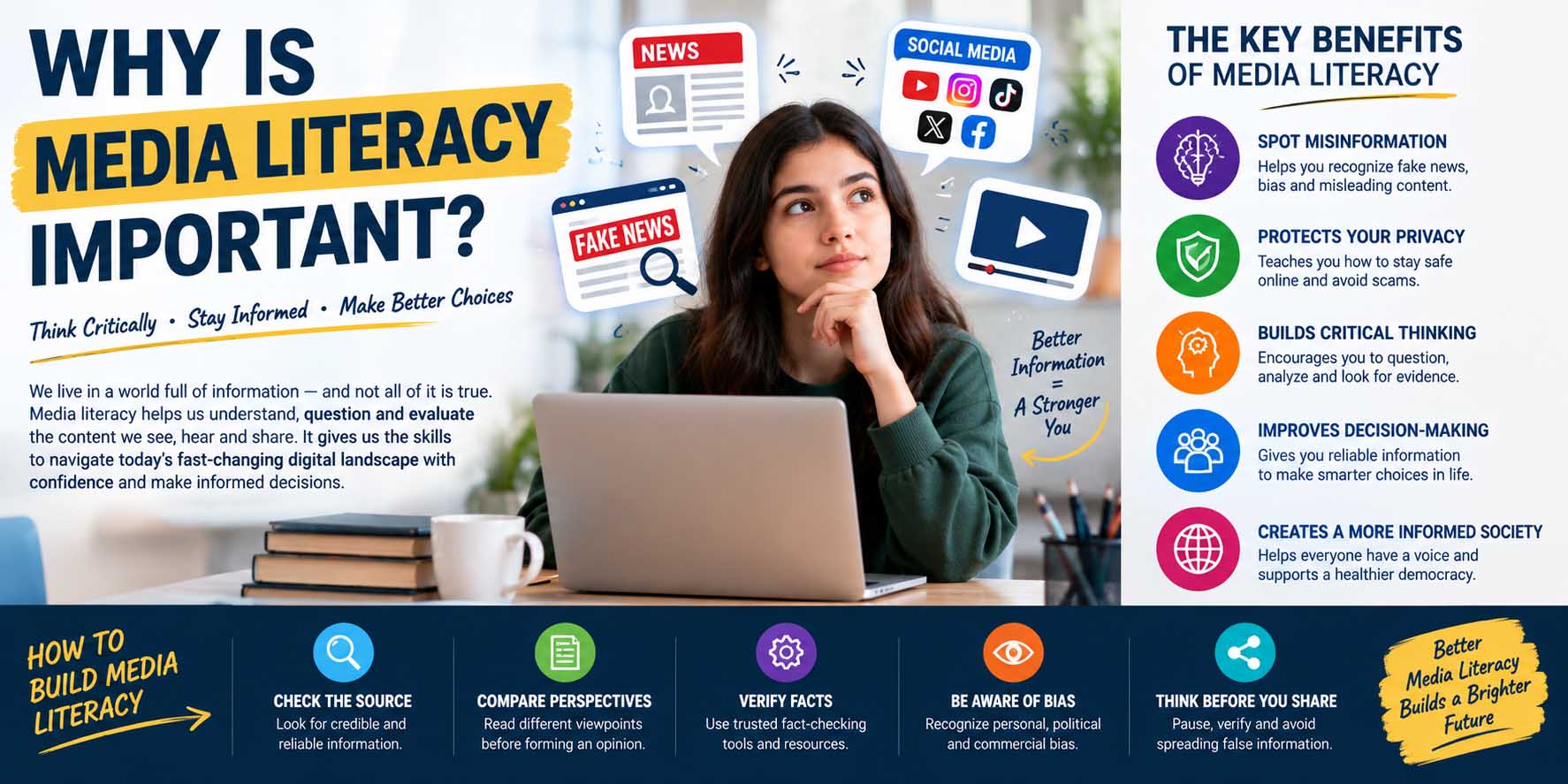
Students encounter information almost everywhere. A news headline appears in a search result, a creator explains a topic in a short video, an advertisement looks like an ordinary post, and an AI tool produces an answer within seconds. So, why is media literacy important? It helps people question, evaluate, understand, and use the information they encounter instead of automatically accepting everything they see, hear, or read.
Media literacy is especially useful for students because research, communication, entertainment, advertising, and social interaction increasingly overlap. A polished video can still contain inaccurate claims, while an unfamiliar website may provide well-supported information. Therefore, students need practical ways to judge content based on evidence rather than appearance alone.
What Is Media Literacy and Why Is It Important?
Media literacy is the ability to access, understand, evaluate, create, and communicate through different forms of media. These forms can include websites, news reports, videos, podcasts, advertisements, social media posts, photographs, and other communication channels.
However, media literacy involves more than knowing how to use a phone or search engine. A media-literate person asks questions such as:
- Who created this content?
- What is its purpose?
- Who is the intended audience?
- What evidence supports the claims?
- Is something significant missing?
- Does another reliable source confirm the information?
- Could advertising, persuasion, or bias affect the message?
These questions help learners become active readers and viewers rather than passive consumers.
Students who develop strong digital literacy skills can also use online tools more effectively, while media literacy adds another layer by helping them evaluate the messages and information those tools deliver.
Why Is Media Literacy Important for Students?
Students regularly use media when completing assignments, researching topics, following current events, and communicating with others. Consequently, the ability to judge information can directly affect the quality of their academic work.
Suppose a student searches online for information about climate change. The results might include government resources, scientific organizations, news articles, opinion pieces, advertisements, videos, and personal blogs.
Simply choosing the first result is not enough.
Instead, the student should examine who published the information, when it was published, what evidence appears, and whether trustworthy sources support the claims.
As a result, media literacy becomes part of effective research rather than a separate skill students use only during media studies classes.
Media Literacy Encourages Better Questions
Good learners do not simply collect information. Instead, they ask questions about it.
For example, a student watching a viral video might ask whether the clip shows the complete event. Likewise, someone reading a surprising statistic might ask where the number came from.
This questioning habit supports deeper learning because students begin separating claims from evidence.
Teachers can strengthen this habit through Critical Thinking Exercises that ask learners to compare evidence, identify assumptions, recognize weak reasoning, and explain why one interpretation may be stronger than another.
Media Literacy Helps Students Evaluate Sources
One of the biggest academic benefits of media literacy is stronger source evaluation.
Not every source serves the same purpose. For example, a peer-reviewed research paper, newspaper report, company advertisement, personal blog, and social media post may discuss the same subject from very different perspectives.
Students should therefore examine several features before relying on a source.
A useful evaluation framework includes four questions:
| Question | What to Check |
|---|---|
| Who created it? | Author, publisher, organization, or account |
| Why was it created? | Inform, persuade, entertain, sell, or influence |
| What supports it? | Evidence, references, data, expert sources |
| Can it be verified? | Confirmation from independent reliable sources |
This process does not mean automatically rejecting unfamiliar sources. Instead, it means judging information based on evidence and context.
Recognizing Misinformation and Misleading Content
Online information can spread quickly, particularly when it is emotional, surprising, or easy to share. However, popularity does not prove accuracy.
A misleading post might use a real photograph with the wrong caption. Likewise, a video might remove context from a longer event. A graph may use accurate numbers while presenting the scale in a way that exaggerates a difference.
Therefore, media literacy teaches students to slow down before reacting or sharing.
Read Beyond the Headline
Headlines often summarize complicated subjects in a few words. However, those words cannot always represent the full context.
Before accepting a headline’s message, students should open the article, identify the original claim, and examine the supporting evidence.
Check the Original Source
If a social media post says, “A new study proves…” students should look for the actual study rather than relying only on the post’s interpretation.
For academic work, understanding what is a scholarly source can help students distinguish research-based material from general commentary and select evidence that fits the requirements of an assignment.
Verify Before Sharing
A simple search can sometimes reveal that an old image, quote, or story has been reused with a new claim.
As a result, spending an extra minute checking information can prevent inaccurate content from spreading further.
Why Media Literacy Is Important in the Age of AI
Generative AI has made information evaluation even more relevant. AI tools can help explain concepts, generate ideas, summarize material, and support learning. However, generated responses can sometimes contain mistakes, unsupported statements, outdated details, or invented references.
Students should therefore treat AI-generated information as something that may require verification rather than assuming that confident wording guarantees accuracy.
For example, if an AI tool provides a historical date for an assignment, the student can verify it using a reliable reference. Likewise, if the tool mentions a research study, the student should confirm that the study exists and accurately supports the claim.
This approach allows students to use new technology while still taking responsibility for the quality of their work.
Lateral Reading Makes Online Research Stronger
Many students evaluate a website by staying on the page and looking at its design, About section, or writing style. While those clues can help, outside verification is often more useful.
This is where lateral reading becomes valuable.
Students learning what is lateral reading can practice leaving an unfamiliar webpage, opening new tabs, and checking what independent sources say about the publisher, organization, author, or claim.
For instance, imagine that a student finds an unfamiliar organization presenting statistics about nutrition. Rather than trusting the professional-looking website immediately, the student can search for information about the organization and check whether established sources confirm its claims.
That simple habit can make online research much more careful.
Understanding Persuasion, Advertising, and Bias
Media messages are created for different reasons. Some aim to inform, while others try to sell products, attract attention, entertain an audience, or persuade people.
Knowing the purpose helps students interpret the message.
For example, an advertisement for a study app may highlight positive features while saying little about limitations. Meanwhile, a sponsored influencer post may resemble a personal recommendation even though payment influenced its creation.
Students can ask:
“Who benefits if I believe this message?”
That question does not automatically prove that the content is false. Instead, it helps reveal possible motivations behind its presentation.
Bias also requires careful thinking. People and organizations may emphasize particular facts, perspectives, or experiences. Therefore, comparing multiple credible sources can give students a broader understanding of complicated subjects.
Images and Videos Also Need Evaluation
Media literacy is not limited to written information.
Photos can be cropped, edited, reused outside their original context, or generated artificially. Videos can also be shortened or presented with captions that change how viewers interpret them.
Meanwhile, realistic AI-generated images, audio, and video make visual verification increasingly relevant.
Students should therefore avoid assuming that “seeing is believing.”
When an image supports an unusual claim, they can search for its original context, examine the source that posted it, and look for independent reporting. Similarly, they can check whether a video is complete or only a short extract from a longer recording.
Media Literacy Supports Better Academic Research
Research assignments require students to make choices. They must decide which keywords to search, which sources to open, which evidence to trust, and which information belongs in their final work.
Media literacy supports every stage of this process.
Consider a student preparing a presentation about renewable energy. Instead of copying information from the first search result, the student might:
- Define the research question clearly.
- Search using several relevant terms.
- Identify potentially useful sources.
- Check the authors and publishers.
- Examine publication dates.
- Trace major claims to supporting evidence.
- Compare information across credible sources.
- Cite the sources used.
This process takes longer than copying a quick answer. However, it produces stronger academic work because students understand where their information comes from.
Media Literacy and Computer Skills Are Different
Media literacy and computer literacy overlap, but they are not identical.
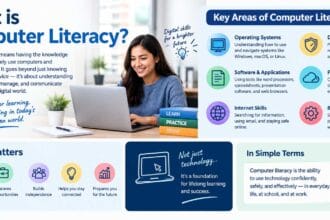
A student may know how to create documents, organize files, use software, browse websites, and troubleshoot basic technology. Those abilities relate closely to what is computer literacy and practical technology use.
Media literacy focuses more heavily on understanding and evaluating messages.
For example, knowing how to open a social media app is a technical skill. Recognizing that a sponsored post is advertising requires media awareness. Similarly, knowing how to perform a web search is a digital skill, while judging whether the search results provide trustworthy evidence requires media literacy.
Students benefit from developing both.
Creating Media Responsibly
Media literacy also includes creating content.
Students may create presentations, videos, podcasts, websites, graphics, or social posts for school and personal projects. Therefore, they should consider accuracy and responsibility from the creator’s perspective as well.
Before publishing or submitting content, students can ask:
- Did I verify my factual claims?
- Did I identify information taken from other sources?
- Did I represent the source accurately?
- Could an image or caption create a misleading impression?
- Have I separated facts from opinions?
- Does my work respect copyright and attribution requirements?
These habits help students become responsible communicators rather than only careful consumers.
Common Media Literacy Mistakes
One common mistake is judging credibility by appearance. A professionally designed website can contain poor information, while a simple page can contain reliable evidence.
Another mistake is assuming that the first search result must be the best source. Search rankings depend on many factors, so students still need to evaluate individual results.
Students may also confuse popularity with credibility. Thousands of shares, likes, or views show that content attracted attention; they do not prove the claim is accurate.
Finally, confirmation bias can affect research. People naturally notice information that supports what they already believe. Therefore, students should actively examine credible evidence that challenges their initial assumptions as well.
A Quick Media Literacy Checklist for Students
Before using online information for an assignment or sharing it with someone else, try this quick check:
Source: Who created or published the information?
Purpose: Is the content designed to inform, persuade, entertain, or sell?
Date: Is the information current enough for the topic?
Evidence: Are claims supported with evidence that can be checked?
Context: Could quotes, images, statistics, or videos be missing relevant context?
Verification: Do independent reliable sources support the main claim?
Language: Does the content rely heavily on emotional or sensational wording?
Action: Have you checked enough information before believing, citing, or sharing it?
With practice, these questions become quicker and more natural.
Frequently Asked Questions
Why is media literacy important?
Why is media literacy important? It helps people evaluate information, recognize misleading content, understand persuasive messages, verify sources, and communicate responsibly. For students, these abilities also support stronger research and academic decision-making.
Why is media literacy important for students specifically?
Students use online information for homework, research, presentations, communication, and everyday learning. Therefore, media literacy helps them choose stronger sources, identify unsupported claims, and make more informed decisions about the information they use.
Is media literacy the same as digital literacy?
No. Digital literacy generally includes the skills needed to use digital technologies effectively, while media literacy focuses strongly on interpreting, evaluating, and creating media messages. However, the two skill areas often overlap.
Can media literacy help identify fake news?
Media literacy can give students useful methods for evaluating questionable information. For example, they can check the publisher, trace claims to original sources, compare independent coverage, examine evidence, and verify the context of images or quotations.
How can students improve media literacy?
Students can improve by questioning sources, comparing coverage, checking evidence, practicing lateral reading, identifying advertising, and verifying surprising claims before sharing them. Regular practice matters because media formats and technologies continue to change.
Make Verification Part of Everyday Learning
Understanding why media literacy is important becomes easier when students see it as an everyday skill rather than another subject to memorize. Each search result, video, headline, advertisement, and AI-generated answer offers a chance to practice thoughtful evaluation.
A useful habit is simple: pause, identify the source, examine the evidence, and verify significant claims elsewhere. Over time, this process becomes faster and more automatic.
Students do not need to distrust everything they encounter. Instead, they need enough curiosity to ask good questions and enough patience to check the answers. Those habits can support stronger research, smarter information choices, and more responsible participation in today’s media environment.