
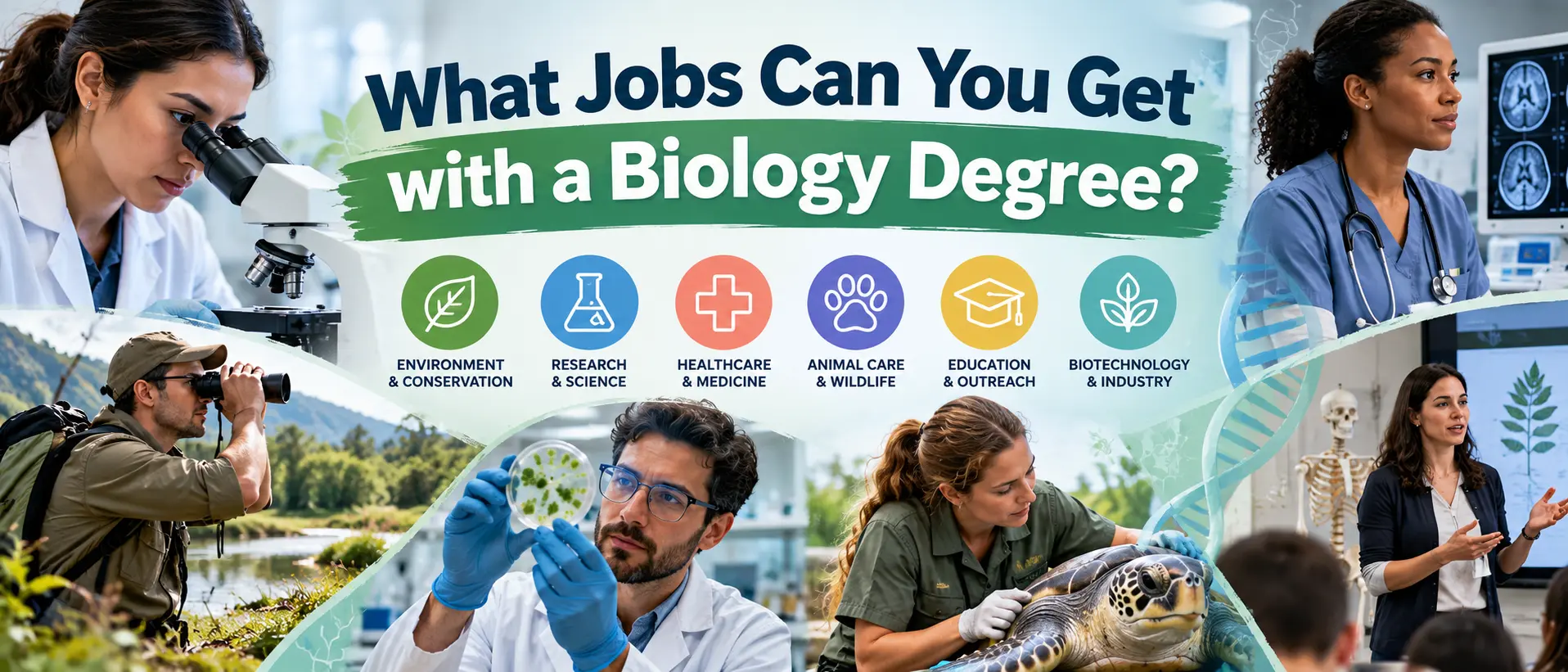
If you enjoy science but are unsure where your major can take you, you may be wondering what jobs can you get with a biology degree after college. Biology graduates can pursue careers in laboratories, healthcare, biotechnology, environmental science, education, public health, conservation, and scientific research. Some positions accept a bachelor’s degree, while others require graduate school, professional training, certification, or an advanced degree.
Because biology covers subjects ranging from cells and genetics to ecosystems and human anatomy, the degree can support many career directions. Therefore, your best option usually depends on the subjects you enjoy, the experience you gain, your preferred work environment, and whether you want to continue your education.
For a broader overview of career outcomes by field of study, the U.S. Bureau of Labor Statistics’ biology degree information can also help you compare occupations and education requirements.
What Jobs Can You Get With a Biology Degree?
A biology degree does not prepare you for only one occupation. Instead, it gives you a scientific foundation that can support careers across research, healthcare, environmental work, education, business, and technology.
Common possibilities include:
- Biological technician
- Laboratory technician
- Research assistant
- Environmental scientist
- Wildlife biologist
- Microbiologist
- Medical or pharmaceutical sales representative
- Science teacher
- Conservation specialist
- Public health worker
- Quality control specialist
- Biotechnology professional
- Clinical research coordinator
- Forensic science technician
- Science writer
However, education requirements vary significantly between occupations. For instance, some laboratory and technical positions may accept a bachelor’s degree, while careers such as physician, dentist, veterinarian, or certain research scientist roles require substantial additional education.
Students who are still planning their undergraduate education may also find How Long to Get a Bachelor’s Degree? helpful when estimating the time needed before entering the workforce or moving into advanced study.
Biology Careers at a Glance
The following table highlights several career directions and the type of work they commonly involve.
| Career | Typical Work | Common Education Path |
|---|---|---|
| Biological Technician | Laboratory testing and research support | Bachelor’s degree |
| Environmental Scientist | Environmental research and protection | Bachelor’s degree |
| Microbiologist | Study microorganisms | Bachelor’s degree; advanced study for some roles |
| Wildlife Biologist | Study animals and habitats | Bachelor’s degree; higher degrees for advanced research |
| Clinical Research Coordinator | Support clinical studies | Bachelor’s degree often useful |
| Science Teacher | Teach biological sciences | Degree plus applicable teaching credentials |
| Biotechnology Professional | Work with biological technologies | Bachelor’s or advanced degree |
| Forensic Science Technician | Analyze scientific evidence | Bachelor’s degree commonly expected |
| Medical Scientist | Conduct health-related research | Advanced degree commonly required |
| Physician | Diagnose and treat patients | Medical degree and professional training |
These are general pathways rather than universal requirements. Therefore, check the qualifications for the specific occupation, employer, and location you are considering.
Laboratory and Research Careers
Laboratory work is one of the most direct career directions for biology graduates.
If you enjoyed biology labs in college, you may prefer work involving experiments, samples, scientific equipment, data collection, and research documentation.
Biological Technician
Biological technicians help scientists conduct laboratory tests and experiments. Their work may include preparing samples, maintaining equipment, recording observations, collecting data, and assisting with research procedures.
This can be a practical entry-level path for bachelor’s graduates because it allows you to build laboratory experience while learning how professional research teams operate.
Over time, experienced technicians may specialize or continue their education for more advanced research positions.
Research Assistant
Research assistants support projects in universities, medical centers, biotechnology companies, government agencies, and private laboratories.
Depending on the project, you might prepare materials, collect specimens, organize results, review scientific information, or help conduct experiments.
Since employers often value practical ability, undergraduate research experience can strengthen your application. In addition, working with a research team can help you decide whether you enjoy laboratory science as a long-term career.
Microbiologist
Microbiologists study microorganisms such as bacteria, fungi, and other microscopic life.
Their work can relate to medicine, agriculture, food safety, pharmaceuticals, environmental science, and biotechnology. Some positions are accessible with a bachelor’s degree, while advanced research roles may require a master’s degree or doctorate.
If microbiology interests you, laboratory experience and relevant coursework can help you identify the type of work you want to pursue.
Healthcare Careers for Biology Graduates
Biology is also a popular foundation for students interested in healthcare.
However, a biology degree alone does not qualify someone to practice medicine. Licensed healthcare professions have their own educational, examination, clinical, and licensing requirements.
Medical and Healthcare Pathways
Biology graduates may continue toward careers such as:
- Physician
- Dentist
- Pharmacist
- Physician assistant
- Veterinarian
- Physical therapist
- Optometrist
- Medical scientist
Your undergraduate biology courses can provide useful preparation in subjects such as anatomy, physiology, genetics, microbiology, and cell biology.
However, professional programs can have specific admission requirements. Therefore, research prerequisites early instead of assuming that a biology degree automatically meets every requirement.
If you are comparing advanced career pathways, understanding What Is a Professional Degree? can help clarify why degrees such as medicine and dentistry differ from a standard bachelor’s or research-focused graduate degree.
What Jobs Can You Get With a Human Biology Degree?
Students asking what jobs can you get with a human biology degree are often interested in careers connected to human health, anatomy, disease, or biomedical research.
Human biology graduates may consider laboratory research, clinical research, public health, healthcare administration, pharmaceutical work, medical sales, or further professional education.
For example, someone interested in how diseases affect the human body might pursue biomedical research. Meanwhile, another graduate who prefers working directly with patients might use human biology as preparation for a healthcare professional program.
Your undergraduate specialization does not automatically determine your career. Instead, internships, certifications, postgraduate education, and practical experience can shape the direction you take.
Environmental and Wildlife Careers
Biology does not have to mean spending your career inside a laboratory.
Students interested in ecosystems, animals, plants, and conservation can explore environmental career paths. These roles can combine fieldwork, data collection, analysis, reporting, and communication.
Environmental Scientist
Environmental scientists investigate environmental problems and help organizations understand issues involving pollution, natural resources, ecosystems, and human health.
The role can combine office work, laboratory analysis, data interpretation, and fieldwork. As a result, it may suit students who enjoy science but want more variety than a laboratory-only career.
Wildlife Biologist
Wildlife biologists study animals, populations, habitats, and ecosystems.
Depending on the position, the work might involve collecting field data, monitoring wildlife populations, analyzing ecological changes, preparing reports, or supporting conservation programs.
Advanced research and leadership roles may require graduate education. Therefore, students interested in this field should consider whether postgraduate study fits their long-term goals.
What Jobs Can You Get With a Marine Biology Degree?
If ocean ecosystems interest you, you may instead ask what jobs can you get with a marine biology degree.
Possible career directions include marine research, fisheries science, conservation, environmental consulting, aquarium work, coastal resource management, and education.
However, marine biology can be competitive. Therefore, field experience can be especially useful.
Internships, volunteer projects, research placements, and practical skills such as data analysis can help students become stronger candidates. Likewise, some research-heavy marine careers require graduate education.
Before applying to graduate programs, learning What Is Grad School? can help you understand how master’s and doctoral study differ from undergraduate education.
Biotechnology and Pharmaceutical Careers
Modern biology also connects closely with biotechnology.
Biotechnology organizations use biological processes to develop products and technologies in areas such as medicine, agriculture, diagnostics, genetics, and industrial science.
A biology graduate might work in:
- Laboratory operations
- Quality assurance
- Quality control
- Clinical research
- Manufacturing support
- Regulatory support
- Pharmaceutical sales
- Research and development
Some jobs focus heavily on experiments, while others combine scientific knowledge with business, communication, documentation, or regulatory responsibilities.
Therefore, biology students who do not want a traditional laboratory career can still find options within science-focused companies.
What Jobs Can You Get With a Biology Associate’s Degree?
Students do not always need to begin with a four-year program.
If you are wondering what jobs can you get with a biology associate’s degree, the available roles tend to be more entry-level and support-focused.
Depending on the employer, possibilities may include laboratory assistant, research support worker, environmental field technician, quality control assistant, or other technical positions.
However, job requirements vary widely. Some employers may prefer a bachelor’s degree even for roles that involve basic laboratory work.
Consequently, an associate degree can also serve as a starting point before transferring into a bachelor’s program. Before choosing this route, check current job listings in your area to see which qualifications employers request.
Skills Biology Majors Can Bring to the Workplace
Your degree title is only one part of your job application.
Employers also care about what you can actually do. Biology students commonly develop skills in scientific observation, research, data collection, laboratory procedures, technical writing, problem-solving, teamwork, and evidence-based reasoning.
Depending on your coursework, you may also gain experience with statistics, laboratory equipment, spreadsheets, scientific software, microscopy, field sampling, or research databases.
When preparing applications, review relevant skills to put on resume and choose abilities you can genuinely demonstrate through coursework, laboratory projects, employment, volunteering, or internships.
Whenever possible, give evidence. Instead of simply writing “research skills,” describe the research method, project, equipment, or data work you completed.
How to Become More Employable Before Graduation
Do not wait until your final semester to start thinking about work.
Instead, use college to build experience alongside your academic knowledge.
Get Practical Experience
Look for laboratory placements, research projects, internships, fieldwork, volunteer opportunities, or part-time positions.
Even a short experience can help you understand what daily work in a particular field actually looks like. It also gives you something concrete to discuss during interviews.
Learn Data Skills
Modern biology involves substantial data collection and analysis.
Therefore, basic statistics, spreadsheet skills, data visualization, and relevant scientific software can make your background more useful.
Students interested in research may also benefit from learning programming or bioinformatics when those skills match their intended field.
Build Relationships With Faculty
Professors can help you discover research opportunities, graduate programs, career options, and professional contacts.
They may also provide references later. Rather than contacting faculty only when you need a recommendation, participate in class and discuss your academic interests throughout your program.
Use Internships Strategically
An internship lets you test a career before committing to it.
For instance, you may think you want laboratory research but discover that environmental fieldwork suits you better.
Students comparing short-term professional experiences may benefit from understanding fellowship vs internship, especially when evaluating opportunities offered by universities, research institutes, nonprofits, and employers.
Do You Need Graduate School With a Biology Degree?
Not necessarily.
Many biology graduates enter the workforce after completing a bachelor’s degree. However, advanced education can become necessary when you want to conduct independent research, teach at certain academic levels, or enter a licensed healthcare profession.
A master’s degree can help you develop deeper expertise in areas such as ecology, biotechnology, microbiology, or another specialization.
Meanwhile, a PhD generally focuses heavily on advanced research and can prepare students for careers in academia, scientific research, or specialized leadership roles.
Before enrolling, identify the career you want and check its actual requirements. Graduate education requires both time and money, so it should support a clear academic or professional purpose.
Common Questions About Biology Degree Careers
Is a biology degree useful outside healthcare?
Yes. Biology graduates can pursue environmental science, biotechnology, research, education, conservation, pharmaceuticals, government, and other fields.
Can I get a job with only a bachelor’s degree in biology?
Yes. Biological technician, environmental science, laboratory support, clinical research, sales, and quality-related roles are examples of pathways that may accept bachelor’s graduates. However, individual employers set their own requirements.
What jobs can you get with a degree in biology if you dislike lab work?
You can consider environmental work, science communication, education, medical or pharmaceutical sales, conservation, public health-related roles, or other careers that value scientific knowledge without requiring full-time laboratory work.
Is biology a good major for medical school?
Biology can provide relevant preparation because many courses overlap with science subjects commonly associated with healthcare education. However, students should check the specific admission requirements of each medical program rather than assuming a biology major automatically covers everything.
Do biology careers pay well?
Earnings vary significantly by occupation, education, employer, experience, industry, and location. Therefore, compare specific careers rather than treating biology as one salary category.
Choosing the Biology Career That Fits You
Knowing what jobs can you get with a biology degree is only the first step. The better question is which career matches your interests, abilities, preferred work environment, and willingness to pursue further education.
If you enjoy experiments, start exploring laboratory and biotechnology roles. If you prefer nature and fieldwork, investigate environmental science, wildlife biology, or conservation. Meanwhile, if human health interests you most, compare clinical research, public health, and professional healthcare pathways.
Then, check real job descriptions before graduation. Pay attention to required education, technical skills, certifications, and experience. From there, choose courses and practical opportunities that close any gaps.
A biology degree gives you a broad scientific foundation. However, your internships, research experience, technical abilities, and career planning determine how effectively you turn that foundation into a career.