
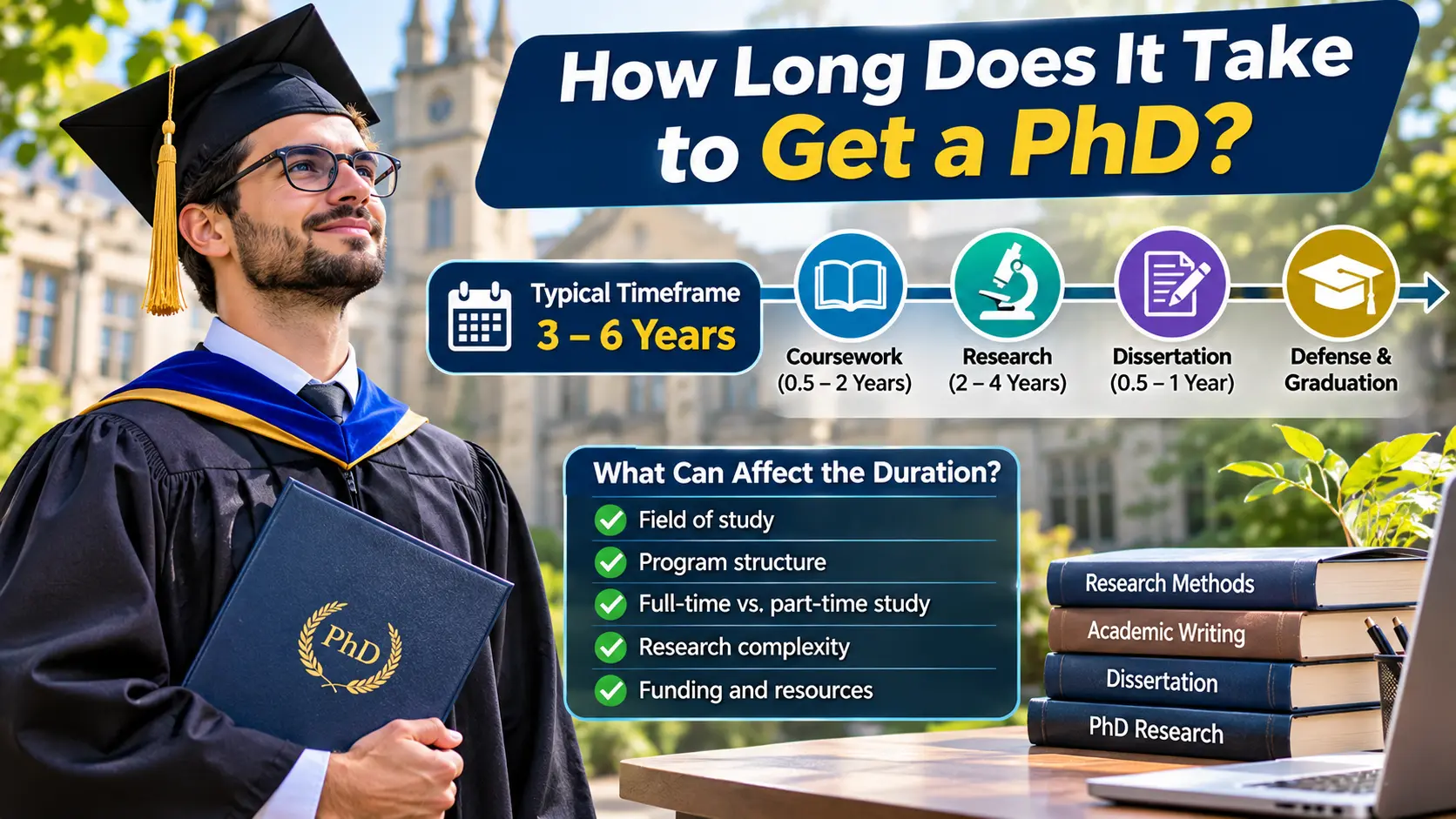
Many students start grad school asking the same thing: how long does it take to get a PhD, really? The honest answer is about five to seven years for most students in the U.S., counted from the first day of the doctoral program. Still, your field, funding, research and life outside school can push that number up or down.
In this guide, you will see what the data says, how a typical PhD unfolds year by year and how timelines differ in psychology, education, history and other fields. Plus, you will find practical tips to help you finish on time.
How Long Does It Take to Get a PhD? The Short Answer
According to the National Science Foundation’s Survey of Earned Doctorates, recent PhD graduates spent a median of about 5.7 years in their doctoral programs. However, that is only one way to measure it.
Three Ways to Measure PhD Time
When you see different numbers online, it is usually because people start the clock at different points. Here are the three common measures from recent national data:
- From starting the doctoral program: About 5.7 years.
- From starting any graduate school: About 7.3 years, since it includes master’s study.
- From earning a bachelor’s degree: About 8.6 years, because many people work or take breaks first.
So, if you are planning from the very start of college, you should also count your undergraduate years. For that part, our guide on How Long to Get a Bachelor’s Degree? explains typical timelines and ways to graduate sooner.
The Typical PhD Timeline, Year by Year
Every program is different. Still, most follow a similar path. If you are new to graduate study in general, our explainer on What Is Grad School? covers the basics before you start planning a doctorate.
Years 1–2: Coursework
First, you take advanced classes in your field. Meanwhile, you often work as a teaching or research assistant. During this time, you also start choosing an advisor and narrowing your research interests.
Exams and Proposal
Next, most programs require qualifying or comprehensive exams. These test whether you know your field well enough to do original research. After that, you write and defend a dissertation proposal. Once you pass, you usually become a “PhD candidate.”
Research and Writing
Then comes the longest stage. You collect data, run experiments, study archives or analyze sources, depending on your field. As a result, this phase often takes two to four years, and it is where timelines vary the most.
Defense
Finally, you write your dissertation and defend it before a faculty committee. After any revisions, you earn your degree.
Here is a quick summary of a typical full-time path:
- Years 1–2: Coursework and teaching or research work.
- Year 2–3: Exams and dissertation proposal.
- Years 3–6: Research and writing.
- Final year: Defense and graduation.
How Long Does It Take to Get a PhD After Masters?
A master’s degree can shorten your PhD, but not always. In some programs, your earlier credits count toward coursework, so you might save about a year. As a result, many students finish in roughly four to five years after a related master’s.
However, other programs require the full course load no matter what. Also, some U.S. programs admit students straight from a bachelor’s and award a master’s along the way. So, ask each school how they treat transfer credits before you apply.
Timelines by Field
Your subject has a big effect on time. Based on recent national data, here are typical medians measured from the start of the doctoral program.
How Long Does It Take to Get a PhD in Psychology?
In recent data, psychology doctorates took a median of about six years. However, clinical and counseling psychology programs often take longer, since they usually include a full-year internship before graduation.
How Long Does It Take to Get a PhD in Education?
Education doctorates often follow a different pattern. Many students are working teachers or school leaders who study part time. Because of that, the total time from bachelor’s degree to doctorate is often much longer in education than in other fields, even when the program itself is a similar length.
How Long Does It Take to Get a PhD in History?
History and other humanities fields tend to take the longest. Recently, the median was close to seven years in humanities and arts programs. Typically, that is because research often involves archive trips, language study and long writing periods.
STEM and Business
In contrast, science and engineering programs averaged around 5.6 years, while business doctorates were among the fastest at about five years. Usually, lab-based programs move faster because students join funded projects early.
What Slows a PhD Down?
Several common factors can stretch your timeline:
- Funding gaps: If you need outside work, research time shrinks.
- Changing topics or advisors: Starting over can cost a year or more.
- Research setbacks: Experiments fail, and data takes longer than planned.
- Part-time study: Balancing a job and family naturally adds time.
- Field requirements: Fieldwork, languages or internships add extra steps.
On the other hand, steady funding often helps students finish faster. That is why many apply for support like fellowships. To learn how these awards work, read our guide on What Is a Fellowship?
PhD vs Professional Doctorate
Not every doctorate is a PhD. For example, degrees like the EdD, PsyD, JD and MD focus on professional practice rather than research. Often, these follow a more structured schedule, so they can be more predictable in length.
Meanwhile, a PhD focuses on creating new knowledge through original research. If you are weighing both paths, our article on What Is a Professional Degree? explains the key differences.
Tips to Finish Your PhD Faster
- Choose your advisor carefully: Look for someone whose students finish on time and who gives regular feedback.
- Pick a focused topic: A clear, manageable question is easier to finish.
- Secure funding early: Assistantships and fellowships let you focus on research.
- Set small deadlines: Break big goals into monthly and weekly tasks.
- Write as you go: Draft chapters early instead of saving all the writing for the end.
- Protect your health: Burnout slows progress, so rest and get support when needed.
Career Paths After a PhD
A doctorate can lead to many careers. For instance, graduates work as professors, researchers, data scientists, policy advisors, consultants and industry experts. Some also teach part time while building their careers. For more on that path, see our guide on What Is an Adjunct Professor?
So, think about your goals early. That way, you can choose research, internships and skills that match the job you want.
Frequently Asked Questions
Can you get a PhD in three years?
It is possible, especially in some countries like the UK, where many programs expect students to arrive with a master’s. However, most U.S. programs take longer.
How long does it take to get a PhD part time?
Generally, part-time study takes about seven to ten years or more, depending on your schedule and program rules.
Is there a time limit to finish?
Yes, many schools set a maximum, often around seven to ten years. Still, rules vary, so check your program’s handbook.
Key Takeaways for Future PhD Students
To sum up, most U.S. students finish a PhD in about five to seven years after starting the program. Meanwhile, humanities fields usually take longer, while business and STEM programs often move a bit faster.
So, before you apply, ask programs about their average completion time, funding and advising support. Then, set clear yearly goals, write steadily and lean on your advisor. Those habits can make a long journey feel much more manageable.