
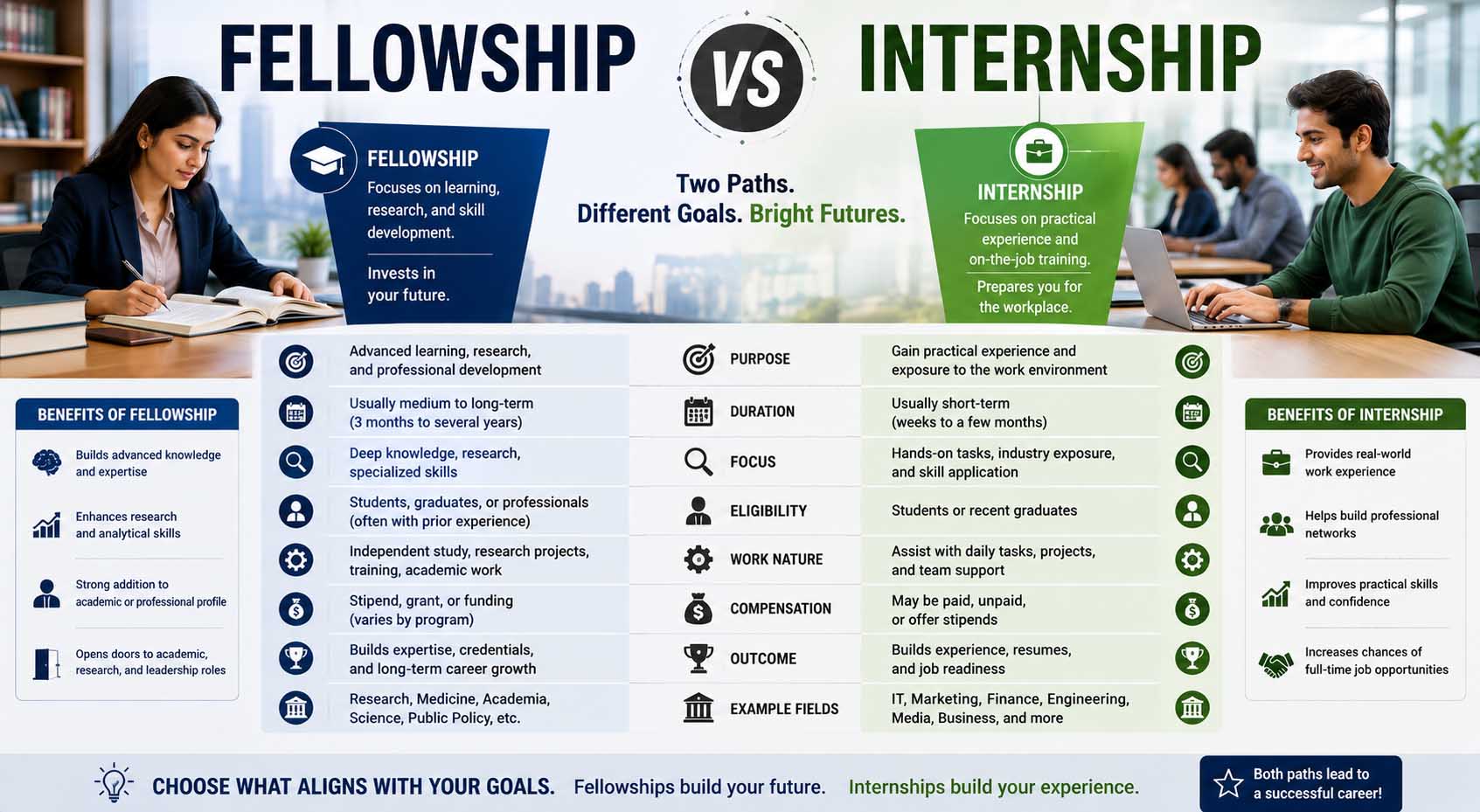
If you are looking for experience beyond the classroom, you may come across both internships and fellowships. Although they can sound similar, fellowship vs internship opportunities often serve different purposes. An internship usually gives students or early-career workers practical experience in a workplace, while a fellowship commonly supports specialized study, research, professional development, public service, or a defined project.
However, those definitions are not universal. Some organizations use the terms differently, so the program description matters more than the title alone.
For students, the right choice usually depends on education level, career goals, existing experience, and what they hope to accomplish next. Therefore, understanding the differences can help you spend your time on opportunities that actually support your future plans.
Fellowship vs Internship: Quick Comparison
The easiest way to understand these opportunities is to compare their typical characteristics.
| Feature | Internship | Fellowship |
|---|---|---|
| Main purpose | Practical work experience | Specialized development, research, study, or service |
| Common applicants | Students and early-career workers | Often graduates, professionals, researchers, or advanced students |
| Experience level | Usually beginner to intermediate | Often intermediate to advanced |
| Structure | Workplace tasks and training | Project, research, training, study, or professional development |
| Duration | Weeks to several months, sometimes longer | Months to a year or more |
| Compensation | Paid or unpaid, depending on program and law | May include salary, stipend, grant, or other support |
| Supervision | Manager or workplace supervisor | Mentor, faculty member, program leader, or professional |
| Main outcome | Job skills and workplace exposure | Deeper expertise, project outcomes, research, service, or career development |
For example, a highly specialized internship could require significant experience, while some fellowships accept recent college graduates.
Therefore, always evaluate the actual requirements before deciding whether a program suits you.
What Is an Internship?
An internship is a temporary work-based learning opportunity. It allows someone to experience a profession, industry, or organization while developing practical skills.
Internships are especially common among college students, recent graduates, and people exploring a new career. However, eligibility varies widely.
For example, a marketing intern might help prepare social media content, conduct competitor research, organize campaign data, and attend team meetings. Meanwhile, an engineering intern could assist with testing, documentation, design work, or technical analysis under supervision.
The goal is usually practical exposure.
Instead of only studying how an industry works, interns see how professionals handle real projects, deadlines, communication, and workplace responsibilities.
Students comparing the difference between undergraduate and graduate education may also notice that internships appear at both levels. Still, undergraduate internships often emphasize exploration and foundational experience, while graduate internships may involve more specialized work.
Are internships paid?
Many internships are paid, although compensation depends on the employer, location, industry, program structure, and applicable employment laws.
Some academic programs may also offer course credit for qualifying internships. However, students should never assume that receiving academic credit automatically determines whether an internship can legally be unpaid. Rules vary by jurisdiction and situation.
Before accepting an offer, check the compensation, expected hours, duties, learning opportunities, supervision, and any costs you would need to cover yourself.
What Is a Fellowship?
If you are wondering what is a fellowship?, think of it as a structured opportunity that often supports a specific academic, professional, research, creative, leadership, or public-service goal.
Fellowships vary significantly.
For instance, one program might fund graduate research. Another could place recent graduates in government or nonprofit organizations. Meanwhile, a professional fellowship could help experienced workers develop leadership skills or gain specialized expertise.
Some fellowships provide a stipend, salary, grant, tuition support, travel funding, housing assistance, or a combination of benefits. Others provide professional development and access to mentors without offering the same type of financial package.
As a result, the word “fellowship” alone tells you relatively little about compensation.
The application process may also be competitive. Depending on the program, applicants could submit essays, academic records, recommendations, project proposals, portfolios, or evidence of previous achievements.
Internship vs Fellowship: The Biggest Differences
Although both experiences can strengthen your education and career, their goals often differ.
Internships focus heavily on workplace experience
Internships commonly introduce participants to day-to-day professional work. Therefore, they can be useful if you want to test a career before committing to it.
For example, a student considering journalism could spend a summer working with an editorial team. That experience may reveal whether the student enjoys reporting, editing, deadlines, and newsroom routines.
Fellowships, by comparison, often have a narrower mission. A journalism fellowship might focus specifically on investigative reporting, international media, data journalism, or another advanced area.
Fellowships may expect stronger qualifications
Many internships are designed for applicants who are still building experience. Consequently, employers may focus heavily on potential, coursework, interests, and transferable abilities.
Fellowships can be different. Some programs expect a degree, previous professional experience, research background, leadership experience, or demonstrated expertise.
If you plan to apply for either opportunity, reviewing the right skills to put on resume can help you present relevant academic projects, technical abilities, volunteer experience, leadership, and previous work clearly.
The expected outcomes can differ
An internship may end once the scheduled work period finishes. Ideally, the intern leaves with stronger skills, professional contacts, references, and a clearer understanding of the career.
A fellowship may have more specific outcomes.
For instance, fellows might complete research, develop a policy proposal, produce creative work, participate in leadership training, teach, conduct community projects, or present their findings.
Therefore, ask yourself what you want to have accomplished when the program ends.
What Is a Fellowship vs Internship for Students?
For students, choosing between the two becomes easier once you identify your current goal.
Choose an internship when you primarily want workplace exposure, hands-on skills, industry contacts, or a chance to explore a career.
For example, suppose you are studying computer science but are unsure whether you prefer software engineering, cybersecurity, or data analysis. An internship can provide real workplace exposure before you make a longer-term decision.
A fellowship may make more sense when you already have a defined academic or professional interest and want a structured opportunity to develop it further.
Students considering What Is Grad School? may encounter fellowships while researching master’s or doctoral programs because some fellowships are connected with graduate education, research, or academic funding.
However, fellowships are not limited to graduate school. Programs also exist in government, education, nonprofits, journalism, science, technology, arts, international affairs, and many other fields.
Fellowship vs Internship vs Apprenticeship
Adding apprenticeships to the comparison can create confusion because all three provide learning outside a traditional classroom.
An apprenticeship usually combines structured training with paid work while preparing someone for a specific occupation. Depending on the field and country, apprentices may follow formal training standards and work toward recognized credentials.
An internship is generally shorter and focuses on gaining exposure or practical experience.
A fellowship, meanwhile, usually supports specialized professional, academic, research, leadership, or service development.
So, when comparing fellowship vs internship vs apprenticeship, think about the primary objective:
- Internship: gain practical workplace experience.
- Fellowship: develop specialized knowledge or complete a focused program.
- Apprenticeship: train systematically for an occupation while working.
Still, program structures vary. Therefore, compare actual responsibilities instead of choosing based solely on the title.
Internship vs Residency vs Fellowship
The terms become more specialized in medical education.
In the United States, medical residency is postgraduate clinical training that physicians complete after medical school. A fellowship generally follows residency when a physician pursues advanced training in a subspecialty.
“Internship” has historically been used for the first postgraduate year of physician training, although current terminology and program structures can differ.
Therefore, internship vs residency vs fellowship in medicine should not be treated as identical to internships and fellowships in ordinary college or corporate settings.
Medical students should rely on current information from accredited programs, licensing bodies, and official medical education organizations when planning their training path.
How to Choose Between a Fellowship and an Internship
Instead of asking which opportunity is better overall, ask which one matches your current stage.
Start by defining your main objective.
Do you need your first serious workplace experience? If so, an internship may offer exactly what you need.
On the other hand, do you already have foundational experience and want to specialize, conduct research, develop leadership abilities, or complete a particular project? In that case, a fellowship may be more suitable.
Next, examine eligibility carefully. Some fellowships require a completed bachelor’s degree, while others accept current students. Likewise, some internships are limited to enrolled students, while others welcome recent graduates or career changers.
Then compare the practical details: compensation, duration, location, working hours, mentorship, expected responsibilities, and what participants have accomplished afterward.
Finally, consider opportunity cost. A prestigious title does not automatically make a program worthwhile. The experience should move you toward your academic or career goals.
Applying for Internships and Fellowships
Strong applications show why your background fits the specific opportunity.
Instead of sending the same resume and cover letter everywhere, adjust your materials to emphasize relevant experience. For example, an internship application may highlight coursework, class projects, technical skills, volunteering, and part-time jobs.
A fellowship application may require a clearer explanation of your long-term goals, previous achievements, research interests, community involvement, or proposed project.
Interviews can also work both ways. Preparing unique interview questions to ask employer can help you understand supervision, responsibilities, learning opportunities, team culture, and expectations before accepting an internship.
For fellowships, ask about mentorship, program goals, funding conditions, deliverables, professional development, and what previous fellows typically do after completing the program.
Common Mistakes When Comparing Opportunities
A common mistake is assuming that every fellowship is more prestigious than every internship. In reality, the value depends on the program and your goals.
Likewise, do not choose solely based on compensation. Pay matters, especially when housing, transportation, or relocation costs are involved. Still, mentorship, responsibilities, networking, and skill development also deserve attention.
Another mistake is ignoring eligibility requirements until late in the application process. Some programs require specific degrees, graduation dates, citizenship or work authorization conditions, academic fields, or experience levels.
Finally, avoid collecting impressive-sounding programs without a career plan. A relevant internship can sometimes provide more value than an unrelated fellowship.
Frequently Asked Questions
Is a fellowship higher than an internship?
Not necessarily. Fellowships often target applicants with more education or experience, but there is no universal hierarchy. Instead, compare eligibility, responsibilities, learning outcomes, and career relevance.
Can undergraduate students get fellowships?
Yes, some fellowships accept undergraduates. However, many others target recent graduates, graduate students, researchers, or established professionals. Eligibility depends entirely on the individual program.
Do fellowships lead to jobs?
They can create professional connections and valuable experience, but a job is not guaranteed unless the program explicitly includes a defined employment pathway. Therefore, applicants should review outcomes from previous participants when that information is available.
Which looks better on a resume?
Neither automatically looks better. Employers generally care about what you accomplished, which skills you developed, and how the experience relates to the position you want.
Should you do both?
You can. For example, a student might complete internships during college and pursue a fellowship after graduation. However, there is no requirement to follow that order.
Making the Right Choice for Your Next Step
The fellowship vs internship decision becomes much simpler when you focus on purpose rather than labels. Internships generally work well for gaining hands-on experience and exploring careers, while fellowships often support specialized study, research, leadership, service, or professional development.
Your education level can influence the choice, but it should not decide everything. Instead, compare the actual work, mentorship, compensation, eligibility requirements, and expected outcomes.
Most of all, choose the opportunity that gives you meaningful experience you can explain later. Whether the title says intern or fellow matters less than the knowledge, skills, connections, and accomplishments you carry forward.