Many students researching colleges eventually ask about the difference between undergraduate and graduate programs. Although both are part of higher education, they serve different purposes and suit students at different stages of their academic journey.
First, an undergraduate program is usually the first level of university education after high school. Then, a graduate program comes afterward and lets students specialize in a subject through advanced study or research. Therefore, knowing how they differ can help you make better decisions about your education, career goals and future opportunities.
What Is the Difference Between Undergraduate and Graduate?
The simplest answer depends on your previous education. According to UCLA’s comparison of undergraduate and graduate degrees, associate and bachelor’s degrees are undergraduate, while master’s and doctoral degrees are graduate.
- Undergraduate students are working toward their first college degree, such as an associate or bachelor’s degree.
- Graduate students have already completed a bachelor’s degree and are pursuing advanced education, such as a master’s or doctoral degree.
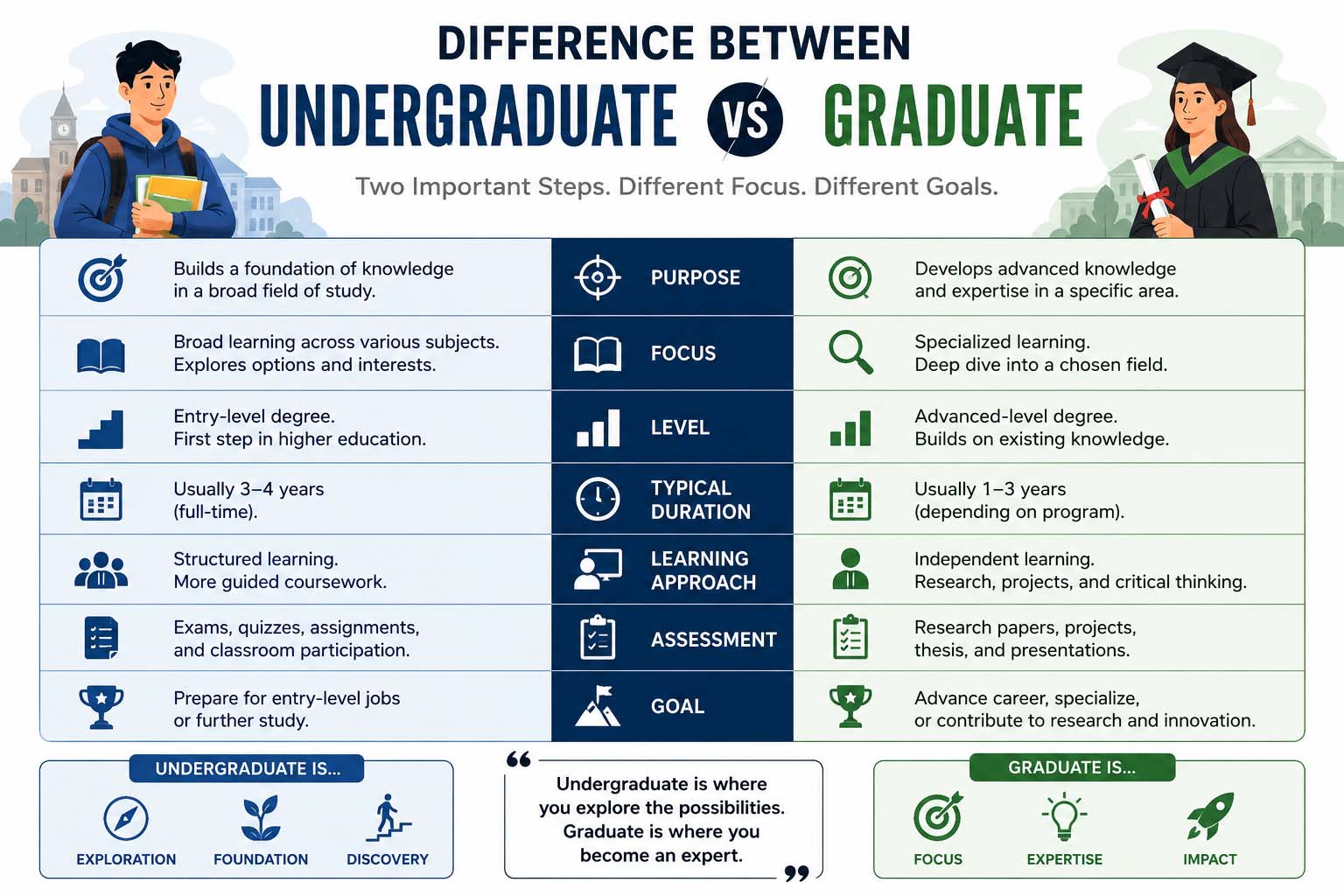
In addition, here is a quick comparison.
| Undergraduate | Graduate |
|---|---|
| First stage of higher education | Advanced stage of higher education |
| Associate or bachelor’s degree | Master’s, doctorate or other graduate degree |
| Broad learning across subjects | Specialized learning in one field |
| Larger class sizes | Often smaller classes and seminars |
| Focus on building knowledge | Focus on advanced skills, research and expertise |
As a result, this overview makes it easier to see how each level supports different educational goals.
What Is an Undergraduate Program?
An undergraduate program is designed for students who begin college after high school or an equivalent qualification. First, these programs introduce foundational knowledge. Also, they help students develop critical thinking, communication and problem-solving skills. Most students explore general education courses before they focus on a major.
Students usually choose from degrees such as an associate degree, a Bachelor of Arts (BA), a Bachelor of Science (BS), a Bachelor of Fine Arts (BFA) or a Bachelor of Business Administration (BBA). However, the exact options depend on the college or university.
If you are still planning your academic timeline, learning How Long to Get a Bachelor’s Degree? can help you understand how long undergraduate studies take and what may affect graduation.
What Is a Graduate Program?
Graduate education begins after you earn a bachelor’s degree. In contrast to undergraduate study, these programs provide deeper knowledge in a specific discipline. As a result, they often prepare students for professional careers, research, leadership roles or academic teaching.
Graduate students usually complete more independent work. For example, many programs include research projects, internships, comprehensive exams or a thesis.
Common graduate degrees include the Master of Arts (MA), Master of Science (MS), Master of Business Administration (MBA), Doctor of Philosophy (PhD) and Doctor of Education (EdD). Also, many universities offer specialized graduate certificates alongside these degrees.
If you are exploring advanced education, understanding What Is Grad School? can clarify how these programs are organized and what students should expect.
Difference Between Graduate and Undergraduate Coursework
One of the biggest differences appears in the classroom. Graduate courses expect students to analyze complex ideas, evaluate research, solve advanced problems and contribute original thinking. Instead of memorizing information, graduate students often discuss theories, complete independent research and present their own findings.
| Learning style | Undergraduate | Graduate |
|---|---|---|
| Main activities | Lectures, quizzes, exams and group projects | Seminars, independent research and presentations |
| Writing | Introductory research papers | Advanced writing and scholarly analysis |
| Subject range | Exploring several disciplines | Focusing deeply on one field |
| Guidance | Structured guidance from professors | Greater independence and self-management |
Therefore, professors generally provide structured guidance throughout an undergraduate semester. In contrast, they often expect graduate students to manage their own learning.
Difference in Admission Requirements: Undergraduate and Graduate
Admission requirements also differ between the two levels. For undergraduate admission, most colleges review high school transcripts, standardized test scores when required, personal essays, recommendation letters and extracurricular activities. As a result, the goal is to judge a student’s readiness for college-level work.
Meanwhile, graduate schools often require:
- A completed bachelor’s degree
- Undergraduate GPA
- Letters of recommendation
- A personal statement
- A resume or CV
- Standardized exams for some programs
- Writing samples or portfolios for selected fields
Some programs may also require interviews before admission. In addition, universities often ask for official academic records, so What Is a Transcript? explains what those records contain and how to request them.
Difference in Class Size: Undergraduate and Graduate
The learning environment changes significantly between the two levels. For example, undergraduate classes often include dozens or even hundreds of students, especially in introductory courses. In contrast, graduate classes are generally much smaller. As a result, these groups encourage discussion, collaboration and close interaction with professors, and students receive more individual feedback.
Faculty expectations also change. Undergraduate students receive more structured instruction, detailed assignments and regular reminders. However, graduate students are expected to take initiative by managing research, meeting deadlines independently and joining advanced academic discussions.
Furthermore, as students progress, they may meet instructors described in What Is an Adjunct Professor?, who often teach specialized courses based on experience in their field.
Research and Academic Writing
Research becomes increasingly important in graduate education. While undergraduate students certainly write research papers, graduate students spend much more time evaluating academic literature and producing original work. Therefore, strong research and writing skills from undergraduate study create a solid foundation for success in graduate school.
Career Opportunities After Each Degree
The education you complete can influence the careers available to you, although experience and skills also play a major role. Many undergraduate degree holders begin successful careers right after graduation. For example, fields such as marketing, finance, education, information technology and business often hire candidates with bachelor’s degrees for entry-level and mid-level positions.
On the other hand, graduate degrees may open doors to specialized careers, leadership roles, research positions or university teaching. In some industries, an advanced degree can also increase earning potential and create opportunities for promotion. Therefore, let your career goals guide your decision rather than the idea that one degree is always “better.”
When Should You Consider Graduate School?
Graduate education is not the right choice for everyone. Before applying, ask yourself questions such as:
- Do I need an advanced degree for my desired career?
- Am I interested in research or specialized knowledge?
- Will a graduate degree improve my career opportunities?
- Am I prepared for the time and financial commitment?
If you answer “yes” to several of these questions, graduate school may be a logical next step after your bachelor’s degree. Otherwise, you may want to wait or explore other options.
Professional Degrees and Specialized Programs
Not every graduate program follows the same path. For example, some students pursue academic degrees focused on research, while others enroll in programs that prepare them for specific professions.
If you are comparing advanced options, learning What Is a Professional Degree? can help you understand programs designed for careers such as law, medicine and pharmacy. Therefore, choose a program based on your long-term plans rather than the highest available degree.
Common Myths About Undergraduate and Graduate Study
Students often hear conflicting advice, so let us clear up a few common myths.
- Myth: Graduate school is required for every career. In fact, many careers only require a bachelor’s degree. Graduate education is valuable in many fields, but it is not a universal requirement for success.
- Myth: Graduate courses are just harder versions of undergraduate classes. Actually, they differ in more ways than difficulty. They emphasize research, critical analysis, discussion and independent learning instead of broad introductory topics.
- Myth: You must continue directly after college. However, many students work for several years first. Professional experience often helps them choose a program that matches their career goals.
How to Decide Which Path Is Right for You
If you are unsure whether to continue after a bachelor’s degree, take time to evaluate your priorities. Think about:
- Your career goals
- Your financial situation
- Your interest in advanced study
- The job market in your chosen field
- The time required to complete another degree
Also, talking with academic advisors, professors and professionals in your field can help you make an informed decision.
Difference Between Undergraduate and Graduate: Quick Checklist
Use this checklist as a simple study aid.
| Undergraduate | Graduate |
|---|---|
| First college degree | Advanced degree after a bachelor’s |
| Broad academic foundation | Specialized subject expertise |
| Larger classes | Smaller seminars and research groups |
| More structured learning | Greater independence |
| General career preparation | Advanced career or research preparation |
| Associate degrees often take about 2 years and bachelor’s degrees about 4 | Master’s programs often take 1 to 3 years, and doctorates usually take longer |
If you remember these points, you will be able to answer many classroom questions with confidence.
FAQs About the Difference Between Undergraduate and Graduate
What’s the difference between undergraduate and graduate?
The main difference is that undergraduate education is the first level of university study. In contrast, graduate education comes after a bachelor’s degree and focuses on advanced learning in a specialized field.
Can I attend graduate school without a bachelor’s degree?
In most cases, no. Universities generally require applicants to complete a bachelor’s degree first. However, some institutions offer combined programs with unique admission pathways.
Is graduate school harder than undergraduate school?
Graduate school is usually more demanding because students complete advanced coursework, independent research and specialized projects. As a result, the workload often requires stronger time management and self-directed learning.
Which is better for jobs: undergraduate or graduate degrees?
That depends on the career. Many professions only require a bachelor’s degree, while others prefer or require graduate education. Therefore, research the qualifications commonly expected in your chosen field before you decide.
Can I change subjects in graduate school?
Yes. Some graduate programs accept students from different academic backgrounds. However, certain fields may require prerequisite courses before admission.
Your Next Step in Higher Education
Understanding the difference between undergraduate and graduate education helps you choose a path that matches your goals instead of following someone else’s expectations.
If you are beginning college, focus on building a strong academic foundation, exploring your interests and developing practical skills. Meanwhile, if you have already earned a bachelor’s degree, consider whether graduate study supports the career you want rather than treating it as the automatic next step.
Every educational journey is different. Therefore, by understanding how the two levels differ, you will be better prepared to compare your options, ask informed questions and make confident decisions about your future.