
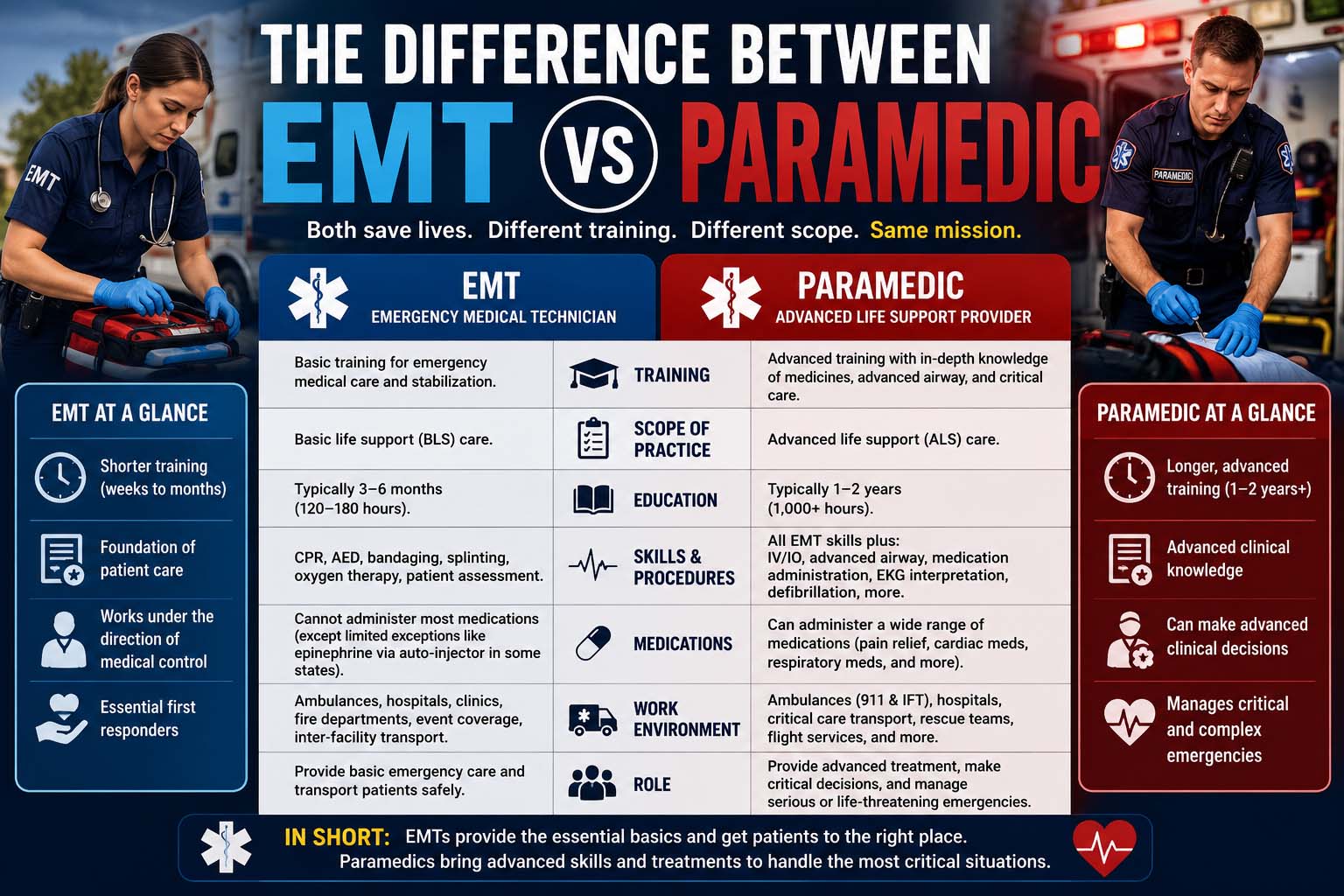
First, understanding the difference between EMT and paramedic roles is a key step toward an emergency medical career. Both professionals respond to medical emergencies, provide lifesaving care, and transport patients to hospitals. However, their education, responsibilities, and scope of practice are quite different.
Also, many students ask whether to become an Emergency Medical Technician (EMT) or a paramedic. Therefore, the right choice depends on your career goals and the training you’re willing to complete. Also, it depends on the type of patient care you want to provide.
In addition, this guide explains the key differences, educational pathways, and career opportunities. As a result, you can confidently choose the path that fits your future.
What Is the Difference Between EMT and Paramedic?
First, the simplest answer to what is the difference between an EMT and a paramedic is education. Also, paramedics receive much more advanced medical training than EMTs.
For example, an EMT provides basic emergency medical care, stabilizes patients, and safely transports them to healthcare facilities. Meanwhile, a paramedic can perform many advanced procedures and administer a wider range of medications. Also, paramedics interpret heart rhythms and manage more complex emergencies.
Furthermore, both roles are essential members of emergency medical teams, and they often work together during emergency calls.
Difference Between EMT and Paramedic at a Glance
First, here’s a quick comparison.
| Feature | EMT | Paramedic |
|---|---|---|
| Education | Basic EMS program | Advanced EMS program |
| Training length | Several months | One to two years (varies by program) |
| Patient care | Basic life support | Advanced life support |
| Medication administration | Limited | Extensive |
| Airway management | Basic | Advanced |
| Medical procedures | Basic emergency care | Advanced procedures and monitoring |
| Career advancement | Entry-level EMS | Advanced EMS professional |
Although requirements differ by country and state, this table reflects the typical progression. Also, the U.S. Bureau of Labor Statistics reports that EMT programs usually take less than a year for EMT-Basic. Meanwhile, paramedic programs typically lead to a nondegree award or an associate’s degree.
Difference Between EMT and Paramedic: What an EMT Does
First, emergency medical technicians are often the first healthcare professionals to arrive at an emergency. For example, their responsibilities include assessing patients, controlling bleeding, performing CPR, providing oxygen therapy, and splinting broken bones. Also, they assist with childbirth emergencies, monitor vital signs, and safely transport patients.
As a result, EMTs play a critical role in keeping patients stable until they reach a hospital or receive more advanced care.
Besides, EMT education is the starting point for many healthcare careers. For example, students exploring related professions may find Online Radiology Tech Programs useful when comparing paths in patient care.
Difference Between EMT and Paramedic: What a Paramedic Does
First, paramedics perform all the duties of an EMT while also providing advanced medical treatment. For example, paramedics may start intravenous (IV) lines, give many medications, and perform airway procedures, depending on local rules. Also, they interpret electrocardiograms (ECGs), use cardiac monitoring equipment, and perform manual defibrillation. Finally, they treat severe trauma and manage cardiac arrest and stroke patients.
Because of their advanced training, paramedics often make complex treatment decisions before patients arrive at the hospital.
Difference Between EMT and Paramedic Education
First, one of the biggest parts of the difference between EMT and paramedic education is the amount of training required. For example, EMT programs introduce students to emergency patient care.
Also, typical EMT coursework includes human anatomy, basic physiology, CPR, trauma care, medical emergencies, patient assessment, and ambulance operations. In addition, most EMT programs combine classroom instruction with practical skills training and supervised clinical experience.
Meanwhile, paramedic education builds upon EMT knowledge and introduces more advanced topics. For instance, students study advanced anatomy, pharmacology, cardiology, airway management, trauma management, pediatric emergencies, obstetrics, and clinical decision-making. Moreover, most paramedic programs also require hospital clinical rotations and field internships under experienced paramedics.
Certification and Licensing
After completing an approved training program, students usually must pass certification or licensing examinations before working professionally. However, requirements vary depending on the country, state, or province. Also, many jurisdictions require continuing education throughout a professional’s career to maintain certification and stay current with evolving medical guidelines.
Difference Between EMT and Paramedic Scope of Practice
First, the difference between EMT and paramedic duties becomes especially clear when looking at their scope of practice. For example, EMTs generally provide Basic Life Support (BLS). Also, this includes CPR, oxygen administration, bleeding control, patient assessment, basic airway management, and AED use. As a result, these interventions help stabilize patients during transport.
However, paramedics provide Advanced Life Support (ALS). For instance, their duties often include medication administration, IV therapy, endotracheal intubation, cardiac rhythm interpretation, and advanced trauma care. Therefore, because they receive more extensive education, paramedics can perform procedures beyond an EMT’s scope of practice.
Working Environment
First, both EMTs and paramedics work in fast-paced environments. For example, they commonly respond to emergencies in homes, schools, highways, workplaces, sporting events, airports, public spaces, and ambulances. Also, every shift presents different challenges, requiring strong communication, teamwork, and quick decision-making.
Besides, students planning long-term healthcare careers may eventually pursue additional education. Also, learning What Is a Professional Degree? helps explain how advanced professional programs differ from standard academic degrees in healthcare and other specialized fields.
Skills Needed for Success
First, whether you become an EMT or a paramedic, several core skills are essential. For example, successful emergency medical professionals typically have strong communication skills, critical thinking, emotional resilience, and physical stamina. Besides, compassion, teamwork, time management, and attention to detail matter. In fact, these skills often become just as valuable as medical knowledge during high-pressure emergencies.
A Typical Emergency Response
First, understanding a typical call helps explain how EMTs and paramedics work together. For example, imagine responding to a serious traffic accident. Then, the EMT may secure the scene, assess the patient, control bleeding, provide oxygen, and prepare the patient for transport.
Meanwhile, the paramedic may establish IV access, administer medications, monitor heart rhythm, and perform advanced airway management if needed. Also, the paramedic may coordinate treatment decisions with the receiving hospital. As a result, the team combines basic and advanced life support to provide comprehensive emergency care before reaching the hospital.
Salary and Career Outlook
First, many students comparing these careers also want to know how income and job opportunities differ. Generally, paramedics earn higher salaries than EMTs because they complete more education and are qualified to perform advanced medical procedures.
For example, the U.S. Bureau of Labor Statistics lists a median annual wage of $44,470 for EMTs and $60,600 for paramedics in May 2025. Also, actual pay depends on factors such as location, employer, years of experience, certifications, and overtime.
Moreover, demand for both EMTs and paramedics remains steady because communities continually need trained emergency medical professionals. In addition, ambulance services, fire departments, hospitals, industrial sites, and event medical teams all employ EMS personnel. Therefore, for students seeking long-term career stability, emergency medical services continue to offer opportunities for growth and specialization.
Difference Between an EMT and a Paramedic in Career Advancement
First, a common question is the difference between an EMT and a paramedic in career progression. For example, an EMT often begins working after completing an entry-level EMS program. Then, with additional education and clinical experience, many EMTs later enroll in a paramedic program.
After that, paramedics may advance into roles such as flight paramedic, critical care paramedic, EMS supervisor, or training instructor. Also, some become emergency management specialists or community paramedics. Moreover, some continue their education to become registered nurses, physician assistants, or physicians.
Besides, you may later explore the difference between undergraduate and graduate education before choosing an advanced degree.
How to Become an EMT or Paramedic
First, although exact requirements vary by location, the general pathway is similar.
- First, complete basic education, because most EMS programs require a high school diploma or equivalent. Also, strong knowledge of biology, health science, and communication can make future coursework easier.
- Next, enroll in an approved EMT program that combines classroom learning with practical skills and supervised clinical experience.
- Then, earn certification, because candidates usually take a certification or licensing examination required by their local authority.
- After that, gain work experience, since many future paramedics spend time working as EMTs before continuing their education. Also, this practical experience builds confidence and improves patient assessment skills.
- Finally, complete a paramedic program for advanced life support, which adds hospital clinical rotations and field internships.
Besides, some students who balance demanding healthcare coursework occasionally look for academic support services. For example, if you’re managing multiple assignments, resources like Do My Nursing Assignment may provide study assistance and help you stay organized.
Choosing the Right Career
First, the best choice depends on your interests, career goals, and preferred level of responsibility. For example, an EMT may be a good fit if you want to enter the workforce quickly. Also, this path suits people who enjoy emergency response, prefer shorter training, or want experience before further education.
However, a paramedic may be the better option if you want to perform advanced medical procedures. Likewise, this path suits people who enjoy complex clinical decisions, want a long-term healthcare career, or accept additional education. Still, neither path is better for everyone. In fact, many successful paramedics began their careers as EMTs and gradually expanded their skills.
Common Misconceptions
First, students often hear inaccurate information about these careers. Therefore, let’s clear up a few common myths.
For instance, some people say EMTs only drive ambulances, but that is false. In fact, EMTs provide patient assessments, emergency treatment, monitoring, and lifesaving care throughout the entire response.
Also, others believe paramedics are doctors, but that is not true. Instead, paramedics receive advanced emergency medical training, but they are not physicians. Moreover, they follow established medical protocols and often work under physician medical direction.
Likewise, some assume that becoming a paramedic is only slightly harder, but that is not quite right. In fact, paramedic education covers much more advanced anatomy, pharmacology, cardiology, and emergency medicine than EMT training.
Finally, some think EMT certification ends your education. However, many EMS professionals continue learning throughout their careers by earning advanced certifications, completing continuing education, and pursuing higher degrees.
Also, some eventually participate in advanced clinical training or specialized research programs. As a result, understanding What Is a Fellowship? can help you learn how structured post-qualification training supports expertise in many healthcare professions.
Frequently Asked Questions About the Difference Between EMT and Paramedic
What is the difference between EMT and paramedic?
First, the main difference is education and scope of practice. Also, EMTs provide basic life support, while paramedics receive advanced training for complex procedures and additional medications.
Can an EMT become a paramedic?
In fact, many people begin as EMTs and later complete a paramedic program after gaining practical experience.
Which career takes longer to complete?
Generally, paramedic education takes longer because it includes advanced coursework, clinical rotations, and field internships beyond EMT training.
Do EMTs and paramedics work together?
Indeed, they commonly respond as part of the same ambulance crew. As a result, patients receive both basic and advanced life support.
Is becoming a paramedic worth it?
Still, for students interested in advanced emergency medicine, becoming a paramedic can be a rewarding long-term career choice.
Key Takeaways on the Difference Between EMT and Paramedic
Therefore, understanding the difference between EMT and paramedic roles helps you choose a path that matches your goals. While EMTs provide essential basic life support, paramedics add advanced clinical training and a broader scope of practice.
Also, both careers make a meaningful difference every day by helping people during medical emergencies. Next, if you’re considering emergency medical services, take time to research local training programs, certification requirements, and career opportunities. Finally, starting as an EMT can be an excellent first step. Moreover, you can always continue your education as your goals grow.