
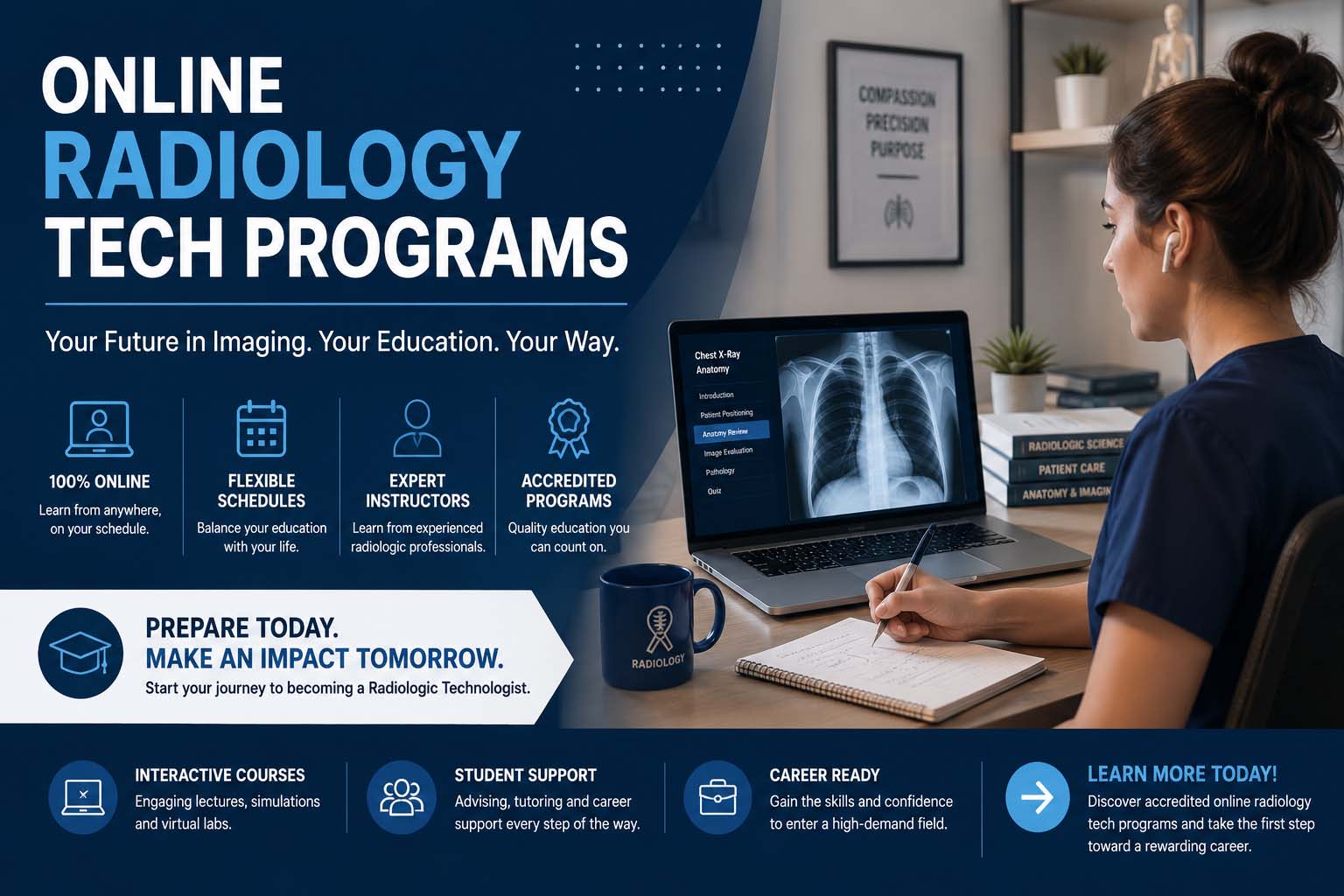
Online radiology tech programs offer a flexible way to begin preparing for a career in medical imaging. Radiologic technologists play an important role in healthcare by producing diagnostic images that help physicians identify injuries, illnesses, and other medical conditions.
Although students can complete many academic courses online, radiologic technology requires practical training. Therefore, most entry-level programs combine online instruction with supervised clinical experience at approved healthcare facilities.
Choosing the right program involves more than comparing tuition fees or course schedules. Students must also consider accreditation, certification eligibility, clinical placements, and state licensing requirements.
This guide explains how online radiology tech programs work, what students learn, and how to evaluate educational pathways before enrolling.
How Online Radiology Tech Programs Work
Healthcare education increasingly uses digital learning platforms to deliver academic instruction. As a result, some radiologic technology programs offer online or hybrid coursework.
Students can often access recorded lectures, complete assignments, participate in discussions, and review educational materials from home.
This flexibility may benefit working adults, parents, and students who live far from educational institutions.
However, online learning does not eliminate the need for practical experience. Radiologic technologists must learn to position patients, follow radiation safety procedures, and operate imaging equipment correctly.
Consequently, students should expect to complete supervised clinical rotations even when their academic courses take place online.
Medical imaging professionals work in hospitals, outpatient clinics, diagnostic centers, and other healthcare settings. Their responsibilities require technical knowledge, attention to detail, and effective patient communication.
Students exploring healthcare qualifications may also find it useful to understand What Is a Professional Degree? when comparing different educational pathways.
How Online Radiology Tech Programs Work
Online radiology tech programs typically combine theoretical education with hands-on clinical training.
Students study medical imaging principles through online classes while developing practical skills at approved healthcare facilities.
However, the amount of online instruction varies by institution. Some schools provide hybrid entry-level programs, while others offer online degree-completion options for professionals who already hold radiologic technology credentials.
Therefore, students should confirm whether a program accepts beginners or requires previous healthcare education.
Online Coursework in Radiology Tech Programs
Radiologic technology students study subjects that support safe and effective medical imaging.
Common coursework includes:
- Human anatomy and physiology
- Medical terminology
- Patient care and positioning
- Radiation physics
- Radiation protection
- Imaging procedures
- Medical ethics
- Image evaluation
- Healthcare communication
These subjects help students understand how imaging equipment works and how to support patients during diagnostic procedures.
For example, knowledge of the extensor carpi radialis longus can contribute to understanding forearm anatomy and appropriate positioning during certain imaging examinations.
In addition, online learning platforms may provide interactive lessons, quizzes, recorded demonstrations, and virtual learning activities.
Clinical Training in Online Radiology Tech Programs
Clinical education remains a central requirement of entry-level radiologic technology training.
During supervised placements, students learn how to prepare examination rooms, communicate with patients, position anatomical structures, and follow established imaging procedures.
Clinical instructors also help students understand patient safety and professional responsibilities.
For example, students may practice performing routine radiographic examinations under appropriate supervision.
However, a virtual simulation cannot replace the required hands-on clinical competencies.
Before enrolling, ask whether the institution arranges clinical placements and whether approved facilities operate near your location.
Examinations and Practical Assessments
Programs generally assess students through written examinations, coursework, and clinical evaluations.
Online tests may measure knowledge of anatomy, radiation protection, and imaging principles.
Meanwhile, clinical assessments evaluate practical performance and professional behavior.
Students must satisfy their program’s academic and clinical requirements before graduating.
Online Associate Radiology Tech Programs
Online associate radiology tech programs are an important option for students entering radiography.
Many entry-level radiography programs award an associate degree and take approximately two years to complete, although the exact duration depends on the institution and program structure.
Students usually complete general education courses alongside specialized radiologic technology subjects.
However, an associate degree program advertised as online may still require regular attendance at clinical facilities or on-campus laboratory sessions.
What Students Learn in an Associate Degree Program
Associate degree programs generally cover the foundations of diagnostic radiography.
Students learn about radiation safety, patient positioning, image production, and professional healthcare practices.
In addition, they develop communication skills that support interactions with patients and medical teams.
Understanding the methods of business communication can provide broader insight into clear professional communication, although radiologic technology programs emphasize healthcare-specific communication and patient safety.
Clinical rotations allow students to apply classroom knowledge in supervised medical environments.
Accreditation and Program Recognition
Accreditation is one of the most important factors to investigate before selecting a radiologic technology program.
Students should verify the institution’s accreditation and determine whether the radiography program holds appropriate programmatic accreditation.
For example, the Joint Review Committee on Education in Radiologic Technology (JRCERT) accredits eligible radiography educational programs.
However, students should not assume that every online program meets the same educational or professional requirements.
Before applying, confirm the program’s current accreditation status, clinical training arrangements, and eligibility for relevant certification examinations.
Certification and State Licensing Requirements
In the United States, many employers prefer or require professional certification.
The American Registry of Radiologic Technologists provides certification pathways for eligible medical imaging professionals.
Students can review the official ARRT certification requirements to understand the organization’s education, ethics, and examination requirements.
For the primary radiography certification pathway, candidates generally must complete an appropriate educational program and meet ARRT’s other eligibility requirements.
In addition, many states regulate radiologic technologists through licensing requirements.
Because state rules differ, students should verify the requirements in the state where they intend to work.
Benefits of Studying Radiologic Technology Online
Online and hybrid education can offer practical advantages for students who need greater scheduling flexibility.
However, the benefits depend on the institution, program structure, and individual circumstances.
Flexible Schedules in Online Radiology Tech Programs
Some programs allow students to watch recorded lectures and complete assignments outside traditional classroom hours.
This arrangement can make it easier to balance education with employment or family responsibilities.
Nevertheless, students must still meet assignment deadlines and attend scheduled clinical training.
Therefore, online learning requires organization and consistent study habits.
Reduced Transportation and Relocation Costs
Online coursework may reduce the need for frequent campus travel.
Students who live far from an educational institution may also avoid some relocation expenses.
However, clinical placements, equipment, textbooks, tuition, and other fees can still create significant costs.
Compare the total cost of attendance rather than assuming every online program is cheaper.
Access to Digital Learning Resources
Online platforms often provide recorded lectures, practice assessments, discussion forums, and digital study materials.
These resources can help students review difficult topics at their own pace.
For example, learners may revisit anatomy lessons before completing related clinical assignments.
In addition, online discussions can support communication with instructors and classmates.
How to Choose Accredited Radiology Tech Programs Online
Choosing a suitable program requires careful research.
Students should evaluate educational quality, professional eligibility, clinical requirements, and affordability before submitting an application.
Verify Accreditation and Certification Eligibility
First, confirm that the institution and program hold appropriate accreditation.
Next, ask whether graduates qualify for the certification pathway they intend to pursue.
Do not rely solely on promotional statements such as “fully accredited” or “certification ready.”
Instead, verify the specific accreditation and certification requirements directly.
Clinical Placements for Online Radiology Tech Programs
Clinical placements can determine whether a program is practical for your location.
Ask whether the school assigns students to approved facilities or expects them to arrange placements independently.
Also, confirm the expected clinical schedule and any travel requirements.
For working students, clinical availability may be more important than the flexibility of online lectures.
Compare Tuition and Additional Expenses
Review tuition, laboratory fees, books, uniforms, background checks, health requirements, and transportation costs.
Some programs may also charge additional fees for examinations or clinical activities.
Therefore, request a complete cost breakdown before enrolling.
Examine Student Support Services
Reliable academic and administrative support can improve the online learning experience.
Look for access to instructors, academic advising, technical assistance, and career services.
In addition, ask how the institution supports students who encounter difficulties during clinical training.
These services can make a meaningful difference throughout the program.
Can You Complete a Radiology Tech Program Fully Online?
Students frequently ask whether they can become radiologic technologists without attending classes or clinical facilities in person.
For entry-level radiography education, a completely online pathway without hands-on clinical training is not a realistic option.
Radiologic technologists must demonstrate practical skills involving patient care, equipment operation, and imaging procedures.
Therefore, programs may deliver academic coursework online, but students still need supervised clinical experience.
Some institutions also require in-person laboratory sessions.
However, professionals who already hold radiologic technology credentials may find more fully online options for advanced degrees or degree completion.
The distinction between entry-level training and continuing education is important when comparing programs.
Are 1 Year Radiology Tech Programs Online Available?
Many prospective students search for one-year radiology tech programs because they want to enter healthcare quickly.
However, students should understand the difference between a short healthcare training program and an educational pathway that qualifies graduates for radiography certification.
Understanding Accelerated Programs
Some institutions offer shorter certificate programs or accelerated educational pathways.
However, these options may serve students who already have relevant qualifications or healthcare experience.
Other short programs may prepare learners for limited-scope imaging roles rather than full radiologic technologist responsibilities.
Therefore, a one-year program should not automatically be considered equivalent to a standard entry-level radiography degree.
Check the Qualification Before Enrolling
Before choosing an accelerated program, confirm which professional credential it supports.
Ask whether graduates meet the applicable certification and licensing requirements.
In addition, verify the program’s clinical training arrangements.
Students should be cautious about advertisements promising rapid certification without clearly explaining eligibility requirements.
A shorter program is only useful when it leads to a recognized qualification appropriate for the intended career.
Career Opportunities After Radiologic Technology Training
Radiologic technologists work in several healthcare environments.
Their primary responsibilities often include preparing patients, positioning equipment, following safety procedures, and producing diagnostic radiographic images.
However, specific duties depend on training, credentials, workplace policies, and applicable regulations.
Hospitals and Emergency Departments
Hospitals employ radiologic technologists to support diagnostic imaging services.
These professionals may assist with examinations involving injuries, illnesses, and emergency medical conditions.
Because hospital departments operate on different schedules, some positions require evening, overnight, weekend, or holiday shifts.
Outpatient Clinics and Imaging Centers
Outpatient facilities provide diagnostic imaging services for patients who do not require hospital admission.
Technologists may perform scheduled examinations and help maintain efficient patient care.
These settings can offer different working conditions from hospital environments.
Specialization in Medical Imaging
Some radiologic technologists pursue additional education and credentials in specialized imaging areas.
Possible pathways include computed tomography, magnetic resonance imaging, and mammography.
However, each specialty has its own educational, clinical, and certification requirements.
For example, MRI technologists use magnetic fields and radiofrequency technology rather than the ionizing radiation used in conventional X-ray imaging.
Students interested in imaging careers should research the requirements of each specialty before selecting a training pathway.
Anatomical Knowledge and Professional Development
Strong anatomical knowledge helps imaging professionals understand patient positioning and image evaluation.
For example, studying structures such as the flexor digitorum longus can support a broader understanding of lower-limb anatomy.
Some experienced professionals also pursue supervisory or administrative positions.
In these roles, understanding organizational operations may become useful. Learning What Is a Business can provide general background on how organizations function, although healthcare administration requires additional specialized knowledge.
Skills Needed for Success in Radiologic Technology
Radiologic technology combines technical knowledge with patient-centered care.
Therefore, students should develop both practical abilities and professional habits.
Attention to Detail
Accurate patient positioning and careful adherence to imaging protocols are essential.
Technologists must follow safety procedures and recognize when an image requires further evaluation.
Communication and Patient Care
Patients may feel uncomfortable or anxious during imaging examinations.
Clear explanations and respectful communication can improve the patient experience.
In addition, technologists must communicate effectively with nurses, physicians, and other healthcare professionals.
Technical Confidence
Medical imaging equipment requires careful operation and ongoing learning.
Students should become comfortable following technical instructions and maintaining professional safety standards.
However, technical confidence develops through supervised practice rather than online lessons alone.
Time Management
Online coursework and clinical rotations can create demanding schedules.
Therefore, students should plan study sessions, meet deadlines, and allow sufficient time for practical training.
Consistent organization can support academic progress and reduce unnecessary stress.
Common Mistakes When Choosing an Online Radiology Program
Selecting the wrong educational pathway can lead to wasted time and unnecessary expenses.
Students should avoid several common mistakes.
Ignoring Accreditation
A program’s online availability does not automatically establish its quality or professional recognition.
Always investigate accreditation and certification eligibility before enrolling.
Assuming Clinical Training Is Optional
Radiography is a practical healthcare profession.
Therefore, students should expect hands-on clinical requirements and confirm how the school organizes them.
Choosing Based Only on Tuition
A low advertised tuition price may not reflect the full cost of attendance.
Compare all mandatory expenses, including travel and clinical requirements.
Confusing Different Imaging Careers
Radiologic technologists, MRI technologists, sonographers, and other imaging professionals do not necessarily follow identical educational pathways.
Before enrolling, identify the exact occupation and credential you want to pursue.
Frequently Asked Questions About Online Radiology Tech Programs
Are Online Radiology Tech Programs Accredited?
Some online and hybrid radiologic technology programs hold appropriate accreditation.
However, accreditation varies by institution and program.
Students should verify current accreditation status and certification eligibility before applying.
Can I Become a Radiology Technician Without Clinical Training?
Many entry-level radiography associate degree programs take approximately two years to complete.
However, program duration varies according to prerequisites, course schedules, clinical requirements, and previous education.
Can I Become a Radiology Technician Without Clinical Training?
Entry-level radiography education generally requires supervised clinical experience.
Online academic courses cannot replace the hands-on competencies necessary for professional practice.
Are One-Year Radiology Programs Enough for Certification?
Not necessarily.
Some shorter programs prepare students for limited-scope roles or serve learners with previous qualifications.
Students should confirm whether a particular program meets the certification and licensing requirements for their intended position.
How Do I Choose Online Radiology Tech Programs?
Look for appropriate accreditation, clear certification eligibility, approved clinical placements, reasonable costs, and reliable student support.
In addition, confirm whether the program accepts beginners or requires existing professional credentials.
Conclusion: Choosing the Right Online Radiology Tech Program
Online radiology tech programs can provide a flexible educational pathway for students interested in medical imaging careers.
However, students must understand that entry-level radiography training requires more than online lectures. Clinical experience, appropriate accreditation, and professional eligibility are essential considerations.
Before enrolling, compare program requirements, total costs, clinical placement arrangements, and certification pathways.
By choosing a suitable program and developing strong academic and practical skills, students can prepare for a rewarding career supporting diagnostic healthcare services