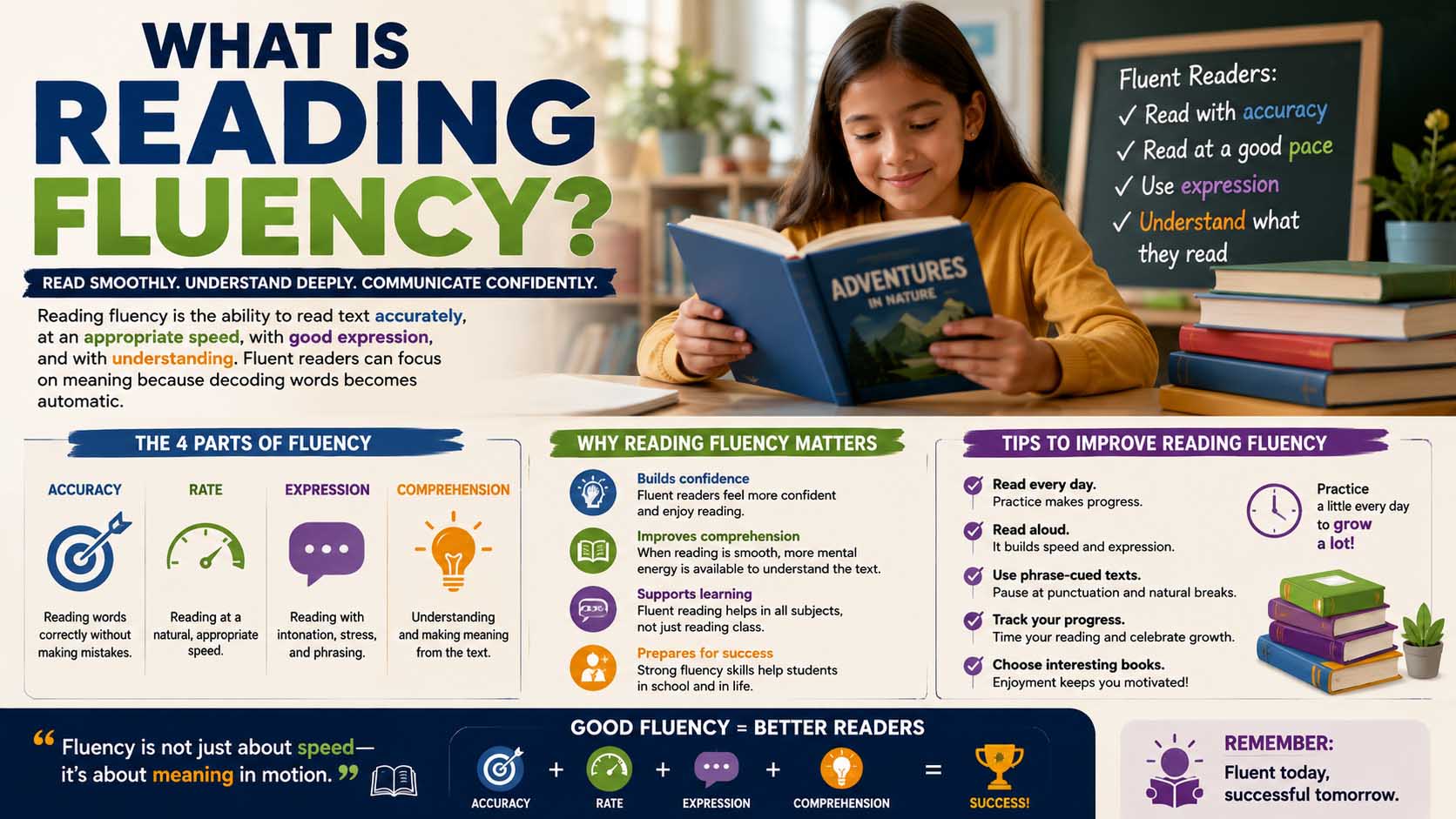
A student may recognize every word on a page yet still read in a slow, choppy way that makes the passage difficult to understand. That difference helps explain what is reading fluency. Reading fluency is the ability to read connected text accurately, at an appropriate pace, and with natural phrasing and expression. When these skills work together, reading sounds smoother and requires less effort, which can support comprehension.
Fluency develops gradually rather than appearing all at once. Beginning readers usually spend considerable attention identifying individual words. However, as word recognition becomes more automatic, they can devote more attention to the meaning of sentences and paragraphs.
For students, parents, and teachers, understanding fluency helps identify whether a reader needs more support with word recognition, practice with connected text, phrasing, or another part of reading.
What Is Reading Fluency in Simple Terms?
In simple terms, fluent reading sounds reasonably smooth and natural.
A fluent reader recognizes most words accurately, groups words into meaningful phrases, pauses appropriately around punctuation, and changes expression when the text calls for it.
For example, consider this sentence:
“Wait for me!” shouted Ben as the bus started moving.
A fluent reader is likely to group the words naturally and give “Wait for me!” an expression that matches the situation.
A struggling reader, meanwhile, might stop after nearly every word:
“Wait… for… me… shouted… Ben…”
Even if every word is eventually pronounced correctly, the interruptions can make the meaning harder to follow.
Reading fluency is often included among the 5 pillars of reading, alongside other foundational areas that support successful literacy development.
The Three Main Parts of Reading Fluency
Educators commonly look at three closely connected features when discussing fluency: accuracy, rate, and prosody.
Accuracy
Accuracy means reading the words correctly.
If a student frequently skips words, substitutes different words, or misreads common spelling patterns, the passage will be difficult to read smoothly.
For instance, changing “The dog ran toward the gate” to “The dog ran through the gate” changes the meaning even though most of the sentence remains correct.
Therefore, accurate word recognition provides the foundation for fluent reading.
Appropriate Reading Rate
Fluency also involves reading at a pace that supports meaning.
A student who races through a passage while ignoring punctuation or making frequent mistakes is not demonstrating strong fluency. Instead, the goal is an appropriate pace that allows accurate, meaningful reading.
The ideal rate also changes with the text. For example, a simple story may be read faster than a difficult science passage filled with unfamiliar vocabulary.
Prosody
Prosody refers to features such as expression, phrasing, stress, rhythm, and intonation.
Rather than reading every word with the same tone, fluent readers use their voices in ways that reflect sentence structure and meaning.
For example, they may raise their voice naturally for a question, pause at punctuation, or emphasize a word that carries special meaning.
So, what is prosody in reading fluency? It is the expressive side of fluent reading that helps connected text sound like meaningful language rather than a list of separate words.
What Is Oral Reading Fluency?
Oral reading fluency describes how accurately, efficiently, and expressively a person reads connected text aloud.
Teachers can listen to oral reading because it makes several aspects of reading visible. For example, they can hear whether a student frequently hesitates, misreads words, ignores punctuation, or reads with natural phrasing.
In some educational settings, teachers may also use timed curriculum-based assessments that calculate words read correctly per minute. Such measures can provide useful information about accuracy and rate.
Still, a single score does not describe everything about reading ability.
A student could achieve a relatively high rate while reading with little expression or weak comprehension. Therefore, educators generally interpret oral reading performance alongside other information about the learner.
Why Reading Fluency Matters for Comprehension
Imagine trying to understand a paragraph while needing several seconds to identify nearly every word.
By the time you reach the end of a sentence, you may have forgotten how it started.
This illustrates the connection between fluent word reading and comprehension. When word recognition becomes more automatic, the reader can use more attention for vocabulary, ideas, relationships between sentences, and the overall meaning of the text.
However, fluency does not guarantee comprehension.
A student might read a paragraph smoothly yet fail to understand unfamiliar vocabulary or lack the background knowledge needed to interpret it.
The simple view of reading provides a useful way to understand this distinction because successful reading comprehension depends on both word recognition and language comprehension rather than fluency alone.
How Decoding Supports Fluent Reading
Before students can read words automatically, they need reliable ways to identify unfamiliar printed words.
This is where decoding in reading becomes relevant. Decoding involves using knowledge of letters, sounds, and spelling patterns to identify written words.
For example, a beginning reader encountering “ship” may recognize the sh pattern, connect the letters with their sounds, and blend those sounds to identify the word.
Initially, that process takes effort.
However, after successful practice and repeated encounters with words and patterns, word recognition can become increasingly automatic. Consequently, the student does not need to consciously work through every familiar word each time it appears.
That growing automaticity supports smoother connected-text reading.
Phonemic Awareness, Phonics, and Fluency
Fluency does not develop in isolation. Instead, earlier foundational skills help readers build accurate word recognition.
Phonemic awareness involves noticing and manipulating individual speech sounds in spoken words. Phonics, meanwhile, teaches relationships between those sounds and written letters or spelling patterns.
Understanding phonics vs phonemic awareness can help parents and teachers recognize why both matter. One focuses on spoken sounds, while the other connects sounds with print.
Once students can apply those relationships to written words, repeated successful reading helps them become more efficient.
Therefore, fluency practice should not replace foundational instruction for students who still struggle to identify words accurately.
What Fluent Reading Looks Like
Consider this short passage:
Maya opened the window. “Did you hear that?” she whispered. Outside, the wind moved quietly through the trees.
A fluent reader might pause naturally after “window,” use questioning intonation for Maya’s question, and lower their voice slightly around “she whispered.”
Meanwhile, a developing reader may pronounce the words accurately but pause in unnatural places.
For example:
“Maya opened… the window. Did… you hear… that?”
The second student may not need to “read faster.” Instead, they may benefit from practice recognizing words more automatically and grouping words into meaningful phrases.
How Teachers Can Assess Reading Fluency
Teachers can learn a great deal by listening to a student read an appropriate passage aloud.
First, they may notice accuracy. Which words does the learner misread, skip, or need help identifying?
Next, they can consider rate. Does the student read extremely slowly because word identification requires substantial effort, or do they rush and sacrifice accuracy?
Teachers can also listen for phrasing and expression.
For example, does the student pause according to punctuation? Do related words sound grouped together? Does the voice reflect questions, dialogue, or changes in meaning?
A short assessment can identify patterns, but teachers should avoid defining a student’s entire reading ability from one timed performance.
For more information about assessing and teaching this skill, Reading Rockets explains reading fluency and practical approaches to fluency instruction.
Practical Strategies for Building Reading Fluency
Students usually improve through a combination of strong word-reading instruction and meaningful practice with connected text.
Repeated Reading
Repeated reading involves practicing an appropriate passage more than once.
During the first attempt, the student may need to work through unfamiliar words. However, later readings can become smoother as those words and sentence patterns become more familiar.
The purpose is not endless memorization. Instead, repetition gives learners an opportunity to practice accuracy, phrasing, and automaticity.
Teacher Modeling
Students benefit from hearing skilled reading.
A teacher can read a short passage aloud while demonstrating natural pauses, expression, and phrasing. Then, students can discuss what they noticed.
For instance, the teacher might ask, “Why did my voice change when I reached the question mark?”
That simple discussion helps connect punctuation and sentence meaning with oral expression.
Echo Reading
During echo reading, an adult or skilled reader reads a short section first. Then, the student rereads the same section while trying to match appropriate phrasing and expression.
This approach gives learners an immediate model.
Still, the passage should match the student’s instructional needs so the activity does not become simple imitation of text they cannot independently process.
Partner Reading
Students can also take turns reading with a partner.
A stronger reader can model fluent reading, while the developing reader gets supported practice.
However, teachers should structure partner work carefully so students receive helpful feedback rather than embarrassment or constant correction.
Why Phonics Instruction May Still Be Needed
Repeated reading alone cannot solve every fluency problem.
If a student reads slowly because they cannot reliably identify common spelling patterns, the underlying issue may involve word-reading skills rather than a lack of fluency practice.
In that situation, teachers may need to revisit explicit phonics instruction.
Knowing how to teach phonics systematically can help educators target missing sound-spelling knowledge before expecting the learner to read connected passages smoothly.
As word-reading accuracy improves, fluency practice can reinforce those skills in meaningful text.
Common Reading Fluency Mistakes
One frequent mistake is treating speed as the main goal.
When students believe faster always means better, they may race through punctuation, guess at words, and pay less attention to meaning.
Instead, emphasize accuracy and understanding first, followed by an appropriate pace and natural expression.
Another mistake is repeatedly giving students text that is far beyond their current reading ability. If they struggle with many words in every sentence, fluent reading becomes unrealistic.
At the same time, practice should not be so easy that students never encounter opportunities to grow.
Finally, avoid turning every reading experience into a performance test. Children also need opportunities to enjoy stories, learn new information, discuss ideas, and hear engaging texts without worrying about a timer.
How Parents Can Improve Reading Fluency at Home
Home practice can be simple and low-pressure.
First, read aloud regularly. Hearing expressive reading gives children examples of natural phrasing and intonation while also exposing them to vocabulary and ideas.
Next, invite the child to reread a familiar short passage if they are comfortable doing so.
You can also take turns reading paragraphs or use echo reading for a challenging sentence.
When a child misreads a word, avoid immediately telling them to guess from a picture. Instead, encourage attention to the letters and spelling patterns they know.
Most of all, keep reading connected with meaning. Ask what happened, what surprised them, or what they think might happen next.
How Long Does It Take to Become a Fluent Reader?
There is no universal timeline.
Children enter school with different language experiences, knowledge, and early literacy skills. Therefore, their reading development will not look identical.
Text difficulty also changes what fluency looks like. A student may read a familiar grade-level story smoothly yet slow down when encountering an unfamiliar science chapter.
Even experienced adult readers adjust their pace for difficult material.
For that reason, fluency should be viewed as developing efficiency across increasingly challenging texts rather than reaching one fixed reading speed.
Reading Fluency Is About More Than Speed
So, what is fluency in reading? It is the ability to read connected text accurately, at an appropriate rate, and with phrasing and expression that support meaning.
Strong fluency grows from accurate word-reading skills, repeated meaningful practice, and increasing automaticity. At the same time, vocabulary and language comprehension remain essential because smooth pronunciation alone does not create understanding.
For students who struggle, the best next step depends on the reason. Some may need more supported oral reading practice, while others need stronger foundational instruction in sounds, spelling patterns, or decoding.
Instead of focusing only on speed, help students become accurate, confident readers who can move through text smoothly enough to focus on what the words actually mean.
Frequently Asked Questions About Reading Fluency
What Is Reading Fluency?
Reading fluency is the ability to read connected text accurately, at an appropriate pace, and with natural phrasing and expression. These qualities help reading sound smooth and can support comprehension.
What Are the Three Components of Reading Fluency?
The three commonly discussed components are accuracy, appropriate rate, and prosody. Accuracy involves reading words correctly, rate describes reading at a suitable pace, and prosody involves phrasing, rhythm, stress, and expression.
Is Fast Reading the Same as Fluent Reading?
No. A student can read quickly while making mistakes or ignoring meaning. Fluent reading balances accuracy, appropriate pacing, and expression rather than focusing only on speed.
What Is Oral Reading Fluency Used For?
Oral reading gives teachers an opportunity to observe how a student handles connected text. They can listen for word-reading accuracy, hesitations, pace, phrasing, and expression. Meanwhile, some assessments also measure words read correctly per minute.
Can a Student Be Fluent but Have Poor Comprehension?
Yes. A student may pronounce words accurately and smoothly yet misunderstand the passage because of limited vocabulary, background knowledge, language comprehension, or other factors. Therefore, fluency is one part of successful reading rather than the entire goal.
What Is the Best Way to Improve Reading Fluency?
There is no single strategy for every learner. Students who can already decode accurately may benefit from repeated reading, teacher modeling, echo reading, and supported oral practice. However, students with weak word-reading skills may first need targeted instruction in phonemic awareness, phonics, or decoding.