
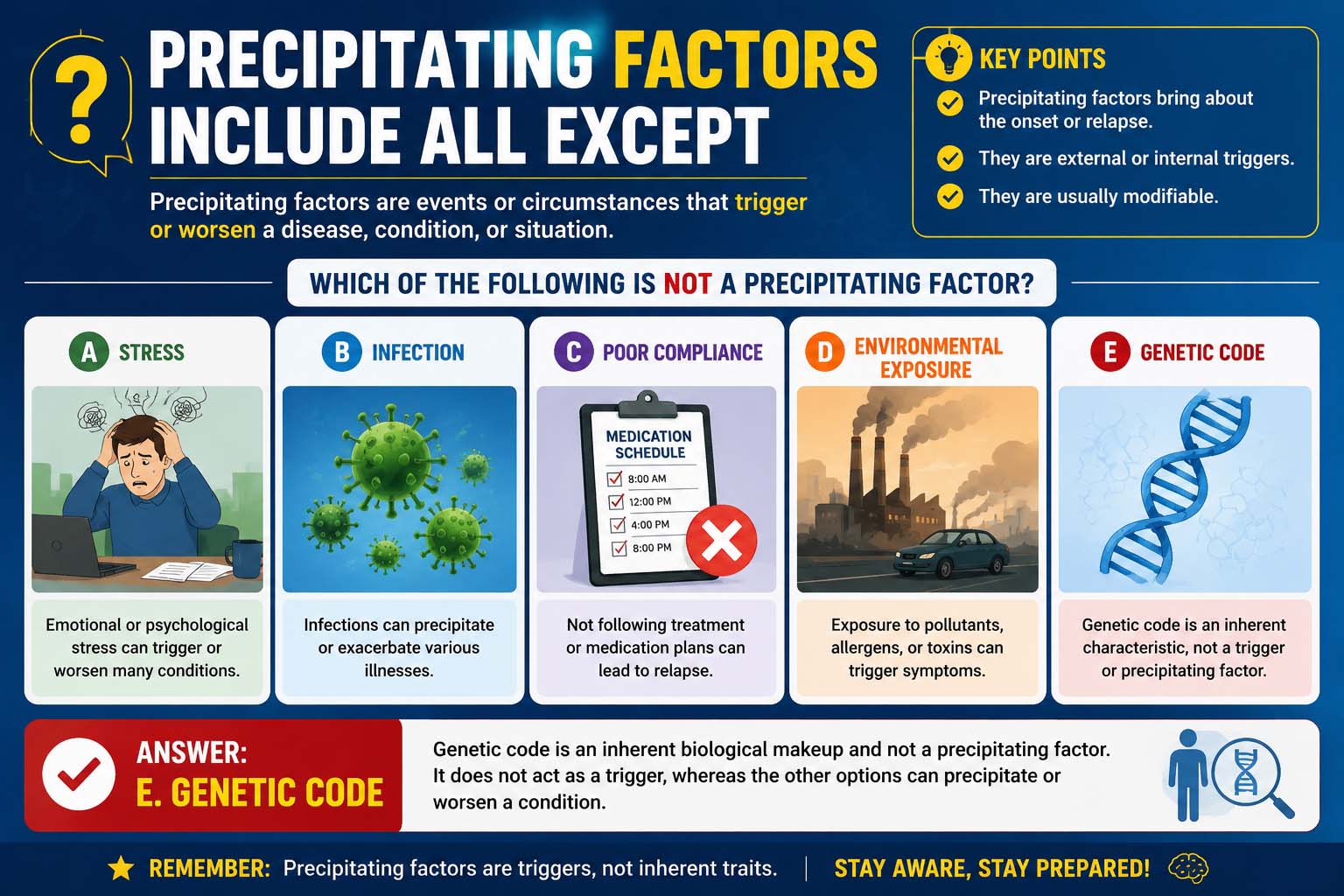
Nursing and medical students often see the phrase precipitating factors include all except in textbooks, quizzes and exams. Specifically, this question type asks you to find the one option that does not trigger a condition. Because it tests reasoning instead of memory, it can feel tricky at first.
First, precipitating factors are events, behaviors or conditions that trigger the start of a disease, a symptom flare or an emergency. In this guide, you will learn what they mean, how they differ from other factors and how to answer these questions with confidence. Also, practicing critical thinking exercises can strengthen the analytical skills these exams require.
Precipitating Factors Include All Except: What It Means
The National Library of Medicine’s MeSH vocabulary describes precipitating factors as factors linked to the definite onset of a disease, illness, accident or behavioral response. In simple words, they are the triggers that set a problem in motion.
In practice, an “all except” question lists several true triggers and one false option. Therefore, your job is to find the choice that does not belong. For example, a question may ask for triggers of a heart failure flare and include a harmless habit among the options.
Educators like this format because it checks deeper understanding. Instead of recognizing one correct fact, you must judge every option. As a result, strong clinical reasoning matters more than memorized lists.
Precipitating vs Predisposing Factors
Students often mix up these terms, so it helps to compare them side by side. First, precipitating factors act as immediate triggers. In contrast, predisposing factors raise a person’s risk over a longer time.
| Type of factor | Meaning | Example (asthma) |
|---|---|---|
| Predisposing | Raises risk over time | Family history of allergies |
| Precipitating | Triggers the problem now | Smoke exposure or a respiratory infection |
| Perpetuating | Keeps the problem going | Ongoing exposure to the trigger |
Also, some textbooks use all three terms, especially in mental health formulations. However, exams usually focus on the difference between predisposing and precipitating factors. Therefore, always check which term the question uses.
Examples of Precipitating Factors by Condition
The right answer always depends on the condition in the question. The table below shows common examples that students often study.
| Condition | Common precipitating factors |
|---|---|
| Heart failure flare | Infection, uncontrolled high blood pressure, too much salt, missed medication |
| Asthma attack | Allergens, smoke, cold air, respiratory infection |
| Diabetic ketoacidosis | Infection, missed insulin doses, severe illness |
| Panic or anxiety episode | Intense stress, trauma reminders, lack of sleep, substance use |
| Heart attack | Heavy exertion, severe emotional stress, cocaine use |
| Kidney injury | Severe dehydration, some medications, serious infection |
Notice that these are triggers, not long-term risks. For instance, high cholesterol raises heart disease risk over many years, so it is usually a risk factor instead of a trigger. Therefore, read each question carefully before you decide.
Precipitating Factors Include All Except Questions: How to Answer
In short, a clear method makes these questions much easier. Follow these steps:
- Identify the condition. First, find out which disease or event the question describes.
- Judge each option. Next, ask whether it directly triggers that condition.
- Mark the odd one out. Then, choose the option that does not fit, since it is the “except” answer.
- Recheck the wording. Finally, confirm that you chose the exception and not a correct trigger.
Also, watch for words such as “always” and “never.” Extreme words can signal a wrong option in some questions, although they do not guarantee it. In addition, take extra care when an option sounds healthy, such as balanced nutrition or good hydration. Healthy habits usually support wellness, so they often become the exception.
Precipitating Factors Include All Except PMDB
Some students search for “precipitating factors include all except PMDB” because they saw the term in a study set or class handout. The abbreviation PMDB is not a standard medical term that I can confirm, and its meaning may depend on your course. Therefore, check your syllabus, textbook or instructor to see what it refers to.
Even so, the method stays the same. Read the scenario, name the condition and test every option as a possible trigger. As a result, you can answer the question correctly even when the label is unfamiliar.
In mental health nursing, for example, triggers for an anxiety episode may include emotional stress, traumatic events and poor sleep. Meanwhile, a regular exercise routine generally supports wellness, so it would be the likely exception.
Precipitating Factors Include All Except Quizlet
Many students also search for “precipitating factors include all except Quizlet” because flashcards help them practice. First, flashcards support repetition and active recall, which makes them useful for learning triggers and definitions.
However, flashcard sets written by other users can contain mistakes. Therefore, verify every answer with your textbook or class notes before you memorize it. Memorizing lists also has limits, because real exams ask you to apply ideas to new situations.
Instead, a better plan combines flashcards with case studies and practice questions. For example, ask why dehydration can trigger kidney injury or why stress can raise blood pressure. In addition, learning how to create a study guide can help you organize each condition and its triggers in one place.
Practice Question
Try this example, then check the explanation below.
Question: Precipitating factors for a heart failure flare include all except which of the following?
- A. Infection
- B. Missing prescribed medication
- C. Eating a very salty meal
- D. Taking medication exactly as prescribed
Answer: D. Infection, missed medication and extra salt can all trigger a flare. In contrast, taking medication as prescribed helps control the condition, so it is the exception.
Study Tips for Nursing Exams
- Compare, don’t just list. For example, make a chart that separates triggers from long-term risk factors.
- Explain the reason. Also, for each trigger, say why it affects the body.
- Practice often. Finally, short daily question sets build speed and confidence.
- Use trusted sources. Rely on your textbook and instructor when a study set seems unclear.
Please note that this article is for study purposes only. It does not replace medical advice or your course materials.
Precipitating Factors Include All Except FAQs
What are precipitating factors?
Simply put, they are events or conditions that trigger the start of a disease, symptom flare or emergency. For example, missing insulin can precipitate diabetic ketoacidosis.
What is the difference between precipitating and predisposing factors?
Precipitating factors trigger a problem now, while predisposing factors increase risk over time. As a result, a family history is predisposing, but a sudden infection is precipitating.
How do I answer an “all except” question?
First, identify the condition. Then, test each option as a trigger and choose the one that does not fit.
Final Thoughts on Precipitating Factors
In short, questions that say precipitating factors include all except test your reasoning, not just your memory. First, identify the condition, separate triggers from long-term risks and eliminate options one by one. Moreover, use flashcards and practice questions together, and verify answers with trusted course materials. As a result, with steady practice, you will spot the exception quickly and answer with confidence.