
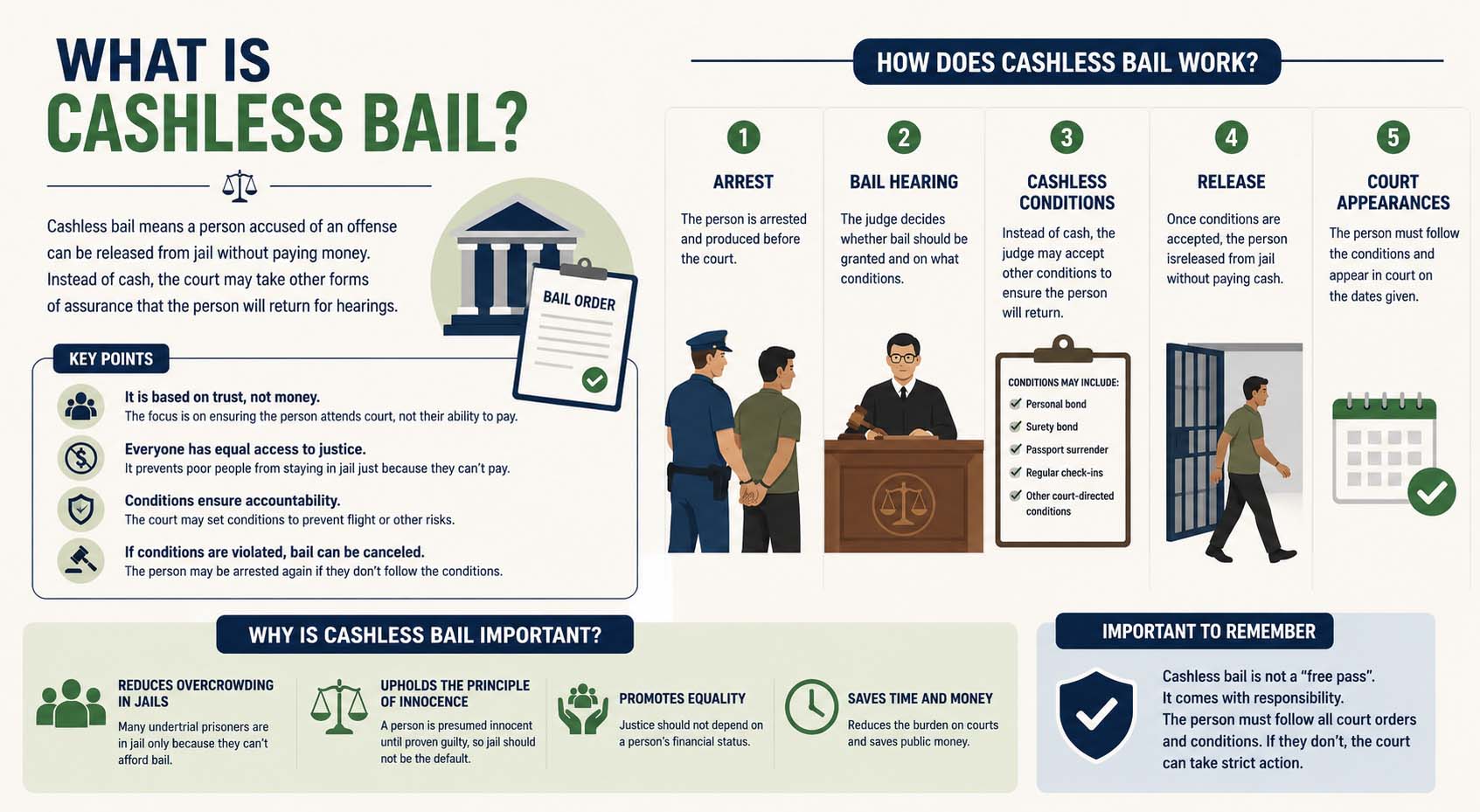
The topic of what is cashless bail has become increasingly important in legal and political discussions across the United States. Cashless bail refers to a system where certain defendants are released from jail without paying money before their court date. Instead of requiring cash payment as a condition for release, judges evaluate factors such as public safety risk, criminal history, and the likelihood that the person will return to court.
Traditional bail systems often required defendants to pay a set amount of money to secure temporary freedom while awaiting trial. Critics argued that this system unfairly punished low-income individuals who could not afford bail, even for minor offenses. Supporters of believe it creates a fairer justice system because it focuses more on risk assessment than financial status.
Cashless bail reforms have been introduced in several states, leading to major debates about crime, public safety, and equal treatment under the law. Understanding how this system works can help people better understand ongoing legal reforms and criminal justice policies.
What Is a Cashless Bail
Many people ask the question, what is a cashless bail, because the term can sound confusing at first. A cashless bail system allows eligible defendants to leave jail without posting money as security. Instead of relying on cash, courts may release individuals on their own recognizance or under supervised conditions.
In traditional systems, a judge might set bail at thousands of dollars. If the defendant cannot pay, they remain in jail until trial. Under cashless bail policies, judges often examine whether the accused person poses a danger to society or has a history of missing court appearances. If the risk is considered low, release may be granted without financial payment.
Supporters believe this approach reduces overcrowding in jails and prevents people from losing jobs, housing, or family stability while waiting for trial. Many individuals charged with nonviolent offenses may spend weeks or months in jail simply because they cannot afford bail. Cashless bail attempts to address this imbalance.
Opponents, however, argue that eliminating cash bail may allow repeat offenders to return to the streets too quickly. Some critics claim that stricter measures are needed to protect communities and ensure defendants appear in court. The debate continues in many states as lawmakers balance justice reform with public safety concerns.
What Is Cashless Bail Mean
Bail was originally designed to guarantee that a defendant would return to court after being released from custody. In traditional systems, money acted as a financial incentive for court attendance.
The meaning of cashless bail is that money is no longer the central factor in determining release for many cases. Instead, judges use risk assessments and legal guidelines to decide whether a defendant can safely remain outside jail before trial.
For example, a person charged with a minor nonviolent offense may be released without payment if they have stable employment, family ties, and no serious criminal record. On the other hand, individuals accused of violent crimes or considered a high flight risk may still be detained.
The concept behind cashless bail focuses on fairness and equality. Advocates argue that wealthy defendants should not automatically receive freedom simply because they can pay large sums of money, while poor defendants remain incarcerated for lesser charges. Understanding commercial awareness meaning can also help readers analyze how public policy decisions affect society and institutions.
At the same time, critics question whether risk assessment systems are always accurate. Some believe that removing financial consequences may reduce accountability. Despite the controversy, cashless bail remains one of the most discussed criminal justice reforms in recent years.
What Is Cashless Bail?
When asking what is cashless bail?, it is important to understand how the system changes the experience of pretrial detention. In many traditional courts, cash bail created two separate realities. Defendants with financial resources could leave jail quickly, while those without money often stayed incarcerated regardless of the seriousness of the charge.
Cashless bail aims to reduce this inequality by allowing judges to focus more on behavior and risk rather than financial status. Courts may impose conditions such as electronic monitoring, regular check-ins, travel restrictions, or mandatory court reminders instead of demanding cash payments.
Research in some regions has shown that many defendants still return to court even without financial bail requirements. Supporters believe this demonstrates that money is not always necessary to guarantee compliance with legal obligations.
Another reason cashless bail receives attention is its effect on local jail populations. Pretrial detention contributes significantly to overcrowded correctional facilities. By releasing low-risk individuals, states may reduce jail costs and focus resources on more serious offenders. Understanding what is a business can also provide insight into how organizations and public institutions make operational decisions.
What Is Cashless Bail in New York
The question of what is cashless bail in New York became especially significant after major bail reforms were introduced in the state. New York implemented reforms aimed at reducing the use of cash bail for many nonviolent and misdemeanor offenses.
Under the updated system, judges are often required to release defendants charged with certain lower-level crimes without setting cash bail. The goal was to prevent unnecessary incarceration for individuals accused of offenses that do not involve serious violence.
Supporters of the New York reforms argued that too many people were being jailed simply because they lacked money. They believed the old system disproportionately affected low-income communities and minority groups. By limiting cash bail requirements, reform advocates hoped to create a more balanced justice system. An executive summary example can be useful when presenting legal policy changes in reports, while effective methods of business communication help professionals explain complex topics clearly.
Conclusion
The discussion around what is cashless bail reflects larger questions about fairness, justice, and public safety in the legal system. Cashless bail seeks to reduce the role of money in pretrial release decisions and instead focus on whether a defendant poses a risk to society or is likely to return to court.