
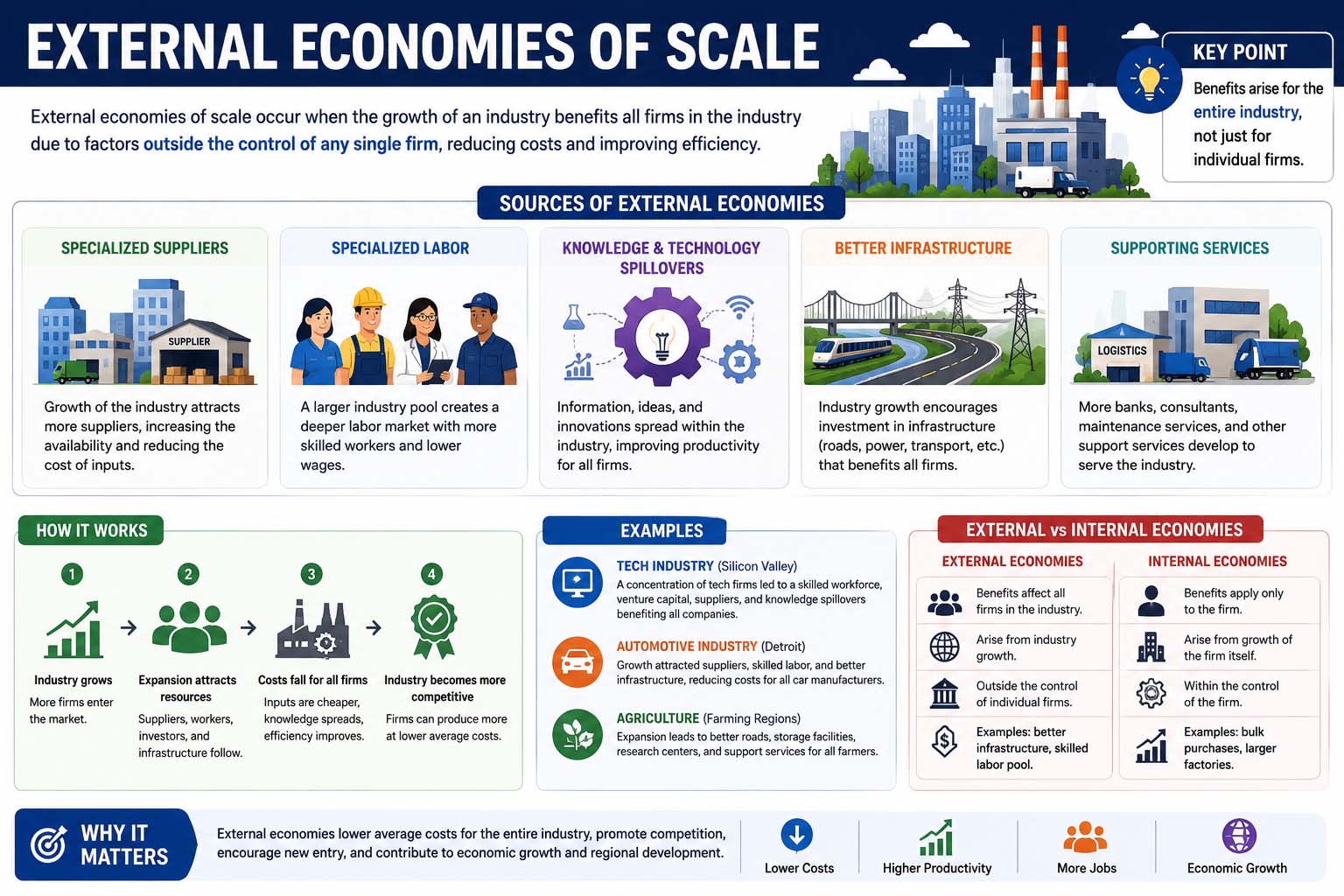
External Economies of Scale economies of are an important concept in economics and business studies. They refer to the cost advantages that companies gain because an entire industry or geographic region grows and develops. Unlike internal economies of , which occur within a single company, of scale happen outside the business but still provide benefits to firms operating in the same market.
As industries expand, businesses often experience lower production costs, better infrastructure, improved transportation systems, and access to skilled workers. These advantages help companies become more efficient and competitive. of play a major role in industrial growth, international trade, and economic development across the world.
Many successful business hubs exist because companies benefit from operating close to one another. Technology firms in Silicon Valley, automobile companies in Germany, and financial institutions in major global cities are all examples of industries that gain advantages from external economies of . Understanding what is a business helps explain why these industries benefit from shared resources and infrastructure.
External Economies of Scale Diagram
An external economies of diagram is commonly used in economics to explain how average costs decrease as the size of the industry increases. In most diagrams, the horizontal axis represents industry output while the vertical axis shows average costs.
As the industry grows, businesses gain access to better infrastructure, suppliers, and skilled labor. Because of these benefits, the average cost curve shifts downward. This means firms can produce goods more efficiently and at lower costs even if their own company size does not change significantly.
Economics students often study the external economies of scale diagram to understand how industries become more competitive over time. When industries expand, the overall environment improves for all businesses within that sector. Roads may improve, technology may advance, and suppliers may offer cheaper materials because of increased demand.
The diagram also helps explain why industries often cluster in specific regions. Businesses located near each other can share resources, information, and transportation systems. This reduces costs and improves productivity for the entire industry.
How External Economies of Scale Work
External economies of occur because businesses benefit from factors outside their direct control. One major factor is infrastructure development. Governments and private organizations may invest in roads, ports, airports, and communication networks that support industrial growth.
Another factor is the development of specialized suppliers. As industries expand, suppliers become more efficient because they can focus on producing materials or services for a large market. This allows businesses to purchase inputs at lower prices.
Labor market improvements also contribute to of . In regions with large industries, workers often develop specialized skills that increase productivity. Companies benefit because they can hire experienced employees without spending excessive money on training.
Knowledge sharing is another important advantage. Businesses operating in the same industry may indirectly exchange ideas and innovations. Employees move between companies, conferences encourage networking, and universities conduct industry-related research. These activities help industries grow more quickly and efficiently. Strong methods of business communication can further support collaboration across organizations.
External Economies of Scale Examples
There are many external economies of scale examples in the modern economy. One of the most famous examples is Silicon Valley in the United States. Thousands of technology companies operate in this region, including software developers, hardware manufacturers, and internet businesses.
Because so many technology firms are concentrated in one area, companies benefit from access to highly skilled workers, advanced research centers, and specialized suppliers. Investors and venture capital firms are also located nearby, making it easier for businesses to secure funding.
Another example can be found in the automobile industry in Germany. Car manufacturers benefit from strong transportation systems, engineering expertise, and suppliers that specialize in automotive parts. This industrial network helps reduce costs and improve efficiency for companies operating in the region.
The Importance of Industrial Clusters
Industrial clusters are closely connected to external economies of scale. A cluster occurs when many businesses from the same industry operate within a specific geographic area. These clusters create economic advantages that benefit all firms involved.
Clusters encourage innovation because companies constantly compete and cooperate with one another. Businesses learn from each other and adopt new technologies more quickly. Universities and training institutions may also focus on supporting the needs of the local industry. Developing commercial awareness meaning can help students understand why these clusters are important for economic growth.
Examples of External Economies of Scale
There are additional examples of external economies of scale in many sectors around the world. The fashion industry in Italy benefits from skilled designers, textile manufacturers, and luxury branding expertise concentrated in certain regions.
The financial sector in cities such as London and New York also benefits from external economies of scale. Banks, insurance companies, investment firms, and financial experts operate close together, allowing businesses to access specialized knowledge and services efficiently.
China’s manufacturing regions provide another strong example. Large industrial zones contain factories, suppliers, shipping facilities, and skilled labor forces. These advantages help manufacturers produce goods at lower costs for global markets.
Internal and External Economies of Scale
Understanding the difference between internal and external economies of scale is essential in economics. Internal economies of scale occur within a company as it grows larger. These advantages may include bulk purchasing, advanced technology, managerial specialization, and marketing efficiency.
External economies of scale, on the other hand, occur because of industry-wide growth rather than individual company expansion. Businesses benefit from external factors such as infrastructure, supplier networks, skilled labor, and knowledge sharing. Preparing an executive summary example can help present these concepts clearly in academic or business reports.
Challenges of External Economies of Scale
Although external economies of scale provide many benefits, there can also be challenges. Rapid industrial growth may lead to congestion, higher land prices, pollution, and increased competition for resources.
Conclusion
External economies of scale are a powerful force in modern economics. They occur when businesses benefit from the growth and development of an entire industry or geographic region. Improved infrastructure, specialized suppliers, skilled labor, and knowledge sharing all contribute to lower production costs and greater efficiency.