
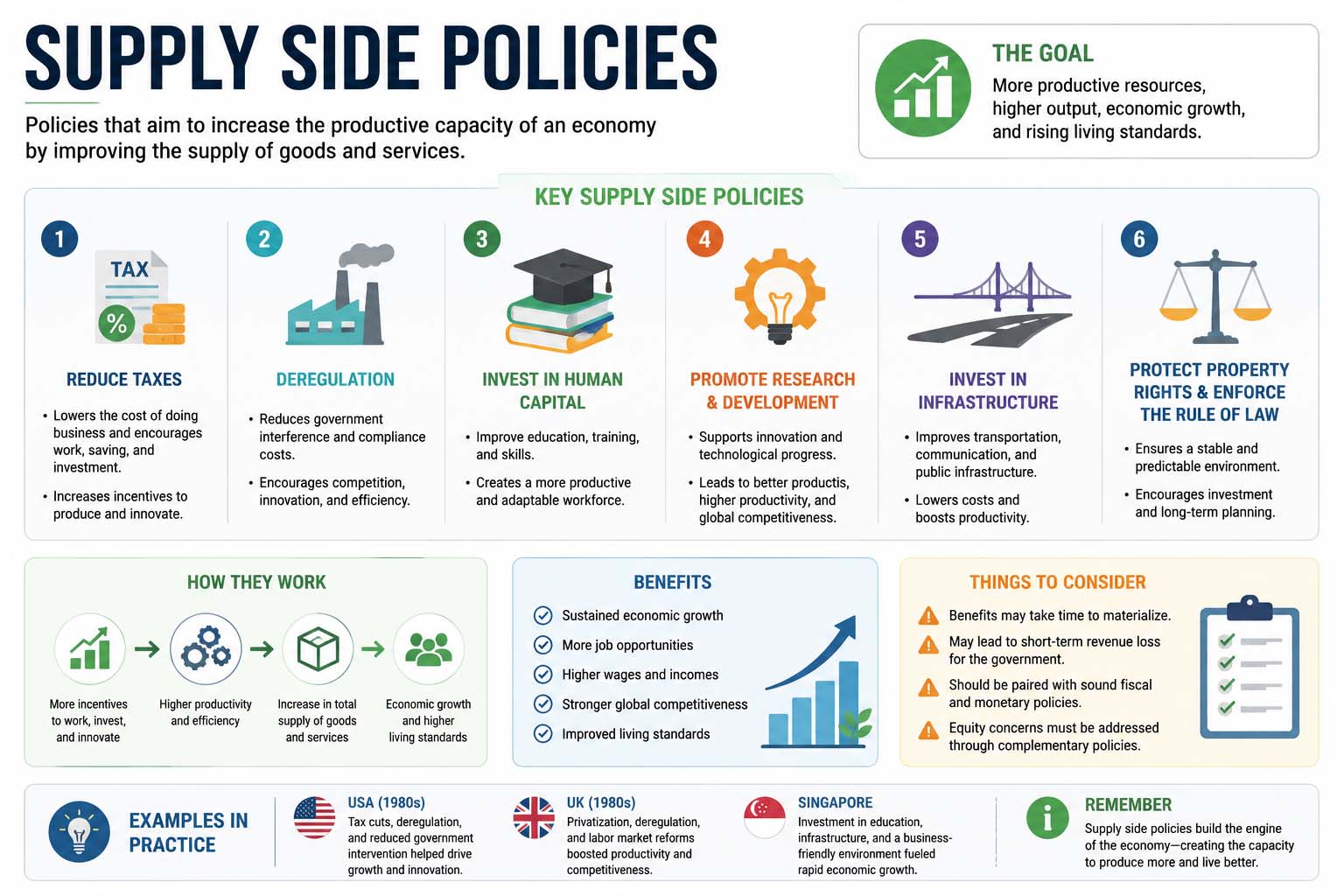
Supply side policies are economic strategies designed to increase the productive capacity of an economy. Governments use these policies to improve efficiency, encourage investment, and boost long-term economic growth. Unlike demand-side policies that focus on increasing spending in the economy, supply side policies aim to improve the ability of businesses and workers to produce goods and services. These policies can influence employment, productivity, inflation, and international competitiveness. In modern economies, supply side policies are often used to create sustainable growth and strengthen economic performance over time.
Supply Side Policies A Level Economics
In Economics, supply side policies are an important topic because they explain how governments attempt to improve aggregate supply. Aggregate supply refers to the total output that firms in an economy are willing and able to produce at a given price level. When are successful, the productive potential of the economy increases, leading to higher output and lower inflationary pressure.
Students studying supply side policies a level economics often learn about the difference between short-run and long-run aggregate supply. In the short run, policies may help firms reduce production costs and increase efficiency. In the long run, these policies can shift the productive capacity of the economy outward. This allows countries to achieve economic growth without causing excessive inflation.
Governments may invest in education and training programs to improve worker skills. Better education increases labor productivity because workers become more efficient and capable of producing higher-quality goods and services. Infrastructure improvements such as better roads, transport systems, and internet access also contribute to productivity growth. These measures are commonly discussed in a level economics because they directly affect economic performance. Similar concepts are also discussed in What Is a Business.
Tax reforms are another major area studied in economics courses. Lower business taxes can encourage firms to invest in new technology and expand operations. Lower income taxes may motivate workers to increase labor participation and work longer hours. Economists often debate whether such policies truly improve growth or mainly benefit high-income individuals and corporations.
What Are Supply Side Policies
Many students and readers ask the question, what are ? These are government measures designed to improve the supply potential of an economy. Their main purpose is to increase productivity, efficiency, and competitiveness. Supply side policies focus on improving the conditions under which businesses operate and workers perform.
Supply side policies can affect several areas of the economy. Labor market reforms may make it easier for firms to hire workers or reduce unemployment benefits to encourage job seeking. Product market reforms can increase competition by reducing regulations and barriers for businesses. Financial market reforms may improve access to investment capital for companies and entrepreneurs.
One of the key goals of is reducing structural unemployment. Governments may address this issue by funding vocational training programs and higher education initiatives. As workers gain relevant skills, businesses can operate more efficiently and productivity rises. These improvements also support the nature of business in a competitive economy.
Another answer to the question what are involves entrepreneurship and innovation. Governments often encourage research and development through grants and tax incentives. Innovation can help firms create new products, improve production methods, and compete more effectively in international markets. Countries that successfully promote innovation often experience higher levels of economic growth.
Supply side policies are also connected to globalization. Economies that maintain efficient labor markets and advanced infrastructure are more likely to attract foreign investment. International companies often prefer countries with skilled workers, stable regulations, and modern transport systems. This can create jobs and strengthen economic development.
Market Based Supply Side Policies
Market based supply side policies focus on increasing efficiency through competition and reduced government intervention. These policies rely on market forces to improve productivity and encourage businesses to innovate. Supporters of market based supply side policies argue that free markets create stronger incentives for firms and workers to perform efficiently.
Privatization is a common example of market based . Competition in the private sector can lead to lower costs, better customer service, and increased innovation. Industries such as telecommunications and transportation have experienced major changes after privatization in several countries.
Deregulation is another important market-based approach. Governments may remove unnecessary rules and restrictions that limit business activity. Reducing bureaucracy can make it easier for firms to start operations, hire employees, and expand production. Advocates believe deregulation encourages entrepreneurship and investment.
Tax reductions are frequently associated with market based . Lower corporate taxes may encourage firms to invest in machinery, technology, and workforce development. Lower personal income taxes can increase incentives for people to work and save money. Some economists argue that these tax cuts eventually increase government revenue through stronger economic growth, although critics question this outcome.
Interventionist Supply Side Policies
Interventionist supply side policies involve direct government involvement in improving economic performance. Unlike market-based approaches, interventionist policies rely on public investment and government planning to increase productivity and growth. Supporters argue that some sectors require government support because private firms may not invest enough in areas with long-term benefits.
Education spending is one of the most important interventionist . Governments invest heavily in schools, colleges, and universities to create a skilled workforce. Highly educated workers are more productive and adaptable to technological change. Education also improves innovation and supports high-value industries.
Healthcare investment is another example of interventionist . Public healthcare systems can improve workforce efficiency and reduce long-term economic costs associated with poor health conditions.
Infrastructure projects are often funded through government spending. Roads, airports, railways, and digital communication networks improve business efficiency and reduce transportation costs. Strong infrastructure also attracts foreign investors who seek reliable systems for production and distribution. Effective planning also depends on Methods of Business Communication Explained within organizations.
Conclusion
Supply side policies remain a central part of modern economic management. They aim to improve productivity, increase efficiency, and expand the productive capacity of an economy. Whether through market based or interventionist governments attempt to create conditions that support long-term growth and competitiveness.