Critical thinking exercises are essential tools for improving how we analyze information, solve problems, and make decisions in everyday life. In a world filled with constant information, developing strong thinking skills is no longer optional—it is necessary. By practicing critical thinking exercises regularly, you can train your brain to evaluate situations more clearly, avoid common reasoning mistakes, and make smarter choices in both personal and professional settings.
Critical Thinking Exercises
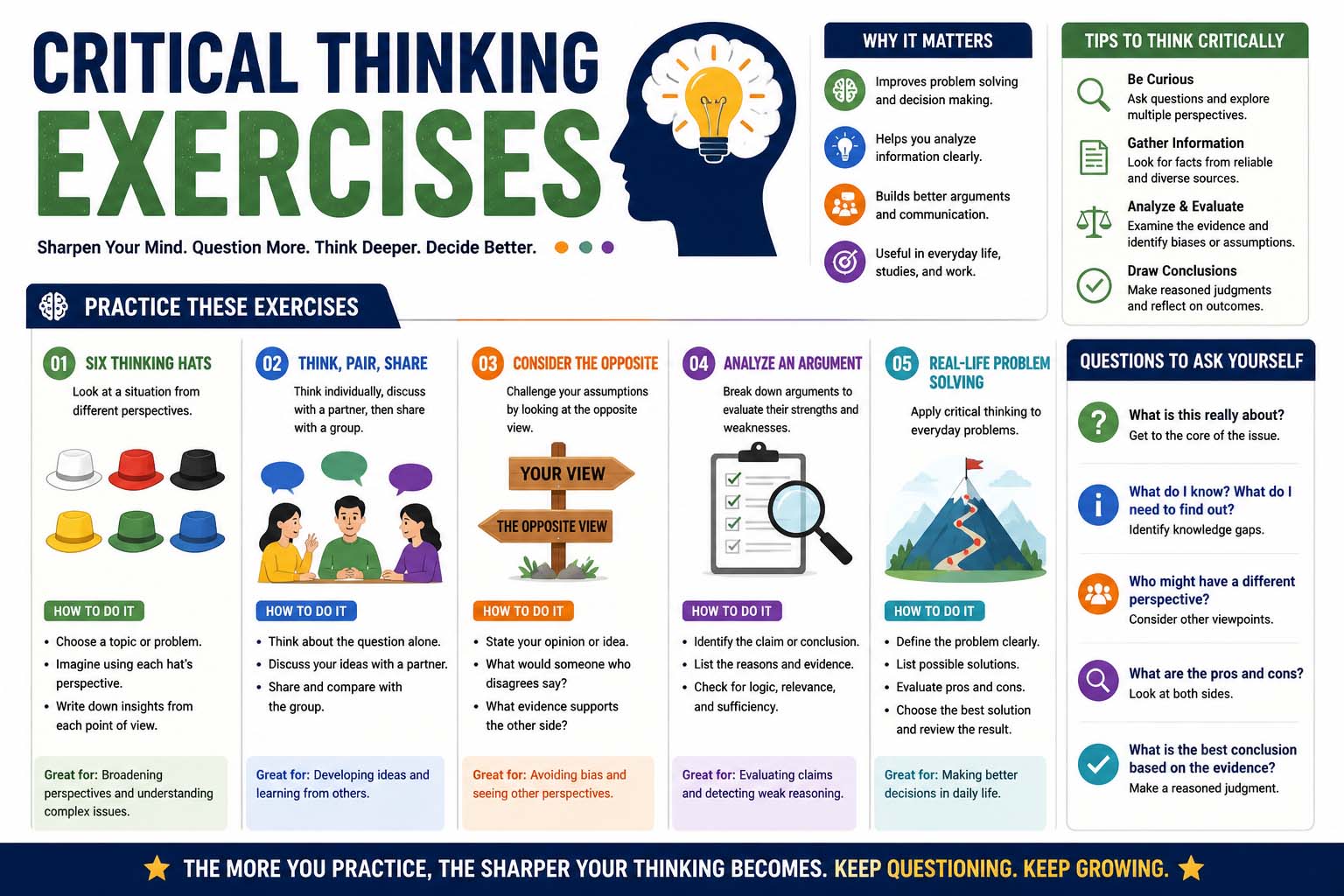
Critical thinking exercises are structured activities designed to challenge the way you think. These exercises push you to question assumptions, analyze evidence, and consider multiple perspectives before arriving at a conclusion. Many people rely on intuition or quick judgments, but critical thinking encourages a slower, more thoughtful approach.
One of the simplest ways to begin is by questioning everything you read or hear. Is there evidence to support this claim? Are there alternative viewpoints? This habit alone can dramatically improve your ability to think critically.
Another effective method is to practice problem-solving scenarios. For example, imagine you are faced with a workplace challenge such as declining productivity. Instead of jumping to conclusions, break the issue into smaller parts. Identify possible causes, evaluate available data, and consider different solutions before deciding on the best course of action.
Engaging in debates is also a powerful exercise. When you defend a position or argue against one, you are forced to organize your thoughts, use logic, and respond to opposing viewpoints. This strengthens your reasoning skills and helps you see issues from multiple angles. Strong communication is also among the top skills to put on resume.
Critical Thinking Exercises with Answers
Critical thinking exercises with answers are particularly helpful because they allow you to check your reasoning and learn from mistakes. These exercises often come in the form of puzzles, logical questions, or real-life scenarios followed by explanations.
His friend asks, “Who is it?” The man replies, “Brothers and sisters, I have none. But that man’s father is my father’s son.” Who is in the photograph? The correct answer is his son. Exercises like this encourage you to carefully analyze language and relationships rather than jumping to a quick answer.
Another type of exercise involves identifying logical fallacies. For instance, if someone argues that a product must be good because it is popular, this is known as a bandwagon fallacy. Recognizing such errors helps you avoid being misled by weak arguments.
Reading case studies and answering questions about them is another excellent approach. For example, you might analyze a business situation, identify the main problem, and suggest solutions. Reviewing the provided answers helps you understand how experienced thinkers approach similar challenges.
These types of critical thinking exercises with answers are especially useful for students and professionals who want measurable improvement in their reasoning abilities.
Critical Thinking Exercises for Kids
Critical thinking exercises for kids are designed to be engaging, fun, and age-appropriate. Children naturally ask questions, but structured activities can help them develop deeper reasoning skills early in life.
One effective exercise is storytelling with a twist. Ask children to create a story but include a problem that needs solving. Then encourage them to think of multiple solutions and discuss which one works best and why. This helps them understand cause and effect while practicing decision-making.
Another great activity is sorting and categorizing objects. Give kids a group of items and ask them to group them based on different criteria, such as color, shape, or function. Then ask them to explain their reasoning. This strengthens their ability to analyze and justify their choices.
Riddles and brain teasers are also excellent tools. They challenge children to think beyond the obvious and consider alternative possibilities. For example, asking questions that require lateral thinking can spark curiosity and creativity.
Role-playing games can also be very effective. Present a scenario, such as planning a birthday party with a limited budget, and ask kids to make decisions. This teaches them to evaluate options, consider consequences, and think ahead.
By incorporating critical thinking exercises for kids into daily routines, parents and teachers can help build strong cognitive skills that will benefit children throughout their lives. Similar reasoning skills are valuable when completing a Student Perception Survey Guide.
Critical Thinking Exercises for Adults
Critical thinking exercises for adults often focus on real-world applications and complex problem-solving. Adults face decisions in careers, finances, relationships, and health, making strong reasoning skills incredibly valuable.
One powerful exercise is reflective journaling. At the end of each day, write about a decision you made and analyze it. Ask yourself what information you used, whether there were biases involved, and what you might do differently next time. This helps improve self-awareness and decision-making over time.
Another useful exercise is analyzing news articles. Choose a topic and read multiple sources covering the same story. Compare how each source presents the information, identify potential bias, and evaluate the credibility of each perspective. This sharpens your ability to distinguish facts from opinions.
Problem-solving workshops or simulations are also beneficial. For example, imagine you are managing a project with limited resources. You must prioritize tasks, allocate resources, and handle unexpected challenges. These exercises mimic real-life situations and help develop practical thinking skills. Similar analytical skills are useful for understanding the nature of business.
Learning new skills, such as programming or strategic games like chess, can also enhance critical thinking. These activities require planning, pattern recognition, and logical reasoning, all of which contribute to stronger cognitive abilities.
Engaging in discussions with others is equally important. Sharing ideas, challenging viewpoints, and defending your opinions helps refine your thinking process and exposes you to new perspectives. These abilities are also valuable when preparing for unique interview questions to ask employer or deciding What Is Grad School?
Conclusion
Critical thinking exercises are essential for anyone looking to improve their mental clarity, decision-making, and problem-solving abilities. Whether you are a student, a professional, or a parent, incorporating these exercises into your daily routine can lead to significant improvements in how you think and act.