
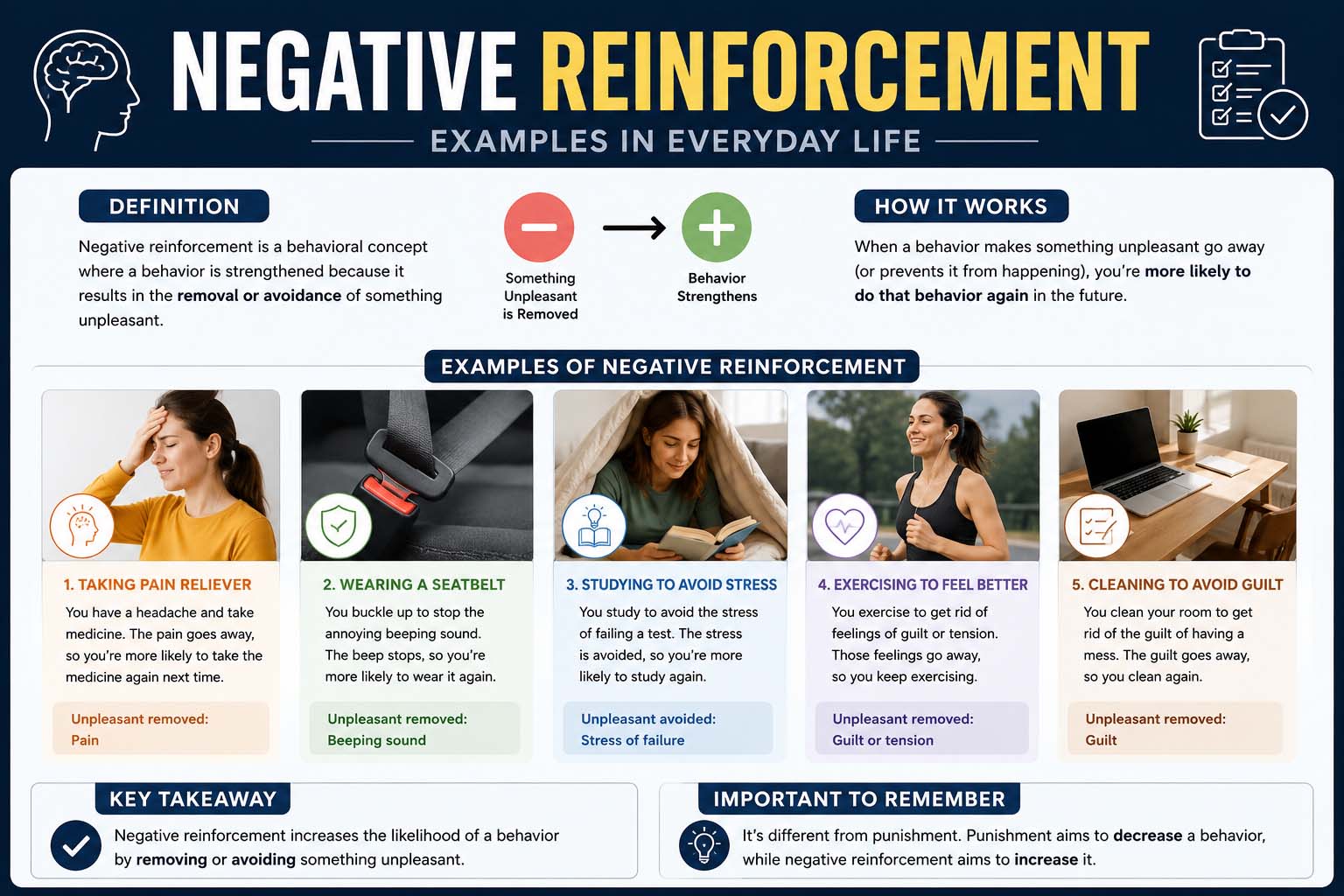
Negative reinforcement is one of the most commonly misunderstood concepts in psychology and education.
Understanding negative reinforcement examples can help students, teachers, parents, and professionals learn how behavior is influenced and maintained. This concept plays an important role in classrooms, workplaces, parenting, and everyday life.
In this guide, you’ll learn what negative reinforcement means, how it works, and see practical examples that make the concept easier to understand.
What Is Negative Reinforcement?
Negative reinforcement is a behavior management technique in which an unpleasant condition is removed after a desired behavior occurs.
The goal is to increase the likelihood that the behavior will happen again in the future.
Simple Definition
Negative reinforcement = Removing something unpleasant to encourage a behavior.
A student completes homework on time and no longer receives reminder emails from the teacher.
The removal of the reminders encourages the student to continue submitting work on time.
How Negative Reinforcement Works
Negative reinforcement follows a simple process.
Step 1: An Unpleasant Situation Exists
A person experiences something they want to avoid.
Examples:
Loud alarm
Extra assignments
Constant reminders
Chores
Step 2: Desired Behavior Occurs
The person performs a specific action.
Step 3: Unpleasant Condition Is Removed
The unwanted situation disappears.
Step 4: Behavior Becomes More Likely
This process strengthens behavior through relief or avoidance.
Negative Reinforcement vs Punishment
Negative ReinforcementPunishmentRemoves something unpleasantAdds or removes consequences to reduce behaviorIncreases behaviorDecreases behaviorEncourages repetitionDiscourages repetitionFocuses on behavior strengtheningFocuses on behavior reduction
Understanding this difference is important when studying psychology and education.
Examples of Negative Reinforcement
Learning through examples makes the concept much easier to understand.
Example 1: Seatbelt Reminder
Behavior:
Fastening the seatbelt
Result:
The annoying sound stops
The driver is more likely to buckle up quickly next time.
Example 2: Homework Completion
A teacher stops sending daily reminders once students consistently submit assignments on time.
Behavior:
Completing assignments
Result:
Reminders are removed
Students are encouraged to continue the behavior.
Example 3: Cleaning a Room
Parents stop reminding a child to clean their room after the task is completed.
Behavior:
Cleaning the room
Result:
Reminders disappear
The child learns that completing the task removes the unwanted reminders.
Example 4: Workplace Performance
An employee completes training requirements and no longer needs to attend additional mandatory review sessions.
Behavior:
Completing training
Result:
Extra sessions are removed
This reinforces compliance with workplace requirements.
Negative Reinforcement Examples for Students
Teachers frequently use negative reinforcement examples for students in educational settings.
Classroom Example
Students who consistently follow classroom rules may be excused from certain corrective activities.
Behavior:
Following rules
Result:
Additional corrective tasks are removed
Study Example
A student finishes all assignments before the weekend.
Behavior:
Completing schoolwork
Result:
No weekend makeup work
This encourages better time management, especially when combined with how to create a study guide for better organization.
Attendance Example
Students with perfect attendance may be exempt from attendance recovery activities.
Behavior:
Attending school regularly
Result:
Recovery requirements removed
These examples show how negative reinforcement can support positive educational outcomes.
Positive and Negative Reinforcement Examples
Many learners study positive and negative reinforcement examples together because both are part of behavioral psychology.
Positive Reinforcement
Something desirable is added.
Example:
A student receives praise after earning a high test score.
Behavior:
Studying effectively
Reward:
Praise
Negative Reinforcement
Something undesirable is removed.
Example:
A student no longer receives homework reminders after consistently submitting assignments.
Behavior:
Completing homework
Result:
Reminders removed
Both methods increase desired behavior, but they operate differently.
Examples of Positive and Negative Reinforcement
To further understand behavioral principles, consider these side-by-side examples.
SituationPositive ReinforcementNegative ReinforcementHomeworkStudent receives praiseReminder emails stopAttendanceStudent earns a rewardAttendance recovery removedChoresChild receives allowanceParents stop remindingWorkplaceEmployee receives bonusAdditional supervision removed
These examples help clarify the distinction between the two approaches.
Why Negative Reinforcement Is Effective
Negative reinforcement works because people naturally seek to avoid discomfort or inconvenience.
Benefits include:
Encouraging responsibility
Supporting habit formation
Improving compliance
Promoting self-management
Reinforcing productive behaviors
When used appropriately, it can be an effective educational and behavioral strategy.
Common Misconceptions About Negative Reinforcement
Several misunderstandings frequently occur.
Myth 1: Negative Means Bad
The word “negative” refers to removing something, not doing something harmful.
Myth 2: It Is the Same as Punishment
Punishment aims to decrease behavior.
Negative reinforcement aims to increase behavior.
Myth 3: It Only Applies to Children
Negative reinforcement can be used in:
Schools
Homes
Businesses
Sports
Healthcare
People of all ages respond to reinforcement.
Educational Applications of Negative Reinforcement
Teachers often use negative reinforcement to encourage positive habits.
Examples include:
Improved Participation
Students who actively participate may be exempt from additional review activities.
Better Organization
Students who stay organized may avoid extra monitoring.
Academic Responsibility
Consistent completion of assignments can reduce corrective interventions.
When implemented fairly, these strategies help promote independence and accountability.
Tips for Students Learning Behavioral Psychology
If you’re studying reinforcement concepts:
Focus on the Outcome
Ask:
“What happened after the behavior?”
Determine What Changed
Was something added or removed?
Identify the Goal
Did the consequence increase or decrease the behavior?
Practice With Examples
Real-life scenarios make learning easier. Students preparing for psychology coursework may also benefit from an AP Psychology study guide and regular critical thinking exercises to strengthen concept application.
These strategies help students master psychology and education concepts.
Real-World Uses of Negative Reinforcement
Negative reinforcement appears in everyday situations.
Examples include:
Alarm clocks
Workplace policies
School systems
Parenting techniques
Traffic warning systems
Because it occurs frequently, understanding it improves behavioral analysis skills. Learners pursuing behavior analysis careers may also find an RBT study guide helpful for reinforcing these concepts in professional settings.
FAQ
What is negative reinforcement?
Negative reinforcement is the removal of an unpleasant condition after a desired behavior occurs, making that behavior more likely to happen again.
Is negative reinforcement punishment?
No. Punishment reduces behavior, while negative reinforcement increases behavior.
What are some negative reinforcement examples?
Examples include stopping reminder messages, turning off an alarm, or removing extra tasks after a desired behavior is performed.
What are negative reinforcement examples for students?
Examples include eliminating homework reminders after assignments are submitted consistently or removing corrective activities after rule-following behavior.
What is the difference between positive and negative reinforcement?
Positive reinforcement adds something desirable, while negative reinforcement removes something undesirable.
Why is negative reinforcement important in education?
It can help encourage responsibility, participation, organization, and positive study habits.
Conclusion
Understanding negative reinforcement examples is essential for students studying psychology, education, and behavior management. Negative reinforcement occurs when an unpleasant condition is removed after a desired behavior, making that behavior more likely to occur again.