If you’ve ever wondered about the types of journals available, you’re not alone. The word “journal” can refer to many different things, from personal notebooks used for daily reflection to peer-reviewed academic publications that share scientific research. Knowing the differences helps you choose the right journal for studying, writing, research, or personal growth.
Whether you’re a student completing a class assignment, a researcher preparing a manuscript, or someone interested in keeping a daily writing habit, understanding the purpose of each journal type can make your work more organized and effective.
What Are Journals?
A journal is a written record used to collect information, ideas, observations, experiences, or research over time.
Some journals are private and intended only for personal use, while others are published for readers around the world.
Although they all involve recording information, each serves a different purpose.
Types of Journals at a Glance
The table below summarizes some of the most common journal types.
| Journal Type | Primary Purpose | Typical Users |
|---|---|---|
| Personal Journal | Record daily experiences | Anyone |
| Reflective Journal | Analyze learning or experiences | Students, professionals |
| Academic Journal | Publish scholarly research | Researchers |
| Research Journal | Document research progress | Scientists, graduate students |
| Learning Journal | Track educational growth | Students |
| Reading Journal | Record thoughts about books | Students, readers |
| Travel Journal | Document trips and memories | Travelers |
| Creative Journal | Develop ideas and inspiration | Writers, artists |
| Gratitude Journal | Focus on positive experiences | Anyone |
| Bullet Journal | Organize tasks and goals | Students, professionals |
Each type supports different learning or personal goals.
Types of Academic Journals
Among all the types of journals, academic journals are especially important in education.
They publish original research, expert analysis, and scholarly discussions that help expand knowledge within a field.
When evaluating research articles, understanding what is a scholarly source can help you identify whether an academic journal is reliable enough to cite in your assignments.
Peer-Reviewed Journals
These journals send submitted articles to experts before publication.
Reviewers evaluate:
- Accuracy
- Research methods
- Originality
- Evidence
- Writing quality
Peer review helps maintain high academic standards by evaluating research for accuracy, quality, and credibility before it is published.
Professional Journals
Professional journals focus on practical knowledge rather than original research.
Teachers, nurses, engineers, and business professionals often use these publications to stay current with industry trends.
Open Access Journals
Open access journals make research freely available online, allowing anyone to read, download, and share scholarly work without a subscription or paywall.
Students and researchers can often read these articles without paying subscription fees.
Different Types of Journals for Personal Growth
Not every journal belongs in a library.
Many people keep journals for personal development.
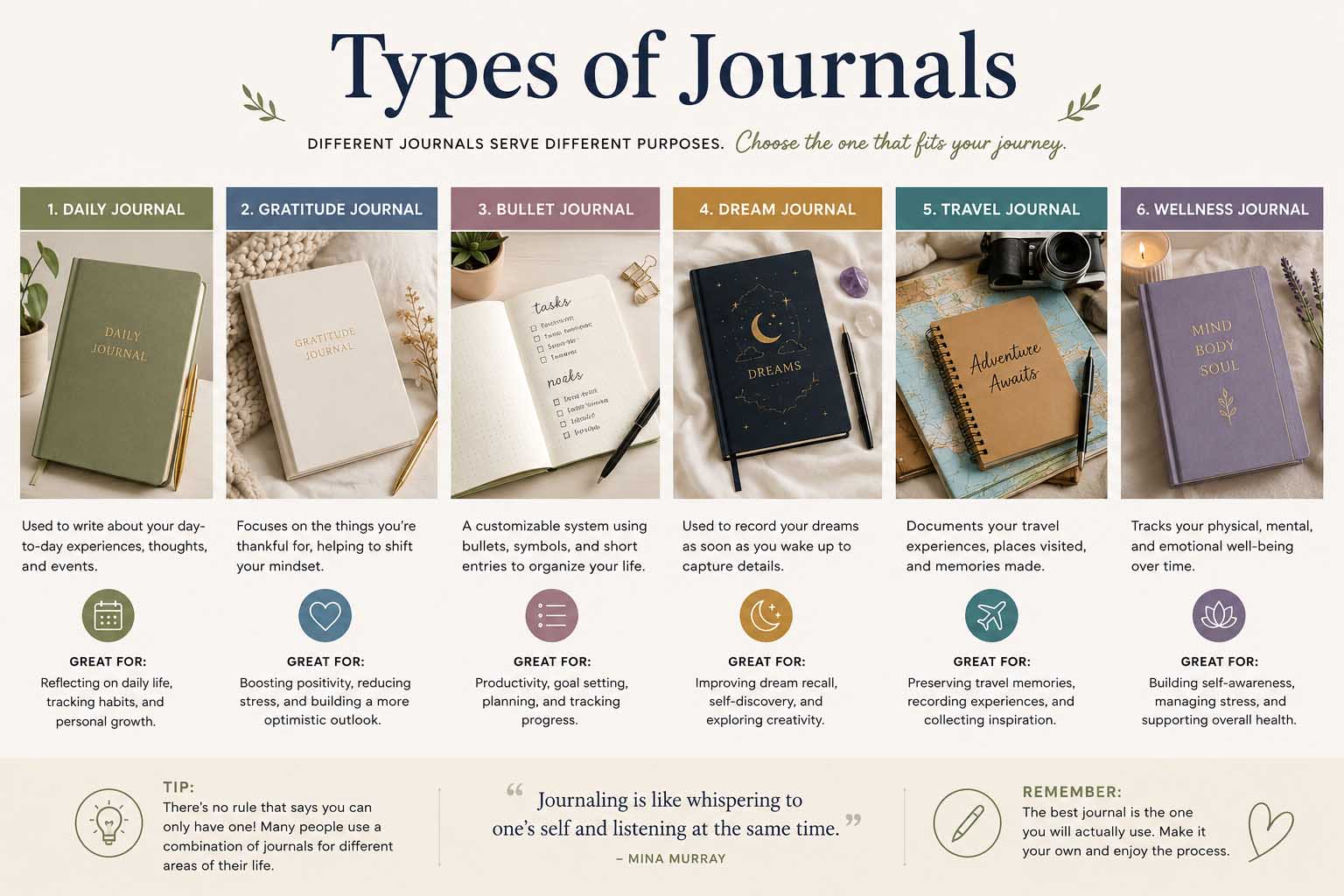
Personal Journal
A personal journal records daily events, thoughts, and feelings.
There are no strict rules.
Some people write every day, while others write only when something meaningful happens.
Gratitude Journal
Instead of documenting the entire day, gratitude journals focus on positive moments.
Many writers list three to five things they appreciate each day.
Reflective Journal
Students and professionals often use reflective journals to think about experiences and identify lessons learned.
Reflection encourages deeper understanding instead of simply recording events.
Creative Journal
Artists and writers use creative journals to capture ideas before they disappear.
Sketches, poems, story ideas, and brainstorming notes all belong here.
Types of Journals to Keep for Students
Students often benefit from keeping more than one journal because each serves a different purpose.
Popular types of journals to keep include:
Learning Journal
A learning journal helps students summarize lessons after class.
Writing key concepts in your own words improves long-term memory.
Reading Journal
Instead of highlighting every page, students can record:
- Important quotes
- Questions
- Themes
- Character observations
- Vocabulary
This habit makes class discussions and essay writing much easier.
Research Journal
Research journals organize:
- Sources
- Notes
- Hypotheses
- Data
- Progress updates
Students completing larger projects often find this approach much more manageable.
If your assignment involves collecting research before writing, learning What Is an Annotated Bibliography? can help you organize your sources alongside your journal notes.
Different Types of Articles in Journals
Academic journals contain several article formats.
Understanding these helps students locate the information they need.
Original Research Articles
These present new studies and original findings.
Most include:
- Introduction
- Methodology
- Results
- Discussion
- References
Review Articles
Review articles summarize existing research rather than introducing new experiments.
They provide an excellent starting point for learning about unfamiliar topics.
Case Studies
Case studies analyze one specific situation, person, organization, or event.
Students completing similar assignments may benefit from learning How to Write a Case Study before beginning their own work.
Short Communications
These brief articles present important findings that don’t require a full-length paper.
Editorials
Editors or invited experts share opinions about current research topics or developments within a field.
Choosing the Right Journal
Not every journal fits every situation.
Ask yourself:
- Why am I writing?
- Who will read it?
- Do I need private reflection or public publication?
- Am I documenting research or personal experiences?
- Will I use it every day?
Your answers make choosing much easier.
How Students Can Start a Journal
Beginning a journal doesn’t require expensive supplies.
Follow these simple steps.
Step 1: Pick Your Purpose
Decide whether you’re keeping:
- A study journal
- A research journal
- A personal journal
- A reading journal
A clear purpose helps keep your writing focused, ensuring your ideas remain organized and your message is easy for readers to understand.
Step 2: Choose a Format
Options include:
- Paper notebook
- Digital notebook
- Note-taking app
- Word processor
- Online journal platform
Select whichever format you’ll actually use consistently.
Step 3: Write Regularly
Consistency matters more than length.
Even five minutes of writing after class can strengthen learning.
Step 4: Review Previous Entries
Looking back helps you identify patterns, improvements, and recurring questions.
Benefits of Keeping a Journal
Journaling supports learning in several ways.
Students often experience:
- Better organization
- Improved memory
- Stronger critical thinking
- Greater self-awareness
- Easier exam preparation
- Better writing skills
- Reduced stress
Regular writing also builds confidence over time.
Journals in Classroom Learning
Teachers often use journals to encourage active learning.
Instead of memorizing facts, students explain concepts in their own words.
For example, after completing a classroom survey, educators may compare student reflections with findings from a Student Perception Survey Guide to better understand learning experiences and classroom engagement.
Reflection turns information into deeper understanding.
Common Mistakes When Keeping a Journal
Many beginners make journaling harder than necessary.
Avoid these common mistakes:
- Trying to write perfect entries
- Skipping weeks between entries
- Writing without a clear purpose
- Recording facts without reflection
- Giving up after missing a few days
Remember, journals are tools for learning, not graded assignments.
Digital Journals vs Paper Journals
Both formats offer advantages.
| Digital Journal | Paper Journal |
|---|---|
| Easy to search | No distractions |
| Can include photos and links | Encourages handwriting |
| Accessible across devices | Doesn’t require batteries |
| Easy backup | More personal for many writers |
Choose the option that best matches your habits.
Tips for Making Journaling a Habit
Building a routine is often the hardest part.
Try these strategies:
- Keep entries short.
- Use prompts if you’re unsure what to write.
- Don’t worry about grammar.
- Review older entries every month.
- Celebrate consistency rather than perfection.
Over time, journaling becomes much easier.
Who Uses Journals?
Journals aren’t limited to schools or universities.
Many people benefit from them, including:
- Students
- Teachers
- Researchers
- Healthcare professionals
- Business leaders
- Writers
- Artists
- Travelers
- Scientists
Each group adapts journaling to meet its own goals.
Frequently Asked Questions
What are the main types of journals?
The most common types include personal journals, reflective journals, academic journals, research journals, learning journals, reading journals, travel journals, gratitude journals, creative journals, and bullet journals.
What are types of academic journals?
Academic journals include peer-reviewed journals, professional journals, open access journals, discipline-specific journals, and research publications that share scholarly work.
What is the difference between a journal and a diary?
A diary mainly records daily events and personal experiences, while a journal often includes reflection, learning, research, planning, or creative writing.
Which journal is best for students?
Learning journals, reading journals, and research journals are excellent choices because they help organize information and improve understanding over time.
How often should I write in a journal?
There’s no fixed rule. Writing several times each week is enough for most students, although daily entries help build a consistent habit.
Make Journaling Work for You
Understanding the different types of journals makes it easier to choose one that fits your goals. Whether you’re documenting research, reflecting on classroom experiences, improving your writing, or simply organizing your thoughts, the right journal can become one of your most valuable learning tools.
Start with a simple notebook or digital document, write consistently, and focus on progress rather than perfection. As your journal grows, you’ll create a personal record of ideas, learning, and achievements that can support your education for years to come.