
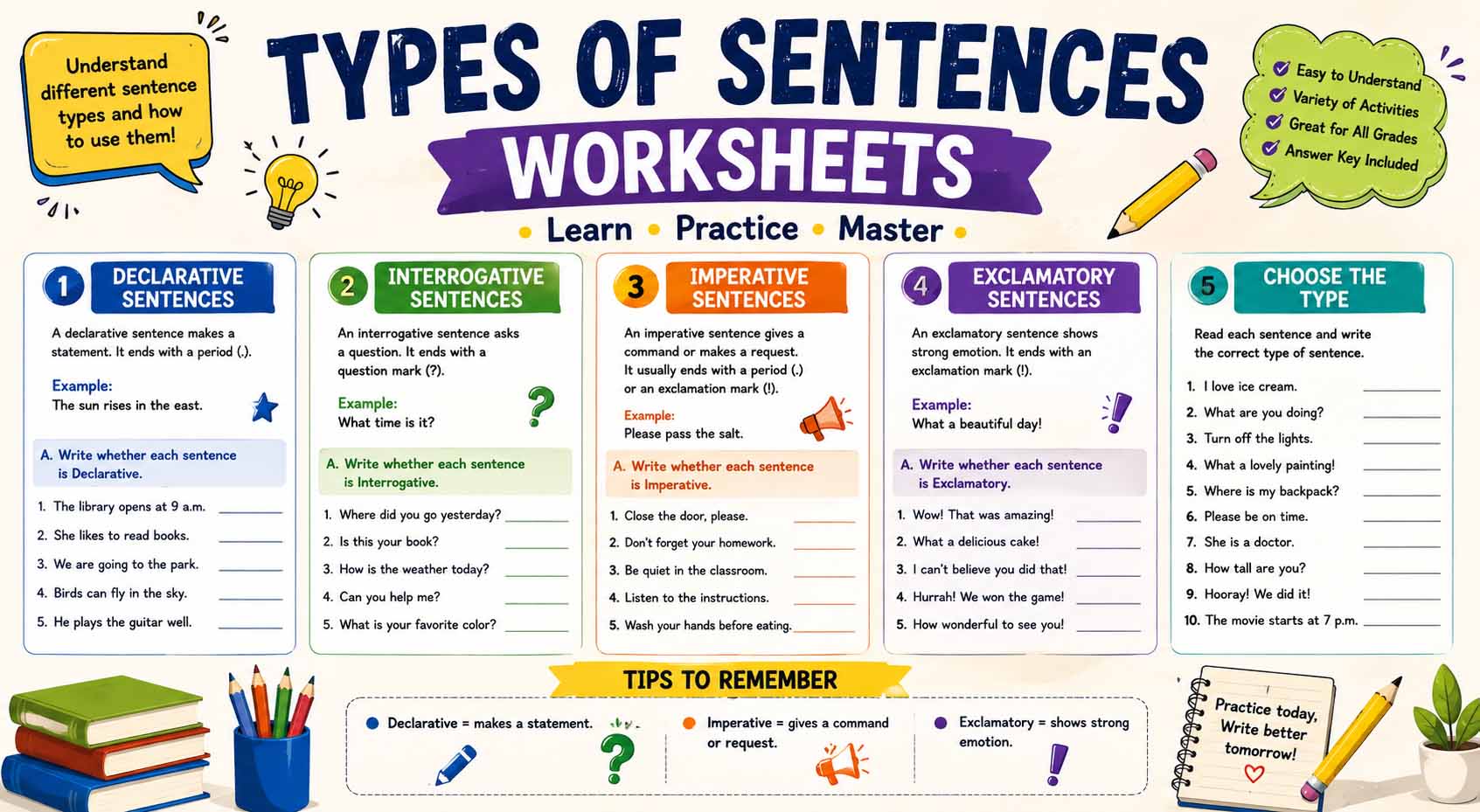
If you’ve been searching for types of sentences worksheets, chances are you’re preparing for a grammar lesson, completing homework, or studying for an English test. Worksheets are a great way to practice, but understanding why a sentence belongs to a certain category is even more valuable. Once you recognize the purpose and punctuation of each sentence type, grammar exercises become much easier.
This guide explains the four main sentence types, shows practical examples, and shares study strategies that help students complete worksheets with confidence.
What Are Sentence Types?
Sentence types are categories based on the purpose of a sentence.
Every complete sentence communicates an idea, but not every sentence has the same goal. Some make statements, others ask questions, give commands, or express strong emotions.
The four basic sentence types are:
- Declarative
- Interrogative
- Imperative
- Exclamatory
Most elementary, middle school, and high school grammar lessons begin with these four categories before introducing more advanced sentence structures.
Types of Sentences Worksheets: The Four Main Sentence Types
Many classroom activities and types of sentences worksheets ask students to identify these four sentence categories.
| Sentence Type | Purpose | Ending Punctuation | Example |
|---|---|---|---|
| Declarative | Makes a statement | Period (.) | The library closes at 5 p.m. |
| Interrogative | Asks a question | Question mark (?) | Where is your homework? |
| Imperative | Gives a command or request | Period or exclamation mark | Please close the door. |
| Exclamatory | Shows strong emotion | Exclamation mark (!) | What an amazing performance! |
Learning this chart first makes worksheet questions much easier.
How to Identify Each Sentence Type
Instead of memorizing definitions, look for clues in the sentence.
Declarative Sentences
Declarative sentences provide information or state facts.
Examples:
- We have science class tomorrow.
- The dog is sleeping.
- My favorite subject is history.
Key clue:
The sentence simply tells something.
Interrogative Sentences
Interrogative sentences ask questions.
Examples:
- Where did you put the notebook?
- Are you ready for the quiz?
- What time does school start?
Key clue:
The sentence asks for information and usually ends with a question mark.
Imperative Sentences
Imperative sentences give directions, commands, advice, or requests.
Examples:
- Finish your assignment.
- Please sit down.
- Turn off the lights.
Key clue:
The subject “you” is often understood instead of written.
Exclamatory Sentences
Exclamatory sentences express excitement, surprise, or strong feelings.
Examples:
- That was incredible!
- What a beautiful rainbow!
- I can’t believe we won!
Key clue:
Strong emotion combined with an exclamation mark.
Step-by-Step Method for Solving Types of Sentences Worksheets
Students often complete grammar worksheets more accurately when they follow the same process every time.
Step 1: Read the Entire Sentence
Don’t focus only on the punctuation.
Think about the purpose of the sentence, as it helps determine the most appropriate text structure, tone, and wording to communicate your message clearly.
Step 2: Ask What the Sentence Is Doing
Is it:
- Giving information?
- Asking a question?
- Giving a command?
- Showing excitement?
The answer usually identifies the sentence type.
Step 3: Check the Ending Punctuation
Periods, question marks, and exclamation marks provide useful clues, although punctuation alone should not determine your answer.
Step 4: Review Your Choice
Read the sentence one more time before moving on.
Small mistakes often happen when students rush.
Practice Examples
Try identifying the sentence type before checking the answer.
Example 1
Please bring your notebook tomorrow.
Answer:
Imperative
Reason:
It gives a request.
Example 2
What is your favorite book?
Answer:
Interrogative
Reason:
The sentence asks a question.
Example 3
The weather is beautiful today.
Answer:
Declarative
Reason:
It simply states information.
Example 4
That was an unbelievable goal!
Answer:
Exclamatory
Reason:
It expresses strong emotion.
Sentence Type vs. Sentence Structure
Many students confuse sentence types with sentence structure.
Sentence types describe the purpose of a sentence.
Sentence structure describes how the sentence is built.
For example, a declarative sentence can also be a simple, compound, or complex sentence.
If you’re reviewing sentence structure as well, studying complex sentence examples can help you understand how longer sentences are organized while still serving one of the four sentence purposes.
Four Types of Sentences Worksheets
Many teachers provide four types of sentences worksheets that include activities such as:
- Matching sentence types
- Multiple-choice questions
- Sorting exercises
- Writing your own examples
- Correcting punctuation
- Identifying sentence purpose
These worksheets help students recognize sentence patterns through repeated practice.
Types of Sentences Worksheets PDF Resources
Many schools provide downloadable practice pages.
You may also find:
- types of sentences worksheets pdf
- Printable classroom activities
- Homework packets
- Online grammar exercises
These resources work best when you attempt the questions independently before checking the answers.
Worksheets on Types of Sentences
Different teachers design worksheets on types of sentences in different ways.
Some focus only on identification, while others ask students to rewrite sentences or change one type into another.
For example:
Declarative:
The game starts at six.
Interrogative:
When does the game start?
Imperative:
Arrive before six.
Exclamatory:
What an exciting game this will be!
Changing the sentence type helps students understand how purpose changes while the topic remains the same.
Common Mistakes Students Make
Even strong writers make grammar mistakes.
Watch out for these common errors:
- Confusing commands with statements
- Choosing answers based only on punctuation
- Forgetting that requests are imperative sentences
- Missing emotional clues in exclamatory sentences
- Reading too quickly
Taking a few extra seconds to identify the sentence’s purpose often improves accuracy.
Classroom Activities That Reinforce Learning
Teachers use many different methods to practice sentence types.
Popular activities include:
- Sentence sorting games
- Partner quizzes
- Grammar scavenger hunts
- Interactive whiteboard lessons
- Writing challenges
- Exit tickets
These activities reinforce the same concepts found in worksheets while making grammar more engaging.
Study Tips for Better Grammar
Grammar becomes easier with regular practice rather than long study sessions.
Creating your own examples for each sentence type helps reinforce what you’ve learned.
Another useful strategy is learning How to Create a Study Guide so you can organize grammar rules, examples, and practice exercises into one resource before quizzes or exams.
Building Stronger Writing Skills
Understanding sentence types improves more than grammar worksheets.
It also helps students write clearer paragraphs and essays.
For example, strong paragraphs usually begin with clear Topic Sentence Examples that introduce the main idea before supporting details are added.
Varying sentence types throughout a paragraph also makes writing more interesting and natural.
Sentence Types and Reading Comprehension
Sentence purpose also supports reading comprehension.
Authors use different sentence types to create mood, build suspense, ask rhetorical questions, or emphasize important ideas.
As students grow, they also study types of text structure, which explains how entire passages are organized. Combining sentence-level and paragraph-level skills strengthens both reading and writing.
Preparing for Grammar Tests
Grammar tests often include more than simple identification.
You may be asked to:
- Identify sentence types.
- Rewrite sentences.
- Correct punctuation.
- Explain your reasoning.
Reviewing different types of questions before an exam can help you recognize common testing formats and improve your confidence during assessments.
Frequently Asked Questions
What are the four types of sentences?
The four basic sentence types are declarative, interrogative, imperative, and exclamatory, each serving a different purpose in communication, such as making a statement, asking a question, giving a command, or expressing strong emotion.
How do I identify sentence types?
Look at the sentence’s purpose first, then use punctuation as a supporting clue.
Are sentence types the same as sentence structures?
No. Sentence types describe the purpose of a sentence—such as making a statement, asking a question, giving a command, or expressing emotion—while sentence structures describe how a sentence is constructed using independent and dependent clauses.
Why are worksheets helpful?
Worksheets provide repeated practice that helps students recognize sentence patterns and apply grammar rules more accurately.
What’s the best way to remember sentence types?
Practice writing your own examples, complete grammar exercises regularly, and review mistakes after each worksheet to reinforce the concepts.
Key Takeaways for Grammar Success
Learning sentence types becomes much easier when you focus on purpose instead of memorizing definitions. Practice identifying whether a sentence makes a statement, asks a question, gives a command, or expresses emotion. The more examples you read and write, the faster you’ll recognize each pattern, making grammar worksheets, classroom assignments, and writing tasks much easier to complete with confidence.