Have you ever wondered why some writing sounds smoother and more engaging than others? One reason is the use of complex sentence examples that connect ideas in a clear, logical way. Whether you’re writing an essay, preparing for an exam, or improving your everyday English, learning how to use complex sentences can make your writing stronger and easier to follow.
While the idea sounds technical at first, it’s actually one of the easiest grammar skills to master once you see plenty of examples. In this guide, you’ll learn what complex sentences are, how they work, common mistakes to avoid, and dozens of examples you can use for practice.
What Are Complex Sentences?
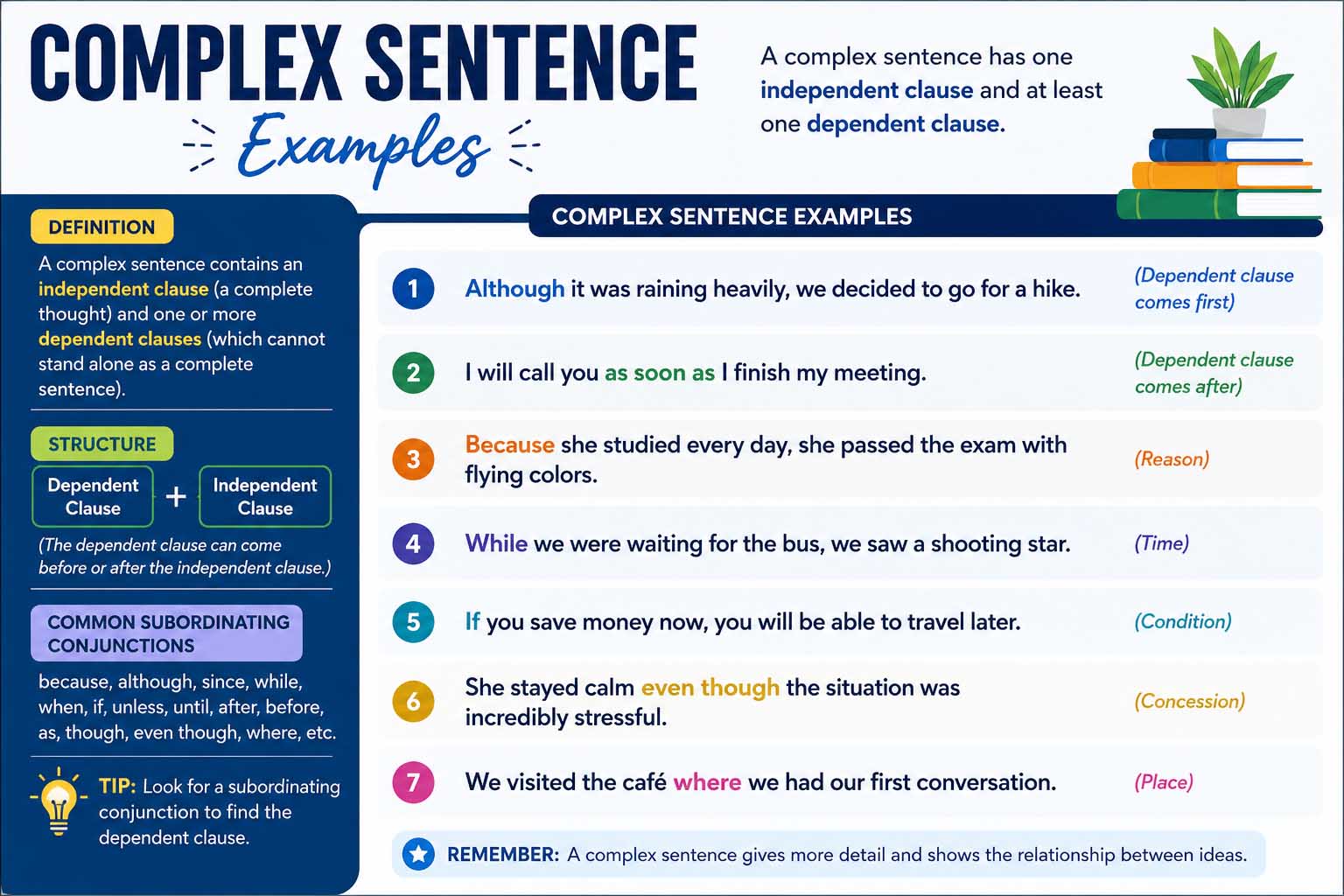
A complex sentence contains:
- One independent clause (a complete thought)
- One or more dependent clauses (an incomplete thought that depends on the main clause)
The clauses are connected with subordinating conjunctions such as:
- because
- although
- since
- while
- after
- before
- unless
- if
- when
- even though
For example:
- Because it was raining, we stayed inside.
- We stayed inside because it was raining.
Both sentences express the same idea. The only difference is where the dependent clause appears.
Learning sentence structure also helps when studying What Is Text Structure?, since well-organized writing depends on connecting ideas clearly from one paragraph to the next.
Why Complex Sentences Matter
Complex sentences make writing more interesting because they show relationships between ideas.
Instead of writing:
I was tired. I finished my homework.
You can write:
Although I was tired, I finished my homework.
The second version explains how the two ideas relate.
Complex sentences help writers:
- explain reasons
- show contrast
- describe time
- express conditions
- improve sentence variety
- create smoother paragraphs
Students who only use short sentences often sound repetitive. Mixing simple and complex sentences creates a more natural writing style.
How to Identify a Complex Sentence
Use this quick checklist.
A sentence is complex if it has:
✅ one complete thought
✅ one incomplete clause
✅ a subordinating conjunction
Example:
Since the library was closed, we studied at home.
Independent clause:
We studied at home.
Dependent clause:
Since the library was closed.
Without the independent clause, the sentence would be incomplete.
Complex Sentence Examples for Everyday English
Here are some easy examples of a complex sentence that you may hear or use every day.
| Dependent Clause | Independent Clause |
|---|---|
| Although I was hungry | I waited until dinner. |
| Because she practiced daily | She improved quickly. |
| After the movie ended | We walked home. |
| While I cooked | My brother set the table. |
| Since the bus was late | We missed the meeting. |
| If you study consistently | You’ll feel more confident. |
| Before school started | I reviewed my notes. |
| Unless you ask | No one will know you need help. |
| When the rain stopped | The children played outside. |
| Even though it was difficult | They completed the project. |
Notice how every sentence has one complete idea and one supporting clause.
Complex Sentence Examples for School Assignments
Teachers often expect students to use more than simple sentences in essays.
Here are examples suitable for school writing.
- Because renewable energy reduces pollution, many countries continue investing in it.
- Although history contains many conflicts, it also teaches valuable lessons.
- Since technology changes rapidly, students should keep learning new skills.
- After the experiment ended, the class discussed the results.
- While reading the novel, I noticed several recurring themes.
- Even though the assignment was challenging, everyone completed it on time.
- If schools encourage curiosity, students become more independent learners.
- Because teamwork improves problem-solving, many teachers assign group projects.
- When scientists collect more evidence, their conclusions become stronger.
- Before submitting the essay, I checked my grammar carefully.
Using sentences like these makes academic writing sound more polished.
Complex Sentence Examples by Subordinating Conjunction
One of the easiest ways to master complex sentences is by practicing each conjunction separately.
Because
- Because I studied every evening, I passed the exam.
- She smiled because she recognized her teacher.
- We stayed indoors because the weather became dangerous.
Although
- Although he was nervous, he gave an excellent presentation.
- Although the recipe looked difficult, it was easy to follow.
- Although traffic was heavy, we arrived on time.
While
- While my parents cooked dinner, I finished my homework.
- While the teacher explained the lesson, everyone listened carefully.
- While traveling, we visited several museums.
Since
- Since everyone agreed, we started immediately.
- Since the classroom was quiet, students concentrated better.
- Since the project required teamwork, everyone shared responsibilities.
If
- If you ask questions, you’ll understand the lesson better.
- If the weather improves, we’ll play outside.
- If you practice every day, your writing will improve.
Complex vs. Simple Sentences
Students often confuse these sentence types.
| Simple Sentence | Complex Sentence |
|---|---|
| I went home. | Because I felt sick, I went home. |
| She finished early. | Although she was tired, she finished early. |
| We played soccer. | After school ended, we played soccer. |
| He studied hard. | Since the exam was difficult, he studied hard. |
| They celebrated. | When the competition ended, they celebrated. |
Complex sentences provide more context, making your ideas clearer.
Compound Complex Sentence Examples
Many students also search for compound complex sentence examples after learning basic complex sentences.
A compound-complex sentence contains:
- two or more independent clauses
- at least one dependent clause
Examples:
- Although it was snowing, we continued hiking, and we reached the cabin before sunset.
- Because Sarah studied every night, she passed the test, and her confidence grew.
- While the coach explained the rules, the players listened carefully, and the referee prepared the field.
- Even though the computer froze, I saved my work, and I finished the assignment later.
- Since the restaurant was crowded, we ordered takeout, but we still enjoyed dinner together.
These sentences are longer but still easy to understand because each idea connects logically.
Many students also confuse complex sentences with persuasive writing techniques. Learning What Is a Rhetorical Device? can help you understand how grammar and language choices work together to make writing more effective.
Common Mistakes Students Make
Complex sentences become much easier once you know what to avoid.
Some common mistakes include:
Forgetting the Independent Clause
Incorrect:
Because I was late.
Correct:
Because I was late, I missed the bus.
Using Too Many Clauses
Long sentences can become confusing if several dependent clauses appear together.
Instead of adding endless details, keep each sentence focused on one main idea.
Misplacing Commas
When the dependent clause comes first, use a comma.
Correct:
Although it rained, we continued hiking.
When the independent clause comes first, a comma usually isn’t needed.
Correct:
We continued hiking although it rained.
Complex Sentence Examples for Different Subjects
Once you understand the structure, you can use complex sentences in almost any subject. Here are examples you can adapt for school assignments.
Science
- Because plants need sunlight, they cannot survive long in complete darkness.
- Since water expands when it freezes, pipes may burst during winter.
- After the chemical reaction ended, the solution changed color.
- While scientists collected data, they recorded every observation.
History
- Although the battle was won, the war continued for several years.
- Because trade routes expanded, cities became wealthier.
- After the treaty was signed, both countries reduced military activity.
- Since printing became more common, ideas spread more quickly.
- While explorers searched for new routes, they discovered new lands.
Literature
- Although the main character appeared confident, she secretly feared failure.
- Because the setting changed dramatically, the mood became darker.
- After reading the final chapter, I understood the author’s message.
- Since the narrator was unreliable, readers questioned every event.
- While the conflict grew stronger, the characters developed emotionally.
Everyday Life
- Because I forgot my umbrella, I got soaked on the way home.
- Although my phone battery was low, I finished the call.
- When my friend arrived, we started cooking dinner.
- Since the store closed early, we returned the next day.
- While my sister exercised, I prepared lunch.
Practice Writing Your Own Complex Sentences
The fastest way to improve is to practice regularly.
Start with a simple sentence.
Simple sentence:
I stayed home.
Now ask yourself a question.
Why?
Because I felt sick.
Combine them.
Because I felt sick, I stayed home.
Try another.
Simple sentence:
We celebrated.
Ask:
When?
After we finished the project.
New sentence:
After we finished the project, we celebrated.
This method works with almost any sentence.
A Simple Formula for Building Complex Sentences
Use this easy framework whenever you’re writing.
- Write one complete sentence.
- Think of a supporting detail.
- Choose a subordinating conjunction.
- Combine both ideas.
For example:
Step 1
The dog barked.
Step 2
It heard a strange noise.
Step 3
Use “because.”
Final sentence
Because the dog heard a strange noise, it barked.
The more often you practice, the easier and faster the process will feel.
When Should You Use Complex Sentences?
Complex sentences are most effective when explaining the relationship between ideas.
Use them to:
- explain causes
- describe time
- compare ideas
- show contrast
- express conditions
- explain results
They are especially useful in essays, reports, stories, emails, and presentations.
At the same time, don’t make every sentence complex. Strong writing mixes short, medium, and longer sentence structures to keep readers interested.
Quick Practice Exercise
See if you can combine these sentence pairs.
Example 1
I finished my homework.
I watched television afterward.
Possible answer:
After I finished my homework, I watched television.
Example 2
She practiced every day.
She became an excellent pianist.
Possible answer:
Because she practiced every day, she became an excellent pianist.
Example 3
The weather improved.
We went hiking.
Possible answer:
When the weather improved, we went hiking.
Example 4
The class ended.
The students packed their bags.
Possible answer:
After the class ended, the students packed their bags.
Example 5
He felt nervous.
He gave an outstanding speech.
Possible answer:
Although he felt nervous, he gave an outstanding speech.
Tips for Writing Better Complex Sentences
If you want your writing to sound natural, keep these tips in mind.
- Start with short ideas before combining them.
- Choose conjunctions that clearly show the relationship.
- Read your sentence aloud to check the flow.
- Avoid making every sentence long.
- Keep each sentence focused on one main point.
- Use punctuation correctly.
- Practice rewriting simple sentences into complex ones.
Strong writing comes from clarity, not length.
Complex Sentences in Essays
Complex sentences help essays sound organized and thoughtful.
For example, instead of writing:
Recycling helps the environment. Many people still do not recycle.
You could write:
Although recycling helps the environment, many people still do not recycle.
This version connects the ideas more effectively.
As you build paragraphs, using Topic Sentence Examples can help you create a strong opening sentence before supporting it with complex sentences that add evidence and explanation.
Likewise, when drafting introductions, reviewing Introduction Paragraph Examples can show you how experienced writers combine engaging hooks with varied sentence structures to capture a reader’s attention.
Common Questions About Complex Sentences
Are complex sentences difficult?
Not at all.
Once you understand independent and dependent clauses, writing complex sentences becomes much easier with practice.
Can a complex sentence start with a dependent clause?
Yes.
Example:
Although it was late, we continued studying.
Simply add a comma after the dependent clause.
Do all complex sentences need commas?
No.
If the dependent clause follows the independent clause, a comma usually isn’t needed.
Example:
We continued studying although it was late.
What is the difference between complex and compound sentences?
A complex sentence has one independent clause and at least one dependent clause.
A compound sentence has two independent clauses joined by a coordinating conjunction such as and, but, or or.
A compound-complex sentence combines both structures.
Why do teachers encourage complex sentences?
They help students explain ideas clearly, show relationships between concepts, and create smoother writing.
Study Tips for Mastering Complex Sentences
Grammar improves through regular practice rather than memorization.
Here are a few simple study habits:
- Read books, newspapers, and articles that use varied sentence structures.
- Rewrite five simple sentences into complex ones every day.
- Highlight subordinating conjunctions while reading.
- Read your paragraphs aloud to spot awkward wording.
If you’re struggling to understand reading passages, learning about types of context clues can also improve comprehension. Better reading naturally leads to better writing because you’ll recognize how experienced authors build sentences.
Key Takeaways
Learning complex sentence examples is one of the easiest ways to improve your writing. Whether you’re completing homework, writing essays, or preparing for exams, complex sentences allow you to connect ideas in a clear and engaging way.
Start with one independent clause, add a related dependent clause, and choose the right subordinating conjunction. As your confidence grows, experiment with compound complex sentence examples to create even more varied writing.
The goal isn’t to make every sentence long. Instead, focus on making each sentence meaningful, easy to understand, and connected to the ideas around it. With regular practice, you’ll write more naturally, communicate your thoughts more effectively, and feel more confident in every assignment.