
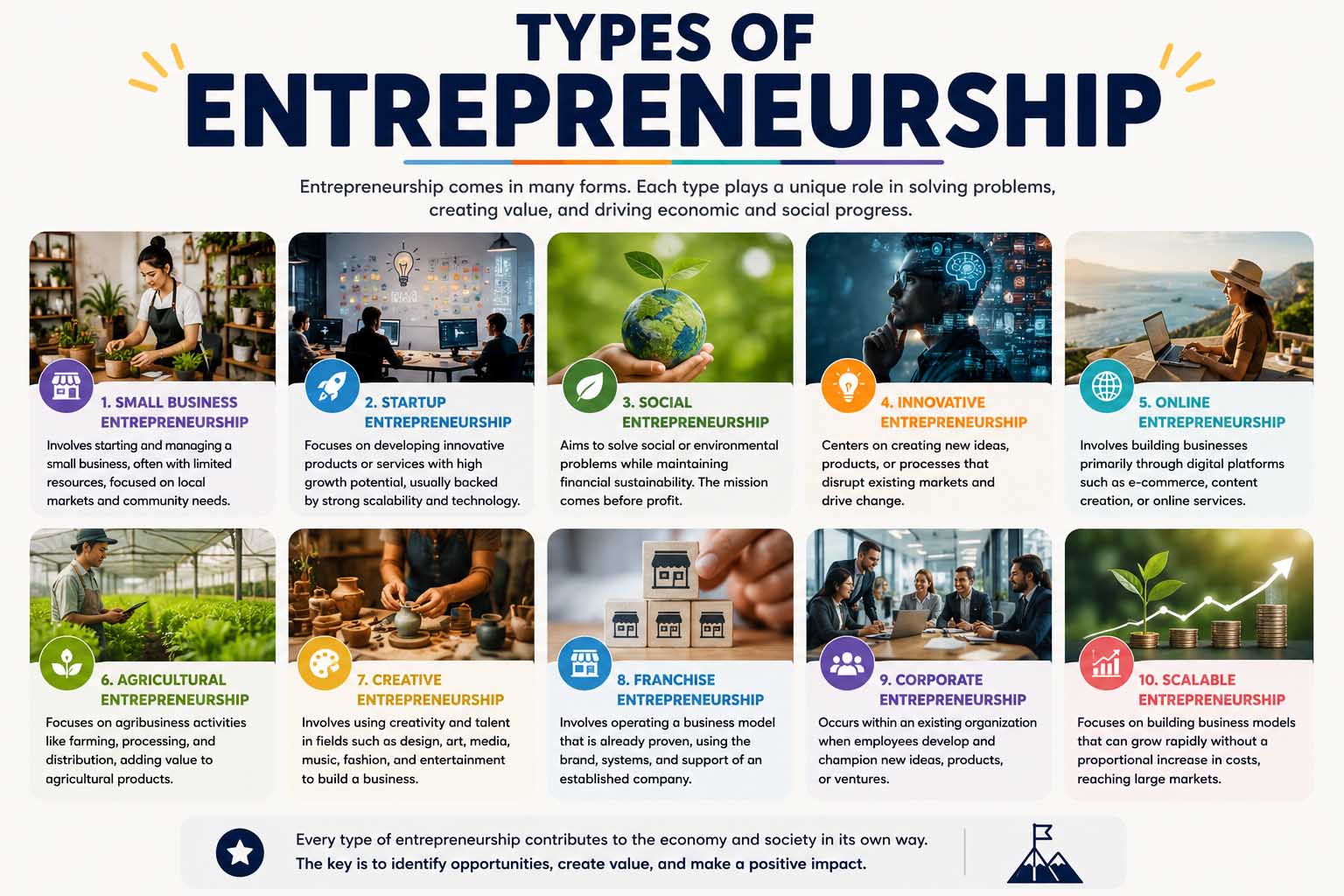
If you’ve ever wondered about the types of entrepreneurship, you’re not alone. Entrepreneurship isn’t limited to launching the next global technology company. Understanding the different types helps students, aspiring business owners, and professionals identify which path best matches their interests, skills, and goals.
This guide explains the most common entrepreneurial models, how they differ, and where each one fits in today’s business world.
What Is Entrepreneurship?
Entrepreneurship is the process of identifying an opportunity, creating value, and building a business or organization around an idea. Entrepreneurs take calculated risks to develop products, services, or solutions that meet customer needs.
Before learning about different entrepreneurial models, it’s helpful to understand What Is a Business, since every entrepreneurial venture begins with the goal of creating value through an organized activity.
Entrepreneurship isn’t limited to making a profit. Some entrepreneurs focus on solving social challenges, improving communities, or developing innovative technologies.
Types of Entrepreneurship Explained
Although experts classify entrepreneurship in different ways, several categories appear consistently in business education.
The following sections cover the most widely recognized types of entrepreneurship and explain where each one is commonly found.
Small Business Entrepreneurship
These businesses are usually owned and managed by individuals or families. Rather than pursuing rapid expansion, owners focus on providing reliable products or services to their local communities.
Examples include:
- Coffee shops
- Restaurants
- Hair salons
- Auto repair shops
- Local retail stores
- Accounting firms
Success often depends on customer service, careful financial management, and steady growth.
Scalable Startup Entrepreneurship
Scalable startups are designed to grow quickly.
Founders often begin with an innovative idea that has the potential to serve national or global markets. Many technology companies follow this model because digital products can reach millions of customers without opening physical locations.
Characteristics include:
- High growth potential
- Outside investment
- Innovation-driven products
- Large target markets
- Rapid expansion plans
Many well-known software companies began as scalable startups before becoming international businesses.
Large Company Entrepreneurship
Even established corporations continue to innovate.
Large company entrepreneurship focuses on developing new products, entering new markets, or adapting to changing customer needs while operating within an existing organization.
Examples include:
- Launching a new product line
- Creating digital services
- Expanding internationally
- Developing sustainable business practices
Innovation helps large companies remain competitive despite changing industries.
Social Entrepreneurship
Social entrepreneurs prioritize solving social or environmental problems while maintaining financial sustainability.
Their primary objective is creating positive change rather than maximizing profits.
Examples include organizations that:
- Improve access to education
- Reduce food waste
- Expand healthcare services
- Support environmental conservation
- Create employment opportunities for underserved communities
Many nonprofit organizations also adopt entrepreneurial strategies to increase their long-term impact.
4 Types of Entrepreneurship
Students often encounter the phrase 4 types of entrepreneurship in textbooks and classroom discussions.
The four classic categories are:
| Type | Primary Goal | Example |
|---|---|---|
| Small Business | Stable income and community service | Local bakery |
| Scalable Startup | Rapid growth | Software startup |
| Large Company | Continuous innovation | Global manufacturing company |
| Social Entrepreneurship | Social impact | Educational nonprofit |
If someone asks, what are the 4 types of entrepreneurship?, this framework is usually the answer taught in introductory business courses.
Types and Forms of Entrepreneurship Beyond the Basics
Modern business environments have created additional entrepreneurial models.
Innovative Entrepreneurship
Innovative entrepreneurs introduce entirely new products, technologies, or business models.
They often invest heavily in research and development before bringing products to market.
Imitative Entrepreneurship
Instead of inventing something completely new, imitative entrepreneurs improve existing ideas.
For example, they may introduce better customer service, lower prices, or improved product quality.
Green Entrepreneurship
Green entrepreneurs build businesses around environmental sustainability.
Examples include:
- Renewable energy companies
- Recycling businesses
- Sustainable agriculture
- Eco-friendly packaging
Digital Entrepreneurship
Digital entrepreneurs operate primarily online.
Common examples include:
- E-commerce stores
- Mobile applications
- Online education platforms
- Software as a Service (SaaS)
- Digital marketing agencies
Digital entrepreneurship continues to grow because online businesses can reach customers across the world.
What Are the Nine Types of Entrepreneurship?
Some universities and business organizations expand the traditional classification into nine categories.
If you’re wondering what are the nine types of entrepreneurship?, a commonly used list includes:
- Small business entrepreneurship
- Scalable startup entrepreneurship
- Large company entrepreneurship
- Social entrepreneurship
- Innovative entrepreneurship
- Imitative entrepreneurship
- Green entrepreneurship
- Digital entrepreneurship
- Corporate or intrapreneurship
The exact categories vary depending on the textbook or institution, but the overall purpose remains the same: helping learners understand the different ways entrepreneurs create value.
Comparing the Main Types of Entrepreneurship
| Entrepreneurship Type | Risk Level | Growth Potential | Main Objective |
| Small Business | Moderate | Moderate | Stable income |
| Startup | High | Very High | Rapid expansion |
| Large Company | Moderate | High | Innovation |
| Social | Moderate | Moderate | Community impact |
| Digital | Moderate | High | Online growth |
| Green | Moderate | High | Sustainability |
This comparison helps students quickly identify how different entrepreneurial paths align with various career goals.
Choosing the Right Entrepreneurial Path
Every entrepreneur has different motivations.
Consider these questions:
- Do you enjoy solving technical problems?
- Would you rather support your local community?
- Are you comfortable taking financial risks?
- Do you want rapid business growth?
- Is social impact your primary goal?
Your answers can help identify the entrepreneurial model that best matches your interests.
Understanding the nature of business also makes it easier to evaluate how different industries and markets influence entrepreneurial opportunities.
Skills Every Entrepreneur Needs
Regardless of the type of business, successful entrepreneurs often develop similar core skills.
These include:
- Leadership
- Communication
- Financial planning
- Problem-solving
- Decision-making
- Time management
- Adaptability
- Customer service
Strong communication deserves special attention because entrepreneurs regularly interact with employees, customers, suppliers, and investors. Learning different methods of business communication can improve teamwork and help businesses build lasting relationships.
Classroom Applications
Teachers often introduce entrepreneurship through practical activities rather than lectures alone.
Students may:
- Develop business ideas
- Research customer needs
- Create marketing plans
- Prepare financial estimates
- Present startup concepts
These projects help learners connect business theory with real-world decision-making.
In many entrepreneurship courses, students also prepare an executive summary example before writing a complete business plan. This teaches them how to explain a business idea clearly and concisely.
Common Mistakes New Entrepreneurs Make
Many first-time entrepreneurs face similar challenges.
Some common mistakes include:
- Skipping market research
- Underestimating startup costs
- Ignoring customer feedback
- Expanding too quickly
- Poor cash flow management
Learning from these mistakes early can improve long-term success.
Career Opportunities in Entrepreneurship
Studying entrepreneurship opens doors to many careers beyond owning a business.
Graduates may become:
- Startup founders
- Business consultants
- Product managers
- Innovation specialists
- Franchise owners
- Nonprofit leaders
- Corporate strategists
- Venture capital analysts
Entrepreneurial thinking is valuable in both small businesses and multinational organizations.
Employers also appreciate graduates with strong Commercial Awareness Meaning because they understand how markets, customers, and competitors influence business decisions.
Study Tips for Learning Entrepreneurship
If you’re preparing for an exam or business course, these strategies can help.
- Compare different entrepreneurial models using charts.
- Memorize the defining features of each type.
- Connect each category to a real company.
- Practice explaining concepts in your own words.
- Review business case studies regularly.
- Focus on why different business models exist rather than simply memorizing definitions.
These techniques make entrepreneurship concepts easier to understand and remember.
Frequently Asked Questions
What are the types of entrepreneurship?
The most common types are small business entrepreneurship, scalable startup entrepreneurship, large company entrepreneurship, and social entrepreneurship. Many educators also include innovative, digital, green, imitative, and corporate entrepreneurship.
What are the 4 types of entrepreneurship?
The four traditional categories are small business, scalable startup, large company, and social entrepreneurship.
What are the nine types of entrepreneurship?
Depending on the educational source, the nine categories often include small business, scalable startup, large company, social, innovative, imitative, green, digital, and corporate entrepreneurship.
Which type of entrepreneurship is best?
There is no single best type. The right choice depends on your goals, available resources, interests, and willingness to take risks.
Why is entrepreneurship important?
Entrepreneurship creates jobs, drives innovation, solves problems, supports economic growth, and improves communities through new products and services.
Keep Learning About Entrepreneurship
Understanding the types of entrepreneurship gives you a strong foundation for studying business, launching a venture, or exploring future career options. Each entrepreneurial path has its own opportunities, challenges, and rewards. Instead of focusing only on famous startups, take time to explore different business models and think about which one matches your skills, interests, and long-term goals. The more examples you study, the easier it becomes to recognize opportunities and develop the mindset needed to succeed in today’s evolving business world.