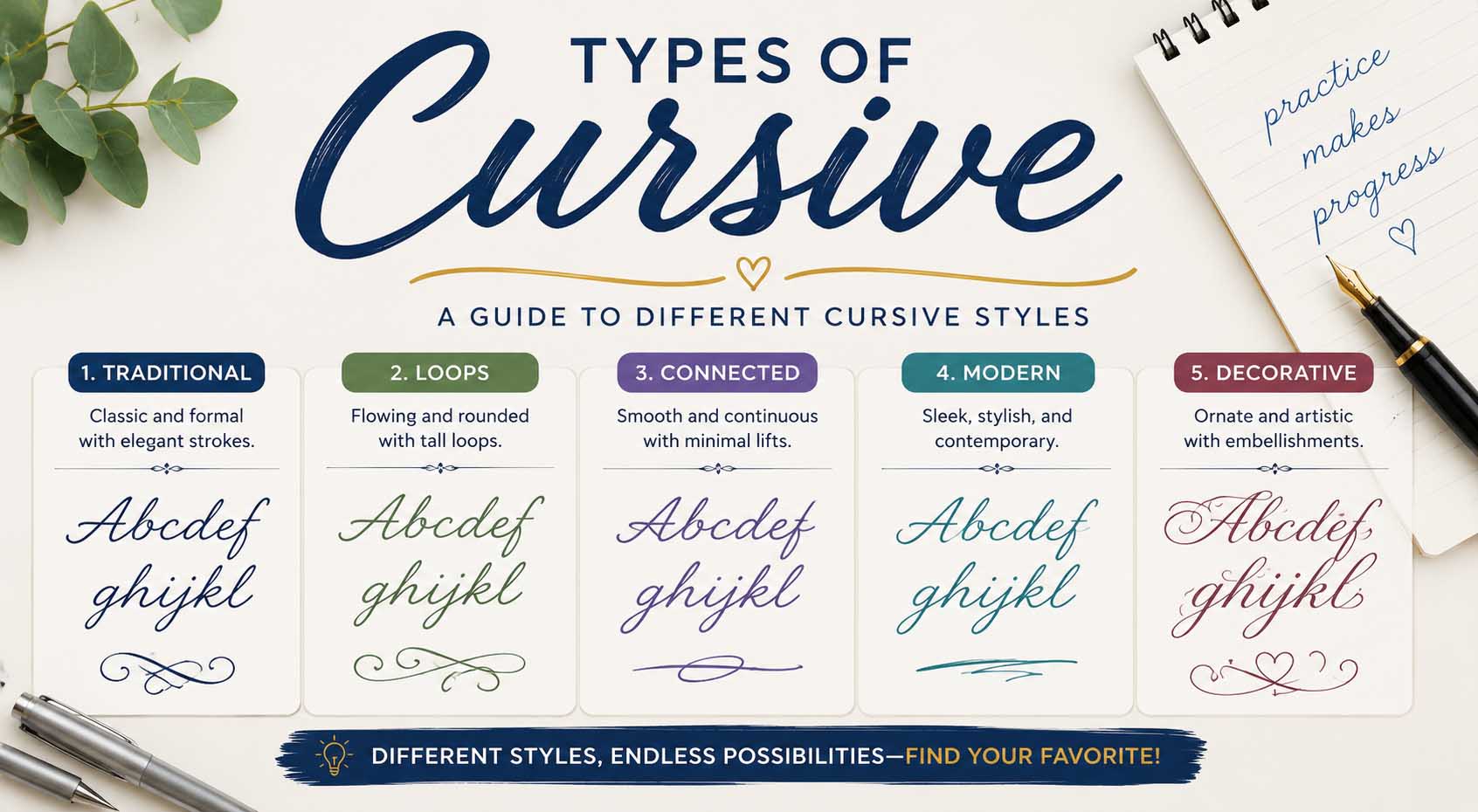
Have you ever noticed that not all cursive handwriting looks the same? Some writing appears elegant and decorative, while other styles are simple enough for elementary students to learn. These variations are known as types of cursive, and each one has its own purpose, history, and writing style.
Whether you’re a student learning cursive for the first time, a parent helping with handwriting practice, or someone interested in improving penmanship, understanding the different styles can make learning much easier. Each cursive style focuses on slightly different letter shapes, connections, and writing techniques, making some better for everyday writing and others ideal for artistic calligraphy.
This guide explains the different types of cursive, where they came from, how they compare, and how to choose the best one for your learning goals.
What Are Types of Cursive?
The term types of cursive refers to different handwriting systems in which letters are connected smoothly to create flowing words. Unlike printed writing, cursive encourages continuous strokes that often make writing faster and more natural once mastered.
Although every cursive style connects letters, the shapes, slant, loops, and teaching methods can vary significantly. Some were designed for classrooms, while others developed for business correspondence or decorative handwriting.
Learning cursive also strengthens letter recognition. As students build handwriting skills, understanding topics like What Is a Root Word? can help connect spelling, vocabulary, and writing into one stronger literacy foundation.
Why Learn Cursive Writing?
Even in today’s digital world, cursive remains a valuable skill for many learners.
Benefits include:
- Improves handwriting speed
- Builds fine motor skills
- Strengthens hand-eye coordination
- Supports memory during note-taking
- Helps students read historical documents
- Encourages neat and consistent handwriting
- Develops greater confidence in written communication
Many schools continue teaching cursive because it combines reading, writing, and motor development in meaningful ways.
Types of Cursive You Should Know
Several handwriting systems are commonly taught or studied today. Each serves different purposes depending on age, skill level, and writing goals.
| Cursive Style | Best For | Difficulty | Main Features |
|---|---|---|---|
| New American Cursive | Elementary students | Easy | Simple joins, fewer loops |
| D’Nealian | School handwriting | Easy to Moderate | Print-to-cursive transition |
| Zaner-Bloser | Classroom instruction | Moderate | Traditional loops and connections |
| Palmer Method | Everyday handwriting | Moderate | Fast, practical writing |
| Spencerian | Artistic handwriting | Advanced | Elegant flourishes and slanted letters |
Different Types of Cursive Explained
New American Cursive
New American Cursive simplifies many traditional cursive letters by removing unnecessary loops. Students learn clear letter connections while avoiding some of the more decorative strokes found in older handwriting systems.
Teachers often recommend this style because it helps young learners transition from printed letters with less frustration.
D’Nealian
D’Nealian was designed to bridge the gap between manuscript printing and cursive writing.
Many printed letters already contain slight curves, making it easier for children to begin connecting letters later. Schools have used this method for decades because it provides a gradual learning process.
Zaner-Bloser
Zaner-Bloser remains one of the best-known classroom handwriting programs.
Its letters include classic loops and consistent slants, helping students develop traditional cursive skills. Many handwriting workbooks still use this approach today.
Palmer Method
The Palmer Method became extremely popular during the late 1800s and early 1900s.
Instead of focusing on decorative writing, it emphasized speed, consistency, and arm movement. Businesses widely adopted this method because it allowed employees to write neatly for long periods.
Spencerian
Spencerian handwriting is often recognized by its graceful curves and decorative flourishes.
Although it requires patience and practice, it remains popular among artists, calligraphers, and people interested in historical penmanship.
Types of Cursive Fonts vs. Handwriting Styles
Many people confuse handwriting styles with digital fonts, but they are not exactly the same.
Types of cursive writing refer to the actual way someone writes by hand.
Types of cursive fonts are computer-generated designs that imitate handwritten cursive.
For example, a wedding invitation may use a cursive font inspired by Spencerian handwriting, even though it was created digitally instead of written with a pen.
Different Types of Cursive Fonts
These generally fall into several categories.
Formal Script Fonts
These resemble elegant handwriting and are commonly used for certificates, invitations, and formal documents.
Casual Script Fonts
Casual scripts imitate everyday handwriting with relaxed letter shapes and easy readability.
Brush Script Fonts
Brush fonts mimic handwriting created with paintbrushes or brush pens, giving text a bold, artistic appearance.
Vintage Script Fonts
These fonts recreate historical handwriting styles and often resemble Palmer or Spencerian penmanship.
Although these are different types of cursive fonts, they are intended for design work rather than handwriting practice.
How to Choose the Best Type of Cursive
The best cursive style depends on your goals.
For Elementary Students
New American Cursive and D’Nealian are excellent choices because they introduce connected writing gradually.
For Everyday Writing
Palmer Method offers speed and consistency, making it practical for note-taking and daily writing.
For Artistic Projects
Spencerian works well for calligraphy, certificates, greeting cards, and decorative lettering.
For Traditional School Practice
Zaner-Bloser continues to provide a structured approach for developing neat handwriting.
How to Learn Different Types of Cursive Step by Step
Learning cursive becomes much easier when you focus on one skill at a time.
Step 1: Learn Individual Letters
Practice lowercase letters before moving to uppercase ones.
Step 2: Master Letter Connections
Next, connect simple letter combinations like:
- an
- in
- on
- me
- be
These common patterns appear frequently in everyday writing.
Step 3: Write Short Words
Practice familiar words before writing complete sentences.
Step 4: Copy Short Paragraphs
Reading and copying passages improves rhythm, spacing, and consistency.
Along the way, reviewing types of syllables can help students break longer words into manageable parts, making cursive practice smoother and improving reading fluency at the same time.
Step 5: Build Speed Slowly
Focus on neatness first.
As your handwriting becomes more comfortable, speed will naturally improve without sacrificing readability.
Common Mistakes When Learning Cursive
Many beginners make similar mistakes during practice.
Avoid these habits:
- Pressing too hard with the pen
- Writing too quickly
- Forgetting consistent slant
- Making letters too large
- Skipping connecting strokes
- Holding the pencil awkwardly
- Practicing only once in a while
Instead, practice for 10–15 minutes several days each week.
Classroom Applications of Cursive
Teachers use cursive instruction for more than handwriting lessons.
Students often use cursive when:
- Taking classroom notes
- Writing journals
- Completing handwriting assignments
- Reading historical documents
- Signing their names
- Practicing spelling words
As writing skills improve, students also begin producing stronger sentences. Reviewing complex sentence examples can help them combine clear handwriting with more advanced writing techniques.
Study Tips for Improving Cursive Writing
Small daily habits often produce the biggest improvements.
Try these strategies:
- Use lined handwriting paper.
- Sit with good posture.
- Relax your grip on the pencil.
- Practice difficult letters separately.
- Trace sample alphabets before free writing.
- Write slowly until letter formation becomes automatic.
- Compare today’s writing with last week’s progress.
Remember that consistent practice is much more effective than occasional long practice sessions.
Quick Reference Guide to Types of Cursive
| Goal | Recommended Style |
|---|---|
| Learning cursive for school | New American Cursive |
| Transition from print | D’Nealian |
| Traditional handwriting | Zaner-Bloser |
| Fast everyday writing | Palmer Method |
| Decorative lettering | Spencerian |
| Graphic design projects | Cursive fonts |
Frequently Asked Questions
Is cursive still taught in schools?
Yes. Many schools continue teaching cursive, although the grade level and amount of instruction vary by district and country.
Which cursive style is easiest to learn?
New American Cursive is often considered one of the easiest because it simplifies many traditional loops while keeping letters connected.
Are cursive fonts the same as cursive handwriting?
No. Cursive handwriting is created by hand, while cursive fonts are digital typefaces designed to imitate handwritten styles.
Which cursive style is best for everyday writing?
The Palmer Method remains a popular choice for practical, everyday handwriting because it focuses on speed and consistency.
Can adults learn cursive?
Absolutely. Adults can learn cursive at any age with regular practice, handwriting worksheets, and patience.
Keep Practicing One Letter at a Time
Learning the types of cursive isn’t about finding a single “best” style—it’s about choosing the one that fits your needs. Students may prefer a simple classroom method, while artists often enjoy decorative scripts. Whatever style you choose, steady practice, proper letter formation, and consistent spacing will help you develop smooth, readable handwriting over time.
Start with basic letters, practice short words every day, and gradually move on to longer passages. As your confidence grows, you’ll discover that cursive becomes faster, more comfortable, and a useful lifelong writing skill.