
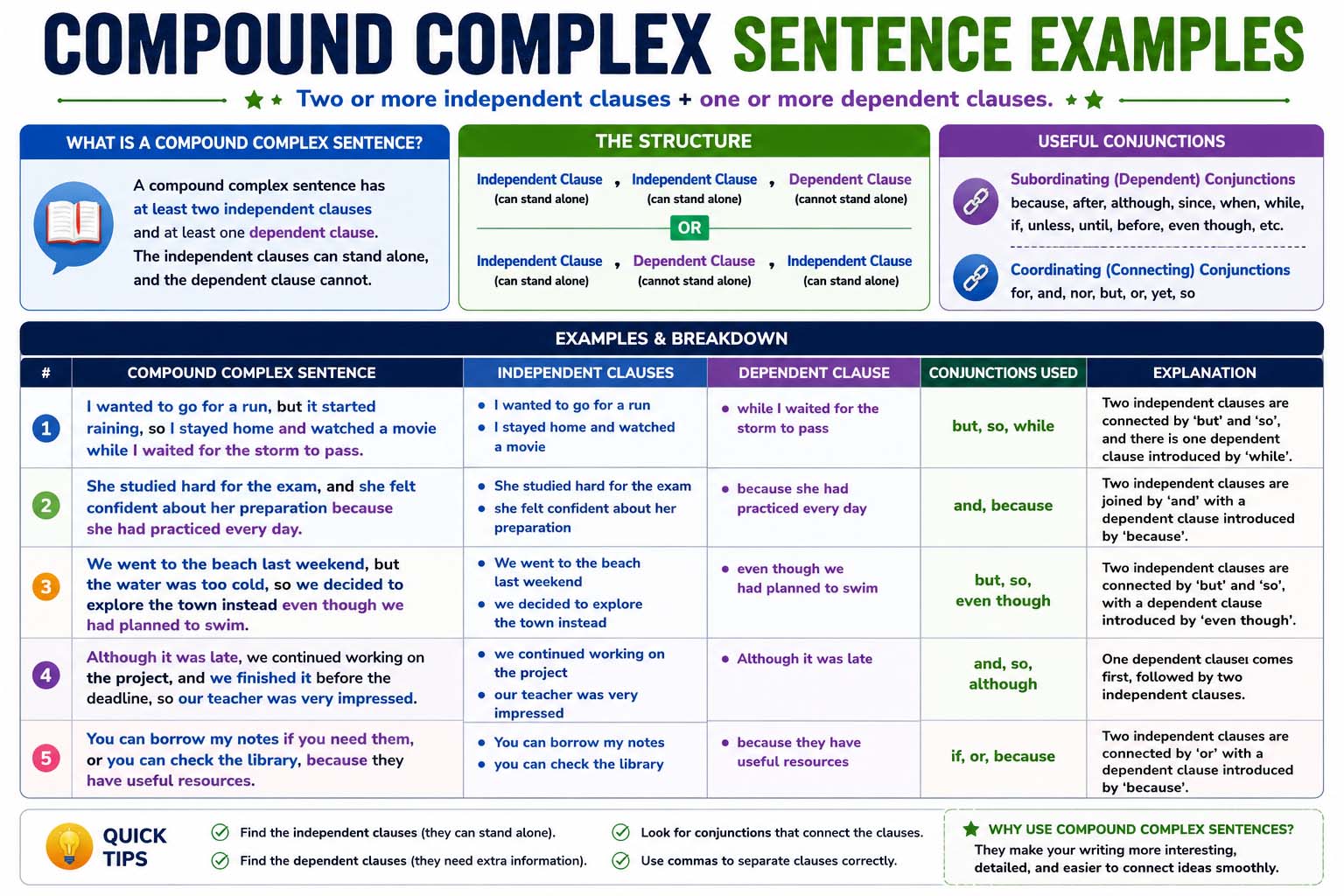
Have you ever read a long sentence that still felt smooth and easy to follow? Chances are, it was a compound-complex sentence. Students often search for compound complex sentence examples because this structure joins several ideas into one clear statement. As a result, it makes writing more detailed and more interesting to read.
First, you will learn the definition and a simple formula. Next, you will see many examples, punctuation rules, a comparison with other sentence types and short practice with answers.
What Is a Compound-Complex Sentence?
A compound-complex sentence has at least two independent clauses and at least one dependent clause. An independent clause is a complete thought. In contrast, a dependent clause cannot stand alone, because it begins with a word such as “although,” “because” or “when.”
According to Grammarly, compound-complex sentences combine a compound sentence with a complex sentence. So the formula is easy to remember:
- 2 or more independent clauses (each could be a sentence on its own)
- + 1 or more dependent clauses (each starts with a word like “although”)
Some people write the term as “complex-compound sentence.” However, the usual name is compound-complex, and it means the same thing.
Compound-Complex Sentence Examples
Study these compound complex sentence examples. Each one has a dependent clause and two independent clauses, as the tables show.
Dependent Clause First
| Sentence | Dependent clause | Independent clauses |
|---|---|---|
| Although the weather was cold, Sarah went for a walk, and she enjoyed the fresh air. | Although the weather was cold | Sarah went for a walk / she enjoyed the fresh air |
| When the teacher entered the classroom, the students became quiet, and they opened their books. | When the teacher entered the classroom | the students became quiet / they opened their books |
| Because James studied all night, he passed the exam, and his parents were proud of him. | Because James studied all night | he passed the exam / his parents were proud of him |
| While the children played outside, their mother prepared dinner, but their father cleaned the house. | While the children played outside | their mother prepared dinner / their father cleaned the house |
| After the movie ended, we went to dinner, but the restaurant was already closed. | After the movie ended | we went to dinner / the restaurant was already closed |
| Although the traffic was heavy, we arrived on time, and the meeting started smoothly. | Although the traffic was heavy | we arrived on time / the meeting started smoothly |
| Since the library closes at nine, I will finish my essay tonight, or I will ask for an extension. | Since the library closes at nine | I will finish my essay tonight / I will ask for an extension |
In these sentences, the opening dependent clause is followed by a comma.
Dependent Clause Last
| Sentence | Dependent clause | Independent clauses |
|---|---|---|
| We planned a picnic, but it rained all morning because a storm moved in. | because a storm moved in | We planned a picnic / it rained all morning |
| I called my sister, and she answered quickly because she was waiting for news. | because she was waiting for news | I called my sister / she answered quickly |
| The team practiced daily, and they won the final because they stayed focused. | because they stayed focused | The team practiced daily / they won the final |
Either way, the sentence needs two complete thoughts plus one supporting clause.
How to Identify a Compound-Complex Sentence
- First, find the independent clauses. Look for two or more complete thoughts, often joined by “and,” “but,” “or” or “so.”
- Next, find the dependent clause. Look for a word such as “because,” “although,” “when,” “after” or “since.”
- Then check that the dependent clause cannot stand alone.
- Finally, if you have at least two independent clauses and at least one dependent clause, the sentence is compound-complex.
For example, take “Because it was raining, we stayed home, and we watched a movie.” The dependent clause is “Because it was raining.” The two independent clauses are “we stayed home” and “we watched a movie.”
Punctuation Rules for Compound-Complex Sentences
Punctuation can look hard, but a few rules cover most cases. The Purdue Online Writing Lab shows the patterns for the two parts of this structure.
- Joining independent clauses: use a comma plus a coordinating conjunction such as “and,” “but,” “or” or “so.” You can also use a semicolon.
- Dependent clause first: put a comma after the dependent clause.
- Dependent clause last: a comma is usually not needed.
For example, here is a version with a semicolon: Although the exam was hard, I felt ready; I had studied for weeks. Because the sentence combines both patterns, check each clause break one at a time.
Compound vs. Complex vs. Compound-Complex Sentences
Students often mix up these sentence types. This table shows how they differ:
| Type | Clauses | Example |
|---|---|---|
| Simple | One independent clause | I stayed home. |
| Compound | Two independent clauses | I felt sick, so I stayed home. |
| Complex | One independent and one dependent clause | Because I felt sick, I stayed home. |
| Compound-complex | Two independent and at least one dependent clause | Because I felt sick, I stayed home, and I rested all day. |
If you want more practice with the middle type, see these complex sentence examples. Then come back here to add a second independent clause.
Compound-Complex Sentence Examples in Real Writing
Writers use this structure in stories, news articles, speeches and essays. Instead of writing several short sentences, they combine related details in one smooth statement. As a result, the writing sounds more natural and avoids a choppy rhythm.
In academic writing, varied sentence types also show stronger control of grammar. For example, a body paragraph might begin with a clear opening line and then add detail with one longer sentence. These topic sentence examples show how to start such a paragraph.
However, do not overuse this structure. Mixing short, medium and long sentences keeps readers interested.
Practice: Combine the Sentences
Combine each group into one compound-complex sentence. Try it before you read the answers.
- The bell rang. All the students left. Only the teacher stayed.
- It was raining. We stayed inside. Then we played board games.
- I was tired. Still, I finished the report. After that, I went to bed.
Possible answers:
- When the bell rang, the students left, but the teacher stayed.
- Because it was raining, we stayed inside, and we played board games.
- Although I was tired, I finished the report, and then I went to bed.
Common Mistakes Students Make
- Joining independent clauses with only a comma. This error is called a comma splice. Instead, add a conjunction such as “and” or “but,” or use a semicolon.
- Leaving a dependent clause alone. “Although the traffic was heavy.” is a fragment, so attach it to an independent clause.
- Making the sentence too long. If readers get lost, split it into two sentences.
- Forgetting the comma after an opening dependent clause.
Tips to Write Better Sentences
- Start with two short, complete sentences.
- Add a dependent clause that gives a reason, time or contrast.
- Choose a conjunction that fits the meaning.
- Read the sentence aloud to check the flow.
- Cut extra words if the sentence feels heavy.
Also, practice with your own writing. For example, rewrite three of your short sentences each day. Finally, compare the new sentences with the old ones, and notice how the ideas connect.
Frequently Asked Questions
What is a compound-complex sentence?
It is a sentence with at least two independent clauses and at least one dependent clause.
How is it different from a complex sentence?
A complex sentence has only one independent clause. In contrast, a compound-complex sentence has two or more.
What is a simple compound-complex sentence example?
“Because it was late, we went home, and we slept.” The dependent clause is “Because it was late,” and the independent clauses are “we went home” and “we slept.”
Do compound-complex sentences need commas?
Usually, yes. You typically put a comma after an opening dependent clause and a comma before a coordinating conjunction that joins two independent clauses.
Should I use them in every sentence?
No. Mix them with shorter sentences so your writing stays clear and varied.
Key Takeaways on Compound-Complex Sentence Examples
Learning compound complex sentence examples helps you connect ideas clearly. First, find at least two independent clauses. Next, add at least one dependent clause. Then check the punctuation at each break.
As a result, your writing will sound smoother and more confident. With regular practice, these longer sentences will feel natural, and your essays will read with better rhythm.