Decision-making is part of everyday life. People make choices at home, in school, at work, and in business. Some decisions require little thought, while others involve difficult trade-offs. Understanding when does decision-making become more complex? can help individuals strengthen their problem-solving abilities and develop better judgment.
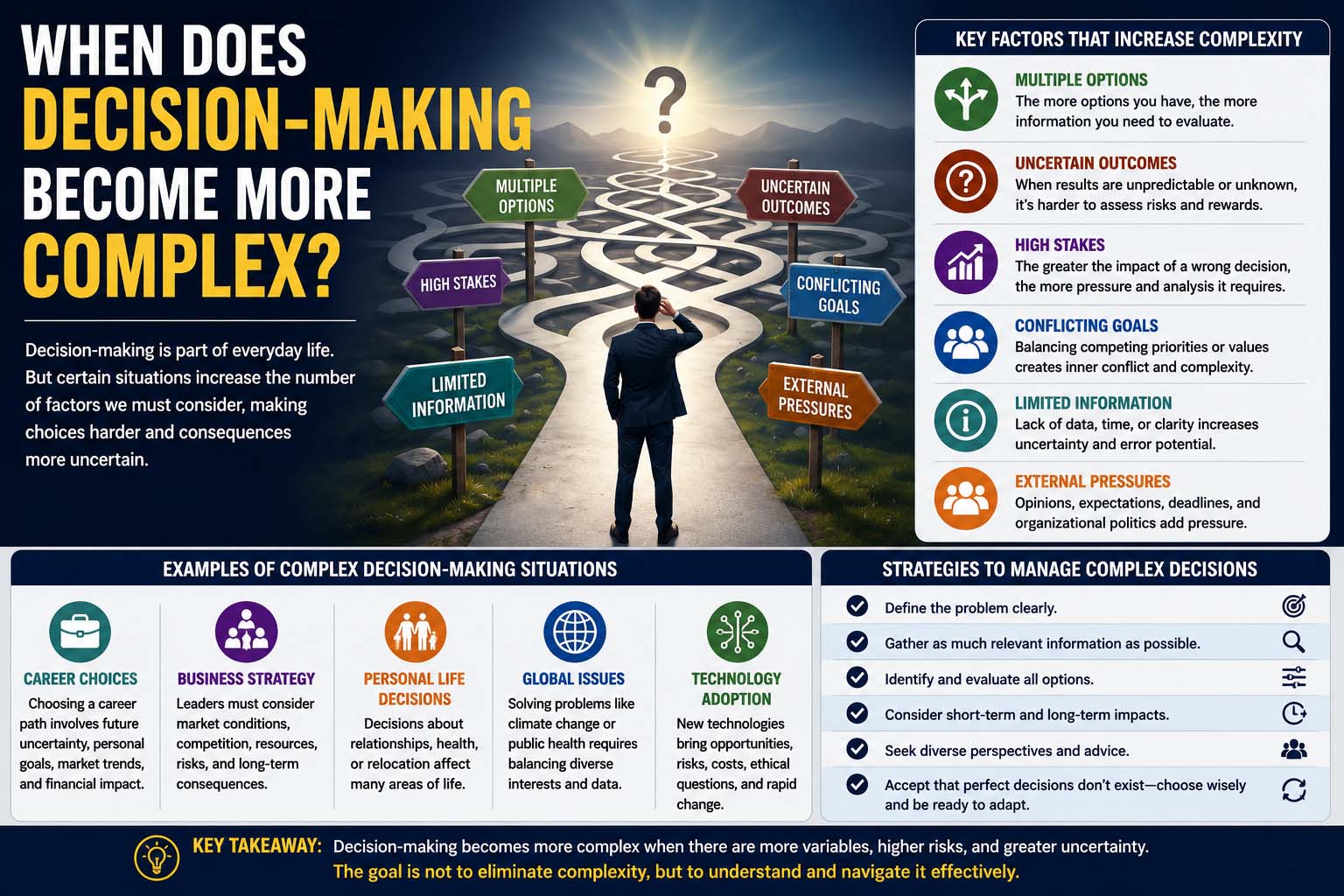
Decision-making becomes more complex when people face multiple choices, incomplete information, uncertain outcomes, conflicting priorities, emotional pressure, or significant risks. As the number of factors increases, evaluating the available options becomes more demanding. Therefore, individuals and organizations often need additional research, careful planning, and structured analysis.
Learning how to approach difficult decisions can also strengthen Critical Thinking Exercises skills. These abilities help people evaluate evidence, recognize assumptions, and compare possible solutions.
When Does Decision-Making Become More Complex?
Decision-making involves selecting a course of action from two or more alternatives. People generally identify a problem, gather relevant information, compare options, and choose a suitable solution.
Simple decisions usually involve limited consequences and familiar circumstances. For example, choosing what to eat for lunch may require only a quick comparison of preferences and available options.
However, important decisions often involve several connected factors. A person choosing a career, for instance, may need to consider education, income, personal interests, location, and long-term opportunities.
As these considerations increase, the process requires more time and attention.
When Does Decision-Making Become More Complex?
Decision-making becomes more complex when a situation requires people to evaluate several interacting factors rather than make a straightforward choice.
For example, selecting a new employee involves more than comparing qualifications. Employers may also consider experience, communication skills, salary expectations, organizational needs, and future potential.
Consequently, decision-makers must balance competing priorities while recognizing that no option may satisfy every requirement.
Several factors commonly increase decision complexity:
- A large number of available alternatives.
- Missing or unreliable information.
- Uncertain outcomes and potential risks.
- Conflicting goals or personal values.
- Emotional pressure and stress.
- Multiple stakeholders with different opinions.
- Limited time to evaluate options.
These factors may appear individually or together. When several occur simultaneously, making a confident decision becomes particularly challenging.
When Multiple Choices Make Decision-Making More Complex
Having more options can be beneficial because it creates opportunities. However, too many alternatives may make comparisons difficult.
For example, a customer choosing between two smartphones can compare their main features relatively quickly. If dozens of models offer different specifications, prices, and warranties, the process becomes more demanding.
Similarly, businesses may struggle when choosing among several suppliers, marketing strategies, or investment opportunities.
Why Too Many Options Create Decision-Making Difficulty
Each additional option introduces information that decision-makers must evaluate.
As a result, people may spend more time comparing small differences rather than focusing on their main priorities. They may also worry about overlooking a better alternative.
To manage this challenge, individuals can identify essential requirements before comparing available choices.
For instance, a smartphone buyer might prioritize battery life, price, and storage capacity. These criteria help narrow the options and simplify the final decision.
When Limited Information Makes Decision-Making More Complex
Incomplete or unreliable information makes decisions harder because people cannot accurately predict every possible outcome.
For example, a business owner planning to introduce a new product may lack reliable information about customer demand, competitor responses, or production costs.
Therefore, the owner must make assumptions while accepting that some expectations may prove incorrect.
The Importance of Research and Reliable Evidence
Research can reduce uncertainty by helping decision-makers understand the situation more clearly.
For instance, businesses can conduct customer surveys, examine market trends, or test products before committing substantial resources.
Individuals can also compare trustworthy information before making important educational, financial, or career decisions.
However, research cannot eliminate every uncertainty. Decision-makers must sometimes act with the best information currently available.
When Risk and Uncertainty Make Decision-Making More Complex
Risk increases decision complexity when different choices involve potentially serious consequences.
Financial decisions provide a common example. Investors must consider possible returns, market changes, and the possibility of losing money.
Likewise, business owners may face uncertainty when expanding into unfamiliar markets.
Understanding Risk and Uncertainty
Risk generally involves outcomes whose probabilities can be estimated, while uncertainty involves situations where probabilities or possible outcomes remain difficult to determine.
For example, a company may estimate the likelihood of equipment failure using historical maintenance records. However, predicting how customers will respond to an entirely new product may be more difficult.
Consequently, decision-makers should distinguish between risks they can estimate and uncertainties they cannot easily measure.
Evaluating Possible Consequences
A practical approach involves identifying possible outcomes and considering their effects.
For example, managers can examine financial costs, operational challenges, and potential benefits before approving a project.
They can also prepare alternative plans in case the preferred strategy fails.
This preparation helps reduce avoidable mistakes without assuming that every outcome is predictable.
When Emotional Pressure Makes Decision-Making More Complex
Emotions influence how people interpret information and evaluate alternatives.
Stress, fear, excitement, and anxiety can affect attention and judgment. As a result, individuals may focus on immediate concerns rather than long-term consequences.
For example, someone considering a career change may feel excited about new opportunities but worried about financial stability.
Both emotions can influence the final choice.
Managing Emotional Influences on Decisions
Recognizing emotional reactions is a useful first step.
When time permits, individuals can pause before making important decisions, review available evidence, and discuss their concerns with trusted people.
In addition, writing down the advantages and disadvantages of each option can help separate immediate feelings from practical considerations.
However, emotions are not always harmful. They can also reveal personal values and priorities that deserve attention.
Why Group Decision-Making Becomes More Complex
Decision-making often becomes more difficult when several people participate.
Different individuals may have conflicting goals, responsibilities, experiences, or opinions. Consequently, reaching an agreement can require additional discussion.
For example, company managers may disagree about whether to invest in new technology or increase employee training.
Both options may offer benefits, but limited resources can make the choice difficult.
Communication and Conflicting Priorities
Effective communication helps groups understand competing viewpoints and identify shared goals.
For instance, managers can explain their recommendations using evidence rather than relying entirely on personal preferences.
Strong methods of business communication can also reduce misunderstandings during meetings, negotiations, and project discussions.
Although group decisions may take longer, different perspectives can reveal risks or opportunities that one person might overlook.
When Technology Makes Decision-Making More Complex
Modern technology creates new opportunities while introducing additional considerations.
Businesses may need to evaluate cybersecurity, customer privacy, software compatibility, and employee training before adopting new systems.
Meanwhile, companies operating internationally must consider different regulations, customer expectations, currencies, and market conditions.
Decisions in Rapidly Changing Environments
Rapid technological changes can make long-term planning more difficult.
For example, a company selecting business software must consider current requirements and future growth.
However, the organization may not know which technologies or customer expectations will change over the coming years.
Therefore, decision-makers often benefit from flexible strategies that allow adjustments when new information becomes available.
Ethical Considerations in Complex Decision-Making
Ethical concerns increase complexity when different choices affect people in competing ways.
For example, a business may need to balance profitability with employee well-being, customer privacy, and environmental responsibilities.
Although a particular decision may offer financial benefits, it could also create ethical concerns.
Balancing Business Goals and Responsibilities
Decision-makers should consider who may benefit or experience harm from each option.
They should also review relevant laws, organizational policies, and professional responsibilities.
For instance, managers evaluating cost reductions may need to consider both financial sustainability and the effects on employees.
These responsibilities are closely connected to understanding What Is a Business and how organizations operate within society.
Consequently, ethical decisions often require careful judgment rather than a simple comparison of costs.
How Time Pressure Makes Decision-Making More Complex
Limited time can make difficult decisions even more challenging.
When deadlines approach, people may have fewer opportunities to gather information, consult others, or evaluate alternatives.
For example, a business facing a sudden supply disruption may need to choose a replacement supplier quickly.
Making Better Decisions Under Pressure
A useful strategy involves identifying the most important information first.
Decision-makers can prioritize immediate risks, compare realistic alternatives, and avoid spending excessive time on minor details.
In addition, established procedures can support faster decisions in familiar situations.
However, urgent decisions should still account for safety, legal responsibilities, and other significant consequences.
The Role of Experience in Complex Decisions
Experience can reduce decision difficulty because people learn from previous situations.
For example, an experienced manager may recognize common project risks more quickly than someone handling a similar project for the first time.
Likewise, trained professionals can use established procedures and specialized knowledge when evaluating challenging situations.
Why Experience Does Not Remove Every Risk
Although experience improves familiarity, it does not guarantee accurate decisions.
New circumstances may differ from previous situations. Furthermore, relying too heavily on familiar approaches can cause people to overlook important changes.
Therefore, experienced decision-makers should remain open to new evidence and alternative perspectives.
Practical Steps to Manage Complex Decisions
People can improve their decision-making process by following a structured approach.
1. Define the Main Problem
First, identify what needs to be decided and why the decision matters.
A clear problem statement prevents unnecessary confusion and helps establish priorities.
2. Gather Relevant Information
Next, collect reliable information about the available options.
Focus on evidence that directly affects the decision rather than trying to examine every possible detail.
3. Identify Realistic Alternatives
List the choices that could reasonably solve the problem.
Then, remove options that do not meet essential requirements or available resources.
4. Compare Benefits, Risks, and Costs
Evaluate each alternative using consistent criteria.
For example, a business might compare expected expenses, implementation time, potential benefits, and operational risks.
5. Consider Different Perspectives
When appropriate, seek advice from knowledgeable people.
Different viewpoints can reveal assumptions, missing information, or potential consequences.
For additional guidance, the Harvard Program on Negotiation’s decision-making resources explore approaches to evaluating choices and improving judgment.
6. Make a Decision and Review the Results
After comparing the alternatives, select the option that best meets the main objectives.
Then, monitor the results and adjust the approach when necessary.
In business settings, preparing an executive summary example can help communicate the reasoning behind important recommendations.
Developing commercial awareness can also support informed decisions by helping people understand customers, competitors, and organizational priorities.
Conclusion
Understanding when does decision-making become more complex? helps individuals recognize why some choices require additional planning and analysis.
Decisions become harder when people face multiple alternatives, incomplete information, uncertain outcomes, emotional pressure, ethical concerns, or conflicting priorities.
However, complexity does not mean that effective decisions are impossible. By defining problems clearly, gathering reliable evidence, comparing alternatives, and reviewing outcomes, individuals and organizations can make more informed choices.
Experience, communication, and structured thinking can also improve decision quality. Therefore, developing these skills helps people manage challenging situations with greater confidence.