
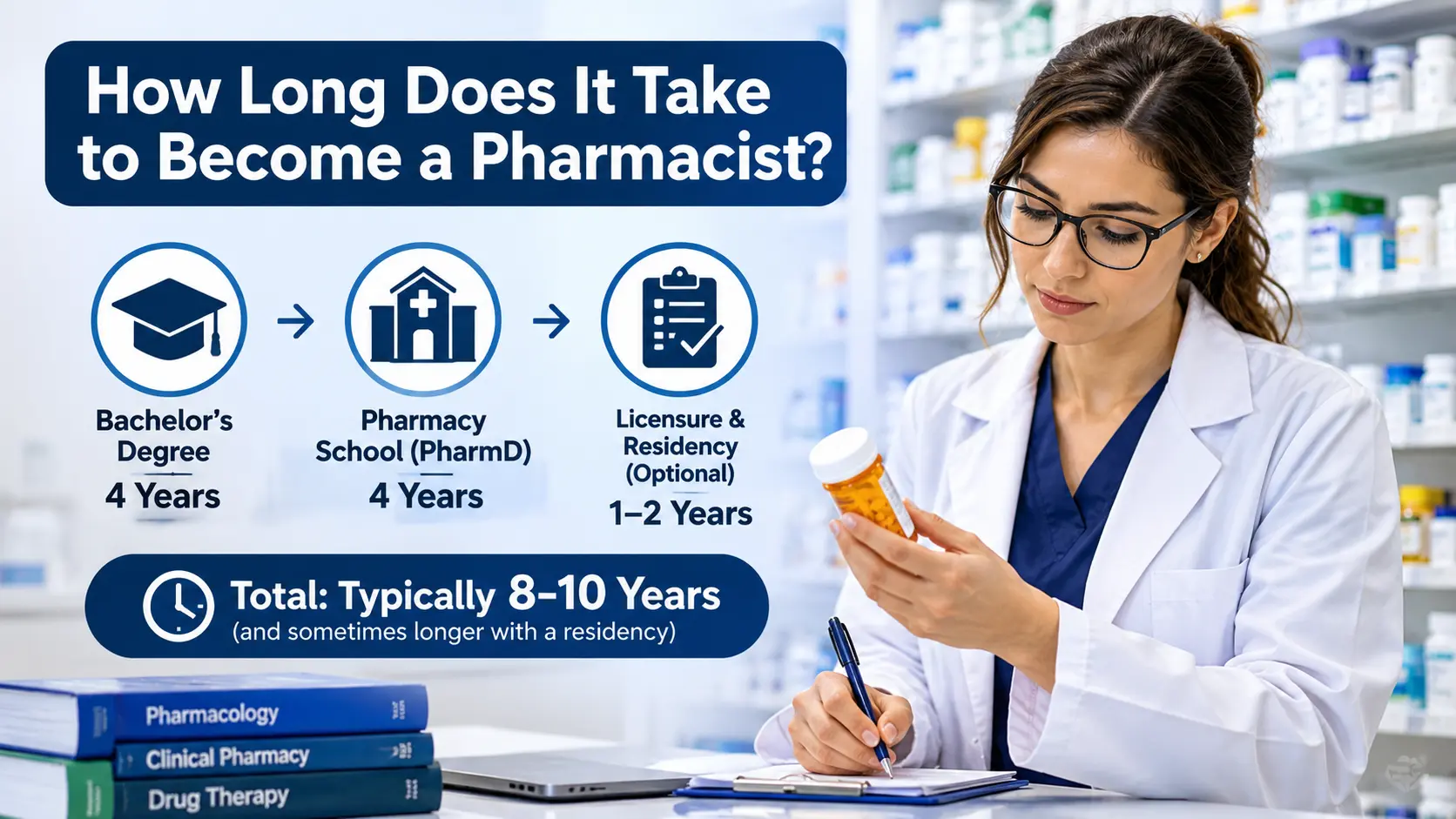
Maybe you love science, enjoy helping people and want a stable healthcare career. So naturally, one big question comes up: how long does it take to become a pharmacist? In short, most people need about 6 to 8 years of college after high school. That usually means 2 to 4 years of prerequisite classes, followed by a 4-year Doctor of Pharmacy (PharmD) program and licensing exams.
Below, you’ll find a simple timeline, each step explained and a few ways to finish faster.
How Long Does It Take to Become a Pharmacist? The Quick Answer
Generally, the path looks like this:
- Pre-pharmacy coursework: 2 to 4 years
- PharmD program: 3 to 4 years
- Licensing exams: usually a few months after graduation
- Optional residency: 1 to 2 more years
As a result, most students become licensed pharmacists in about 6 to 8 years. However, if you add a residency for hospital or specialty work, the total can stretch to 9 or 10 years.
Pharmacist Timeline at a Glance
| Stage | Typical Length | What Happens |
|---|---|---|
| High school | 4 years | Build strong science and math skills |
| Pre-pharmacy | 2–4 years | Complete biology, chemistry, math and other prerequisites |
| PharmD program | 3–4 years | Classes, labs and hands-on rotations |
| Licensing | A few months | Pass the NAPLEX and, in most states, a law exam |
| Residency (optional) | 1–2 years | Advanced training for hospital or specialty roles |
How Long It Will Take to Become a Pharmacist, Step by Step
Now let’s break the journey into clear steps.
- Prepare in high school. First of all, take biology, chemistry, algebra and, if possible, AP science classes. Also, volunteer at a hospital or pharmacy, because admissions teams like real-world experience.
- Finish pre-pharmacy prerequisites. Next, complete required college courses, such as general and organic chemistry, biology, anatomy, physics, calculus and statistics. While some schools need only two years of prerequisites, others prefer a full degree, so it helps to know How Long to Get a Bachelor’s Degree? before you plan your path.
- Apply to pharmacy school. Then, most students apply through PharmCAS, the shared application service. Here, you’ll submit transcripts, recommendation letters and a personal essay.
- Complete the PharmD program. After that, you’ll spend about four years on classes, labs and clinical rotations in real pharmacies and hospitals.
- Pass licensing exams. Finally, you take the national exam and, in most states, a pharmacy law exam before your state grants your license.
For step three, your essay matters a lot. So if you’re unsure how much to write, our guide on how long should a personal statement be explains typical limits and what to include.
What the PharmD Program Includes
Basically, the PharmD is a doctoral-level degree that prepares you for practice, not research. In other words, it’s a career-focused program, and our explainer on What Is a Professional Degree? shows how it compares to degrees like the MD or JD.
During the first years, you’ll study pharmacology, chemistry and patient care. Then, the final year usually focuses on full-time clinical rotations, so you gain hands-on experience before graduating.
Do You Still Need the PCAT?
In most cases, no. According to the American Association of Colleges of Pharmacy, the Pharmacy College Admission Test was retired in January 2024. As a result, schools now focus more on grades, experience, essays and interviews.
How Long Does It Take to Become a Licensed Pharmacist After School?
Once you graduate, licensing usually takes a few months. Typically, you’ll need to:
- Pass the NAPLEX, which tests your pharmacy knowledge and patient-care skills.
- Pass the MPJE or a state law exam, since most states require one.
- Complete state requirements, such as background checks and internship hours.
Also, rules vary by state, so check with your state board of pharmacy early. That way, you won’t face surprise delays after graduation.
Faster Routes: 0–6 and 3-Year Programs
If you want to save time, look into these options:
- 0–6 programs: Here, you enter straight from high school and finish your PharmD in about six years total.
- Accelerated 3-year PharmD programs: Instead of long summer breaks, you study year-round and finish faster.
- Early assurance programs: Similarly, some colleges reserve PharmD spots for strong undergrads at partner schools.
However, faster programs are intense. So make sure you’re ready for a heavy, nonstop schedule.
Ways to Save Time and Money
Besides accelerated programs, a few smart moves can help:
- Take AP or dual-credit classes in high school, so you start college with credits.
- Plan prerequisites carefully, because missing one class can delay your application.
- Use summer terms to get ahead, especially for tough science courses.
Also, many students start at a two-year school to cut costs. In fact, the benefits of community college include lower tuition and smaller classes, as long as your credits transfer to your target pharmacy program.
Pharmacist vs. Pharmacy Technician
Sometimes, people mix up these two careers. However, they have very different training paths.
| Role | Training Time | Main Duties |
|---|---|---|
| Pharmacist | About 6–8 years | Review prescriptions, counsel patients, manage medications |
| Pharmacy technician | A few months to 2 years | Prepare prescriptions, manage inventory, assist pharmacists |
How Long Does It Take to Become a Pharmacist Tech?
If you’re searching for how long does it take to become a pharmacist technician, the good news is it’s much shorter. Generally, training programs last from a few months to about two years. Also, many techs earn certification through PTCB or NHA, although state rules vary.
In fact, many future pharmacists work as techs during school. That way, they gain experience and earn money at the same time.
Study Tips for Future Pharmacists
- Master chemistry early, because it shows up everywhere in pharmacy school.
- Join study groups, since explaining concepts helps you remember them.
- Shadow pharmacists, so you understand daily work before committing.
- Protect your GPA, especially in science classes.
FAQs
Does it take long to become a pharmacist after a bachelor’s?
Usually, it takes about four more years for the PharmD, plus a few months for licensing. So with a finished bachelor’s degree, you’d need roughly 4 to 5 more years.
What should I major in before pharmacy school?
Many students choose biology or chemistry, because those majors cover most prerequisites. Also, if you later change direction, our guide on what jobs can you get with a biology degree shows plenty of backup options.
Is a residency required?
No, but it helps. In fact, many hospital and clinical roles prefer or require one or two years of residency.
Your Next Steps
To sum up, plan for about 6 to 8 years of education, plus licensing. So start by checking the prerequisites at two or three pharmacy schools you like.
Then, map your classes semester by semester and look for pharmacy volunteer or tech jobs. As a result, you’ll build a strong application and reach your goal with fewer surprises.