A student repeatedly talks during independent work, a child refuses to follow a household rule, or a teenager misses an agreed deadline. In each situation, adults need a response that teaches rather than simply stops the behavior for a moment. Understanding the types of discipline helps parents, teachers, and caregivers choose approaches that match the child’s age, behavior, and situation.
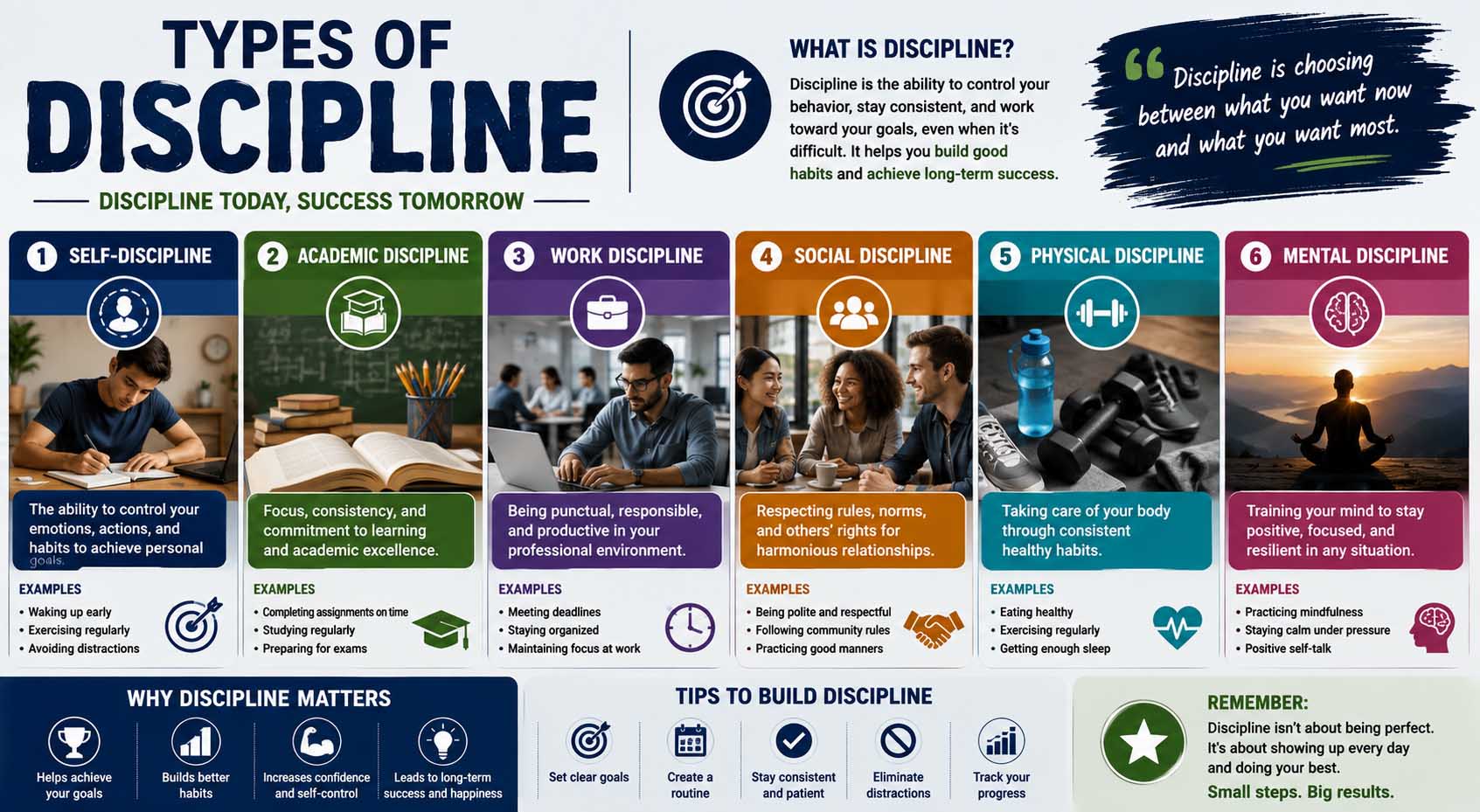
Discipline is often confused with punishment. However, effective discipline has a broader purpose. It teaches boundaries, responsibility, emotional regulation, decision-making, and the consequences of choices. While punishment focuses mainly on what happens after unwanted behavior, good discipline also helps prevent problems and teaches better alternatives.
There is no single method that works perfectly in every situation. Instead, different approaches can be useful depending on the learner, environment, and behavior involved.
What Does Discipline Mean in Education and Parenting?
Discipline is the process of teaching expectations, appropriate behavior, responsibility, and self-control. In a classroom, it can include clear routines, consistent rules, positive feedback, logical consequences, and opportunities to correct mistakes.
At home, parents may use many of the same principles. For example, a child who leaves art supplies scattered across the floor may be expected to clean them up before starting another activity.
The goal is not simply obedience. Over time, effective discipline should help children understand why rules exist and gradually manage their own behavior.
Psychology also helps explain why some disciplinary strategies influence behavior. Students learning Classical vs Operant Conditioning Explained can see how consequences and environmental cues may shape behavioral responses, although real-world discipline also involves relationships, emotions, communication, development, and context.
Different Types of Discipline at a Glance
Several discipline methods appear frequently in homes, schools, and educational settings.
| Type | Main Idea | Simple Example |
|---|---|---|
| Positive discipline | Teach and reinforce appropriate behavior | Praising a student for waiting their turn |
| Preventive discipline | Prevent problems before they occur | Explaining classroom expectations beforehand |
| Natural consequences | Allow safe outcomes to teach | A forgotten toy is unavailable for the day |
| Logical consequences | Connect consequences directly to behavior | Cleaning a mess after making it |
| Restorative discipline | Repair harm and relationships | Replacing something that was damaged |
| Behavior-based discipline | Use reinforcement and consequences | Rewarding consistent homework completion |
| Assertive discipline | Set clear, consistent boundaries | Calmly enforcing a known classroom rule |
| Self-discipline | Develop internal regulation | Completing work without reminders |
Although lists of 10 types of discipline may divide these ideas into additional categories, the underlying goal should remain teaching appropriate behavior while maintaining reasonable, developmentally appropriate expectations.
Types of Discipline That Focus on Positive Behavior
Positive Discipline
Positive discipline focuses on teaching children what they should do rather than concentrating only on what they did wrong.
Suppose two students interrupt each other during a discussion. Instead of simply saying, “Stop talking,” the teacher might remind them to wait until the speaker finishes and then recognize them when they follow that expectation.
Positive discipline can include encouragement, clear expectations, choices, problem-solving, and recognition of appropriate behavior.
This does not mean ignoring poor behavior. Instead, adults still maintain boundaries while making the expected alternative clear.
Positive Reinforcement
Positive reinforcement occurs when something desirable follows a behavior, making that behavior more likely to happen again.
For instance, a teacher might praise a student who begins an assignment promptly. Likewise, a parent might allow extra story time after a child completes an evening routine.
Readers studying Classical Conditioning Examples should remember that positive reinforcement belongs to operant conditioning rather than classical conditioning. That distinction helps students understand the psychological principles behind behavior management more accurately.
Rewards also do not need to be material. Attention, recognition, privileges, and specific praise can reinforce behavior.
Preventive Discipline: Stopping Problems Before They Start
Preventive discipline tries to reduce behavior problems by creating clear expectations before difficulties occur.
Teachers commonly use this approach at the beginning of a school year. For example, they may explain how students should enter the classroom, submit assignments, ask questions, use technology, and transition between activities.
Clear routines reduce uncertainty. As a result, students spend less time guessing what they should do.
Parents can use the same approach. Before entering a store, for example, a parent can explain that the child needs to stay nearby and that they are shopping only for items on the list.
Preventive discipline works especially well when expectations are specific. “Behave yourself” gives a child little guidance, whereas “Please walk beside me and keep your hands away from the shelves” explains the expected behavior clearly.
Natural Consequences
Natural consequences happen without an adult creating a separate penalty.
For example, if a child forgets a nonessential toy at home, the natural consequence is not having that toy during the outing. Likewise, a student who spends free study time chatting may have less time available to finish optional work.
Natural consequences can help children connect choices with outcomes. However, adults should not use this approach when allowing the consequence would create an unreasonable safety, health, or serious academic risk.
A young child should never be allowed to experience a dangerous consequence simply to “learn a lesson.”
Therefore, adults need to use judgment rather than applying the method automatically.
Logical Consequences
Logical consequences are arranged by an adult, but they directly relate to the behavior.
Suppose a student draws on a desk. A logical response could involve helping clean the desk. If siblings misuse a shared game after receiving clear instructions, access to that game might pause until they can use it appropriately.
The connection matters because children can more easily understand why the consequence occurred.
By contrast, removing an unrelated privilege for every problem can make discipline feel unpredictable.
When learning about behavior, Negative Reinforcement Examples can also clarify a common misconception: negative reinforcement does not simply mean punishment. Instead, it involves removing something unpleasant to strengthen a behavior.
Restorative Discipline
Restorative discipline asks a different question. Rather than focusing only on “What rule was broken?”
Imagine that one student damages another student’s project during an argument. A restorative response might involve discussing what happened, understanding the effect on the other student, repairing or recreating the project, and agreeing on a better way to handle future conflict.
Schools may use restorative conversations, circles, conferences, or problem-solving meetings depending on the situation.
However, restorative practices do not mean removing all consequences. Instead, accountability focuses strongly on understanding impact and repairing harm.
This approach can be particularly useful when behavior has affected relationships within a classroom community.
Assertive and Boundary-Based Discipline
Children generally benefit from knowing where boundaries are.
Assertive discipline emphasizes clear rules and consistent responses. Teachers communicate expectations directly, while students understand what will happen if they choose not to follow them.
For example, a teacher might establish that students receive one reminder about inappropriate device use before the device must be put away according to school policy.
The adult remains calm and predictable rather than changing the consequence according to mood.
Consistency matters here. If a rule is enforced one day but ignored the next, students may struggle to understand whether the expectation is genuine.
Still, consistency should not mean rigidity. Teachers may need to consider disability, developmental level, individual support plans, circumstances, and school policies when responding to behavior.
Types of Discipline for Children at Different Ages
Effective discipline changes as children develop. A strategy that makes sense for a teenager may be confusing or unrealistic for a toddler.
Types of Discipline for Toddlers
Young children are still developing language, impulse control, emotional regulation, and their understanding of cause and effect.
Therefore, types of discipline for toddlers often emphasize simple rules, redirection, predictable routines, close supervision, choices between acceptable options, and brief explanations.
For instance, if a toddler throws a toy, an adult can calmly stop the behavior and demonstrate an appropriate way to use the toy.
Long lectures are rarely useful at this age. Instead, simple language such as “Blocks are for building, not throwing” gives clearer guidance.
School-Age Children
School-age children can understand more detailed rules and consequences. Therefore, adults can involve them more actively in problem-solving.
A child who repeatedly forgets homework, for example, might help create an evening checklist rather than simply receiving repeated criticism.
At this stage, children can also begin reflecting on how their behavior affects other people.
Teenagers
Teenagers usually need increasing independence, yet reasonable boundaries still matter.
Collaborative rule-setting can work well because teenagers can understand longer-term consequences and participate in decisions about responsibilities, technology, schoolwork, curfews, and privileges.
Still, expectations should remain clear. Independence works best when it develops alongside accountability.
Behavior-Based Discipline in Learning Environments
Behavior-based approaches look closely at what happens before and after a behavior. Educators may identify triggers, teach alternative behaviors, adjust the environment, and reinforce useful skills.
For example, suppose a student regularly leaves their seat during difficult assignments. Rather than assuming the student is simply being defiant, a teacher might examine whether the work is too difficult, instructions are unclear, or the student needs an appropriate way to request a break.
This type of careful observation is especially relevant for learners using an RBT Study Guide, since behavior-support training emphasizes understanding observable behavior and the environmental factors connected with it.
However, classroom teachers should work within school policies and seek specialist support when a student has persistent or complex behavioral needs.
Discipline, Psychology, and Learning
Discipline connects naturally with several areas of educational psychology.
Students preparing with an AP Psychology Study Guide, for instance, may encounter concepts such as reinforcement, punishment, conditioning, observational learning, motivation, and development.
These concepts can help explain why behavior changes, yet no single theory explains every classroom interaction.
Children learn by observing adults, experiencing consequences, practicing skills, receiving feedback, and developing socially and emotionally. Therefore, effective discipline usually combines several strategies rather than depending on one psychological principle.
Relationships matter as well. Students are often more receptive to correction when they believe the adult is fair, predictable, and genuinely interested in helping them succeed.
Common Discipline Mistakes to Avoid
One common mistake is creating rules without explaining the expected behavior. Saying “Don’t be disruptive” is less useful than explaining when students may talk and how they should request help.
Another problem is inconsistency. If the same behavior produces dramatically different responses, children may focus more on the adult’s mood than on the rule.
Public embarrassment can also damage trust. Whenever practical, teachers should address individual behavior privately rather than turning correction into a performance for classmates.
Adults should also avoid unrealistic expectations. Young children cannot regulate emotions and impulses at the same level as older students.
Finally, consequences should not replace teaching. If a student repeatedly struggles with the same behavior, simply increasing penalties may not address the reason the problem keeps happening.
How to Choose an Appropriate Discipline Approach
Start by identifying the behavior clearly. Instead of saying a student has a “bad attitude,” describe what actually happened.
Next, consider what may be contributing to the behavior. Is the expectation clear? Does the child understand it? Is the task appropriate? Has the behavior been reinforced unintentionally?
Then choose a response that fits both the behavior and the child’s developmental level.
Whenever possible, explain what the child can do differently next time. This turns discipline into instruction rather than making the consequence the entire lesson.
Finally, watch what happens afterward. If the same problem continues, adults may need to adjust the environment, teach a missing skill, communicate with caregivers or educators, or seek appropriate professional support.
FAQs About Types of Discipline
What are the most common types of discipline?
Common approaches include positive discipline, preventive discipline, natural consequences, logical consequences, restorative practices, behavior-based methods, assertive discipline, and strategies that build self-discipline.
Is discipline the same as punishment?
No. Punishment is one possible response to behavior, while discipline is broader. Effective discipline teaches expectations, skills, responsibility, and self-control while using appropriate consequences when necessary.
Which type of discipline works best for children?
There is no universal method. The best approach depends on age, development, behavior, circumstances, and individual needs. In many situations, clear expectations, positive reinforcement, reasonable consequences, and calm communication work together.
Should teachers use the same discipline for every student?
Teachers should apply classroom expectations fairly, yet individual needs can differ. Age, disability, learning needs, behavioral support plans, and school policies may affect the appropriate response.
What is self-discipline?
Self-discipline is the ability to manage behavior and work toward goals without depending entirely on external reminders or consequences. Students build it gradually through routines, practice, responsibility, and reflection.
Helping Children Build Discipline That Lasts
The most useful way to think about the different types of discipline is to ask what each method teaches. A consequence may stop behavior temporarily, but lasting learning happens when children understand expectations and develop better ways to respond.
Parents and educators can support that growth by setting clear boundaries, modeling respectful behavior, recognizing progress, and using consequences that make sense for the situation.
As children mature, the focus can gradually shift from adult-controlled discipline toward self-discipline. That shift is the bigger educational goal: helping learners make responsible choices even when nobody is standing beside them telling them what to do.