
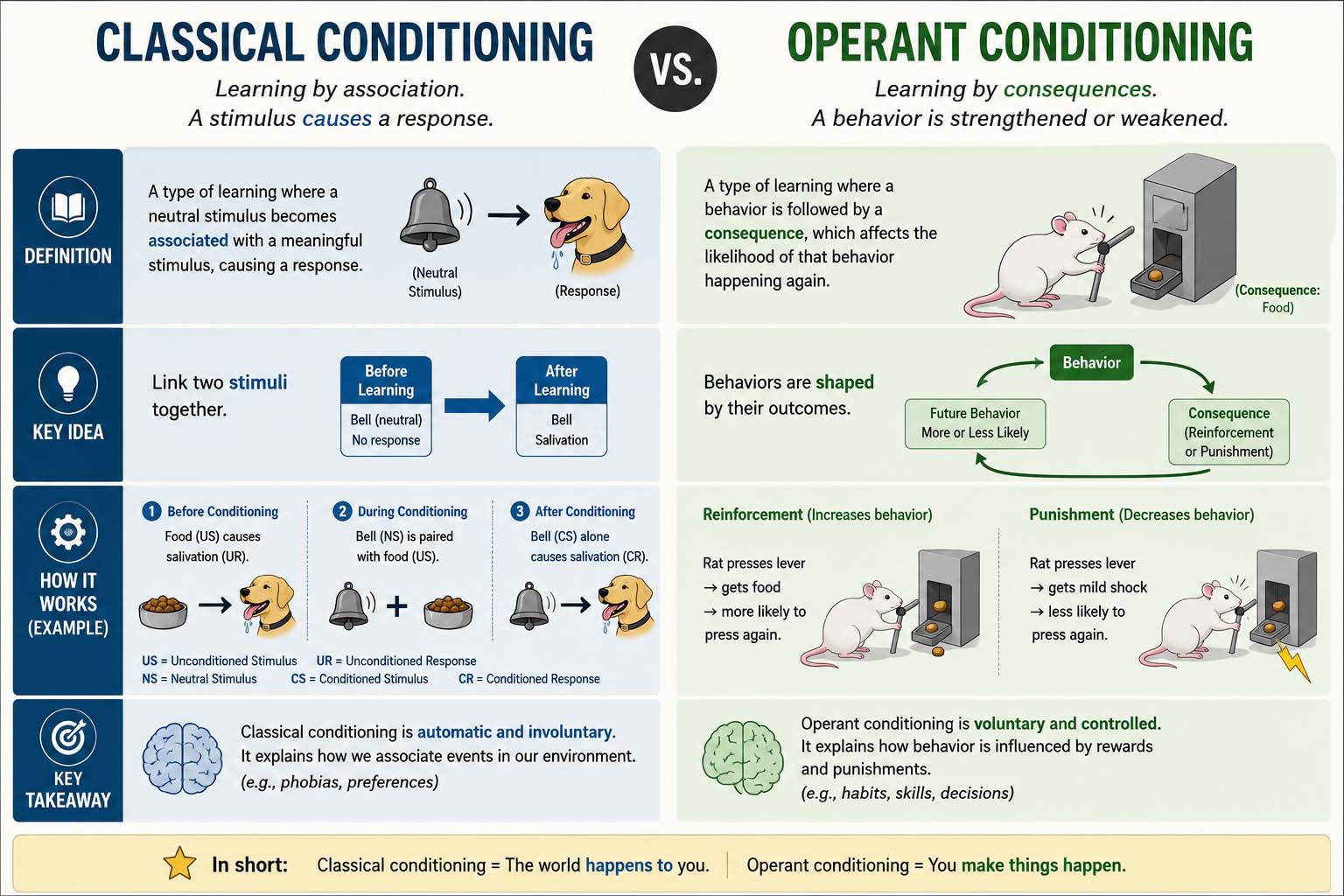
The topic of classical vs operant conditioning is one of the most important concepts in psychology and behavioral science. These two learning theories explain how humans and animals develop behaviors through experiences and environmental influences. Although both forms of conditioning focus on learning, they differ in how behaviors are formed and reinforced.
Classical conditioning was first introduced by Ivan Pavlov, while operant conditioning was later developed by B. F. Skinner. Their research changed the understanding of behavior and learning forever. Today, these theories are widely used in education, therapy, parenting, animal training, and even marketing.
Classical conditioning focuses on automatic responses triggered by associations, while operant conditioning involves learning through rewards and punishments. Understanding the differences between these two concepts helps students, psychologists, and educators better understand how behavior develops over time.
Operant vs Classical Conditioning
When discussing operant vs classical conditioning, the main difference lies in how learning occurs. Classical conditioning involves associating two stimuli to create an automatic response. Operant conditioning, on the other hand, focuses on voluntary behaviors shaped by consequences.
In classical conditioning, behavior happens before a consequence is introduced. Pavlov’s famous dog experiment demonstrated this concept clearly. Dogs naturally salivated when food was presented. Pavlov then paired the sound of a bell with food repeatedly. Eventually, the dogs began salivating at the sound of the bell alone, even without food being present. This showed how associations can create learned responses.
. In Skinner’s experiments, animals learned behaviors by receiving rewards or avoiding negative consequences. For example, a rat pressing a lever to receive food learns to repeat that action because the reward reinforces the behavior.
Another key distinction between operant and classical conditioning is the type of behavior involved. Classical conditioning usually deals with involuntary responses such as fear, salivation, or emotional reactions. Operant conditioning focuses on voluntary actions like studying, exercising, or following rules. Practicing critical thinking exercises can help students distinguish between these learning theories more effectively.
Both learning theories are extremely influential in psychology because they explain how environmental factors shape behavior over time.
Classical Conditioning vs Operant Conditioning
The comparison between classical conditioning vs operant conditioning often appears in psychology courses because both concepts are foundational learning theories. Although they share similarities, their methods and outcomes are quite different.
Classical conditioning depends on creating associations between stimuli. A neutral stimulus becomes meaningful after being paired repeatedly with an unconditioned stimulus. This process explains many emotional reactions and habits people experience in daily life.
For example, someone who becomes anxious every time they hear a dentist’s drill may have developed a conditioned response through previous unpleasant experiences. The sound itself is not harmful, but the brain associates it with discomfort or pain.
Operant conditioning focuses more on consequences. Behaviors followed by positive outcomes are likely to increase, while behaviors followed by negative outcomes are likely to decrease. This process is commonly used in classrooms, workplaces, and parenting strategies.
Positive reinforcement is one of the most effective tools in operant conditioning. Rewarding good behavior encourages repetition of that behavior. A student receiving praise for completing homework may feel motivated to continue studying hard. Negative reinforcement also increases behavior, but it does so by removing an unpleasant condition.
Operant Conditioning vs Classical Conditioning
The debate around operant conditioning vs classical conditioning continues because both theories explain important aspects of learning. However, many psychologists believe the two forms of conditioning often work together rather than separately.
In real-life situations, behaviors are usually influenced by both associations and consequences. For example, a child may feel nervous entering a classroom because of previous negative experiences, which reflects classical conditioning. At the same time, the child may study harder after receiving praise from teachers, demonstrating operant conditioning.
Operant conditioning is especially powerful when shaping long-term habits and routines. Athletes, teachers, employers, and parents frequently use reinforcement systems to encourage desired behaviors. Reward-based systems are commonly used in education because they increase motivation and engagement. A student perception survey can also help educators evaluate how reinforcement strategies affect learning.
Classical conditioning often explains emotional responses and automatic reactions. Phobias, preferences, and emotional triggers can develop through conditioned associations. Someone who hears a specific song connected to a happy memory may instantly feel positive emotions when hearing it again years later.
Modern psychology recognizes the value of both theories in understanding human behavior. Therapists use conditioning principles to treat anxiety disorders, addictions, and behavioral challenges. Behavioral therapy often combines reinforcement strategies with techniques designed to change emotional associations.
Classical vs Operant Conditioning MCAT
Students preparing for psychology or medical exams frequently study classical vs operant conditioning MCAT concepts because they are common topics in behavioral science sections. Understanding the differences between these theories is essential for answering exam questions accurately.
The MCAT often tests students on identifying examples of classical and operant conditioning in practical situations. Students must understand terms such as conditioned stimulus, unconditioned response, reinforcement, punishment, and extinction.
Classical conditioning questions may involve identifying how a neutral stimulus becomes associated with a response. Operant conditioning questions often focus on understanding how rewards or punishments influence voluntary behavior.
Memory techniques can help students remember the differences. Classical conditioning involves associations between stimuli, while operant conditioning involves consequences following behavior. Recognizing whether a behavior is involuntary or voluntary also helps distinguish between the two concepts. Learning about the flexor digitorum longus is another example of how students build foundational knowledge across healthcare subjects.
Why Conditioning Theories Still Matter
The study of classical vs operant conditioning remains important because these theories continue influencing modern psychology, education, and behavioral science. They help explain why people develop habits, fears, motivations, and emotional responses.
Teachers use reinforcement systems to improve classroom behavior. Therapists use conditioning principles to treat mental health conditions. Businesses use behavioral psychology in advertising and customer engagement strategies. Even daily habits such as exercising, studying, or checking smartphones are influenced by conditioning processes. Students entering the workforce may also benefit from understanding skills to put on resume when preparing for future career opportunities.