
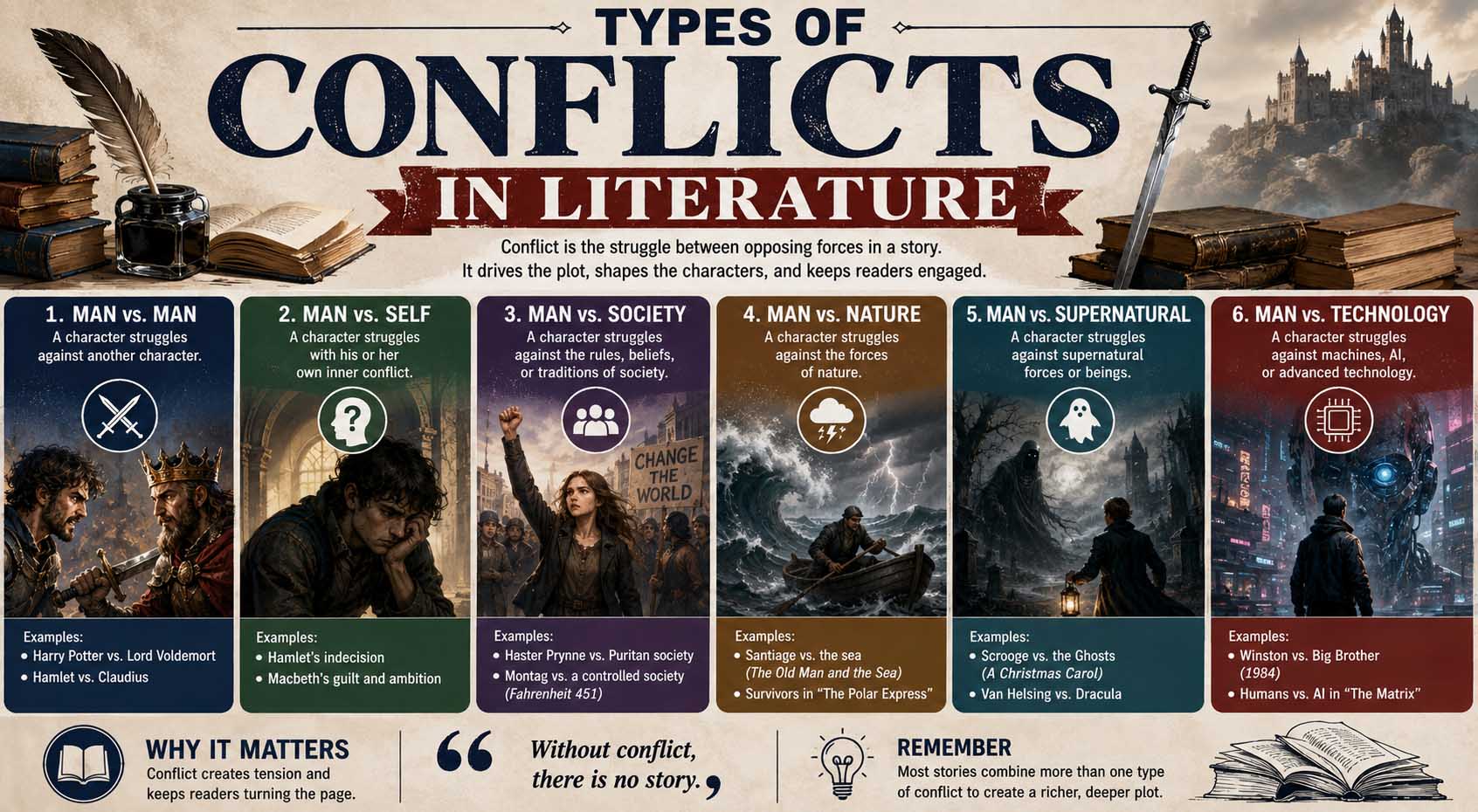
Stories become interesting when characters face problems they cannot easily solve. In fact, understanding the types of conflicts in literature can help students recognize why characters make certain choices, how plots develop, and what an author may be trying to say. Conflict might happen between two people, inside a character’s mind, or between a person and a much larger force such as society or nature.
Although teachers sometimes organize literary conflict differently, most lessons focus on a few major categories. Once you understand them, analyzing novels, short stories, plays, and even movies becomes much easier.
What Is Conflict in Literature?
Conflict is a struggle between opposing forces within a story. Usually, a character wants something, but another person, an internal struggle, a social rule, nature, technology, or another force makes that goal difficult to achieve.
For example, imagine a student wants to tell the truth about something that happened at school. However, the student worries that telling the truth could hurt a close friend. The struggle takes place inside the character, so it represents internal conflict.
By contrast, suppose the same student wants to tell the truth but another character actively threatens to stop them. Now the conflict exists between two characters.
Conflict is one of the essential Parts of a Story because it gives characters problems to solve and creates reasons for events to happen. Without meaningful conflict, many stories would have little tension or forward movement.
Internal and External Types of Conflicts in Literature
Before memorizing individual categories, students can make literary conflict easier to understand by separating it into two broad groups: internal and external conflict.
Internal conflict happens within a character. The character may struggle with fear, guilt, identity, beliefs, desires, or a difficult decision.
External conflict, meanwhile, occurs between a character and something outside that character. The opposing force might be another person, society, nature, technology, or a supernatural force.
This distinction is useful because many stories contain both forms at the same time. For instance, a character trying to survive a dangerous journey may battle harsh weather externally while also struggling internally with fear.
Students who need a closer explanation of character-versus-self struggles may find an internal conflict definition helpful before moving on to more complicated examples.
Here is a quick reference:
| Conflict Type | Main Struggle | Internal or External? |
|---|---|---|
| Character vs. Self | Character against thoughts or emotions | Internal |
| Character vs. Character | One character against another | External |
| Character vs. Society | Character against social rules or systems | External |
| Character vs. Nature | Character against natural forces | External |
| Character vs. Technology | Character against technology | External |
| Character vs. Fate/Supernatural | Character against destiny or supernatural forces | Usually external |
Character vs. Self
Character vs. self occurs when the main struggle happens within a character’s thoughts or emotions. As a result, the character becomes both the person experiencing the problem and part of the obstacle.
For example, a character might know that admitting a mistake is the right choice. However, embarrassment and fear prevent them from speaking. The conflict exists because two desires compete inside the same person.
Writers commonly use this conflict to explore guilt, fear, morality, identity, ambition, grief, or personal responsibility.
Character vs. self can also make characters feel more realistic. After all, people regularly experience competing thoughts and emotions. Therefore, readers may understand a fictional character better when they see those private struggles.
Character vs. Character
Character vs. character is one of the easiest conflicts to recognize. In this situation, two or more characters have opposing goals, beliefs, needs, or interests.
The struggle does not always involve physical fighting. Instead, it may involve competition, disagreement, deception, rivalry, or conflicting values.
For instance, imagine two siblings who both want control of a family business. One wants to modernize it, while the other wants to preserve its traditions. Their different goals create character-versus-character conflict even if they never physically fight.
Likewise, heroes and villains often represent this type of conflict. Still, neither character has to be clearly good or bad. Sometimes both sides have understandable motivations, which can make the story more complex.
A reader’s interpretation may also change depending on who tells the story. Reviewing point of view examples can therefore help students see how perspective affects the way a conflict is presented.
Character vs. Society
Character vs. society occurs when a character challenges the beliefs, expectations, laws, traditions, or institutions of the larger community.
For example, a fictional society might require everyone to choose a career at a certain age. However, the protagonist refuses because they believe people should make their own choices. The character’s personal goal now conflicts with the rules of society.
Authors often use this type of struggle when exploring topics such as freedom, justice, conformity, discrimination, power, and social expectations.
However, students should avoid assuming that every disagreement with another person represents character vs. society. The opposing force must represent a broader social system, expectation, institution, or widely accepted rule.
Character vs. Nature
Character vs. nature places a person against forces in the natural world.
Common examples include storms, extreme temperatures, wilderness, floods, oceans, mountains, droughts, or dangerous environments.
Suppose a hiker becomes lost during a snowstorm. The character needs shelter and a safe route home, while freezing temperatures and difficult terrain threaten survival. Therefore, nature functions as the opposing force.
These stories often focus on survival, preparation, endurance, or human vulnerability. At the same time, the natural setting may create internal struggles. The lost hiker, for example, could begin doubting whether they have the strength to continue.
Consequently, one situation can produce several types of conflict at once.
Character vs. Technology
Character vs. technology has become especially relevant in stories about artificial intelligence, machines, surveillance systems, robots, and advanced scientific inventions.
In this type of conflict, technology creates or becomes the obstacle that a character must confront.
Imagine that an automated computer system controls transportation throughout a futuristic city. After the system malfunctions, one character must find a way to travel safely while the technology blocks normal movement. That creates character-versus-technology conflict.
However, technology does not always need to be evil or conscious. A machine, algorithm, or technological system can create conflict simply because its operation clashes with a character’s needs.
This category frequently appears in science fiction, although modern realistic stories can use it as well.
Character vs. Fate or the Supernatural
Some stories place characters against forces that seem beyond normal human control. Depending on the story, these forces might include destiny, gods, prophecies, ghosts, monsters, curses, or supernatural powers.
For instance, a character may receive a prophecy predicting a terrible future. The character then spends the story trying to prevent that prediction from becoming reality.
This conflict appears frequently in mythology, fantasy, tragedy, and supernatural fiction. However, teachers and textbooks may label the category differently. Some separate character vs. fate from character vs. supernatural, while others discuss them together.
Therefore, students should follow the terminology used by their course or teacher when completing an assignment.
What Are the Different Types of Conflicts in Literature Working Together?
Strong stories rarely depend on only one conflict. Instead, authors often layer several struggles together.
Consider a character who leaves home during a dangerous flood. The flood creates character vs. nature. Meanwhile, another person refuses to help, creating character vs. character. At the same time, the protagonist feels guilty about leaving family members behind, creating character vs. self.
Because these conflicts overlap, the story gains depth.
Conflict can also help reveal a story’s larger message. When students study Thematic Statement Examples, they can see how repeated struggles and character choices may contribute to a theme without treating the conflict itself as the theme.
For example, a story about a character repeatedly challenging unfair rules could develop ideas about courage, individual freedom, or social responsibility.
How to Identify the Types of Conflicts in Literature
Students sometimes identify conflict based only on the most dramatic event. However, a simple step-by-step method usually produces a better answer.
Step 1: Identify what the character wants
First, ask what the main character is trying to achieve.
Perhaps the character wants to survive, win a competition, protect someone, solve a mystery, gain independence, or overcome fear.
Step 2: Find the main obstacle
Next, identify what prevents the character from reaching that goal.
Is another person blocking them? Is the character struggling with fear? Does society reject the character’s choices? Is a natural disaster creating the problem?
Step 3: Match the obstacle to a category
Once you identify the opposing force, classification becomes much easier.
If the obstacle comes from the character’s own thoughts, the conflict is character vs. self. If another individual creates the obstacle, it is probably character vs. character. Likewise, broader rules may indicate society, while weather or wilderness usually points toward nature.
Step 4: Look for secondary conflicts
After identifying the main struggle, check for other conflicts.
A story may have one central conflict and several smaller ones. Recognizing those layers can strengthen literary analysis because it shows how different problems influence the character.
Why Conflict Matters to Plot and Character Development
Conflict does more than make a story exciting. Instead, it forces characters to respond to pressure.
Their reactions reveal personality.
For example, two characters might experience the same crisis but respond differently. One might remain calm, while another panics. Therefore, the conflict gives readers information that ordinary description may not communicate as effectively.
Conflict also moves the plot forward. A problem leads to a choice, the choice produces consequences, and those consequences create new events.
Meanwhile, authors can shape how readers understand those events through language and technique. Learning What Is a Rhetorical Device? can help students recognize how repetition, contrast, rhetorical questions, and other choices may emphasize a character’s struggle or an author’s larger idea.
Common Mistakes When Analyzing Literary Conflict
One common mistake is confusing conflict with any unpleasant event. A rainy afternoon, for example, is not automatically character vs. nature. The rain must create a meaningful obstacle for a character.
Another mistake involves identifying the topic instead of the conflict. Saying “the conflict is friendship” does not explain the opposing forces. A stronger answer would describe two friends whose different goals threaten their relationship.
Students may also identify only one conflict even when a story clearly contains several. Therefore, after finding the central struggle, look for secondary internal and external problems.
Finally, avoid relying entirely on labels. In an essay or classroom response, explain how the conflict works and support the answer with evidence from the text.
Quick Study Strategy for Remembering Literary Conflicts
A useful study trick is to start with one question:
What is working against the character?
If the answer is their own mind, think self.
If the answer is another person, think character.
This method works better than memorizing definitions alone because it teaches you to recognize conflict inside an actual story.
FAQs About Different Types of Conflicts in Literature
What are the main types of conflicts in literature?
The commonly taught categories include character vs. self, character vs. character, character vs. society, character vs. nature, character vs. technology, and character vs. fate or the supernatural. However, classifications can vary slightly between textbooks and courses.
What is the difference between internal and external conflict?
Internal conflict takes place within a character’s thoughts, emotions, or personal struggles. By contrast, external conflict occurs when a character faces an outside force, such as another person, society, nature, or technology.
Can a story have more than one type of conflict?
Yes. In fact, many stories combine several conflicts. A protagonist might fight another character while simultaneously dealing with fear, guilt, or doubt.
Is character vs. self always the internal conflict?
Character vs. self is the standard form of internal conflict because the opposing forces exist within the character. Other major categories generally involve something outside the character.
Why do writers use conflict?
Writers use conflict to create obstacles, encourage character development, move the plot forward, build tension, and explore larger ideas. As a result, conflict often connects plot, character, and theme.
A Simple Way to Improve Your Literary Analysis
When studying the types of conflicts in literature, do more than memorize category names. Instead, identify what the character wants, determine what stands in the way, and explain how that struggle affects the character’s choices.
Then, look at how the conflict changes over the course of the story. If you can connect the struggle to the plot, character development, and theme, your analysis will become much stronger.
Most importantly, use evidence from the text. A clear explanation supported by specific events or quotations usually demonstrates deeper understanding than simply labeling a conflict as “character vs. character” or “character vs. self.”