Have you ever read a story and wondered why it felt so personal or why you seemed to know exactly what a character was thinking? Understanding point of view examples can help you discover how authors control the information readers receive and whose experiences shape a story.
Point of view, often called POV, describes the perspective from which someone tells a story. For example, a narrator might describe personal experiences using “I,” address the reader using “you,” or describe another character using “he,” “she,” or “they.”
Although these perspectives may seem similar, each creates a different reading experience. Therefore, learning to recognize them can improve your reading comprehension and storytelling skills.
Whether you’re studying for an English class, preparing a writing assignment, or analyzing a novel, this guide explains the major types of point of view with clear definitions, comparison tables, and practical exercises.
What Is Point of View in Literature?
Point of view is the perspective through which a narrator presents the events of a story. It determines who tells the story, what information readers receive, and whose thoughts or feelings influence the narrative.
For example, a first-person narrator describes events from personal experience. In contrast, a third-person narrator tells the story from outside the action.
The narrator may be:
- A character participating in the story
- A voice addressing the reader directly
- An outside narrator describing characters and events
Point of view affects several important storytelling elements:
- What readers know about events
- How readers understand characters
- The emotional connection between readers and the story
- How much information the narrator reveals
- The overall storytelling style
As a result, authors choose narrative perspectives based on the experience they want to create.
Students who want to understand how narration fits into a complete story can also explore the Parts of a Story.
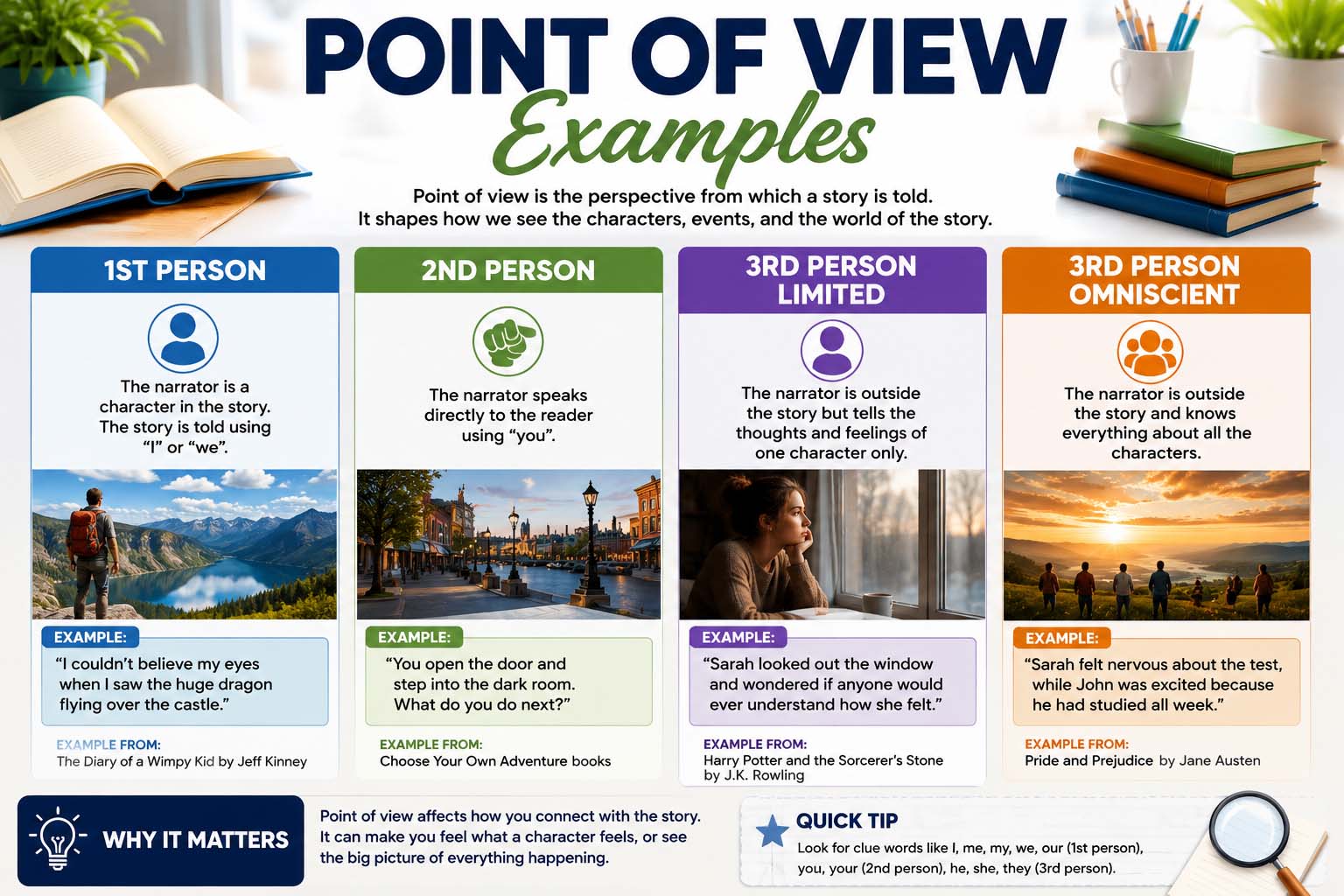
Quick Comparison of Point of View Examples
The following table explains the four main narrative perspectives students commonly encounter.
| Point of View | Common Pronouns | Who Tells the Story? |
|---|---|---|
| First Person | I, me, my, we | A character within the story |
| Second Person | You, your | A narrator addresses the reader or another “you” |
| Third Person Limited | He, she, they | An outside narrator focuses on one character’s inner experience |
| Third Person Omniscient | He, she, they | An outside narrator can reveal multiple characters’ thoughts |
Although pronouns provide useful clues, they don’t always identify the narrator’s perspective on their own.
Therefore, you should also consider whose thoughts the narrator reveals and how much information the narrator knows.
First Person Point of View Examples
First-person narration tells a story through the perspective of a character who participates in or witnesses the events.
Common first-person pronouns include:
- I
- Me
- My
- Mine
- We
- Our
Because the narrator speaks from personal experience, readers often develop a close connection with that character.
Example of First Person Narration
I opened the old wooden door and stepped into the empty house. My hands shook as I looked around.
In this example, the narrator describes personal actions and emotions.
Readers understand what the narrator experiences. However, they cannot automatically know what other characters are thinking.
Another First Person Example
I studied all night for the exam, but I still felt nervous when the teacher handed out the papers.
Here, the narrator directly shares feelings about an upcoming test.
As a result, readers experience the situation through one person’s perspective.
When Writers Use First Person
First-person narration works particularly well for:
- Personal storytelling
- Memoirs
- Character-focused fiction
- Emotional experiences
- Stories with limited information
For example, a mystery narrator may misunderstand an important clue. Consequently, readers may share that character’s confusion until the truth becomes clear.
Second Person Point of View Examples
Second-person narration addresses someone as “you.”
Writers often use this perspective to make readers feel directly involved in an experience.
Common pronouns include:
- You
- Your
- Yours
- Yourself
Unlike first-person narration, second person doesn’t usually rely on a character saying “I” to describe the action.
Example 1: Classroom Situation
You walk into the classroom and notice everyone looking at you. Suddenly, you remember that today is presentation day.
This example places the reader in the classroom situation.
Example 2: Adventure Story
You reach for the treasure chest, hoping no one sees you. However, a strange sound comes from behind the door.
Here, the narrator addresses the reader as the person experiencing the adventure.
Where Writers Use Second Person
Second-person narration often appears in:
- Interactive fiction
- Choose-your-own-adventure stories
- Video game tutorials
- Instruction guides
- Experimental fiction
For example, an interactive story might ask readers to choose whether to open a door or follow another path.
Therefore, second person can create a strong sense of participation.
For a more detailed explanation, read our guide to second person point of view.
Third Person Limited Point of View Examples
Third-person limited narration follows a particular character while using third-person pronouns.
Common pronouns include:
- He
- She
- They
- His
- Her
- Their
The narrator describes events from outside the story but usually reveals the inner experiences of one viewpoint character at a time.
As a result, readers can understand that character’s thoughts without automatically knowing what everyone else feels.
Example 1: Emma at the Library
Emma smiled as she entered the library. She hoped today’s test would be easier than the last one.
The narrator reveals Emma’s thoughts about the test.
However, readers don’t learn what other characters think.
Example 2: Daniel and the Storm
Daniel watched the storm approach. He wondered whether his friends would arrive before the rain began.
Here, readers understand Daniel’s concern.
Meanwhile, the narrator doesn’t reveal his friends’ private thoughts.
Why Authors Use Third Person Limited
This perspective offers several advantages:
- Creates a close connection with a character
- Maintains suspense
- Allows detailed descriptions
- Limits information naturally
- Supports character development
For example, a mystery story can follow a detective who doesn’t yet understand the evidence.
Consequently, readers discover clues alongside the main character.
Some novels also switch between different limited viewpoints in clearly separated chapters or scenes. However, each section usually maintains a consistent viewpoint.
Third Person Omniscient Point of View Examples
The word “omniscient” means “all-knowing.”
In third-person omniscient narration, the narrator can reveal the thoughts, feelings, and experiences of multiple characters.
Unlike third-person limited, this perspective doesn’t restrict readers to one character’s inner world.
Example 1: Students Before an Exam
Emma felt nervous about the exam, but her teacher believed she was ready. Across the room, Liam worried about a completely different problem.
This example reveals the thoughts or beliefs of several characters.
Therefore, readers understand more than any single character does.
Example 2: A Family Surprise
Maria thought her family had forgotten her birthday. Meanwhile, her brother secretly prepared a surprise party, excited to see her reaction.
Here, the narrator reveals Maria’s mistaken belief and her brother’s hidden plans.
As a result, readers know something Maria doesn’t.
When Authors Choose Omniscient Narration
This perspective can help writers:
- Explore several characters’ experiences
- Show different sides of a conflict
- Explain events happening in different places
- Provide broader background information
- Create dramatic irony
However, writers must manage changes in focus carefully.
Otherwise, frequent movement between characters’ thoughts can confuse readers.
Examples of Point of View Using the Same Story
One of the easiest ways to understand narrative perspective is to compare the same event told in different ways.
Consider this situation: A dog runs away.
First Person Example
I ran after my dog as fast as I could, hoping he would stop before reaching the road.
The narrator participates in the action and uses “I.”
Second Person Example
You see your dog running toward the park, so you sprint after him.
The narrator addresses the reader directly.
Third Person Limited Example
Sarah chased her dog through the neighborhood. She worried she might lose him forever.
The narrator describes Sarah’s actions and reveals her thoughts.
Third Person Omniscient Example
Sarah chased her dog in panic. Meanwhile, the dog happily followed another animal’s scent, unaware of her fear.
The narrator reveals Sarah’s emotions and the dog’s experience.
These point of view examples demonstrate how the same event can feel different depending on who tells the story.
Although the basic action remains unchanged, the narrator controls which details readers understand.
Point of View Examples in Literature
Famous novels provide useful opportunities to identify different narrative perspectives.
For example, some authors use first person to create a personal connection, while others use third person to follow characters from outside the action.
| Book | Author | Main Point of View |
|---|---|---|
| The Hunger Games | Suzanne Collins | First Person |
| To Kill a Mockingbird | Harper Lee | First Person |
| Harry Potter series | J. K. Rowling | Predominantly Third Person Limited |
| Charlotte’s Web | E. B. White | Third Person Omniscient |
| The Great Gatsby | F. Scott Fitzgerald | First Person |
First Person in The Hunger Games
Katniss Everdeen narrates much of her experience using first-person language.
Therefore, readers closely follow her fears, decisions, and understanding of events.
First Person in To Kill a Mockingbird
Scout Finch narrates the story from her perspective.
As a result, readers experience events through her recollections and observations.
Third Person Limited in Harry Potter
The main narrative generally follows Harry’s experiences.
Although the series occasionally shifts its narrative focus, readers usually discover important information alongside Harry.
Third Person Omniscient in Charlotte’s Web
The narrator can describe different characters’ experiences and perspectives.
Consequently, readers gain a broader understanding of the story than one character alone could provide.
These literary examples help students connect classroom definitions with actual novels.
In addition, understanding different types of narratives can strengthen your knowledge of storytelling techniques.
How to Identify Point of View in a Story
Recognizing the narrator’s perspective becomes easier when you follow a simple process.
Step 1: Look at the Pronouns
First, identify the pronouns that appear in the narration.
Ask whether the narrator frequently uses:
- I
- We
- You
- He
- She
- They
For example, a narrator who repeatedly describes personal experiences using “I” probably uses first person.
However, remember that dialogue may contain different pronouns without changing the overall point of view.
Step 2: Identify Whose Thoughts Readers Know
Next, examine the narrator’s access to characters’ thoughts.
Ask yourself:
- Do readers know only one character’s thoughts?
- Can readers understand several characters’ private feelings?
- Does the narrator describe only visible actions?
For example, knowing one character’s inner thoughts may suggest third-person limited narration.
Meanwhile, access to multiple characters’ private thoughts may indicate omniscient narration.
Step 3: Determine Who Tells the Story
Then, consider the narrator’s relationship to the events.
Is the narrator a character participating in the story?
Does the narrator address someone as “you”?
Or does an outside narrator describe the characters?
These questions help distinguish the major narrative perspectives.
Step 4: Check the Entire Passage
Finally, read more than one sentence before making your decision.
A single sentence may not reveal enough information.
For instance, third-person limited and omniscient narration can both use “he,” “she,” and “they.”
Therefore, examine how the narrator handles thoughts and information throughout the passage.
For additional guidance on narrative perspective, the Purdue Online Writing Lab’s explanation of point of view discusses how different perspectives shape writing.
Why Point of View Matters in Storytelling
Narrative perspective affects much more than pronoun choice.
It influences how readers interpret events, understand characters, and respond emotionally.
Point of View Creates Suspense
A limited narrator may not know everything happening in the story.
For example, readers following one character may discover a hidden danger only when that character notices it.
As a result, limited information can create suspense.
Point of View Builds Emotional Connections
First-person and close third-person narration can help readers understand a character’s personal experiences.
Therefore, these perspectives often work well for emotional stories.
Point of View Changes Reader Understanding
Different narrators may interpret the same event differently.
For instance, one character may consider an argument unfair, while another believes it was necessary.
Consequently, the chosen narrator shapes how readers understand the situation.
This becomes especially useful when analyzing different types of conflicts in literature.
Common Mistakes Students Make With Point of View
Students sometimes confuse narrative perspectives because they focus on individual words rather than the narrator’s role.
Fortunately, a few simple checks can prevent these mistakes.
Confusing Third Person Limited and Omniscient
Third-person limited usually follows one viewpoint character’s inner experiences at a time.
In contrast, omniscient narration can reveal the thoughts of multiple characters.
Therefore, ask whose private thoughts the narrator can access.
Looking Only at Pronouns
Both limited and omniscient third-person narration use pronouns such as “he,” “she,” and “they.”
However, those pronouns alone don’t explain how much the narrator knows.
Instead, examine the information available to readers.
Confusing Dialogue With Narration
A character may say “I” during a conversation even when the story uses third-person narration.
For example:
Sarah opened the door. “I thought you were coming tomorrow,” she said.
Although the dialogue contains “I,” the surrounding narration remains third person.
Mixing Viewpoints Without Clear Transitions
Writers sometimes shift between characters’ private thoughts without warning.
For example:
Sarah entered the classroom, worried about the exam. Daniel secretly hoped she would fail.
This passage reveals two characters’ private thoughts.
That approach may work in omniscient narration. However, it can create confusion if the writer intends to maintain Sarah’s limited perspective.
Tips for Writing in Different Points of View
Choosing a consistent perspective can make your stories clearer and easier to follow.
Writing in First Person
When writing in first person:
- Use “I” or “we” consistently.
- Describe the narrator’s personal experiences.
- Share emotions naturally.
- Avoid revealing information the narrator couldn’t know.
For example, a first-person narrator can describe another character’s expression but cannot automatically know that person’s hidden thoughts.
Writing in Second Person
When writing in second person:
- Address the reader or intended character as “you.”
- Use clear descriptions of actions.
- Maintain a consistent narrative voice.
- Avoid unnecessary perspective changes.
For instance, second person works well when writing an interactive adventure.
Writing in Third Person Limited
When writing in third-person limited:
- Select a viewpoint character.
- Focus on that character’s experiences.
- Describe other characters through observable actions and dialogue.
- Change viewpoint only when the structure clearly supports it.
As a result, readers can follow the story without confusion.
Writing in Third Person Omniscient
When writing in third-person omniscient:
- Maintain a clear narrator’s voice.
- Reveal different characters’ thoughts purposefully.
- Use transitions when changing focus.
- Avoid unnecessary jumps between characters.
Therefore, readers can understand multiple perspectives while following the story’s main events.
Practice Exercises: Identify the Point of View
Test your understanding with these short examples.
Exercise 1
Mia looked outside and smiled. She couldn’t wait for the snow to begin.
Answer: Third Person Limited
The narrator reveals Mia’s thoughts while describing her in third person.
Exercise 2
I couldn’t believe I had forgotten my homework again.
Answer: First Person
The narrator uses “I” to describe a personal experience.
Exercise 3
You open your notebook and discover a mysterious message inside.
Answer: Second Person
The narrator addresses someone as “you.”
Exercise 4
Olivia feared the storm, but her brother secretly enjoyed watching the lightning.
Answer: Third Person Omniscient
The narrator reveals the feelings of two characters.
Exercise 5
Marcus waited outside the principal’s office. He wondered whether anyone had discovered his mistake.
Answer: Third Person Limited
The narrator follows Marcus and reveals his private thoughts.
Practicing with short passages helps you recognize narrative perspectives more quickly.
In addition, analyzing complete stories can improve your understanding of how authors organize information.
For example, learning What Is Text Structure? can help you recognize how writers arrange ideas and events.
Quick Point of View Study Guide
Use this chart when reviewing stories or preparing for an English exam.
| If You Notice… | Likely Point of View |
|---|---|
| A narrator uses “I,” “me,” or “my” | First Person |
| The narration addresses someone as “you” | Second Person |
| An outside narrator reveals one character’s thoughts | Third Person Limited |
| An outside narrator reveals several characters’ thoughts | Third Person Omniscient |
However, remember that pronouns provide clues rather than complete proof.
For example, a third-person narrator may include first-person dialogue without changing the overall perspective.
Therefore, always consider who tells the story and what information the narrator reveals.
Frequently Asked Questions About Point of View
What Is Point of View?
Point of view describes the perspective from which a narrator tells a story.
It determines whose experiences readers follow and how much information they receive.
What Are the Main Types of Point of View?
The main types include first person, second person, third person limited, and third person omniscient.
In addition, some stories use third-person objective narration, which reports observable actions and dialogue without directly revealing characters’ private thoughts.
What Is the Easiest Point of View to Recognize?
First person is often the easiest because the narrator uses pronouns such as “I,” “me,” and “my.”
However, you should examine the narration rather than relying on dialogue alone.
Is Second Person Common in Literature?
Second person appears less frequently than first-person or third-person narration in traditional novels.
However, it often appears in interactive stories, instructions, and experimental fiction.
What’s the Difference Between Third Person Limited and Omniscient?
Third-person limited generally focuses on one viewpoint character’s inner experiences at a time.
In contrast, third-person omniscient narration can reveal multiple characters’ thoughts and feelings.
Why Do Teachers Ask Students to Identify Point of View?
Identifying the narrator helps students understand how stories communicate information.
As a result, students can improve reading comprehension, analyze literature, and develop stronger writing skills.
Key Takeaways for Students
Learning from point of view examples can help you become a more confident reader and writer.
First-person narration uses a character’s personal perspective, while second person addresses someone as “you.” Meanwhile, third-person limited focuses on one character’s inner experiences, and third-person omniscient can reveal the thoughts of multiple characters.
When reading a story, pay attention to the narrator, pronouns, and information available to readers. In addition, practice comparing the same event from different perspectives.
With regular practice, identifying narrative viewpoints becomes easier. As a result, you’ll be better prepared to analyze novels, complete English assignments, and write clear, engaging stories.