Learning the parts of a story is an important skill for reading and writing. Whether you are studying a fairy tale, novel, movie, or classroom assignment, understanding story structure helps you follow events, characters, and emotions.
Stories can entertain readers, teach lessons, or share experiences. To create a complete narrative, writers usually combine elements such as characters, setting, plot, conflict, theme, climax, and resolution. Together, these elements give a narrative structure and meaning.
Understanding these elements can improve reading comprehension, creative writing, and literary analysis. In addition, it helps students organize their ideas when they create their own stories.
What Are the Parts of a Story?
Many students ask, “What are the parts of a story?” The answer includes the main elements that give a narrative its structure and meaning.
The most common elements include:
- Characters
- Setting
- Plot
- Conflict
- Theme
- Climax
- Resolution
Together, these elements help readers understand what happens, why events happen, and how the narrative develops from beginning to end.
For example, characters take action, while the setting establishes when and where events occur. Meanwhile, conflict creates a problem that moves the plot forward. The climax brings the central tension to its peak, and the resolution shows the outcome.
Without these connected elements, a narrative can feel incomplete or difficult to follow. Therefore, understanding their individual roles makes story analysis much easier.
Why Story Structure Matters
Story structure organizes events in a logical and engaging order. Readers usually expect a narrative to have a beginning, middle, and ending.
Good structure also helps readers follow character development and changes in the plot. For example, writers can build suspense by introducing a problem and gradually increasing the challenges that characters face.
As a result, students can use this knowledge in reading assignments, book reports, and creative writing. Learning what is a hook in an essay can also help students understand how strong writing captures attention at the beginning.
Story structure extends beyond books, too. In fact, movies, television shows, video games, and advertisements often use similar narrative patterns to keep audiences interested.
Parts of a Story Plot Explained
The plot focuses on the sequence of events in a narrative. Think of it as the path that connects the beginning of the story to its ending.
A plot often develops through several stages. First, the writer introduces the situation and characters. Next, problems create tension and push the action forward. Then, the conflict reaches an important turning point before the story moves toward its resolution.
When analyzing a plot, ask:
- What happens in the narrative?
- What problem must the characters solve?
- How do the characters respond to challenges?
- Which event changes the direction of the story?
- What is the final outcome?
These questions make it easier to understand how individual events connect. Furthermore, they can help students explain why particular events matter instead of simply summarizing what happened.
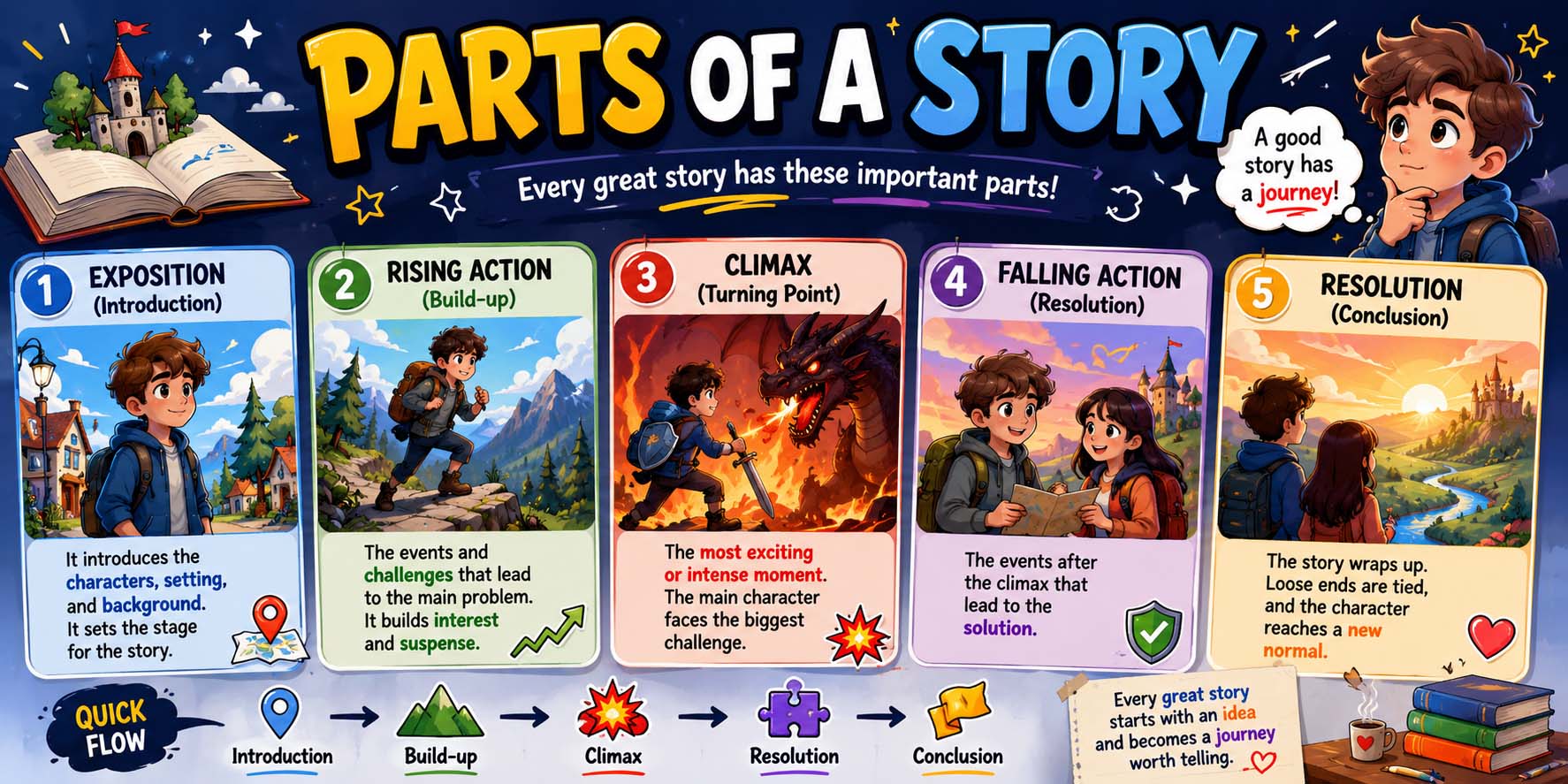
The 5 Parts of a Story
The five-part structure is a common way to explain how a narrative develops. The stages are exposition, rising action, climax, falling action, and resolution.
1. Exposition
The exposition introduces the main characters, setting, and background information.
Readers learn who the characters are, where the story takes place, and what the situation looks like before the main conflict begins.
For instance, a fantasy story might introduce a young hero who lives peacefully in a small village. This opening gives readers the information they need before the main problem appears.
2. Rising Action
The rising action includes events that build tension and develop the central conflict.
Challenges, problems, discoveries, and surprises often appear during this stage. As a result, the characters face increasingly difficult situations.
The rising action may contain several smaller events before the main turning point occurs. Therefore, this stage often takes up a significant part of a narrative.
3. Climax
The climax is the most important turning point in the narrative. It usually occurs when the central conflict reaches its highest level of tension.
For example, the climax might involve a major decision, confrontation, discovery, or emotional turning point. Afterward, the story begins moving toward its conclusion.
4. Falling Action
The falling action shows what happens after the climax.
Characters begin dealing with the results of their choices, and the main tension starts to decrease. Consequently, this stage connects the central turning point with the final outcome.
5. Resolution
The resolution brings the narrative to an end.
At this point, the main conflict reaches an outcome, and readers learn what happens to the characters. Some stories provide a clear solution, while others leave certain questions open for interpretation.
Overall, these five stages provide a useful framework for understanding how many narratives develop from beginning to end.
Characters: The Heart of a Story
Characters drive the action and give readers someone to care about. They can have different roles depending on the narrative.
Common character types include:
- Protagonist: The central character whose goals often drive the main action.
- Antagonist: A character or force that creates opposition for the protagonist.
- Supporting characters: Other characters who help develop the plot, setting, or main characters.
Readers often connect with characters through their goals, personalities, relationships, and struggles. In addition, character choices frequently influence how the plot develops.
For example, an adventure story may follow a main character who faces difficult challenges while learning something about courage or responsibility. As the character responds to each challenge, the plot develops.
Setting: Time and Place
The setting explains when and where a narrative takes place.
A setting may include:
- A historical period
- A city or country
- A school or home
- A fantasy world
- A future society
Setting can also influence the mood of a story. For example, a dark forest may create a sense of mystery or danger, while a sunny beach may create a relaxed atmosphere.
In addition, a well-developed setting helps readers imagine the world where the events occur. Writers can use details about locations, weather, time, and surroundings to make that world feel more realistic.
As a result, setting can do more than establish a location. It can also affect the characters’ experiences and the direction of the plot.
Conflict: The Central Problem
Conflict is the main challenge that characters must face. It creates tension and gives characters a reason to act.
Without a meaningful conflict, a narrative may lack direction. However, the conflict does not always involve a physical battle. It can also involve difficult choices, relationships, or internal struggles.
Common types include:
Character vs. Character
Two characters have opposing goals or interests. Their disagreement creates the central problem.
Character vs. Nature
A character struggles against natural forces such as storms, extreme weather, or other environmental challenges.
Character vs. Society
A character faces rules, expectations, or systems that conflict with their beliefs or goals.
Character vs. Self
A character struggles with emotions, fears, beliefs, or difficult decisions.
Conflict keeps the narrative moving because characters must respond to problems. Therefore, identifying the type of conflict can help students understand why characters behave in certain ways.
Practicing Critical Thinking Exercises can also help students examine characters’ decisions and the problems they face.
Theme: The Deeper Meaning
The theme is the central idea, message, or insight that a reader can take from a narrative.
Common themes include:
- Friendship
- Courage
- Honesty
- Family
- Perseverance
- Cooperation
For example, a story about teamwork may show why cooperation matters when people face a difficult challenge.
A theme does not always appear as a direct lesson. Instead, readers can identify it by looking at repeated ideas, character choices, conflicts, and outcomes.
Moreover, the same theme can appear in very different types of stories. A writer may explore courage through an adventure, a family situation, or a personal struggle.
How to Analyze Story Structure
Students can follow a simple process when analyzing a narrative.
Step 1: Identify the Main Characters
First, determine who the narrative focuses on. Consider the main character’s goals, relationships, and challenges.
Step 2: Determine the Setting
Next, identify where and when the events take place. Notice how the setting affects the mood or action.
Step 3: Find the Conflict
Then, identify the main problem. Ask what the characters want and what prevents them from achieving that goal.
Step 4: Follow the Plot Events
After that, track the important events from beginning to end. Look for the rising action, climax, falling action, and resolution.
Step 5: Identify the Theme
Finally, consider the larger message or idea. Ask what the characters’ experiences reveal about life, relationships, choices, or society.
This process can improve reading comprehension and literary analysis. In addition, students can use it when preparing book reports, classroom discussions, or creative writing assignments.
Some educators also use a Student Perception Survey Guide to understand student learning experiences.
A Real-World Example of Story Structure
A simple fairy tale can make the structure easier to understand.
In “Cinderella,” the exposition introduces Cinderella and her difficult home life. The rising action includes the invitation to the royal ball and the magical transformation that allows her to attend.
The story reaches its central turning point when the prince searches for the person who left the glass slipper. The falling action reveals Cinderella’s identity, and the resolution shows what happens after the conflict is resolved.
This example demonstrates how different elements can work together to create a complete narrative. Similarly, students can use the same framework when analyzing other books, movies, and fictional stories.
Readers can also explore stories from the Library of Congress to see how characters, settings, and events shape different kinds of narratives.
How Story Elements Work Together
The individual elements of a narrative do not work separately. Instead, they influence one another throughout the story.
For example, the setting can create a problem for the characters. That problem can produce conflict, while the characters’ responses move the plot forward. Their choices can then reveal the theme.
Therefore, analyzing several elements together gives readers a clearer understanding of the entire narrative.
When writing a story, students can use the same approach. First, start with characters and a setting. Next, introduce a meaningful conflict and develop the events. Finally, provide an ending that fits the choices made throughout the narrative.
FAQ About Story Elements
What are the parts of a story?
The main elements include characters, setting, plot, conflict, theme, climax, and resolution. Each one contributes to the development and meaning of the narrative.
What are the 5 parts of a story?
The five stages are exposition, rising action, climax, falling action, and resolution. Together, they provide a common framework for understanding how a plot develops.
Why is story structure important?
Story structure organizes events and helps readers understand how one event leads to another. It also helps writers build tension and create satisfying endings.
What is the plot of a story?
The plot is the sequence of events that make up a narrative. It includes the actions, challenges, turning points, and outcomes that move the story forward.
How can students improve story analysis skills?
Students can practice by identifying the characters, setting, conflict, major plot events, and theme. Then, they can explain how these elements connect and contribute to the overall meaning.
Conclusion
A strong narrative combines characters, setting, plot, conflict, theme, and resolution to create a meaningful experience for readers.
Learning these elements makes it easier to analyze books, understand movies, complete reading assignments, and create original stories. In addition, understanding the five stages of plot can help students organize their own writing more clearly.
With regular practice, students can recognize how different elements work together and explain why a story succeeds in engaging its audience.