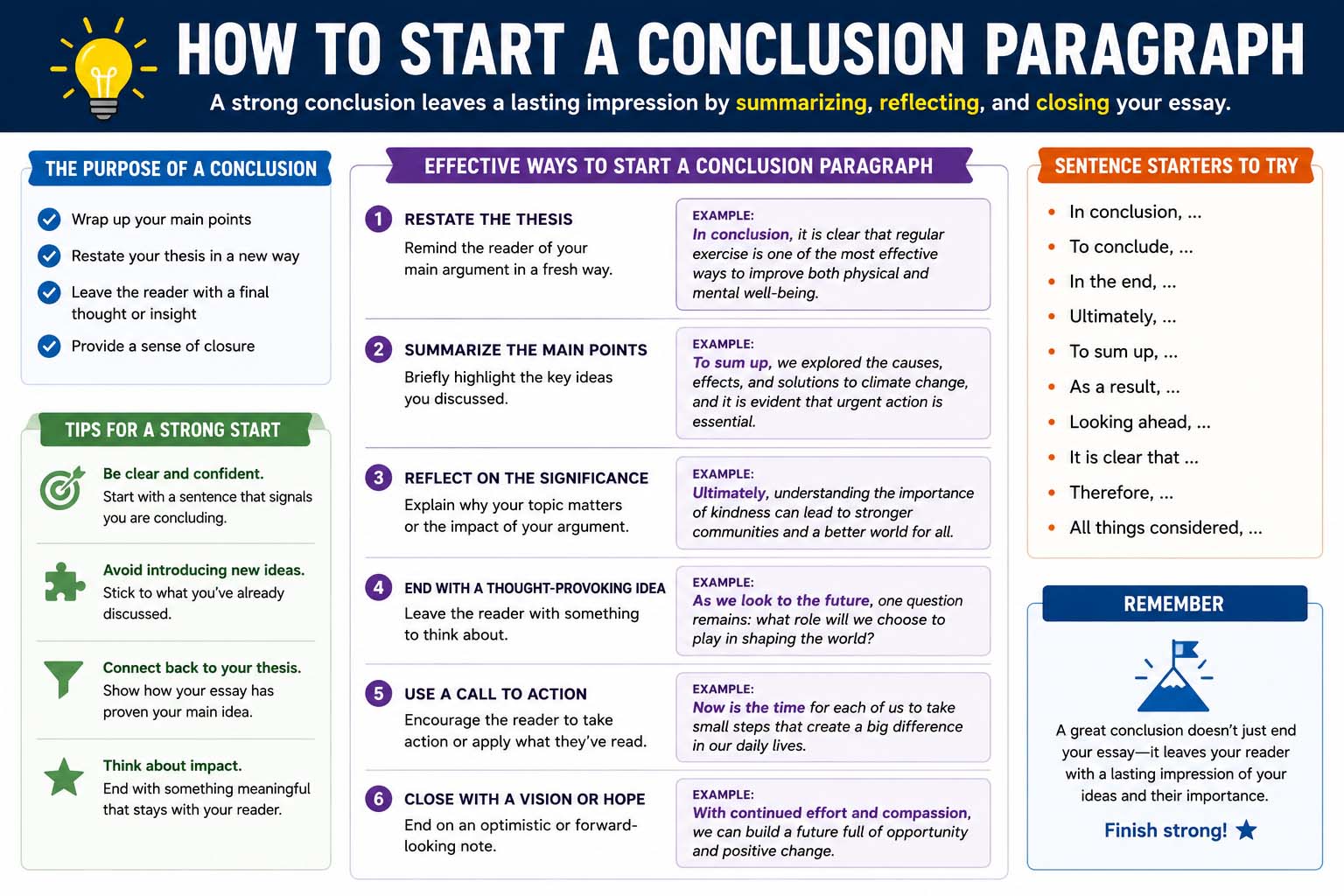
Learning how to start a conclusion paragraph can help students finish essays with clarity and confidence. Although many students know how to write an introduction, they often struggle to end their assignments effectively. A strong conclusion brings the main ideas together, reinforces the central argument, and gives readers a satisfying ending.
The best way to begin a conclusion is to revisit your main point using fresh wording. Next, connect the supporting ideas and explain why they matter. Finally, leave readers with a meaningful thought that relates to the essay’s purpose.
Whether you are writing a school essay, research paper, argumentative assignment, or personal reflection, these techniques can help you create a more organized final paragraph.
This guide explains practical conclusion-writing strategies, provides examples for different essay types, and shows how Critical Thinking Exercises can strengthen your ability to connect and evaluate ideas.
What Is a Conclusion Paragraph?
A conclusion paragraph is the final section of an essay or written assignment. Its purpose is to bring the discussion to a meaningful close rather than introduce an entirely new argument.
A well-written conclusion usually accomplishes three things:
- Restates the central idea: Reminds readers of the essay’s main argument without copying the thesis.
- Connects supporting points: Shows how the most important ideas work together.
- Provides closure: Explains the significance of the discussion or offers a thoughtful final observation.
For example, an essay about healthy eating might end by connecting balanced meals, daily habits, and long-term well-being.
However, a conclusion should do more than repeat earlier sentences. It should help readers understand why the information matters.
Why a Strong Essay Conclusion Matters
The final paragraph shapes how readers remember an essay. Therefore, a clear ending can strengthen the overall impression of your writing.
A strong conclusion helps students:
- Reinforce their main argument
- Connect important supporting ideas
- Improve the logical flow of an essay
- Demonstrate understanding of the topic
- Leave readers with a meaningful final message
For instance, an argumentative essay may present several pieces of evidence. Its conclusion should explain how those points support the overall position.
In contrast, a weak ending may repeat the introduction or stop without explaining the significance of the discussion.
The University of North Carolina at Chapel Hill’s Writing Center provides further guidance on writing effective conclusions, including ways to avoid common ending mistakes.
How to Start a Conclusion Paragraph Step by Step
Students often ask how to start a conclusion paragraph without repeating their introduction. Fortunately, a simple three-step method works for many academic assignments.
Step 1: Restate the Main Idea in Fresh Words
Begin by returning to the central argument or purpose of your essay.
However, avoid copying your original thesis sentence word for word. Instead, express the same idea from a slightly different perspective.
For example:
Original thesis:
“Regular exercise improves physical health, reduces stress, and supports better sleep.”
Conclusion opening:
“Developing a consistent exercise routine can improve several important aspects of everyday well-being.”
The second sentence reinforces the original argument without repeating it exactly.
Step 2: Connect Your Most Important Points
Next, briefly bring together the strongest supporting ideas.
For example:
“By supporting physical fitness, emotional balance, and healthier sleep patterns, regular activity contributes to a more balanced lifestyle.”
Notice that this sentence connects the main points rather than listing every detail from the essay.
As a result, readers can see how the argument fits together.
Step 3: Finish With a Meaningful Final Thought
Finally, explain why the topic matters or what readers should remember.
For example:
“Even small changes to daily routines can create opportunities for healthier habits over time.”
This ending provides closure without introducing a new argument.
How to Start a Conclusion Paragraph With Transition Words
Transition words help readers recognize that an essay is approaching its final message.
However, the best conclusion starters should fit naturally with the tone and purpose of your writing.
Here are several useful options:
| Conclusion Starter | Best Use |
|---|---|
| Overall, | Summarizing a general argument |
| Taken together, | Connecting several supporting points |
| As these examples show, | Referring to evidence discussed earlier |
| Considering these points, | Bringing different ideas together |
| The evidence suggests that | Ending an analytical or argumentative essay |
| In the end, | Writing a reflective or personal essay |
| These findings highlight | Summarizing research or observations |
For example, an essay about online education could begin its conclusion with:
“Overall, online education offers valuable flexibility, although students must also develop strong time-management skills.”
Alternatively, a research-based essay might use:
“Taken together, these findings suggest that consistent study habits support stronger academic performance.”
Both examples create a natural transition into the final paragraph.
How to Start a Conclusion Paragraph Without Saying In Conclusion
Many students want to avoid beginning every essay with the phrase “In conclusion.”
Although the phrase is grammatically correct, repeating it across assignments can make writing sound predictable.
Instead, try one of these alternatives:
- “Overall, the evidence supports…”
- “Taken together, these ideas suggest…”
- “As the discussion demonstrates…”
- “Considering these arguments…”
- “The examples presented throughout this essay show…”
- “The central lesson is clear…”
- “These findings help explain why…”
For example:
Basic opening:
“In conclusion, recycling is important for the environment.”
Improved opening:
“Taken together, the environmental benefits of recycling show why reducing waste should remain a community priority.”
The improved version connects the argument to its broader meaning.
However, you do not always need a transition phrase. Sometimes, a direct statement creates a stronger opening.
Examples of Strong Conclusion Paragraph Openings
Understanding how to start a conclusion paragraph becomes easier when you compare complete examples.
Consider an essay about the benefits of reading.
Example 1: Simple School Essay Conclusion
“Overall, regular reading supports vocabulary development, creativity, and stronger communication skills. By making reading part of everyday life, students can improve their understanding of different subjects. Even a few minutes of reading each day can help build a lasting learning habit.”
This conclusion works because it restates the main idea, connects supporting points, and ends with a practical observation.
Example 2: Argumentative Essay Conclusion
“The evidence presented throughout this essay supports greater investment in renewable energy. Solar and wind technologies can help diversify energy supplies while reducing reliance on fossil fuels. Therefore, thoughtful investment in cleaner energy sources can contribute to long-term environmental and economic goals.”
Here, the writer reinforces a position without introducing a completely new argument.
Example 3: Personal Reflection Conclusion
“Looking back, the experience taught me that patience often matters more than immediate success. Although the project involved unexpected challenges, each setback helped me develop better problem-solving skills. As a result, I now approach difficult situations with greater confidence.”
This example uses reflection and personal growth to create a meaningful ending.
How to Start a Conclusion Paragraph for Different Essay Types
Different assignments require different approaches to their final paragraphs.
Therefore, choose an opening that matches your essay’s purpose rather than using the same phrase every time.
How to Begin an Argumentative Essay Conclusion
An argumentative essay should reinforce its central position and connect the evidence supporting it.
For example:
“The arguments presented throughout this essay demonstrate why schools should encourage regular physical activity.”
Next, the writer can briefly connect the strongest reasons before finishing with a broader implication.
However, avoid introducing an entirely new argument in the final paragraph.
How to Begin an Informative Essay Conclusion
An informative essay explains a subject rather than defending a specific position.
Therefore, its conclusion should summarize the central explanation and highlight its significance.
For example:
“Understanding the causes and effects of climate change helps communities recognize the importance of environmental planning.”
This opening reminds readers of the essay’s purpose without adding unrelated information.
How to Begin a Narrative Essay Conclusion
A narrative essay often ends with a reflection, lesson, or change in perspective.
For example:
“That experience changed the way I understood teamwork and personal responsibility.”
Afterward, the writer can explain how the experience influenced their thinking.
How to Begin a Research Paper Conclusion
A research paper should bring its findings together and explain their relevance.
For example:
“Taken together, the findings highlight the relationship between consistent study routines and academic performance.”
However, the conclusion should reflect the actual evidence presented in the paper.
Avoid making claims that go beyond the research.
How to Connect Your Introduction and Conclusion
One effective writing technique is to create a connection between the beginning and ending of an essay.
For example, if your introduction raises a question, your conclusion can return to that question and explain what the discussion has revealed.
Similarly, if the introduction describes a problem, the conclusion can summarize the solution or perspective developed in the essay.
This approach creates a sense of unity.
Understanding what is a hook in an essay can also help students connect an engaging introduction with a satisfying ending.
Example of Connecting an Essay Hook to Its Ending
Imagine an essay that begins with this question:
“What would happen if every student spent twenty minutes reading each day?”
The body paragraphs discuss vocabulary, comprehension, and creativity.
A suitable conclusion could begin:
“Daily reading may seem like a small habit, but its benefits extend across several areas of learning.”
The writer can then connect the supporting points and finish with a thoughtful observation.
As a result, the essay feels more complete because its opening and ending address the same central idea.
Common Mistakes When Starting a Conclusion Paragraph
Even a well-researched essay can lose clarity when its ending contains avoidable mistakes.
Fortunately, students can improve their conclusions by recognizing these common problems.
Repeating the Thesis Word for Word
A conclusion should revisit the main argument without copying the introduction.
Instead, restate the central idea using fresh language that reflects the discussion.
Introducing Completely New Arguments
New evidence or major claims usually belong in the body paragraphs.
Therefore, use the conclusion to explain the meaning of ideas already discussed.
Ending Too Abruptly
A conclusion that stops immediately after restating the thesis may feel unfinished.
For example, add a sentence explaining why the topic matters.
Using Complicated Language
Some students believe academic conclusions must contain advanced vocabulary.
However, clear and precise wording is usually more effective than unnecessarily complicated sentences.
Overusing Conclusion Starters
Repeated phrases can make an essay sound mechanical.
Instead, select a transition that fits the argument, or begin directly with a clear summary statement.
Best Tips for Writing Better Conclusion Paragraphs
Strong conclusions require thoughtful organization rather than complicated techniques.
Use these practical strategies:
- Read your essay again: Identify the central message before writing the final paragraph.
- Focus on the strongest points: Avoid repeating every supporting detail.
- Maintain a consistent tone: Match the style of the introduction and body paragraphs.
- Use natural transitions: Help readers follow the shift toward the final message.
- Explain significance: Show why the discussion matters.
- Check for repetition: Remove sentences that simply restate earlier wording.
- Revise the final sentence: Make sure it provides a clear sense of closure.
For example, a persuasive essay may benefit from a final statement about the importance of the argument.
Meanwhile, a reflective essay may end more effectively with a personal insight.
A Simple Conclusion Paragraph Structure for Students
Beginners can use a three-part structure to organize their conclusions.
| Part | Purpose | Example |
|---|---|---|
| Opening sentence | Restate the central idea | “Overall, healthy habits support student well-being.” |
| Supporting sentence | Connect key points | “Balanced meals, regular activity, and adequate sleep contribute to daily health.” |
| Final sentence | Provide closure | “Together, these habits create a foundation for a healthier routine.” |
This structure works well for many school assignments.
However, longer research papers may require more detailed conclusions.
The same organizational principles appear in What Is Text Structure?, which explains how writers arrange information logically.
How Long Should a Conclusion Paragraph Be?
The ideal length depends on the assignment, essay structure, and teacher’s instructions.
For a short school essay, one focused paragraph may be enough.
However, a longer research paper may need a more developed ending that connects several major findings.
Instead of following a rigid word count, ask whether the conclusion:
- Revisits the central argument
- Connects the most important ideas
- Explains their significance
- Ends without unnecessary repetition
If all four elements are clear, the paragraph is likely serving its purpose.
How to Practice Starting and Writing Conclusions
Regular practice helps students become more confident with academic writing.
For example, choose a short essay and write three different conclusion openings.
Next, compare the versions to determine which one best reflects the central argument.
You can also practice these exercises:
- Rewrite a thesis statement using different words.
- Summarize three supporting points in one sentence.
- Write a final sentence that explains why the topic matters.
- Compare two conclusions and identify the stronger ending.
- Revise an old assignment by improving its final paragraph.
In addition, students can use Topic Sentence Examples to practice organizing ideas clearly before connecting them in a conclusion.
Over time, these exercises can make conclusion writing feel more natural.
Why Effective Conclusions Can Improve Essay Quality
Teachers often assess essays based on clarity, organization, argument development, and writing quality.
Therefore, a thoughtful conclusion can contribute to a stronger overall assignment.
A clear ending demonstrates that the writer understands how the main ideas connect.
For example, a student who explains the relationship between evidence and the central argument shows more understanding than someone who simply repeats the introduction.
However, a strong conclusion cannot compensate for missing evidence or weak body paragraphs.
Instead, it should support the quality of the essay as a whole.
Frequently Asked Questions About Conclusion Paragraphs
What Is the Best Way to Start a Conclusion Paragraph?
Begin by restating the main idea in fresh words. Then, connect the most important supporting points and explain their significance.
How Can I Start a Conclusion Without Repeating Myself?
Focus on what the evidence or discussion means rather than repeating earlier sentences. For example, explain how the main points work together.
Can I Use “In Conclusion” in an Essay?
Yes. The phrase is grammatically correct. However, alternatives such as “Overall” or “Taken together” may sound more natural in some assignments.
What Are Good Words to Start a Conclusion Paragraph?
Useful options include “Overall,” “Considering these points,” “Taken together,” and “As these examples show.” Choose a phrase that matches the essay’s tone.
How Long Should an Essay Conclusion Be?
A short essay often needs one focused concluding paragraph. Longer assignments may require a more developed ending, depending on their complexity.
Should I Add New Information to a Conclusion?
Avoid introducing major new arguments or evidence. Instead, bring existing ideas together and explain their significance.
How Do I Make My Final Sentence Stronger?
End with a meaningful observation, reflection, or implication connected to the essay’s main argument. Avoid unrelated statements or exaggerated claims.
Final Thoughts on How to Start a Conclusion Paragraph
Learning how to start a conclusion paragraph is an essential academic writing skill. A strong opening reminds readers of the central argument, while the rest of the paragraph connects supporting ideas and provides closure.
The most effective conclusions do not simply repeat the introduction. Instead, they show how the discussion supports the essay’s main message.
By using clear wording, natural transitions, and a thoughtful final sentence, students can create conclusions that make their writing feel organized, complete, and meaningful.