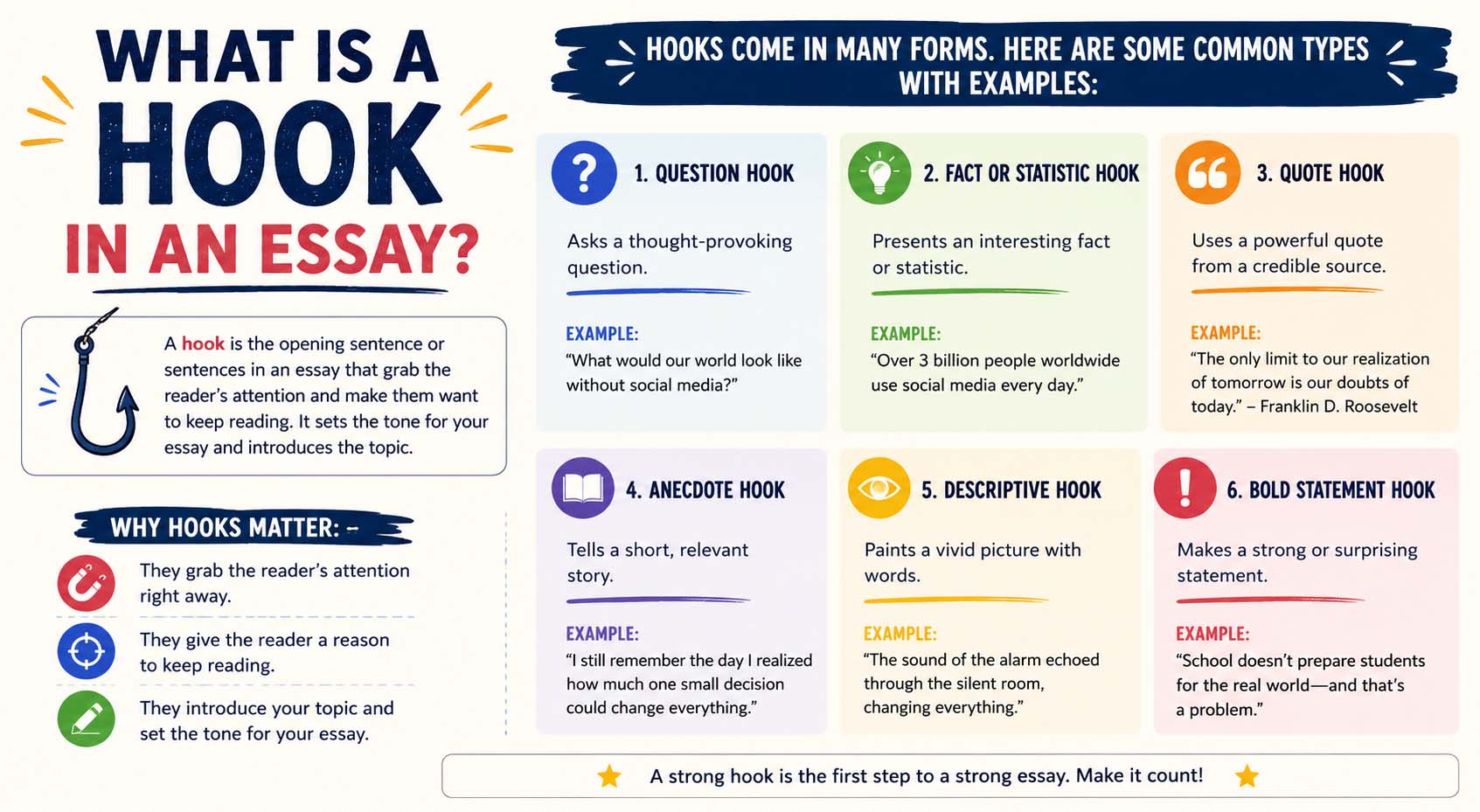
A hook in an essay is an opening sentence or phrase that grabs the reader’s attention and encourages them to keep reading. It can be a surprising fact, an interesting question, a short story, a quote, or a strong statement related to the topic. In fact, understanding what is a hook in an essay matters because a good hook creates interest and sets the tone for the rest of the writing. Ideally, an effective hook stays relevant to the subject and leads naturally into the introduction and main idea.
Often, students struggle with introductions because the first few lines create the first impression. However, a good hook builds curiosity, emotion, or interest while it introduces the main topic.
Whether you are writing a school assignment, an argumentative essay, a research paper, or a personal narrative, knowing what is a hook in an essay can improve your writing significantly. Also, learning from Introduction Paragraph Examples can help you create stronger openings.
What Is a Hook in an Essay and Why Does It Matter?
First, the beginning of an essay is extremely important. Teachers and readers often decide quickly whether the writing feels interesting, clear, and organized.
As a result, a strong hook captures attention, introduces the topic smoothly, and sets the tone of the essay. In addition, it encourages readers to continue and creates emotional or intellectual interest. Without a good hook, an essay may feel boring or difficult to follow from the start.
Moreover, hooks help essays feel more professional and organized. Therefore, good introductions can improve reader engagement, essay flow, argument clarity, and teacher impressions. Today, students also write scholarship applications, online course assignments, and research papers, so strong introductions help their writing stand out in digital and classroom settings.
What Is a Hook in an Essay Example?
Fortunately, many students understand hooks better through examples. For example, an essay about writing could open with this question: “What if the first sentence of your essay could make a stranger want to read the rest?” Clearly, this hook creates curiosity and encourages readers to think about the topic.
Similarly, a statistic can attract attention, as in “Millions of plastic bottles enter the ocean every year.” Overall, hooks can be creative, emotional, surprising, or informative, depending on the essay type.
Types of Hooks Used in Essays
Different essays call for different hook styles. Here are the five most common types.
Question Hook: First, a question encourages readers to think. For instance, you could ask, “What would happen if schools removed homework completely?”
Statistic Hook: Next, statistics build credibility and interest. However, always use a real number from a trusted source, never an invented one.
Quote Hook: Also, quotes can introduce themes or arguments, as in “Education is the passport to the future.” Still, choose a quote that closely fits your argument.
Story Hook: Then, short personal stories create an emotional connection. For example, you might write, “The first time I spoke in front of a classroom, my hands were shaking.”
Fact Hook: Finally, interesting facts quickly grab attention. For instance, “A strong first sentence can decide whether readers keep going or stop.”
What Is a Hook in an Argumentative Essay?
In argumentative essays, hooks are especially important because they prepare readers for debate and persuasion. Specifically, a hook in an argumentative essay should introduce the issue clearly, create interest, and lead naturally into the thesis statement. In addition, it should encourage critical thinking exercises that make readers weigh both sides.
For example, this question works well: “Should social media platforms be responsible for online misinformation?” Clearly, it introduces a debate topic and encourages discussion. Overall, argumentative essay hooks work best when they connect directly to the central argument.
More Examples of Hooks in Essays
Students often search for real examples they can adapt for assignments. Here are three simple ones.
Question hook: First, “Would you trust artificial intelligence to make important life decisions?”
Statistic hook: Second, “Millions of plastic bottles enter the ocean every year.”
Emotional hook: Third, “Losing access to education can change a person’s future forever.”
Overall, each example creates interest while it introduces a broader topic naturally.
Step-by-Step Guide to Writing a Strong Hook
Understand the Topic: First, know the essay’s main purpose before you write the hook.
Choose the Right Hook Type: Next, match the hook to the essay. For example, narrative essays may use stories, while research essays often use facts or statistics.
Keep It Relevant: Then, make sure the hook connects clearly to the essay topic.
Make It Interesting: Also, strong hooks create curiosity or emotional impact.
Transition Smoothly: Finally, guide readers from the hook toward the thesis statement. Later, you can prepare for How to Start a Conclusion Paragraph near the end of the essay.
According to the University of North Carolina Writing Center, strong openings often use an intriguing example, a puzzling scenario, an anecdote, or a thought-provoking question. On the other hand, it warns that famous quotations and dictionary definitions often work poorly in academic papers.
Common Mistakes Students Make
Unfortunately, many students write hooks that feel disconnected from the essay. For example, common mistakes include using unrelated quotes, adding confusing jokes, making hooks too long, using fake statistics, and repeating obvious information.
Instead, strong hooks are clear, concise, and relevant to the essay topic.
Hook Examples for Different Essay Types
Because different writing styles need different opening strategies, the table below matches each essay type with a sample hook.
| Essay Type | Sample Hook |
|---|---|
| Narrative essay | “I never expected one decision to completely change my life.” |
| Persuasive essay | “School uniforms continue dividing opinions among students and parents.” |
| Research essay | “Climate change affects nearly every ecosystem on Earth.” |
| Compare-and-contrast essay | “Online learning and classroom learning offer very different student experiences.” |
In addition, the quick guide below shows which hook type suits which kind of writing.
| Hook Type | Best Use |
|---|---|
| Question hook | Persuasive essays |
| Statistic hook | Research papers |
| Story hook | Narrative essays |
| Quote hook | Reflective writing |
| Fact hook | Informative essays |
How Long Should a Hook Be, and Other Tips
Generally, most hooks are one or two sentences long. Otherwise, very long hooks may confuse readers or delay the introduction of the essay topic. Therefore, simple and direct hooks usually work best for beginner writers.
Additionally, you can improve your hooks with a few habits. First, read strong essays regularly to study how introductions work. Second, practice writing several hook styles for the same topic. Third, use clear language instead of complicated vocabulary. Finally, keep readers curious right away, and connect the hook to the main idea while you maintain good text structure throughout the essay.
As a result, students who master essay introductions often become more confident writers overall.
FAQ About What Is a Hook in an Essay
What is a hook in an essay? It is the opening statement that grabs the reader’s attention.
How does an argumentative essay use a hook? Basically, it is an attention-grabbing introduction that presents a debate or opinion topic.
Which hook types work well? For instance, examples include questions, facts, statistics, quotes, and short stories.
How long should a hook be? Usually, one or two sentences are enough.
Why are essay hooks important? Because hooks create interest, they encourage readers to continue reading the essay.
Final Thoughts on What Is a Hook in an Essay
In short, understanding what is a hook in an essay is an important writing skill for students. A strong hook captures attention, introduces the topic effectively, and creates a better reading experience from the very beginning.
Whether you use a question, statistic, quote, or story, good hooks help essays feel more engaging and professional. With practice, students can create introductions that improve both academic writing quality and overall confidence.