Stories can describe a childhood memory, explain an adventure, follow a character through a conflict, or even pass history from one generation to another. Because stories can work in so many ways, learning the types of narratives helps students understand both what they read and how they write. Once you recognize how a narrative is organized, you can identify its purpose, follow its events more easily, and choose a suitable approach for your own storytelling.
A narrative is more than a list of events. Instead, it usually connects characters, setting, conflict, actions, and outcomes in a meaningful sequence. However, writers can arrange and present those elements in very different ways.
What Is a Narrative?
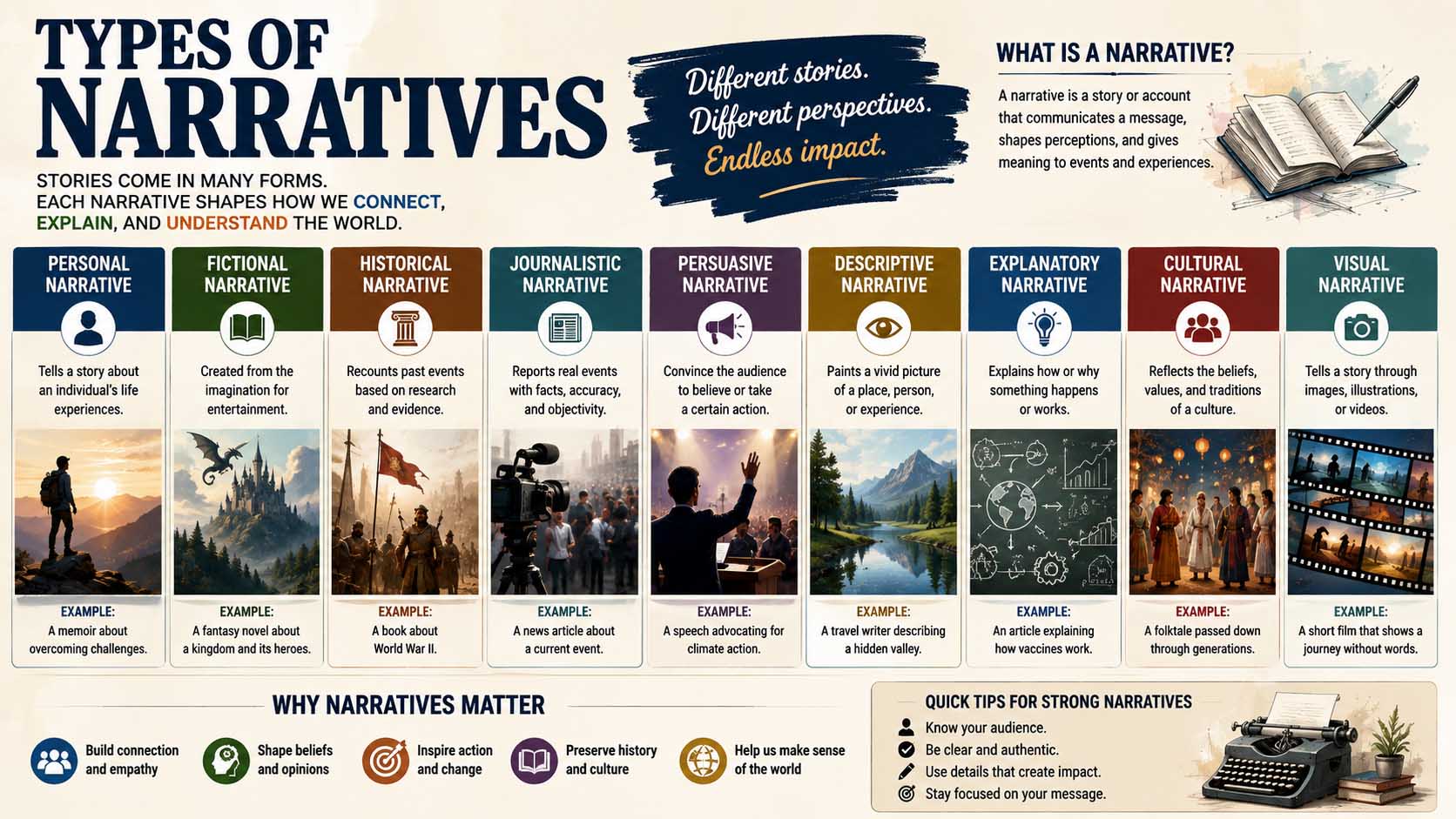
A narrative is an account of connected events presented as a story. Although narratives often appear in novels and short stories, they also occur in biographies, memoirs, personal essays, films, speeches, myths, and everyday conversations.
Most narratives answer basic questions such as: Who is involved? What happened? Where and when did it happen? Why did it matter?
For students, understanding the Parts of a Story can make narrative analysis much easier. For example, recognizing characters, setting, plot, conflict, and resolution gives you a framework for examining how a writer builds a story.
However, not every narrative follows exactly the same pattern. Some move from beginning to end in chronological order, while others jump between different periods. Likewise, some focus strongly on action, while others emphasize description, perspective, or ideas.
What Are the Different Types of Narratives?
There is no single classification system used in every classroom or textbook. Still, several common narrative categories help students discuss how stories are organized and told.
The major types include linear, nonlinear, descriptive, viewpoint, quest, and oral narratives. Meanwhile, individual stories can fit more than one category. For instance, a quest narrative may also use a linear structure and first-person narration.
Here is a quick comparison:
| Narrative type | Main feature | Simple example |
|---|---|---|
| Linear | Events follow chronological order | A student describes their first day at a new school |
| Nonlinear | Events appear outside chronological order | A novel begins in the present and returns to childhood |
| Descriptive | Sensory details and atmosphere receive strong attention | A traveler describes arriving in a snowy mountain town |
| Viewpoint | Perspective shapes how readers understand events | Two characters describe the same argument differently |
| Quest | A character pursues a goal or destination | A hero travels to recover a missing object |
| Oral | Stories are spoken and passed between people | A grandparent tells a traditional family story |
Therefore, when a teacher asks you to identify a narrative type, look at how the story presents its events rather than relying only on its subject.
Main Types of Narratives and Their Examples
Linear Narrative
A linear narrative presents events in chronological order. In other words, the story generally moves from an earlier event to a later event without major jumps backward or forward in time.
For example, imagine a student writing about a school competition. First, they explain how they entered. Next, they describe preparing for it. Then, they recount competition day. Finally, they explain the result.
Because the sequence is straightforward, linear narratives are often easy for beginners to follow and write. As a result, teachers commonly use them when introducing narrative writing.
However, a linear story can still contain complex characters and themes. The term describes the arrangement of events rather than the difficulty of the story.
Nonlinear Narrative
A nonlinear narrative does not present every event in chronological order. Instead, the writer may use flashbacks, flash-forwards, memories, dreams, or multiple timelines.
For instance, a story might open with an adult character returning to their childhood home. Then, a particular room triggers a memory from 20 years earlier. Later, the narrative returns to the present.
This structure can reveal information gradually. Therefore, readers often need to pay close attention to dates, ages, settings, and other time clues.
When studying nonlinear stories, create a simple timeline. First, record events in the order the author presents them. Then, rearrange them into chronological order. This strategy can make a complicated plot much easier to understand.
Descriptive Narratives
A descriptive narrative combines storytelling with detailed description. Although events still happen, the writer gives special attention to places, people, emotions, sounds, smells, textures, or visual details.
For example, instead of simply writing, “We entered the old house,” a descriptive narrator might explain how the wooden floor creaked, how dust floated through the sunlight, and how the rooms smelled of old books.
However, effective description should support the story. Too many details can slow the action and distract readers.
Students can improve descriptive narrative writing by choosing details that create a particular mood. For instance, descriptions of flickering lights, empty hallways, and distant footsteps can create tension without directly telling the reader to feel nervous.
Viewpoint Narratives and Narrative Perspective
A viewpoint narrative emphasizes the perspective from which readers experience events. As a result, the narrator’s knowledge, opinions, emotions, and limitations can shape the entire story.
First-person narration uses words such as I and we. Therefore, readers usually experience events through one character’s perspective.
Third-person narration uses words such as he, she, and they. However, third-person narrators can have limited knowledge of one character or broader knowledge of several characters.
Less commonly, a writer may use second person point of view, addressing the reader as “you.” This technique can make the reader feel directly involved in the experience, although it appears less frequently in traditional fiction than first- or third-person narration.
When analyzing perspective, students should ask who tells the story and what that narrator knows. Looking at point of view examples can also help learners compare how changing the narrator changes the information readers receive.
Quest Narratives
A quest narrative follows a character or group pursuing a goal. Usually, the journey includes challenges, discoveries, setbacks, and some form of change.
The goal might involve reaching a place, finding a person, recovering an object, solving a problem, or gaining knowledge. Therefore, a quest does not always require a fantasy hero traveling across an imaginary world.
For example, a student searching for information about an unknown relative could form the basis of a realistic quest narrative. Along the way, the character might interview family members, examine old photographs, and discover unexpected information.
Conflict plays a major role in these stories because obstacles make the goal difficult to achieve. Studying the types of conflicts in literature can help students distinguish between challenges involving other characters, society, nature, technology, or a character’s own thoughts and feelings.
Types of Oral Narratives
Not every narrative begins on a page. In fact, people told stories long before writing systems became widespread.
The types of oral narratives can include myths, legends, folktales, family stories, personal experiences, traditional tales, and historical accounts passed through speech.
Oral narratives often change slightly as different storytellers retell them. Consequently, two communities or families may preserve different versions of a similar story.
For example, a grandparent might tell children how their family moved to a new city decades ago. Although the story describes real experiences, each retelling may emphasize different people or moments.
Meanwhile, folktales can carry cultural values and lessons across generations. Therefore, studying oral narratives can help learners understand both storytelling techniques and cultural traditions.
Narrative Type vs. Narrative Structure
Students sometimes confuse narrative type with text structure. Although these ideas overlap, they are not exactly the same.
Narrative type describes the general way a story is told. In contrast, structure refers to how information and events are arranged within the text.
For example, a quest story describes a type of narrative based on the character’s journey. However, that quest could use either chronological or nonlinear organization.
Similarly, learning about types of text structure can help students recognize organizational patterns across narrative and informational writing rather than treating every text as if it follows the same format.
This distinction becomes especially useful during reading assessments because a question may ask about structure, narrator, genre, or narrative type separately.
How to Identify a Narrative Type Step by Step
When a story seems difficult to classify, avoid guessing from the title alone. Instead, work through the text systematically.
Step 1: Identify the narrator. Ask who tells the story and whether the narration uses first, second, or third person.
Step 2: Examine the timeline. Check whether events occur chronologically or move between different periods.
Step 3: Find the main purpose. Decide whether the story mainly follows events, creates an atmosphere, presents a particular perspective, or follows a goal.
Step 4: Look for a journey or objective. If the central character spends much of the story pursuing something, you may be reading a quest narrative.
Step 5: Consider how the story was communicated. A spoken traditional or personal story may belong to an oral narrative tradition.
Step 6: Support your answer with evidence.The narrative is nonlinear because the writer repeatedly shifts between the character’s childhood and adult life, rather than presenting events in chronological order
That final step matters because teachers often assess your reasoning as well as your answer.
Choosing a Narrative Style for Your Own Writing
Understanding different types of narratives also improves writing skills. Before drafting a story, consider what you want readers to experience.
If clarity matters most, a linear narrative may work well. Meanwhile, if a past event explains a character’s present behavior, a flashback can make a nonlinear structure useful.
Likewise, choose viewpoint carefully. A first-person narrator can create a close personal connection, while third-person narration may give you more freedom to describe characters and events.
Afterward, outline the major events before writing full paragraphs. Even a five-line plan can prevent plot gaps and unnecessary repetition.
Then, make sure every scene contributes something. A scene should normally advance the action, reveal character, build conflict, establish atmosphere, or provide information readers need.
Common Mistakes Students Make
One common mistake is assuming that every narrative belongs to only one category. In reality, categories often overlap. For example, an oral family story can follow a linear timeline, while a quest narrative can use flashbacks.
Another mistake is confusing genre with narrative type. Fantasy, mystery, romance, and science fiction describe genres, while terms such as linear and nonlinear describe how a narrative may be organized.
Students also sometimes identify a narrative without evidence. Instead, point to specific features in the text that support your classification.
Finally, avoid focusing only on plot. Narrative analysis can also involve perspective, characterization, setting, conflict, structure, tone, and theme.
A Simple Study Strategy for Narrative Analysis
When preparing for a quiz or reading assignment, create a small chart with four headings: Narrator, Timeline, Main Goal, and Evidence.
As you read, fill in each category. For example, write “first person” under Narrator, “chronological” under Timeline, and “finding a missing friend” under Main Goal.
Next, add one quotation or event as evidence. This method encourages active reading because you must notice how the story works instead of simply remembering what happened.
Then, compare two narratives. Ask how the same event might change if another character narrated it or if the writer rearranged the timeline. This comparison builds stronger reading and writing skills because it connects narrative choices with their effects.
FAQs About Types of Narratives
What are the main types of narratives?
Common categories include linear, nonlinear, descriptive, viewpoint, quest, and oral narratives. However, classification can vary by curriculum, and one story may use several narrative techniques at once.
What are the different types of narratives students should know?
Students should usually understand chronological and nonlinear storytelling, narrative perspective, descriptive storytelling, quest narratives, and oral traditions. However, teachers may introduce other categories depending on grade level and course goals.
What is the easiest narrative type to write?
For many beginners, a linear narrative is easiest because events follow chronological order. Therefore, students can plan the beginning, middle, and ending without managing multiple timelines.
Can a story have more than one narrative type?
Yes. For example, a quest narrative can be nonlinear, descriptive, and told from a first-person viewpoint. These labels describe different features of storytelling, so they do not always compete with one another.
What is the difference between narrative and story?
A story refers broadly to connected characters and events, while narrative also includes the way those events are selected, organized, and presented to an audience. In everyday conversation, however, people often use the two terms interchangeably.
Build Your Narrative Skills Through Practice
The easiest way to remember the types of narratives and their examples is to identify them in stories you already know. Choose a novel, short story, movie, or personal story and ask three questions: Who tells it? In what order do events appear? What storytelling approach receives the most attention?
Then, try rewriting a short event in another form. For example, turn a linear story into a nonlinear one by opening with the ending and adding a flashback. Alternatively, retell the same event from another character’s viewpoint.
Through regular practice, narrative terminology becomes more than something to memorize for a test. Instead, it becomes a practical set of tools for understanding stories, discussing literature, and becoming a more confident writer.